



1. Background
The hospital emergency department (ED) is a critical access point for healthcare services and plays a vital role in delivering urgent and lifesaving care. However, the high workload, time pressure, and need for rapid clinical decision-making may render EDs particularly vulnerable to inequities and discriminatory practices in service delivery (1). In such environments, implicit biases may influence clinical judgment and contribute to unequal care experiences among different patient groups (2).
Healthcare discrimination refers to the unequal or differential provision of services based on characteristics such as race, ethnicity, gender, socioeconomic status, or health conditions. Discrimination may occur at both systemic and individual levels and can adversely affect the quality, accessibility, and continuity of healthcare services (3). Perceived discrimination is recognized as a significant psychosocial stressor that may contribute to adverse health outcomes, including psychological distress, reduced trust in healthcare systems, and diminished well-being (4, 5). These effects are fundamentally inconsistent with the ethical principles underlying nursing and medical practice, including justice, equity, and respect for persons.
A well-documented consequence of discrimination in emergency care is inadequate pain assessment and management, particularly among vulnerable populations and racial or ethnic minority groups, often resulting in the undertreatment of pain (6). Discriminatory experiences may also erode patient satisfaction and trust, leading to reduced healthcare utilization and increased health risks (7). Addressing these disparities is therefore essential to improving healthcare equity and overall service quality in emergency settings.
Discrimination in healthcare access has been reported across multiple dimensions, including race, ethnicity, age, gender, geographic location, and insurance status. Evidence consistently indicates that people from low-income backgrounds and ethnic minority groups face substantial barriers to equitable healthcare access (8). International studies further demonstrate that discrimination in EDs is a global concern. For example, research from New Zealand has shown that patients with mental health conditions and substance use disorders experience discriminatory treatment in emergency settings (3). Similarly, an ethnographic study in France reported an association between patients' socioeconomic status and the timeliness of emergency care, suggesting that healthcare inequalities may persist even within well-resourced systems (9).
In Iran, although health disparities have been examined in several contexts, empirical research specifically addressing discrimination in EDs remains limited. Existing studies, including ethnographic research in intensive care units, have identified discrimination as an important component of healthcare inequality and have emphasized the need for further investigation in emergency care settings (10). In addition, qualitative evidence has documented discriminatory experiences among older adults in healthcare environments in Iran (11).
Given the complexity and contextual nature of discrimination in EDs, comprehensive and methodologically rigorous research is needed to identify its dimensions and underlying mechanisms.
2. Objectives
The proposed study will use a sequential, qualitative, multi-methods approach to explore discrimination in hospital EDs and synthesize stakeholder perspectives with existing evidence. By integrating qualitative inquiry with a structured scoping review, the study aims to generate a nuanced understanding of discrimination in emergency healthcare service delivery and inform context-sensitive recommendations for promoting equity in care.
3. Methods
3.1. Study Design
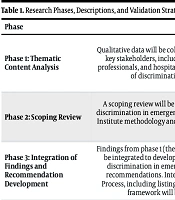
This study will adopt a sequential qualitative multi-method design that integrates complementary qualitative approaches across 3 interconnected phases (Table 1). This design enables an in-depth exploration of discrimination in ED service delivery by combining empirical qualitative inquiry with a structured evidence synthesis, followed by systematic integration of findings to generate actionable recommendations. The sequential structure allows findings from each phase to inform the subsequent phase, thereby enhancing methodological coherence and analytical depth (12).
Table 1.Research Phases, Descriptions, and Validation Strategies
| Phase | Description | Validation and Rigor Strategies |
|---|---|---|
| Phase 1: Thematic Content Analysis | Qualitative data will be collected through semistructured, in-depth interviews with key stakeholders, including patients, family caregivers, emergency healthcare professionals, and hospital administrators, to explore experiences and perceptions of discrimination in emergency department service delivery. | Trustworthiness criteria: Credibility: Member checking and prolonged engagement. Transferability: Thick description of participants and context. Dependability: Systematic documentation of data collection and analysis procedures. Confirmability: Audit trail and reflexive memo writing. |
| Phase 2: Scoping Review | A scoping review will be conducted to map and synthesize existing evidence on discrimination in emergency departments. The review will follow the Joanna Briggs Institute methodology and search electronic databases, including PubMed, Scopus, and Web of Science. | Methodological rigor: Adherence to PRISMA-ScR reporting guidelines. Independent screening and data extraction by at least 2 reviewers. Transparent documentation of the search strategy and study selection process. |
| Phase 3: Integration of Findings and Recommendation Development | Findings from phase 1 (thematic content analysis) and phase 2 (scoping review) will be integrated to develop a comprehensive understanding of the dimensions of discrimination in emergency healthcare services and inform evidence-based recommendations. Integration will be conducted using the Pillar Integration Process, including listing, matching, checking, and pillar building. A conceptual framework will be developed based on the integrated findings. | Integration quality: Application of the Mixed Methods Integration Quality Framework. Systematic evaluation of integration across planning, interpretation, reporting, and joint displays. Use of joint displays to enhance transparency and interpretability. |
3.2. Study Status and Timeline
At manuscript submission, the study was in the preparatory phase, and participant recruitment and data collection had not begun. All study procedures were approved by the relevant ethics committee. Preparatory activities, including the development of the interview guide and planning of the scoping review, were underway. Participant recruitment is expected to commence in July 2026 and be completed by September 2026. Data collection for the qualitative interviews is anticipated to conclude by December 2026. Integration of findings and development of recommendations are expected to be completed by March 2027, with final study results anticipated by mid-2027.
3.3. Study Setting
The study will be conducted in hospital EDs affiliated with Lorestan University of Medical Sciences in Khorramabad, Iran. These EDs serve a diverse patient population and represent typical public emergency care settings within the Iranian healthcare system. Data collection will occur in locations appropriate for each participant group, including hospital environments for healthcare professionals and administrators and convenient, safe settings for patients and family caregivers.
3.4. Phase 1: Qualitative Thematic Content Analysis
The first phase will consist of a qualitative study using thematic content analysis to explore perceptions, experiences, and interpretations of discrimination in emergency healthcare services from the perspectives of key stakeholders. At manuscript submission, no interviews had been conducted, and participant recruitment had not begun.
3.4.1. Participants and Sample Size
Participants will include diverse stakeholders involved in or affected by emergency healthcare service delivery, including ED patients, family caregivers of ED patients, emergency healthcare professionals (eg, nurses and physicians), medical ethics and nursing experts, and hospital administrators and managers.
Purposive sampling with maximum variation will be used to capture a wide range of demographic characteristics, professional roles, and experiential backgrounds. Sampling will continue until data saturation is achieved, defined as the point at which no new themes or substantive insights emerge from additional interviews.
3.4.2. Inclusion Criteria
The inclusion criteria are as follows:
1) age 18 years or older;
2) ability to communicate verbally and articulate experiences relevant to the study; and
3) willingness to participate and provide informed consent.
3.4.3. Exclusion Criteria
The exclusion criteria are as follows:
1) withdrawal from the study at any stage; and
2) inability to participate meaningfully in the interview because of acute distress or communication barriers at the time of data collection.
3.4.4. Interview Guide Development
An interview guide will be developed to explore perceptions, experiences, and interpretations of discrimination in ED service delivery. The guide will be informed by the existing literature on healthcare discrimination and refined through research-team discussions to ensure conceptual relevance and clarity.
Open-ended questions will encourage participants to describe their experiences in their own words while allowing the interviewer to probe emerging issues. Questions will be tailored to participant groups. Examples for healthcare professionals and administrators include the following: Can you describe your role and responsibilities in the emergency department? How would you describe decision-making processes in the ED during busy or high-pressure situations? Have you observed situations in which patients were treated differently? If so, how and why?
Examples for patients and family caregivers include the following: Please describe your experience receiving care in the emergency department. Did you ever feel that you or your family member was treated differently from others? Please explain.
The interview guide will remain flexible, allowing new questions to emerge based on participants' responses.
3.4.5. Conducting Interviews
Data will be collected through semistructured, in-depth interviews conducted at a time and place convenient for participants and in an environment that ensures privacy and minimal disturbance. Interviews will be conducted by trained researchers with experience in qualitative interviewing.
With participants' informed consent, interviews will be audio-recorded. Field notes will capture contextual details and nonverbal cues when relevant. All audio recordings will be transcribed verbatim before analysis to ensure data accuracy and completeness.
3.4.6. Data Analysis
Thematic content analysis will be performed using the 6-phase framework of Braun and Clarke (13): familiarization with the data, initial coding, searching for themes, reviewing themes, defining and naming themes, and reporting findings. After verbatim transcription, the research team will read all transcripts repeatedly to achieve immersion in the data. Two researchers will independently code the transcripts to identify meaningful units and initial codes. Coding will be primarily inductive, allowing themes to emerge from participants' accounts rather than being imposed a priori.
After independent coding, regular analytical meetings will be held in which coders compare coding decisions, discuss similarities and discrepancies, and collaboratively refine codes and emerging themes. Disagreements will be resolved through critical discussion and reflexive engagement with the data. When necessary, a third senior researcher will be consulted to support consensus building and enhance analytical depth. As the analysis progresses, related codes will be grouped into candidate themes, which will be iteratively reviewed in relation to the coded data and the entire dataset. Themes will be refined, clearly defined, and named to ensure internal coherence and distinctiveness. Reflexive discussions within the research team will be used throughout the process to examine assumptions, enhance interpretive rigor, and ensure that findings remain grounded in the data. MAXQDA software (version 2022) will be used to organize, manage, and retrieve qualitative data throughout the analysis. An iterative and nonlinear analytical approach will allow movement between phases of analysis as themes are refined and insights deepen.
3.4.7. Rigor and Trustworthiness
Lincoln and Guba's 4 criteria—credibility, transferability, dependability, and confirmability—will be applied to enhance the study's rigor (14, 15).
Credibility will be supported through member checking, in which preliminary findings are shared with participants for validation. Prolonged engagement and multiple data-collection phases will facilitate in-depth insights (14, 15).
Transferability will be supported through detailed descriptions of the study context, sample characteristics, and research conditions to facilitate the application of the findings to other settings (14, 15).
Dependability will be enhanced through systematic documentation to ensure transparency in coding and analysis.
3.5. Phase 2: Scoping Review
The second phase will consist of a scoping review to systematically map, describe, and conceptualize existing evidence on discrimination in health service delivery within hospital EDs. A scoping review is appropriate given the broad and heterogeneous nature of the literature on healthcare discrimination and its suitability for identifying key concepts, knowledge gaps, and research trends (16, 17). At manuscript submission, the scoping review had not begun, and database searches had not been performed.
This scoping review will be conducted according to the JBI methodology for scoping reviews (18).
3.5.1. Review Framework and Research Questions
The review will be guided by the Population-Concept-Context (PCC) framework.
The population will comprise individuals receiving emergency healthcare services, including patients and family caregivers. The concept will be discrimination in healthcare service delivery. The context will be hospital EDs, with an international scope and contextual relevance to Iran. This framework will inform the review questions, eligibility criteria, and data extraction.
3.5.2. Eligibility Criteria
Eligible sources will include peer-reviewed literature addressing discrimination in emergency healthcare service delivery, including original qualitative, quantitative, and mixed-methods studies, as well as relevant reviews and study protocols. Grey literature, such as official reports from recognized health organizations, may be included when directly relevant to the review objectives. Blogs, non-peer-reviewed online content, and documents without identifiable authorship or institutional affiliation will be excluded.
3.5.3. Search Strategy
A 3-step search strategy consistent with JBI guidance will be used. First, an initial limited search will identify relevant keywords and index terms. Second, a comprehensive search will be performed across selected electronic databases, including PubMed, Scopus, and Web of Science, using combinations of keywords such as discrimination, health inequity, equity in service provision, and emergency healthcare services. Third, the reference lists of included studies will be screened to identify additional relevant sources. Supplementary searches will be conducted using Google Scholar to ensure coverage of potentially relevant literature.
3.5.4. Study Selection and Data Extraction
Study selection will be conducted in 2 stages: 1) title and abstract screening and 2) full-text review. Two reviewers will independently screen all records according to predefined eligibility criteria. Discrepancies will be resolved through discussion, and a third reviewer will be consulted if consensus cannot be reached. Data will be extracted using a standardized form developed by the research team. Extracted information will include bibliographic details, study objectives, setting, design, population, and key findings relevant to discrimination in emergency healthcare service delivery.
3.5.5. Data Synthesis and Presentation
Extracted data will be synthesized descriptively and thematically to summarize the scope and nature of the existing evidence. Findings will be organized into categories reflecting key dimensions and patterns of discrimination identified in the literature. Results will be presented in tables and narrative summaries to enhance clarity and transparency.
3.5.6. Validity and Reporting
The scoping review will be reported according to the PRISMA-ScR (Preferred Reporting Items for Systematic Reviews and Meta-Analyses Extension for Scoping Reviews) guidelines to ensure transparency, methodological rigor, and reproducibility (19).
3.6. Phase 3: Integration of Findings and Development of Recommendations
The third phase will focus on integrating and synthesizing findings generated from phase 1 (thematic content analysis) and phase 2 (scoping review). The purpose of this phase is to develop a comprehensive and coherent understanding of the dimensions of discrimination in emergency healthcare service delivery by identifying points of convergence, divergence, and complementarity across empirical and evidence-based findings.
3.6.1. Integration Approach
Findings will be integrated using the PIP as a structured qualitative integration technique (20). The PIP will systematically combine themes derived from the qualitative study with key concepts and patterns identified in the scoping review. The process will involve 4 sequential steps:
1) Listing: Key themes and findings from phases 1 and 2 will be compiled side by side to provide an overview of the evidence generated by each phase (20).
2) Matching: Themes from the qualitative analysis will be compared with findings from the scoping review to identify areas of convergence, divergence, and complementarity (20).
3) Checking: The coherence and consistency of matched findings will be critically examined through team discussions to ensure interpretive accuracy and to clarify contextual or conceptual differences when needed (20).
4) Pillar building: Integrated themes will be developed by synthesizing insights from the previous steps. These themes will represent higher-level dimensions of discrimination in emergency healthcare services and will be displayed using joint displays to illustrate relationships between data sources (20).
3.6.2. Rigor of Integration
To enhance the rigor and transparency of the integration process, the study will be informed by the Mixed Methods Integration Quality Framework (MMIQF) as a guiding framework for evaluating integration quality rather than as a rigid checklist (21). Particular attention will be paid to the following:
1) Planning, data collection, and analysis: Ensuring alignment among the study objectives, qualitative findings, and evidence synthesized from the scoping review (21).
2) Interpretation: Critically examining how findings from different phases inform, complement, or challenge one another (21).
3) General reporting: Clearly and transparently presenting integrated findings to enhance interpretability (21).
4) Joint displays: Using tables or visual representations to support the integration and interpretation of findings (21).
3.6.3. Development of the Conceptual Framework and Recommendations
Based on the integrated findings, a conceptual framework will be developed to illustrate the key dimensions and underlying mechanisms of discrimination in emergency healthcare service delivery. This framework will reflect interactions among structural, organizational, cultural, and interpersonal factors identified across both study phases.
Drawing on this framework, context-sensitive recommendations will be formulated to inform strategies for reducing discrimination and promoting equity in EDs. Recommendations will be grounded in empirical findings and existing evidence, with consideration of the organizational and sociocultural context of the healthcare system.
3.7. Ethics Approval and Consent to Participate
This study received ethical approval from the Ethics Committee of Lorestan University of Medical Sciences, Khorramabad, Iran (approval code: IR.LUMS.REC.1403.398; approval date: January 7, 2025). Before data collection, all participants will receive detailed information about the study objectives, procedures, and their rights. Written informed consent will be obtained from all participants. Participation will be voluntary, and participants may withdraw at any time without consequences. Confidentiality and anonymity will be maintained throughout the study. Personal identifiers will be removed from transcripts, and data will be anonymized or coded before analysis. All study data will be securely stored using password-protected, encrypted systems accessible only to the research team. Special ethical considerations will apply when engaging with potentially vulnerable participants, including patients and family caregivers. Interviews will be conducted sensitively; if a participant experiences distress during data collection, appropriate support and the option to discontinue participation will be provided.
All procedures will be conducted according to relevant ethical guidelines and regulations for research involving human participants. No data-collection activities were initiated before ethical approval, and all study procedures will commence only after formal authorization.
4. Results
At the time of manuscript submission, the study was in the preparatory phase. Participant recruitment, qualitative interviews, scoping review searches, and data integration had not yet begun. Consequently, no empirical results were available.
5. Discussion
Discrimination in health service delivery within hospital EDs is a complex, multifaceted phenomenon operating at systemic and individual levels. Existing evidence suggests that vulnerable populations, including people with mental health and substance use conditions, are more likely to experience unfair treatment, diagnostic overshadowing, and inequitable care in emergency settings, resulting in poorer health outcomes (3). These disparities highlight the ethical and practical importance of systematically examining discrimination within high-pressure emergency care environments (3).
Structural factors, particularly ED overcrowding, may further exacerbate discriminatory practices by intensifying time constraints, increasing cognitive load, and amplifying reliance on implicit decision-making shortcuts. These conditions may disproportionately disadvantage marginalized groups through delayed care and reduced service quality (22). Previous research suggests that interventions such as bias-aware triage processes, cultural competence training, and the integration of mental health services within emergency care may help mitigate these inequities (23, 24). However, the effectiveness and contextual relevance of such strategies remain insufficiently explored, particularly in low- and middle-income healthcare systems.
The present study protocol addresses this gap by proposing a sequential qualitative multi-method approach designed to capture experiential and evidence-based dimensions of discrimination in emergency healthcare service delivery. Through thematic content analysis, the study seeks to elicit in-depth perspectives from multiple stakeholder groups, including patients, family caregivers, healthcare professionals, and administrators, thereby clarifying how discrimination is perceived, enacted, and justified in routine emergency care practices (3). Complementing this empirical phase, the scoping review will map and synthesize the broader literature to contextualize local findings and identify recurring patterns and gaps in existing research (25).
By integrating findings from these 2 phases, the study aims to generate a coherent conceptual understanding of discrimination in EDs and inform the development of context-sensitive recommendations. Rather than evaluating the effectiveness of specific interventions, the proposed research focuses on identifying key dimensions, mechanisms, and contributing factors that shape discriminatory practices, thereby providing a foundation for future intervention development and evaluation (26).
Compared with existing studies examining discrimination within specific populations or service contexts, such as transgender individuals or ethnic minority groups (27, 28), the proposed study adopts a broader, stakeholder-oriented perspective within the ED setting. This approach aligns with emerging research trends emphasizing system-level analyses of health inequalities across emergency medical services (29), while acknowledging the role of prior discriminatory experiences in shaping patients' healthcare-seeking behaviors (30).
Overall, this study protocol contributes to the growing body of emergency care equity research by offering a methodologically rigorous and contextually grounded approach to examining discrimination in health service delivery. By clarifying the dimensions and underlying mechanisms of discrimination in EDs, the findings are expected to inform future research, policy discussions, and the design of equity-oriented strategies within emergency healthcare systems (31).
5.1. Strengths and Limitations
This study uses a sequential qualitative multi-methods design that integrates rich stakeholder perspectives with a comprehensive scoping review, enabling a nuanced and context-sensitive understanding of discrimination in EDs. The inclusion of diverse participants—patients, caregivers, providers, and administrators—and the use of rigorous integration methods, including the PIP and MMIQF, strengthen the credibility and applicability of the proposed recommendations.
However, as a qualitative study, the findings may be specific to Iranian public hospital emergency settings and may not be fully generalizable to other healthcare systems. Potential researcher bias and subjectivity inherent in thematic analysis, along with the time-intensive nature of mixed-methods integration, are important limitations that will be mitigated through prolonged engagement, member checking, and transparent audit trails.