
1. Background
The mental health of medical students is a critical issue, with the prevalence of suicidal ideation estimated to range from 7.4% to 24.2% (1). Although first-year students may face psychological challenges similar to those of their peers, their mental health often declines during medical training because of information overload, financial stress, academic pressure, and exposure to suffering (2). This is particularly concerning because many psychiatric disorders emerge before the age of 24 years (3). In Iran, the prevalence of suicidal ideation among medical students has been reported to be approximately 24.7% and has been linked to factors such as hopelessness, perfectionism, burnout, and anxiety (4). Identifying at-risk students is therefore essential for developing effective strategies to reduce suicidal ideation among future physicians.
Suicidal ideation, which ranges from a desire to die to specific suicide plans, is a major predictor of suicide attempts (5) and is closely associated with suicide attempts and future risk (6). Research has shown that 6% to 43% of medical students experience suicidal thoughts, with at least 11.2% reporting such thoughts (1). Although high rates of suicidal ideation have been reported among medical students globally, evidence from Iranian medical students remains limited. Individuals who experience suicidal thoughts are at increased risk of attempting suicide, underscoring the importance of identifying at-risk students in medical schools. Research indicates that psychological, social, physiological, cultural, and environmental factors may increase the risk of suicidal ideation, particularly among medical students. Key predictors include childhood emotional and physical abuse, insomnia, low mood, hopelessness, and burnout (7). Although many studies have focused on intrapersonal factors, fewer have examined psychosocial factors such as academic pressure.
1.1. Suicidal Ideation and Academic Burnout
Burnout syndrome is a persistent emotional condition characterized by emotional, physical, and cognitive exhaustion (1). Although burnout is often associated with work, it is also common in academic settings. Academic burnout includes symptoms such as emotional exhaustion, cynicism, and reduced efficacy and has a substantial impact on students, particularly medical students. The global prevalence of burnout among medical students is approximately 44% (8-10). Research has linked burnout to suicidal ideation, as burnout may foster feelings of hopelessness (11). For example, Dyrbye et al. (5) found that medical students who experienced academic burnout were more likely to report suicidal thoughts. A meta-analysis also supports the association of burnout, depression, and stress with an increased risk of suicidal ideation (12), highlighting the need to understand possible mediating factors.
Although previous studies have investigated the association between academic burnout and suicidal ideation in medical students, no comprehensive model fully explains this relationship. The job demand-control model highlights how workplace pressures affect mental health through job demands, task control, and support. However, this model has limited applicability in academic contexts because it does not account for cognitive factors such as repetitive negative thinking (RNT), which can intensify academic stress. Gender differences may also influence coping styles and experiences of burnout, thereby affecting the relationships among these variables (13). New conceptual models are needed to capture these factors and improve understanding of suicidal ideation among medical students.
1.2. Repetitive Negative Thinking as a Mediator
RNT, identified in the late 2000s as a risk factor for suicidality, involves persistent negative thoughts related to psychological stressors (14). RNT includes worry and rumination, which may prolong stress responses and hinder recovery, resulting in poor health outcomes (12). Studies have shown that high levels of worry and rumination are associated with burnout, particularly among physicians, and contribute to mental health problems such as depression and anxiety (15). Factors such as high job demands and limited support during work breaks may exacerbate rumination (16). For example, intensive care unit staff may experience increased stress because of long working hours, resulting in higher rates of rumination and psychiatric illness (17).
RNT may increase the risk of suicidal ideation. O'Connor et al. (13) found that worry and rumination, along with recurrent hopelessness, are personality traits that contribute to the stability of suicidal behavior. Rumination, defined as repeated thinking about distress and its causes, predicts suicidal ideation, especially during stressful events (18). This is consistent with Baumeister's model of suicide as an escape from distressing thoughts and emotions (19), as well as the distress reinforcement model of depression (20), which suggests that a perceived inability to control thoughts increases distress and the likelihood of suicidal ideation. In a review, Morrison and O'Connor (21) reported that rumination was associated with suicidal ideation or attempts in 10 of 11 studies. Worry consists of future-oriented thoughts about ambiguous and potentially negative events and can contribute to several pathological outcomes, including suicidality (22). Longitudinal studies have shown that high levels of childhood worry are associated with suicidal ideation in adulthood (16). Research has also shown that individuals who died by suicide often had high levels of worry (23). RNT, particularly after negative emotional events such as burnout, may create feelings of hopelessness and entrapment, contributing to suicidal ideation (24). Although RNT is considered a common factor in suicide, most studies have focused on specific forms, such as rumination, rather than examining rumination and worry together (24). Investigating both processes may improve understanding of their distinct roles in suicidal ideation.
1.3. Gender as a Moderator
Several studies have indicated that suicidal ideation is more common among female medical students than among male medical students (25). However, one study found that male medical students may experience more severe suicidal ideation (18). In addition, gender plays an important role in social support dynamics, with men and women differing in their need for social support and use of social connections (26). This is important when considering suicidal ideation because major etiological theories of suicide, such as the interpersonal perspective, emphasize social connections and community as protective factors. Thus, gender may influence risk and protective factors for suicidal ideation.
Moreover, research has shown that some forms of RNT, such as rumination, are more frequent among young women than among men (27). Therefore, gender may moderate the relationship between RNT and suicidal ideation, as well as the relationship between academic burnout and suicidal ideation.
2. Objectives
Suicide is a major mental health concern among medical students and has serious consequences. Suicidal ideation is a critical predictor of suicidal behavior (1), underscoring the need to understand the relevant psychological and social factors. Academic burnout is an important risk factor and often leads to feelings of helplessness and hopelessness. However, much of the existing research has focused on the direct association between burnout and suicide, overlooking potential mediating and moderating mechanisms. This study aimed to examine suicidal ideation among medical students by investigating the roles of RNT and gender. Using a moderated mediation framework, we analyzed the relationships among academic burnout, RNT, and suicidal ideation, with gender examined as a moderator to address existing gaps in the literature (Figure 1).
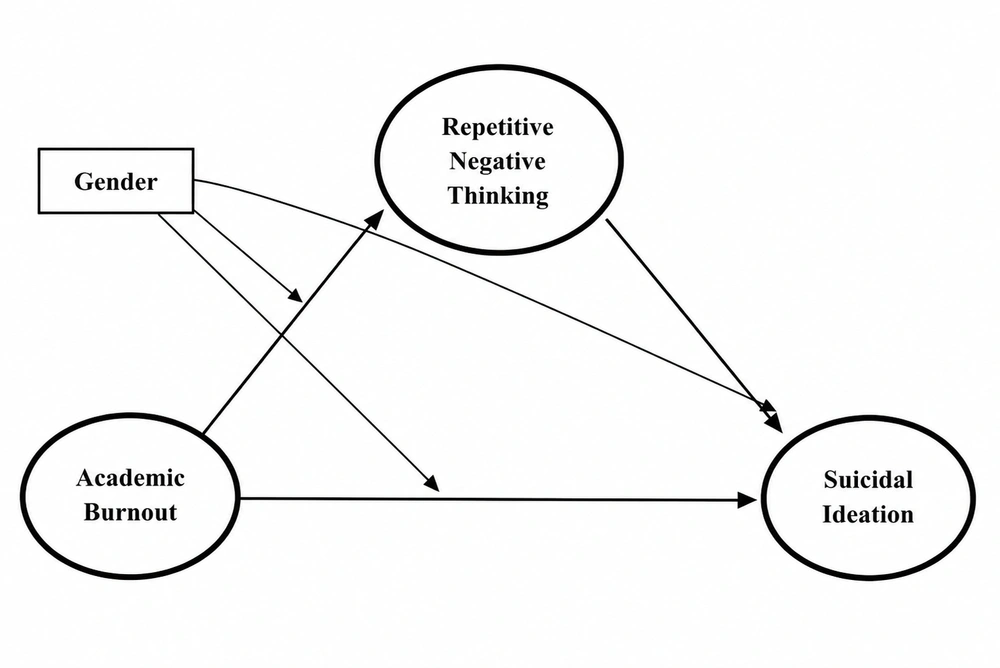
Figure 1.
The proposed model
3. Materials and Methods
3.1. Participants
The Institutional Review Board of Shiraz University of Medical Sciences approved the study protocol (Reference Number: IR.SUMS.REC.1403). This correlational, descriptive study used multistage cluster random sampling at Shiraz University of Medical Sciences during the 2024 - 2025 academic year. The primary clusters comprised selected academic faculties within the university. The secondary clusters comprised specific academic years (eg, first year and second year) within those faculties. Eligible medical students from the selected academic years and faculties were invited to participate through official departmental communications and classroom announcements within the selected clusters. Although a detailed response-rate calculation was not initially included, the final recruited sample included 593 students based on the invitations extended within the selected clusters. The minimum required sample size was calculated as 330 participants using online software for structural equation modeling (Free Statistics Calculation, version 4.0), based on 10 observed variables and 3 latent variables, a predicted effect size of 0.19, a significance level of 0.05, and statistical power of 0.80. To account for an anticipated attrition rate of approximately 35% due to incomplete questionnaires, refusal to participate, and exclusion criteria, 593 medical students were initially recruited. Of these, 88 declined to participate, and 62 met the exclusion criteria, including 28 receiving psychotherapy, 25 with psychiatric disorders, 5 with neurological disorders, and 4 with physical problems. The remaining 443 participants completed the questionnaires. After excluding 70 participants due to incomplete data, the final analytic sample consisted of 373 participants, which exceeded the minimum required sample size of 330 and strengthened statistical power (Figure 2).
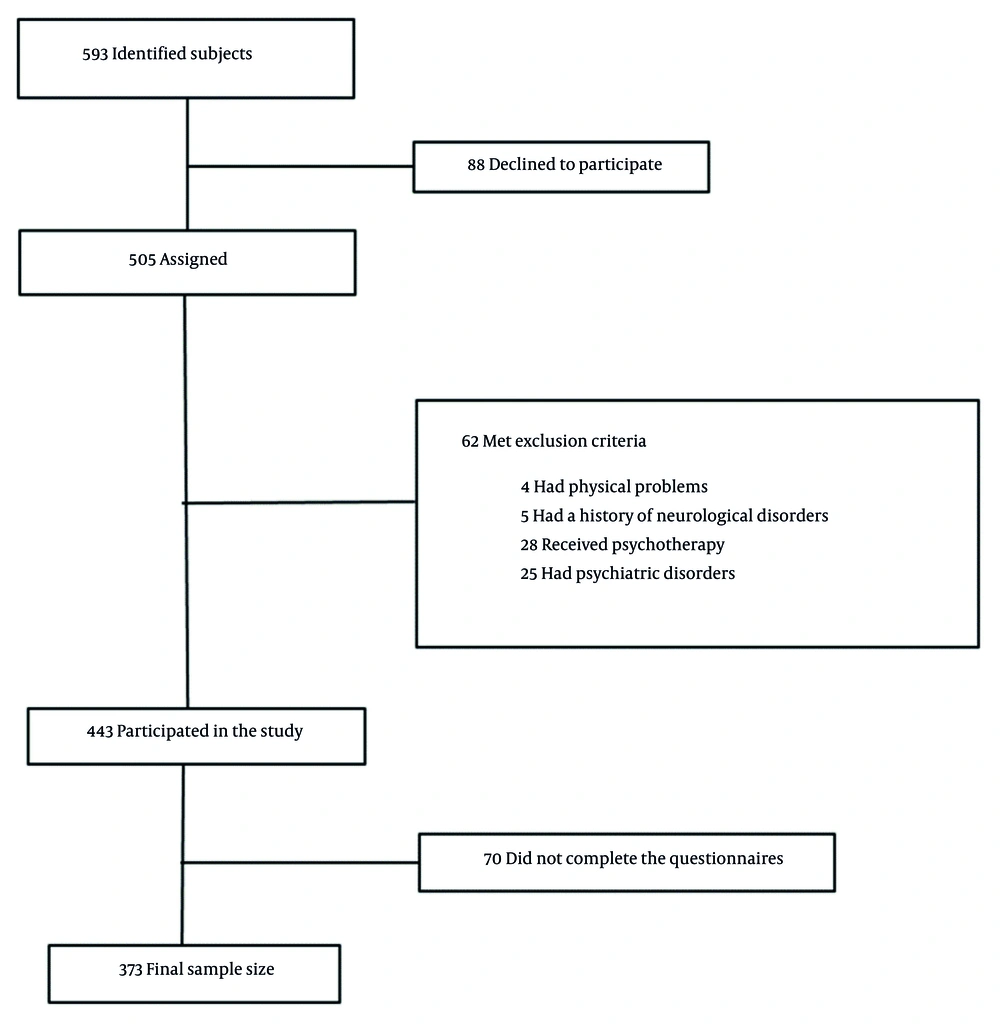
Figure 2.
Participants flow diagram
The inclusion criteria were provision of informed consent and current enrollment in general or specialized medicine. The exclusion criteria were major psychiatric disorders, such as substance abuse and psychotic disorders; medication or therapy within the past 6 months; recent trauma; severe physical problems; head injuries; neurological diseases; significant visual impairment; failure to complete the questionnaires; and inability to understand the study instructions.
3.2. Measures
Beck Scale for Suicidal Ideation. This questionnaire, developed by Aaron T. Beck (28), assesses the severity of suicidal ideation, behaviors, and planning over the previous week using 19 items. It focuses on factors such as death wishes, suicidal thoughts, self-control, and prevention. The 19 items include 5 items on the desire to die, 7 on preparation, and 5 on actual desire, as well as 2 on prevention. The scale uses a 3-point Likert scale ranging from 0 to 2, with total scores ranging from 0 to 38. Scores of 1 to 5 indicate suicidal ideation, scores of 6 to 19 indicate readiness to attempt suicide, and scores of 20 to 38 indicate intent. The questionnaire has high reliability, with a Cronbach alpha of 0.82, and correlates positively with depression as measured by the SCL-90-R.
Maslach Burnout Inventory-Student Survey. This questionnaire, developed by Schaufeli et al. (29), assesses burnout using 15 items rated on a 7-point Likert scale, with total scores ranging from 0 to 90 across 3 subscales: exhaustion, cynicism, and efficacy. Higher scores indicate greater academic burnout, categorized as low (0 - 27), moderate (28 - 54), and high (55 - 90). Factor analysis identified 3 components explaining 58% of the variance, with Cronbach alpha values of 0.74, 0.79, and 0.76. Hashemi Sheikh Shabani et al. (30) translated the instrument into Persian and confirmed its psychometric properties, with Cronbach alpha values of 0.78, 0.82, and 0.68.
Perseverative Thinking Questionnaire. This 15-item questionnaire, developed by Ehring et al. (31), measures RNT across 3 subscales: core characteristics of repetitive thinking (9 items), unproductiveness (3 items), and RNT capturing mental capacity (3 items). It assesses the cognitive process of RNT, focusing on the intrusive, difficult-to-disengage nature of negative thoughts, regardless of whether they concern the past (rumination) or the future (worry). The total PTQ score reflects overall RNT and is rated on a 5-point scale from 0 (never) to 4 (almost always). The PTQ has demonstrated good psychometric properties, including a Cronbach alpha of 0.8, and has been validated in previous research.
3.3. Procedure
Before study initiation, the research objectives and ethical considerations were explained to participants. Participants then completed written informed consent forms and were assured that the questionnaire data would be used solely for research purposes. To minimize potential order effects, the questionnaires were administered in different sequences. Participants completed the Beck Scale for Suicidal Ideation (BSSI), the Maslach Burnout Inventory-Student Survey (MBI-SS), and the Perseverative Thinking Questionnaire (PTQ) in group classroom settings. In the current study, 70 incomplete questionnaires were excluded from the 443 collected questionnaires, resulting in a final sample of 373 participants (Figure 2). Because demographic data were missing from the excluded questionnaires, comparisons with the included participants were not possible. The analysis therefore focused on complete, valid responses.
3.4. Data Integrity, Confidentiality, and Participant Support
Data integrity was ensured through the use of validated instruments, including the BSSI, MBI-SS, and PTQ. Potential biases arising from common method variance in self-reported data were rigorously assessed using Harman's single-factor test. Participant anonymity was maintained by excluding identifying information from all questionnaires. Participants were explicitly informed at the outset that their responses would be kept strictly confidential, consistent with the descriptive-correlational design of the study. Given the sensitive nature of the topic and the potential for distress, particularly as indicated by the use of the BSSI, participants were provided with clear information about available mental health support services, including contact information for local crisis hotlines and mental health counseling centers. These resources were communicated through the informed consent form and at the conclusion of the survey instrument.
3.5. Statistical Analysis
Statistical analyses were performed using IBM SPSS Statistics version 25.0 and the PROCESS macro. First, Harman's single-factor test was used to assess common method variance. Descriptive statistics and bivariate correlations were then calculated for the main constructs. Finally, the hypothesized models were tested using the PROCESS macro (Models 4 and 14) with 5000 bootstrap resamples and bias-corrected 95% confidence intervals. Statistical significance was determined by confidence intervals that did not include zero, indicating nonzero indirect or moderated effects (32). The mediation and moderated mediation findings reflect statistical associations and should not be interpreted as evidence of temporal causality.
4. Results
4.1. Procedural and Statistical Control of Common Method Variance
4.2. Descriptive Statistics
Preliminary analyses examined demographic differences in suicidal ideation among participants (Table 1). The mean age of participants was comparable across gender groups, with female students reporting a mean age of 26.8 years (SD = 7.02; range, 18 - 53) and male students reporting a mean age of 26.8 years (SD = 7.34; range, 18 - 57). An independent-samples Welch t test indicated no significant age difference between genders, t(df = 352) = 0.04, P = 0.965, suggesting that age was unlikely to confound subsequent analyses. Inferential analyses revealed several significant demographic differences in suicidal ideation (BSSI total score). Male students reported significantly higher suicidal ideation than female students, Welch t(df = 181) = -7.17, P < 0.001, d = 0.78. Single participants also reported higher ideation scores than married participants, Welch t(df = 235) = 2.76, P = 0.006, d = 0.30. Academic level was significantly associated with suicidal ideation, Welch F(df = 4, 149) = 2.77, P = 0.029, with a general trend of increasing scores from preclinical students to residents. In contrast, perceived economic status, residence type, and sibling status were not significantly associated with suicidal ideation (all P > 0.05). Assumption checks indicated violations of normality and homogeneity of variance (Shapiro-Wilk W = 0.672, P < 0.001; Levene F = 7.64, P < 0.001), justifying the use of Welch robust statistics.
Table 1.
Descriptive and Inferential Statistics for Demographic Predictors of Suicidal Ideation
| Variables | No (%) | Comparison of suicidal ideation |
|---|---|---|
| Gender | Welch t (181) = -7.17, P < 0.001 | |
| Male | 169 (45.3) | |
| Female | 204 (54.7) | |
| Academic level | Welch F (4, 149) = 2.77, P = 0.029 | |
| Student | 71 (19.0) | |
| Internship | 43 (11.5) | |
| Externship | 77 (20.6) | |
| Residency | 121 (32.4) | |
| Preclinical | 61 (16.4) | |
| Perceived economic status | Welch F (3,24.3) = 1.83, P = 0.168 | |
| Low | 21 (5.6) | |
| Moderate | 241 (64.6) | |
| Good | 104 (27.9) | |
| High | 7 (1.9) | |
| Residence | Welch F (3,54.1) = 0.142, P = 0.934 | |
| Dormitory | 183 (49.1) | |
| House with family | 131 (35.1) | |
| House with relatives | 14 (3.8) | |
| Living alone | 45 (12.1) | |
| Marital status | Welch t (235) = 2.76, P = 0.006, Cohen d = 0.30 | |
| Single | 281 (75.3) | |
| Married | 92 (24.7) | |
| Sibling status | Welch t (143) = -0.689, P = 0.492 | |
| Only child | 80 (21.4) | |
| Has siblings | 293 (78.6) |
Descriptive statistics (Table 2) indicated that male students reported higher levels of academic burnout (MBI total score = 50.4 vs 34.3), RNT (PTQ total score = 34.4 vs 25.3), and suicidal ideation (BSSI total score = 3.96 vs 0.81) than female students. Most variables showed approximately normal distributions; however, suicidal ideation scores among male students showed a noticeable positive skew (skewness = 1.79). Spearman correlation analyses revealed significant positive associations among all study variables (P < 0.01). The association between academic burnout and RNT was stronger among female students (ρ = 0.714) than among male students (ρ = 0.601), whereas correlations with suicidal ideation were relatively similar across genders (ρ ≈ 0.58). These findings are consistent with the proposed cognitive pathway linking academic burnout to suicidal ideation through RNT, as examined in subsequent analyses (Table 2).
Table 2.
Descriptive Statistics and Spearman Ρ Correlations for Main Variables by Gender a
| Variables | Mean | SD | Skewness | Kurtosis | rho (MBI-PTQ) | rho (MBI-BSSI) | rho (PTQ-BSSI) |
|---|---|---|---|---|---|---|---|
| MBI | |||||||
| Female | 34.3 | 13.0 | 0.02 | -0.06 | |||
| Male | 50.4 | 9.20 | 0.75 | 0.80 | |||
| PTQ | |||||||
| Female | 25.3 | 9.18 | 0.28 | -0.50 | 0.714 b | ||
| Male | 34.4 | 9.53 | 0.45 | 0.13 | 0.601 b | ||
| BSSI | |||||||
| Female | 0.81 | 1.22 | 1.26 | 0.37 | 0.522 b | 0.583 b | |
| Male | 3.96 | 5.60 | 1.79 | 2.63 | 0.474 b | 0.572 b |
a Abbreviations: MBI, Maslach Burnout Inventory; PTQ, Perseverative Thinking Questionnaire; BSSI, Beck Scale for Suicidal Ideation; SD, standard deviation; rho, Spearman rank-order correlation coefficient. Skewness and kurtosis represent distribution-shape statistics.
b P < 0.01 (two-tailed).
4.3. The Mediating Role of Repetitive Negative Thinking
The study examined academic burnout as the independent variable, suicidal ideation as the dependent variable, and RNT as the mediator. Mediation analysis was conducted using Hayes' PROCESS macro (Model 4) in SPSS version 25.0 with 5000 bootstrap samples to estimate bias-corrected confidence intervals. The results indicated that academic burnout significantly predicted suicidal ideation (B = 0.33, P < 0.001). Academic burnout also significantly predicted RNT (B = 0.71, P < 0.001). In turn, RNT significantly predicted suicidal ideation (B = 0.44, P < 0.001). Bootstrapping analysis showed that the indirect effect of academic burnout on suicidal ideation through RNT was significant (B = 0.33; 95% CI, 0.25 - 0.41). However, the direct effect of academic burnout on suicidal ideation was not significant (B = -0.001, P = 0.931), indicating that RNT fully mediated the relationship between academic burnout and suicidal ideation among university students (Table 3).
Table 3.
Indirect Effect of Academic Burnout on Suicidal Ideation Through Repetitive Negative Thinking a
| Predictors | Dependent Variable | B | SE | t | P-Value | 95% CI |
|---|---|---|---|---|---|---|
| Academic burnout → suicidal ideation | BSSI | 0.33 | 0.07 | 4.85 | 0.001 | 0.19 - 0.47 |
| Academic burnout → RNT | PTQ | 0.71 | 0.05 | 14.2 | 0.001 | 0.63 - 0.79 |
| RNT → suicidal ideation | BSSI | 0.44 | 0.06 | 7.33 | 0.001 | 0.33 - 0.55 |
| Academic burnout → suicidal ideation (direct c') | BSSI | -0.001 | 0.04 | -0.09 | 0.931 | -0.08 - 0.07 |
a Abbreviations: MBI, Maslach Burnout Inventory; PTQ, Perseverative Thinking Questionnaire; BSSI, Beck Scale for Suicidal Ideation; B, unstandardized regression coefficient; SE, standard error; CI, confidence interval. Bootstrap confidence intervals were based on 5000 resamples using Hayes' PROCESS macro (Model 4). Indirect effect (a x b) = 0.33, 95% CI, 0.25 - 0.41.
4.4. The Moderated Mediation Effect of Gender
To examine whether gender moderated the indirect pathway between academic burnout and suicidal ideation, a moderated mediation analysis was conducted using Hayes' PROCESS macro (Model 14). The results showed a significant interaction between RNT and gender in predicting suicidal ideation (B = 0.160, t = 3.75, P < 0.001), indicating that gender strengthened the association between RNT and suicidal ideation. Specifically, the association between RNT and suicidal ideation was stronger among male students than among female students. In contrast, the interaction between academic burnout and gender in predicting RNT was not significant (B = -0.012, P = 0.284), suggesting that gender did not moderate the relationship between academic burnout and RNT. The conditional indirect effects further showed that the indirect effect of academic burnout on suicidal ideation through RNT was stronger for male students (B = 0.108; 95% CI, 0.068 - 0.157) than for female students (B = 0.024; 95% CI, 0.005 - 0.045). The index of moderated mediation was significant (index = 0.084; 95% CI, 0.044 - 0.132), confirming that gender significantly moderated the indirect pathway linking academic burnout to suicidal ideation (Table 4).
Table 4.
Moderated Mediation Model of Academic Burnout and Suicidal Ideation a
| Variables | β | SE | t | P-Value | 95% CI |
|---|---|---|---|---|---|
| Predictor/Interaction Terms | |||||
| RNT → suicidal ideation | 0.118 | 0.024 | 4.96 | 0.001 | 0.07, 0.16 |
| Gender (main effect) | 1.966 | 0.431 | 4.56 | 0.001 | 1.12, 2.81 |
| RNT × gender | 0.160 | 0.043 | 3.75 | 0.001 | 0.08, 0.24 |
| Academic burnout × gender | -0.012 | 0.011 | -1.05 | 0.284 | -0.03, 0.01 |
| Conditional indirect effect by gender | |||||
| Male | 0.108 b | - | - | - | 0.068, 0.157 |
| Female | 0.024 b | - | - | - | 0.005, 0.045 |
| Index of moderated mediation | 0.084 b | - | - | - | 0.044, 0.132 |
a Abbreviations: β, unstandardized regression coefficient; SE, standard error; CI, confidence interval. Bootstrap confidence intervals were based on 5000 resamples. Gender was coded as 0 = female and 1 = male.
b Indirect β.
4.5. Simple Slope Analysis
A simple slope analysis was conducted to examine the moderating role of gender in the relationship between RNT and suicidal ideation. As shown in Table 5, the slope for male students was significantly steeper (B = 0.206, SE = 0.03, P < 0.001), indicating a stronger positive association between RNT and suicidal ideation. For female students, the slope was smaller but remained statistically significant (B = 0.046, SE = 0.02, P = 0.014). These results suggest that the association between RNT and suicidal ideation is stronger among male students, supporting the moderating role of gender in the PTQ-BSSI pathway.
Table 5.
Simple Slope Analysis of Repetitive Negative Thinking and Suicidal Ideation a
| Gender | B-simple | SE | P-Value | 95% CI |
|---|---|---|---|---|
| Male | 0.206 | 0.03 | 0.001 | 0.150 - 0.262 |
| Female | 0.046 | 0.02 | 0.014 | 0.010 - 0.082 |
a Abbreviations: B, unstandardized regression coefficient; SE, standard error; CI, confidence interval. Simple slopes represent the conditional effect of repetitive negative thinking on suicidal ideation at each level of gender. Gender was coded as 0 = female and 1 = male.
5. Discussion
This study investigated whether RNT mediates the relationship between academic burnout and suicidal ideation in medical students. Although no direct association was found between academic burnout and suicidal ideation, RNT significantly mediated this relationship, particularly among male students.
This study found no direct relationship between academic burnout and suicidal ideation among medical students, which is consistent with another study but contrasts with other studies (4, 35). These differences may stem from the statistical models used. Earlier research often relied on simpler correlations, whereas the present study used a model that included RNT as a mediator, suggesting that the association is indirect and operates through cognitive factors. According to the stress-vulnerability model (36), chronic stressors such as burnout lead to psychological problems when combined with internal vulnerabilities, such as hopelessness. In addition, individual resilience, emotion regulation, and coping skills may substantially influence the psychological effects of burnout (37).
The findings link academic burnout to RNT, consistent with recent research (38). This association can be understood through the ruminative response styles perspective (39), which conceptualizes rumination as a stress response focused on negative emotions. Factors such as interactions with hospital residents and high academic demands may foster work-related rumination (40). Emotional exhaustion resulting from burnout may impair emotion regulation and disrupt the ability to break negative thought patterns (38). In addition, high expectations and blurred work-home boundaries have been linked to rumination during breaks and after work (41, 42).
This study highlights an association between RNT and suicidal ideation among medical students, with Caudle et al. (24) identifying RNT as a significant risk factor independent of depression or anxiety. Baumeister's escape model (19) suggests that an inability to control negative thoughts may lead individuals to view suicide as an escape. Capron et al. (20) explain that intrusive thoughts create feelings of helplessness, thereby increasing suicidal ideation. Rumination and chronic worry may trap individuals in negative emotions and impair problem-solving (43, 21). Nolen-Hoeksema et al. (39) found that maladaptive coping intensifies emotional dysregulation and reinforces negative self-perceptions. Ultimately, RNT may undermine cognitive function and lead individuals to view suicide as the only solution.
The present findings show that RNT plays a significant role in mediating the association between academic burnout and suicidal thoughts among medical students. This is consistent with research showing that rumination and worry mediate the effects of chronic stressors, such as academic burnout, on severe outcomes, including depression and suicidal thoughts (15, 17). According to the Beck cognitive-behavioral model of suicide (44), distorted thoughts and acute stressors can trigger suicide-related schemas. Over time, cognitive biases such as rumination may foster helplessness and despair, which can increase the risk of suicidal thoughts (45).
The finding that the mediating pathway from academic burnout to RNT and suicidal ideation was significant only in men warrants further discussion. This finding suggests that RNT may function as a critical cognitive vulnerability for men, specifically linking burnout to heightened suicidal thoughts. Sociocultural pressures may play an important role by leading men to internalize feelings of burnout, which may amplify rumination and limit engagement in emotion-focused coping strategies (46). Furthermore, the experience of feeling like a burden, which is strongly associated with suicidal behavior, appears to be more pronounced in men, thereby increasing the risk of suicidal ideation (47). Research on gender roles in academic burnout highlights a stronger association between negative cognitions and suicidal ideation in men, a link that is less significant or statistically absent in women. This is consistent with previous research indicating that men may ruminate more intensely on suicidal thoughts, possibly because of societal norms that discourage open emotional expression (48). In addition, neuroimaging studies suggest potential differences in how men and women process negativity, with men showing heightened activity in areas associated with impulsive behavior (49). The strong correlation between hostile rumination in men and suicidal thoughts further supports this perspective (50). Notably, the direct association between academic burnout and suicidal ideation was not significant for either gender in the present study, underscoring the crucial mediating role of RNT, particularly among male participants.
Recent research continues to underscore the complex interplay among academic burnout, ruminative response styles, and suicidal ideation among students. A meta-analysis by Esparza-Reig and Julián (51) highlighted that although the direct association between burnout and suicidal ideation remains an area of ongoing investigation, these experiences are deeply intertwined, with burnout potentially intensifying suicidal thoughts. This is consistent with findings that academic burnout is a multifaceted phenomenon influenced by academic, psychological, personal, and social factors (51). Furthermore, studies emphasize the critical need to identify readily available suicide risk factors in student populations to inform targeted prevention efforts, noting that characteristics such as gender are important considerations in understanding these outcomes (52). Although direct exploration of the mediating role of RNT in post-2022 literature is developing, established associations among negative cognitive styles, stress, and suicidality (43, 21, 39) provide a strong foundation for understanding its significance. The continued focus on understanding gender differences in academic experiences and mental health outcomes (53) also supports the finding that RNT may function as a particularly important cognitive vulnerability for men in linking burnout to heightened suicidal thoughts.
5.1. Conclusions
This observational, cross-sectional study identified significant associations among RNT, academic burnout, and suicidal ideation in medical students, with a particularly pronounced association observed among male students. These findings highlight the critical importance of monitoring student mental well-being throughout medical education. Although the observed associations suggest potential areas for intervention development, it is important to note that the effectiveness of any specific intervention cannot be inferred from this study design. Regular screening for burnout and negative thought patterns may therefore be considered part of a supportive strategy within medical education environments. This study provides a foundational understanding of the challenges faced by medical students and emphasizes the need for further investigation into effective support mechanisms and preventive strategies.
5.2. Limitations and Future Directions
This study provides insights into cognitive and social mechanisms related to suicidal ideation among medical students, but it has several limitations. The cross-sectional design limits the ability to draw causal inferences regarding academic burnout, RNT, suicidal ideation, and the influence of gender. In addition, because of this design, the present data cannot determine the effectiveness of any proposed interventions. Self-reported measures may also be affected by sociocultural biases. The focus on a single medical university limits generalizability, and confounding variables such as resilience and coping styles were not controlled. In addition, the study did not consider participants' history of suicide attempts or differentiate between transient and persistent thoughts. Another key limitation is the focus on Shiraz University of Medical Sciences. Although multistage cluster random sampling was used to enhance representativeness, the results may not be generalizable to all Iranian medical students because of differences in curricula, cultural contexts, institutional characteristics, and regional factors. The findings may also not apply to international populations because attitudes toward mental health vary across contexts.
Another limitation of the present study is that potentially important psychosocial covariates, such as depression, anxiety, perceived social support, and coping styles, were not assessed or controlled in the analyses. Future studies should consider including these variables to better clarify the unique contribution of RNT to the relationship between academic burnout and suicidal ideation.
Future studies should use longitudinal designs to examine causal relationships among variables across academic years. In addition, this observational study suggests potential avenues for future intervention development, such as regular suicide-risk screening and therapies including rumination-focused cognitive-behavioral therapy, acceptance and commitment therapy, and gender-specific strategies. However, because this study did not include an intervention, these recommendations should be viewed as hypotheses for further research rather than direct evidence of effectiveness in this population. Including factors such as academic resilience and emotion regulation could deepen understanding of these relationships. Cross-cultural studies in medical universities could enhance generalizability, while diverse measurement methods, including digital tools, could address limitations related to self-reporting. In addition, developing risk-prediction algorithms that incorporate cognitive, emotional, and behavioral markers could help create effective early warning systems for high-stress populations such as medical students. Future research should adopt multicenter approaches and include diverse cultural contexts to improve generalizability and external validity.