Image Credit:J Cell Mol Anesth
Outline
Bioinformatics Prediction of Potential Inhibitors For the SARS-CoV-2 NTPase/Helicase Using Molecular Docking and Dynamics Simulation From Organic Phenolic Compounds
Authors

Abstract
Background: Coronavirus disease 2019 (COVID-19), caused by the severe acute respiratory syndrome coronavirus 2 (SARS-CoV-2), is a disorder with human-to-human rapid transmission. Besides several vaccines that have been represented, it is crucial to discover effective drugs to combat this infection in a short-period therapeutic procedure. The NTPase/helicase contributes to playing an important role in the replication of the viral RNA. Materials and methods: We estimated the binding affinity of several natural polyphenolics, commonly found in fruits and vegetables, with the catalytic site of SARS-CoV-2 helicase by molecular docking analysis using the AutoDock tool. The stability of connections between top-ranked components inside the catalytic site of the helicase was evaluated by molecular dynamics (MD) simulations. The most active residues within the catalytic site of the helicase were ranked based on their degree in a phenolics-residue interaction (PRI) network. Results: Amentoflavone, theaflavin 3'-gallate, and procyanidin were estimated to be the most potential effective SARS-CoV-2 helicase inhibitors with the salient inhibition constant value (Ki) at the picomolar scale. The energy of binding of these compounds with the helicase catalytic site was estimated between -13.90 and -12.77 kcal/mol. Asp534 and Leu412 demonstrated more degrees than the other residues. Conclusion: The present study predicts that amentoflavone, theaflavin 3'-gallate, and procyanidin might be helpful for the treatment of COVID-19.
Highlights
References
- 1.References are in the PDF file of the article.
Copyright
© 2021, Author(s). This open-access article is available under the Creative Commons Attribution 4.0 (CC BY 4.0) International License (https://creativecommons.org/licenses/by/4.0/), which allows for unrestricted use, distribution, and reproduction in any medium, provided that the original work is properly cited.
Similar Articles
Investigating the Mechanism of Action of SARS-CoV-2 Virus for Drug Designing
Shabani F, Farasat A, Namdar P, Gheibi N. Investigating the Mechanism of Action of SARS-CoV-2 Virus for Drug Designing. J Inflamm Dis. 2024;24(2):e156211. doi:
Computational Identification of Potential Isoflavonoid Derivatives Targeting SARS-CoV-2 Mpro and ACE2: Insights from Molecular Docking, DFT, and ADMET Analysis
Ataollahi E, Saeidi M, Emami L, Moein M, Sabahi Z. Computational Identification of Potential Isoflavonoid Derivatives Targeting SARS-CoV-2 Mpro and ACE2: Insights from Molecular Docking, DFT, and ADMET Analysis. Jundishapur J Nat Pharm Prod. 2026;21(2):e171972. doi: https://doi.org/10.5812/jjnpp-171972
In Silico Study of Pacific oyster Antiviral Polypeptides as Potential Inhibitory Compounds for SARS-CoV-2 Main Protease
Mohammadi M, Rajabi S, Piroozmand A, Mirhosseini SA. In Silico Study of Pacific oyster Antiviral Polypeptides as Potential Inhibitory Compounds for SARS-CoV-2 Main Protease. Jentashapir J Cell Mol Biol. 2020;11(3):e108932. doi: https://doi.org/10.5812/jjcmb.108932
An In-silico Screening Strategy to the Prediction of New Inhibitors of COVID-19 Mpro Protein
Abbasi M, Sadeghi-aliabadi H. An In-silico Screening Strategy to the Prediction of New Inhibitors of COVID-19 Mpro Protein. Iran J Pharm Res. 2021;20(4):e124262. doi: https://doi.org/10.22037/ijpr.2021.114997.15146
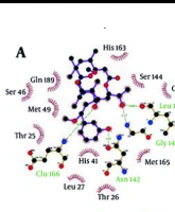
Natural Marine-derived Compounds as Potential Inhibitors of SARS-CoV-2 Main Protease: A Comprehensive Computational Study
Nowroozi G, Rahmani S, Jalali P, Zareie A, Asvar Z, et al. Natural Marine-derived Compounds as Potential Inhibitors of SARS-CoV-2 Main Protease: A Comprehensive Computational Study. J Rep Pharm Sci. 2025;13(1):e159451. doi: https://doi.org/10.5812/jrps-159451
- Scopus by DOI: 4
Last Update: 1 month ago
- Scopus by Title: 4
Last Update: 1 month ago
- Scopus by Title (Ref): 4
Last Update: 1 month ago
- CrossRef: 0
Last Update: 6 days ago
- OpenAlex: 0
Last Update: 1 day ago
- OpenCitations: 0
Last Update: 4 days ago
