Image Credit:J Cell Mol Anesth
Outline
A Comparative Study of Clonidine and Dexmedetomidine with 0.5% Levobupivacaine in ultrasound-guided Axillary Brachial Plexus Block for Upper Limb Surgeries
Authors
Abstract
Background: Clonidine and Dexmedetomidine as an additive to Levobupivacaine in ultrasound-guided axillary brachial plexus block are not studied well. Hence, this study was designed to compare the efficacy of the Clonidine and Dexmedetomidine, used as an adjunct to Levobupivacaine in ultrasound-guided axillary brachial plexus block in upper limb elective surgery.Materials and Methods: Eighty patients of the American Society of Anesthesiologists Grade I/II undergoing upper limb elective surgery were divided into two equal age/gender-matched groups. Group-LD received ultrasound-guided axillary brachial plexus block using injection 0.5% Levobupivacaine 20 ml+dexmedetomidine (1 ?g/Kg), and group LC received ultrasound-guided axillary brachial plexus block using injection 0.5% Levobupivacaine 20 ml + Clonidine (1.5 ?g/Kg). The onset and duration of sensory and motor block, hemodynamics, and side effects were recorded. Results: The time for onset of sensory block and motor block in group LD was significantly faster than group LC (4.53?1.07 and 7.88?1.29 min vs. 5.90?0.81 and 8.85?1.81min, p<0.0001). The duration of motor block in group LD was significantly longer than group LC (Sensory and motor block: 662.50 ? 50.95 and 625.50 ? 51.95min, vs 567.75 ? 62.33 and 560.62 ? 67.19 min. p< 0.0001). The sedation score was highly significant at 30 min (p<0.0001) and was significant at 60 min (p<0.05), postoperatively. Conclusion: The addition of Dexmedetomidine (1?g/Kg) as an adjuvant to Levobupivacaine (0.5%) for upper limb surgeries by axillary brachial plexus block had provided the rapid onset of sensory block and motor block and enhanced duration of sensory and motor block with arousable sedation without any adverse effects compared to clonidine (1.5?g/Kg).
Highlights
References
- 1.References are in the PDF file of the article.
Copyright
© 2021, Author(s). This open-access article is available under the Creative Commons Attribution 4.0 (CC BY 4.0) International License (https://creativecommons.org/licenses/by/4.0/), which allows for unrestricted use, distribution, and reproduction in any medium, provided that the original work is properly cited.
Similar Articles
The Effect of Adding Dexmedetomidine as an Adjuvant to Lidocaine in Forearm Fracture Surgeries by Supraclavicular Block Procedure Under Ultrasound-Guided
Akhondzadeh R, Rashidi M, Gousheh M, Olapour A, Baniahmad A. The Effect of Adding Dexmedetomidine as an Adjuvant to Lidocaine in Forearm Fracture Surgeries by Supraclavicular Block Procedure Under Ultrasound-Guided. Anesth Pain Med. 2018;8(4):e74355. doi: https://doi.org/10.5812/aapm.74355
Effects of Dexmedetomidine Versus Ketorolac as Local Anesthetic Adjuvants on the Onset and Duration of Infraclavicular Brachial Plexus Block
Mirkheshti A, Saadatniaki A, Salimi A, Manafi Rasi A, Memary E, et al. Effects of Dexmedetomidine Versus Ketorolac as Local Anesthetic Adjuvants on the Onset and Duration of Infraclavicular Brachial Plexus Block. Anesth Pain Med. 2014;4(3):e17620. doi: https://doi.org/10.5812/aapm.17620
Effects of adding dexmedetomidine to lidocaine on the onset and duration of axillary block for upper extremity surgeries
Zaman B, Noorizad S, Seyed Siamdoust SA, Etemadi SH, Askarian Omran S, et al. Effects of adding dexmedetomidine to lidocaine on the onset and duration of axillary block for upper extremity surgeries. J Kermanshah Univ Med Sci. 2017;21(3):e69237. doi:

Comparison of the Ketamine-Lidocaine and Fentanyl-Lidocaine in Postoperative Analgesia in Axillary Block in Upper Limb Fractures By Ultrasound Guidance
Akhondzadeh R, Rashidi M, Gousheh M, Olapour A, Tasbihi B. Comparison of the Ketamine-Lidocaine and Fentanyl-Lidocaine in Postoperative Analgesia in Axillary Block in Upper Limb Fractures By Ultrasound Guidance. Anesth Pain Med. 2019;9(6):e92695. doi: https://doi.org/10.5812/aapm.92695
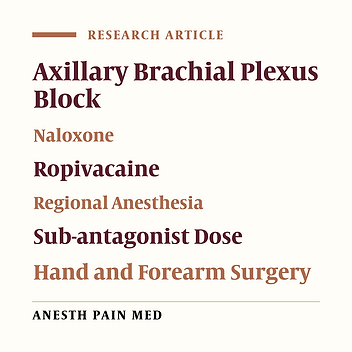
Effect of Sub-antagonist Doses of Naloxone as an Adjuvant to Ropivacaine on the Onset and Quality of Axillary Brachial Plexus Block in Patients Undergoing Forearm and Hand Surgery: A Randomized Double-Blind Clinical Trial
Zaman B, Mohseni M, Seyed Siamdoust SA, Nouri N, Noorizad S, et al. Effect of Sub-antagonist Doses of Naloxone as an Adjuvant to Ropivacaine on the Onset and Quality of Axillary Brachial Plexus Block in Patients Undergoing Forearm and Hand Surgery: A Randomized Double-Blind Clinical Trial. Anesth Pain Med. 2026;16(3):e172772. doi: https://doi.org/10.5812/aapm-172772
More by these authors
- Scopus by DOI: 0
Last Update: 1 month ago
- Scopus by Title: 0
Last Update: 1 month ago
- Scopus by Title (Ref): 0
Last Update: 1 month ago
- CrossRef: 0
Last Update: 6 days ago
- OpenAlex: 0
Last Update: 10 hours ago
- OpenCitations: 0
Last Update: 4 days ago
