
J Compr Ped

Image Credit:J Compr Ped

The Impact of SARS-CoV-2 on the Mental Health of Patients with Primary Immune Deficiency and Their Parents

Author(s):
Maryam Bagherian KazemabadiMaryam Bagherian KazemabadiMaryam Bagherian Kazemabadi ORCID1, Aysa AsiyonAysa Asiyon2, Hamid AhanchianHamid AhanchianHamid Ahanchian ORCID2, Mansoureh MirzadehMansoureh MirzadehMansoureh Mirzadeh ORCID3, Nasrin MoazzenNasrin MoazzenNasrin Moazzen ORCID2,*
1Department of Pediatrics, Faculty of Medicine, Mashhad Univercity of Medical Sciences, Mashhad, Iran
2Allergy Research Center, Mashhad University of Medical Sciences, Mashhad, Iran
3Department of Psychiatry, Faculty of Medicine, Islamic Azad University of Mashhad, Mashhad, Iran
*Corresponding Author: Allergy Research Center, Mashhad University of Medical Sciences, Mashhad, Iran. Email: [email protected]; [email protected]

Journal of Comprehensive Pediatrics:Vol. 15, issue 3; e144051
Published online:Apr 29, 2024
Article type:Research Article
Received:Dec 31, 2023
Accepted:Apr 02, 2024
How to Cite:Bagherian Kazemabadi M, Asiyon A, Ahanchian H, Mirzadeh M, Moazzen N. The Impact of SARS-CoV-2 on the Mental Health of Patients with Primary Immune Deficiency and Their Parents. J Compr Ped. 2024;15(3):e144051. doi: https://doi.org/10.5812/jcp-144051

Abstract

Since the start of the Coronavirus disease (COVID-19) pandemic, people have had to cope with significant mental pressure regarding this mysterious infection. The rapid spread of syndrome coronavirus 2 (SARS-CoV-2) worldwide has led to immense anxiety and depression among people, especially in the immunocompromised population and their close relatives. This study aims to evaluate the mental health of patients with primary immune deficiency (PID) and their mothers during the first year of the COVID-19 outbreak. A cross-sectional study was conducted from September 2020 to March 2021 among pediatric patients with PID and their family members. Thirty PID patients and their mothers were investigated using the Zung Self-Rating Anxiety Scale and Beck Anxiety Inventory (BAI), respectively. The results showed that mothers of younger PID patients experienced higher levels of anxiety (P-value = 0.019). Additionally, PID patients who did not comply with quarantine measures had significantly higher anxiety levels (P-value = 0.02). The results indicate mild to moderate anxiety in PID patients aged 12.1 ± 1.46 years during the first year of the COVID-19 outbreak. Furthermore, there was mild anxiety observed in mothers of PID patients. Non-compliance with quarantine measures significantly contributed to higher anxiety scores in both groups, emphasizing the importance of staying home and adhering to restricted social interactions to improve mental health.

1. Background

Since the emergence of severe acute respiratory syndrome coronavirus 2 (SARS-CoV-2) in 2019, a wide range of disease manifestations and complications has been observed. While respiratory symptoms are among the most prevalent presentations, other organs might be involved in different ways (1, 2). That’s why complications that are expected as a consequence of this infection are very different.
The World Health Organization (WHO) introduced SARS-CoV-2 as a major threat to mental health (3). People worldwide experienced a variety of psychological responses during the Coronavirus disease (COVID-19) outbreak. When people faced an unknown viral infection with a breakneck speed of spread, they normally responded to that with fear, anxiety, and even depression. These, alongside the economic burden induced by the pandemic, affect people in different aspects (4). Moreover, stay-at-home protocols of governments in infection prevention can significantly worsen the situation. Lack of physical contact with family and friends, especially when they are experiencing such tough moments, could worsen the mental problems (5, 6).
Eventually, WHO and other relevant organizations provided multiple guidelines for improving mental health and screening high-risk people such as children, older adults, and those with chronic mental illnesses, among others. Anxiety is one of the psychological problems that can be accompanied by fear, excessive concern, and mood instability. One of these high-risk populations comprises people who have underlying susceptibility to infections like primary immune deficiencies (PIDs) (7). In the first months of the SARS-CoV-2 outbreak, many of our PID patients stopped visiting hospitals. They preferred online visits, which caused multiple difficulties in managing their problems on time (8). So, we conducted this study to examine their psychological status over time.

2. Methods

A cross-sectional study was conducted from September 2020 to March 2021 among the pediatric population with PID and their family members. Psychological assessment in children was based on the Zung Self-Rating Anxiety Scale, and we also evaluated anxiety in their mothers using the Beck Anxiety Inventory (BAI). Both of their Persian formats were validated by previous studies (9). The Zung Scale includes 20 multiple-choice questions (10). Each question is scored between 0 and 3, so the final score will range from 0 to 60. Scores above 26 are considered severe anxiety, while scores between 8 and 15 and between 16 and 25 are considered mild and moderate anxiety, respectively.
In the BAI, there are 21 multiple-choice questions describing common symptoms of this psychological problem, including mental, physical, and panic symptoms. Scoring is the same as the Zung Scale, but the final score will be 63. Each question is scored between 0 and 3. Scores above 26 are considered severe anxiety, while scores between 8 and 15 and between 16 and 25 are considered mild and moderate anxiety, respectively. After obtaining consent from the parents of the children, they were evaluated by a psychologist. Data were analyzed using SPSS 22, and the Shapiro-Wilk and Kolmogorov-Smirnov tests were performed to check the normal distribution of the quantitative variables of age and the total score of the questionnaires. Ethical code: IR.MUMS.REC.1399.155.

3. Results

Among 30 patients with PID, with a mean age of 12.1 ± 1.4 years (range: 4 - 21 years), humoral immune deficiency was the most prevalent (30%). Other types of PIDs in our participants are listed in Table 1. Approximately eighteen participants (60%) had to regularly admit to the hospital and receive intravenous immunoglobulin (IVIG). Others did not need IVIG at all. There was an equal frequency of compliance with quarantine. During the study period, 16 patients (53.3%) experienced at least one symptom attributed to infection, such as fever, chills, cough, fatigue, or sneezing. They underwent nasal PCR for SARS-CoV-2; however, only 5 patients had positive results.
Table 1.Demographic Characteristics of Primary Immune Deficiency Patients Participating in Our Study a
VariablesFrequency
Sex (male/female)17/13
Type of PID
Humoral immune deficiency (CVID, Broton) 9 (30)
CID2 (6.7)
Phagocytic disorder (neutropenia, CGD, LAD) 5 (16.7)
MSMD2 (6.7)
Syndromic disease (hyper IgE, ataxia telangiectasia, wiskott aldrich)12 (40)

Abbreviation: PID, primary immune deficiency.

aValues are expressed as No. (%).

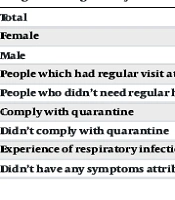
The mean score of the Zung Self-Rating Anxiety Scale in primary immune deficient patients was 16.4 ± 4.2 (range: 9 - 26). There wasn't any statistically significant relationship between the total Zung score and age (P-value = 0.876) or sex (P-value = 0.98). However, there was a significant relationship between anxiety and regular hospitalization for IVIG administration (P-value = 0.001). In addition, those PID patients who didn’t comply with quarantine had significantly more anxiety (P-value = 0.02). More details are in Table 2.
Table 2.Mean Scores of the Zung Self-rating Anxiety Scale
Zung Self-rating Anxiety ScaleMean ± Standard DeviationP-Value a
Total16.4 ± 4.2
Female16.38 ± 3.70.98
Male16.41 ± 4.8
People which had regular visit at hospital for IVIG infusion19.50 ± 4.180.001
People who didn’t need regular hospitalization for IVIG14.33 ± 2.97
Comply with quarantine 14.94 ± 2.550.02
Didn’t comply with quarantine18.57 ± 5.46
Experience of respiratory infection manifestation during study16.1 ± 3.720.59
Didn’t have any symptoms attributing to the respiratory infection16.85 ± 4.97

a Independent t-test.

The mean score of the BAI in mothers of PID patients was 8.56 ± 7.45 (range: 0 - 22). Because the distribution of this score was abnormal, we analyzed it using Spearman’s statistical analysis. There was a significant relationship between the age of children and the anxiety of their mothers. As a result, mothers of younger PID patients had more anxiety (P-value = 0.019). In addition, there was more anxiety in those mothers whose children experienced suspected COVID-19 manifestations and those whose families didn’t comply with quarantine. However, regular hospitalization for IVIG did not cause a higher anxiety score in mothers. More details are in Table 3.
Table 3.Beck Anxiety Inventory in Mothers of PID Patients
Beck Anxiety Inventory Mean ± Standard DeviationP-Value a
Total8.56 ± 7.45
People which had regular visit at hospital for IVIG infusion14.81 ± 1.20.59
People who didn’t need regular hospitalization for IVIG16.54 ± 2
Comply with quarantine 11.56 ± 1.50.03
Didn’t comply with quarantine21.42 ± 3.2
Experience of respiratory infection manifestation during study18.56 ± 2.50.04
Didn’t have any symptoms attributing to the respiratory infection12.2 ± 1.3

Abbreviation: IVIG, intravenous immunoglobulin.

a Mann-Whitney test.

4. Discussion

After the emergence of SARS-CoV-2, strict regulations were put in place to enforce staying at home, which restricted social interactions and led to major concerns about this mysterious contagious infection. There wasn’t any effective approved preventive or treatment strategy, so mental health was treated as a major concern, especially in immunocompromised patients (3, 5, 6). We conducted this study in the first year of the COVID-19 outbreak, aiming to investigate anxiety in children with inborn errors of immunity and their mothers. According to our data, there was mild to moderate anxiety in PID patients aged 12.1 ± 1.46 years during the first year of the COVID-19 outbreak. Additionally, there was mild anxiety in mothers of PID patients. These results are in agreement with Akdag et al., who evaluated anxiety in parents of PID patients during the COVID-19 outbreak and found that it was significantly higher than in parents of healthy children (11). Also, in the study by Sowers and Galantino, anxiety was higher in the pediatric population with PID during the outbreak compared to before the outbreak (12).
In a study conducted by Topal et al. in 2020, anxiety was evaluated in parents of children with PID who had to receive IVIG monthly. They found that these parents had a higher anxiety score than parents of non-PID children (P = 0.003), which contrasts with our study (13). In our study, all patients had inborn errors of immunity, so we expected parents to be concerned about infection in their immunocompromised child. Therefore, regular hospitalization or non-hospitalization did not lead to a significant difference between the two groups.
One of our limitations was the non-availability of anxiety data in the general population in Iran, especially during the outbreak. This emphasizes the need for larger studies conducted in healthy people. Additionally, follow-up studies in immunocompromised patients after the COVID-19 outbreak will be helpful. Comparing the results will illustrate the impact of COVID-19 on the mental health of these susceptible populations.

4.1. Conclusions

According to our data, there was mild to moderate anxiety in PID children and mild anxiety in their mothers during the first year of the COVID-19 outbreak. Non-compliance with quarantine significantly led to higher anxiety scores in both groups. Therefore, advice to stay home and more restricted social communication improved mental health.
Footnotes

  • Authors' Contribution: M.B.K. and H.A. conceived and designed the evaluation, and drafted the manuscript. M.B.K. participated in designing the evaluation, performed parts of the statistical analysis, and assisted in drafting the manuscript. N.M., M.M., A.A., and H.A. re-evaluated the clinical data, revised the manuscript, conducted the statistical analysis, and further revised the manuscript. M.B.K., A.A., and H.A. collected the clinical data, interpreted them, and revised the manuscript. M.B.K., N.M., and H.A. re-analyzed the clinical and statistical data and revised the manuscript. All authors read and approved the final manuscript.

  • Conflict of Interests Statement: The authors declare no conflicts of interest.

  • Data Availability: The dataset presented in the study is available on request from the corresponding author during submission or after publication.

  • Ethical Approval: Our study protocol has been reviewed and approved by the Health Research Ethical Committee of the Faculty of Medicine, Mashhad University of Medical Sciences. The ethical code is IR.MUMS.REC.1399.155 .

  • Funding/Support: This study was supported by Mashhad University of Medical Sciences, grant number 990160 .

  • Informed Consent: Informed consent was obtained from the parents of the children.

References

  • 1.
    Guan WJ, Ni ZY, Hu Y, Liang WH, Ou CQ, He JX, et al. Clinical Characteristics of Coronavirus Disease 2019 in China. N Engl J Med. 2020;382(18):1708-20. [PubMed ID: 32109013]. [PubMed Central ID: PMC7092819]. https://doi.org/10.1056/NEJMoa2002032.
  • 2.
    Baradaran A, Malek A, Moazzen N, Abbasi Shaye Z. COVID-19 Associated Multisystem Inflammatory Syndrome: A Systematic Review and Meta-analysis. Iran J Allergy, Asthma Immunol. 2020. https://doi.org/10.18502/ijaai.v19i6.4927.
  • 3.
    World Health Organization. Mental Health and COVID-19: Early evidence of the pandemic’s impact: Scientific brief, 2 March 2022. Geneve, Switzerland: World Health Organization; 2022, [cited 2023]. Available from: https://www.who.int/publications/i/item/WHO-2019-nCoV-Sci_Brief-Mental_health-2022.1.
  • 4.
    Gong Y, Liu X, Zheng Y, Mei H, Que J, Yuan K, et al. COVID-19 Induced Economic Slowdown and Mental Health Issues. Front Psychol. 2022;13:777350. [PubMed ID: 35310204]. [PubMed Central ID: PMC8931846]. https://doi.org/10.3389/fpsyg.2022.777350.
  • 5.
    Moazzen N, Imani B, Aelami MH, Motevali Haghi NS, Kianifar HR, Khoushkhui M, et al. How to Boost our Immune System Against Coronavirus Infection? Arch Bone Jt Surg. 2020;8(Suppl 1):220-5. [PubMed ID: 32733978]. [PubMed Central ID: PMC7296589]. https://doi.org/10.22038/abjs.2020.47559.2330.
  • 6.
    Ben-Ezra M, Sun S, Hou WK, Goodwin R. The association of being in quarantine and related COVID-19 recommended and non-recommended behaviors with psychological distress in Chinese population. J Affect Disord. 2020;275:66-8. [PubMed ID: 32658825]. [PubMed Central ID: PMC7329674]. https://doi.org/10.1016/j.jad.2020.06.026.
  • 7.
    Moazzen N, Ahanchian H, Aelami MH, Asiyon H, Astaneh M, Naeimi AM, et al. COVID-19 in children with inborn errors of immunity: clinical scenarios. Am J Clin Exp Immunol. 2021;10(3):77-85. [PubMed ID: 34824897]. [PubMed Central ID: PMC8610801].
  • 8.
    Delavari S, Abolhassani H, Abolnezhadian F, Babaha F, Iranparast S, Ahanchian H, et al. Impact of SARS-CoV-2 Pandemic on Patients with Primary Immunodeficiency. J Clin Immunol. 2021;41(2):345-55. [PubMed ID: 33263173]. [PubMed Central ID: PMC7707812]. https://doi.org/10.1007/s10875-020-00928-x.
  • 9.
    Kaviani H, Mousavi AS. [Psychometric properties of the Persian version of Beck Anxiety Inventory (BAI)]. Tehran Univ Med J. 2008;66(2):136-40. Persian.
  • 10.
    Zung WWK. Self-Rating Anxiety Scale (SAS) [Database record]. BMC Psychiatry. 1971. https://doi.org/10.1037/t04092-000.
  • 11.
    Akdag B, Onder A, Gizli Coban O, Kocacik Uygun DF, Surer Adanir A, Erdem A, et al. Psychological State of Parents of Children with Primary Immunodeficiencies During the COVID-19 Pandemic. Pediatr Allergy Immunol Pulmonol. 2022;35(1):12-8. [PubMed ID: 35180363]. https://doi.org/10.1089/ped.2021.0081.
  • 12.
    Sowers KL, Galantino ML. Living with primary immunodeficiency disease during the Covid-19 pandemic. Z Gesundh Wiss. 2022;30(12):2753-60. [PubMed ID: 33936932]. [PubMed Central ID: PMC8075281]. https://doi.org/10.1007/s10389-021-01545-7.
  • 13.
    Topal OY, Metin A, Cop E, Dinc GS, Uneri OS. Anxiety among the parents of pediatric patients receiving IVIG therapy during the Covid-19 pandemic. Turk J Pediatr. 2021;63(5):801-10. [PubMed ID: 34738362]. https://doi.org/10.24953/turkjped.2021.05.008.

Copyright

Copyright © 2024, Bagherian Kazemabadi et al. This open-access article is available under the Creative Commons Attribution 4.0 (CC BY 4.0) International License (https://creativecommons.org/licenses/by/4.0/), which allows for unrestricted use, distribution, and reproduction in any medium, provided that the original work is properly cited.

Similar Articles

12
May
2021

Evaluating the Depression, Anxiety, Stress, and Predictors of Psychological Morbidity Among COVID-19 Survivors in Mashhad, Iran

Zanireh Salimi,
Romina Najafi,
Alireza Khalesi,
Reza Oskoei,
Fatemeh Moharreri,
Saeideh Hajebi Khaniki
,et al.

Salimi Z, Najafi R, Khalesi A, Oskoei R, Moharreri F, et al. Evaluating the Depression, Anxiety, Stress, and Predictors of Psychological Morbidity Among COVID-19 Survivors in Mashhad, Iran. Iran J Psychiatry Behav Sci. 2021;15(2):e108972. doi: https://doi.org/10.5812/ijpbs.108972

6
Jan
2024
Compr Health Biomed Stud

Depression and Anxiety Among Children and Adolescents During the COVID-19 Outbreak: A Systematic Review

Maryam Seyedtabib,
Masoomeh Asadi,
Fatemeh Maghsoodi,
Naser Kamyari

Seyedtabib M, Asadi M, Maghsoodi F, Kamyari N. Depression and Anxiety Among Children and Adolescents During the COVID-19 Outbreak: A Systematic Review. Compr Health Biomed Stud. 2023;1(4):e142440. doi: https://doi.org/10.5812/chbs-142440

11
Dec
2024
J Compr Ped

Difficulties of Families with Children and Adolescents with Psychiatric Disorders During the COVID-19 Outbreak: A Cross-Sectional Study

Forough Riahi,
Maryam Izadi-Mazidi

Riahi F, Izadi-Mazidi M. Difficulties of Families with Children and Adolescents with Psychiatric Disorders During the COVID-19 Outbreak: A Cross-Sectional Study. J Compr Ped. 2024;15(4):e144416. doi: https://doi.org/10.5812/jcp-144416

2
Apr
2020
Archives of Clinical Infectious Diseases

COVID-19 and Anxiety: A Review of Psychological Impacts of Infectious Disease Outbreaks

Mohammad Ali Fardin

Fardin MA. COVID-19 and Anxiety: A Review of Psychological Impacts of Infectious Disease Outbreaks. Arch Clin Infect Dis. 2020;15(COVID-19):e102779. doi: https://doi.org/10.5812/archcid.102779

1
Aug
2022

Posttraumatic Stress Symptoms, Anxiety, and Depression Among COVID-19 Survivors After Discharge from Hospital

Razieh Salehian,
Mahnaz Abdi,
Mahdi Sadegh Abedin,
Azad Maroufi,
Khaled Rahmani

Salehian R, Abdi M, Sadegh Abedin M, Maroufi A, Rahmani K. Posttraumatic Stress Symptoms, Anxiety, and Depression Among COVID-19 Survivors After Discharge from Hospital. Iran J Psychiatry Behav Sci. 2022;16(3):e122958. doi: https://doi.org/10.5812/ijpbs-122958

Download PDF91.59 KB
Indexed in

Crossmark

Crossmark

Checking

Share on
Cited by
Metrics

Ordering Reprints

Articles are published under the Creative Commons license stated on each article. No permission or royalty fee is required for uses permitted by that license. CCC handles optional bulk and customized reprint orders. Any quotation covers production and delivery services only, not copyright permission. > Request Reprints from CCC 

Search Relations

Author(s):

Related Articles