
1. Background
Diabetes mellitus represents the most prevalent metabolic disorder, characterized by hyperglycemia alongside dysregulation in the metabolism of carbohydrates, lipids, and proteins. Specifically, diabetes manifests as a condition in which the affected individual’s body is incapable of utilizing blood glucose effectively; this inability arises either from the pancreas’s failure to secrete adequate insulin or from the incapacity of insulin receptor cells within the organism to facilitate glucose uptake (1).
In light of the escalating prevalence of diabetes on a global scale, the world health organization has designated this condition as a concealed epidemic, urging nations worldwide since 1993 to implement measures to combat it (2). Projections from this organization indicate that the diabetic population is anticipated to surge to more than twice the figure from 30 years ago by 2025 (3). This escalation is expected to reflect a 170% increase in developing nations, contrasted with a 42% rise in developed countries. Notably, 79% of individuals afflicted with diabetes reside in low-and-middle-income nations (4). Furthermore, diabetes ranks as the seventh leading cause of mortality in the United States and consistently occupies a position among the top ten causes of death in Iran (5).
In 2017, an estimated 451 million individuals aged between 18 and 99 globally were diagnosed with diabetes. It has been approximated that nearly half (49.7%) of these individuals remained undiagnosed (6). The financial burden of healthcare for diabetes management globally in 2017 was estimated at 850 billion dollars. Projections indicate that the global prevalence of diabetes is increasing and is higher in urban areas (10.8%) compared to rural areas (7.2%). In 2019, the global prevalence of impaired glucose tolerance was estimated at 7.5% (374 million), with forecasts suggesting it will rise to 8.0% (454 million) by 2030 and 8.6% (548 million) by 2045 (6, 7).
Type 1 diabetes is an autoimmune disease in which the immune system erroneously targets insulin-secreting cells in the pancreas, leading to their destruction through the release of self-generated antibodies and resulting in a complete inability to produce insulin (8). This variant of diabetes is predominantly observed among children and young adults. The global population of children and adolescents under the age of 15 is approximately 625,000, with an annual incidence exceeding 108,000 cases (9). In Iran, the annual incidence rate recorded in 2015 was 13.35 per 100,000 individuals (10).
According to the report published by the International Diabetes Federation (IDF), approximately 1,200,000 children and adolescents are presently afflicted by type 1 diabetes, with over fifty-four percent of this population being under the age of 15 (11). Individuals diagnosed with type 1 diabetes are susceptible to a myriad of complications associated with this condition. Self-monitoring of blood glucose (SMBG) levels is paramount in mitigating acute, sub-acute, and chronic complications of diabetes; however, it often receives less emphasis compared to insulin therapy (12, 13). It is crucial to identify effective strategies for blood glucose regulation and to eliminate barriers that hinder self-monitoring practices among these individuals. The significance of self-monitoring in achieving a reduction of HbA1c levels in patients with type 1 diabetes has been well-established. Engaging in SMBG levels yields enhanced glycemic control and diminishes the incidence of complications affecting the ocular, renal, neurological, and cardiovascular systems, while concurrently improving overall quality of life and decreasing healthcare expenditures. Scientific guidelines advocate for blood glucose measurement to occur at least four times daily (14). Various studies conducted across different populations, as well as among diverse age and gender cohorts, have produced varying findings regarding the frequency of daily blood glucose monitoring and the influencing factors thereof.
2. Objectives
The aim of the present study is to investigate factors associated with adherence to SMBG in type 1 diabetes during the first two decades of life in Iran, so that policymakers in health can achieve better management of diabetes in children and adolescents.
3. Methods
3.1. Study Design and Setting
This cross-sectional study was conducted on people with type 1 diabetes during the first two decades of their lives (children and adolescents) in Kermanshah, Iran, from June 2022 to December 2023. Given the purpose of the study and the ease of access to samples, sampling was conducted at the only diabetes clinic in Kermanshah, which serves as a referral center.
The inclusion criteria were individuals with a known diagnosis of diabetes aged 18 years or younger, along with their legal guardian's willingness to participate in the study and completion of the written consent form. In this study, individuals with mental disorders and those with incomplete personal or medical information were excluded.
3.2. Sample Size
Based on the inclusion criteria, 275 individuals were included in this study. The sample size was calculated at 270, assuming that half of the questions would be answered correctly and using a confidence level of 95% and a margin of error of 5%.
3.3. Instrument
To evaluate the validity and reliability of the self-made questionnaire, a pilot study was conducted with 30 participants, and experts' opinions (two internal specialists, a psychologist, and an epidemiologist) were obtained. Cronbach's alpha was determined to be 0.83. The questionnaire consists of three parts: (1) Socio-demographic information and medical characteristics: Gender (female, male), age, education, occupations of the participants’ parents, length of illness, insulin regimen, HbA1c, number of hypoglycemia episodes, Body Mass Index (BMI), and diabetes symptoms; (2) adherence to blood glucose assessment with a glucometer: Including the number of times blood glucose was assessed per day, during the last week, and during the last month; (3) causes affecting blood glucose measurement: Including glucometer price, pain when checking blood glucose with a glucometer, non-availability of glucometer strips in the market, lack of belief in the usefulness of checking blood glucose with a glucometer, sadness due to the reactions of those around me to my illness, lack of necessary training on the use of a glucometer, insufficient time to check blood glucose frequently with a glucometer, unavailability of a glucometer, forgetting to check blood glucose with a glucometer, fear of knowing my blood glucose number, the price of glucometer strips in the market, and the belief that measurement in the clinic is sufficient (responses rated as: Do not agree, fairly agree, strongly agree).
3.4. Data Collection
The purpose of the study was explained to the supervisors of the participants. Written informed consent forms were signed, and with their permission, the individual performing glucose self-monitoring or their guardian completed the questionnaire. The necessary training was provided to the participants by the researcher. Incomplete questionnaires were excluded from the study.
3.5. Data Analysis
To evaluate quantitative and qualitative data, descriptive statistical methods (prevalence, mean, and standard deviation) and analytical tests (chi-square, Pearson correlation coefficient) were used with SPSS software version 18. The bivariate Spearman correlation coefficient was utilized to ascertain the magnitude and direction of the associations between the frequency of blood glucose assessment and HbA1c. Binary logistic regression analyses were conducted to identify sociodemographic and economic factors influencing blood glucose measurements, adhering to basic logistic regression assumptions. Blood glucose assessment with a glucometer more than four times daily by the patient was considered adherence to SMBG. The linearity of the variables was tested using scatterplots, which indicated linear relationships. No specific errors were found (relevant predictors were included, and irrelevant ones were excluded). There was no multicollinearity among the independent variables. Outliers in the samples were assessed using the case list table for binomial regression outputs; three samples had multiple values in the ZRESID column, so they were removed and the test was repeated. Differences were considered significant at a P-value of 0.05 for all statistical tests.
3.6. Ethical Approval
The Research Ethics Committee at Kermanshah University of Medical Sciences approved the study protocol (ethics No: IR.KUMS.MED.REC.1403.231). Additionally, supervisors of the patients were informed about participation in the study and signed the consent form. Data were kept confidential, with availability limited to only the researchers and the participants' physicians.
4. Results
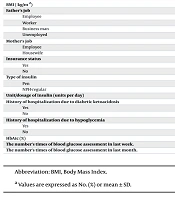
The results of the present study showed that most of the children participating in the study were boys (54.4%), and their average age was 10.48 ± 3.63 years. Most fathers of children with type 1 diabetes were self-employed (53.8%). Additionally, the majority of mothers of children with type 1 diabetes were housewives (78.6%). One patient (0.4%) experienced diabetic renal complications, seven (2.5%) experienced diabetic eye complications, and four (1.5%) developed diabetic foot ulcers. The average number of blood glucose assessments with a glucometer in the last week among the studied patients was 27.33 ± 19.39 times. The average number of blood glucose assessments with a glucometer in the last month among the studied patients was 112.59 ± 83.42 times (Table 1).
Table 1.
Sociodemographic Characteristics of the Participants a
| Characteristics | Total |
|---|---|
| Gender | |
| Girl | 126 (45.6) |
| Boy | 149 (54.4) |
| Age (y) | 10.48 ± 3.63 |
| Ageofdiagnose(y) | 6.44 ± 3.40 |
| Duration of diabetes(y) | 5.80 ± 4.25 |
| BMI ( kg/m2) | 21.89 ± 3.52 |
| Father's job | |
| Employee | 73 (33.8) |
| Worker | 29 (10.5) |
| Business man | 148 (53.8) |
| Unemployed | 8 (2.9) |
| Mother's job | |
| Employee | 39 (21.4) |
| Housewife | 236 (78.6) |
| Insurance status | |
| Yes | 247 (89.8) |
| No | 28 (10.2) |
| Type of insulin | |
| Pen | 257 (93.5) |
| NPH-regular | 18 (6.5) |
| Unit/dosage of insulin (units per day) | 55.89 ± 25.46 |
| History of hospitalization due to diabetic ketoacidosis | |
| Yes | 84 (30.5) |
| No | 191 (69.5) |
| History of hospitalization due to hypoglycemia | |
| Yes | 17 (6.2) |
| No | 258 (93.8) |
| HbA1c (%) | 7.68 ± 2.14 |
| The number's times of blood glucose assessment in last week. | 27.33 ± 19.39 |
| The number's times of blood glucose assessment in last month. | 112.59 ± 83.42 |
Abbreviation: BMI, Body Mass Index.
a Values are expressed as No. (%) or mean ± SD.
The results showed that 53.4% of patients checked their blood glucose with a glucometer more than four times per day (Table 2).
Table 2.
The Number's Times of Blood Glucose Assessment Per Day
| The Number's Times of Blood Glucose | No. (%) |
|---|---|
| More than 4 times daily | 147 (53.4) |
| Two - four times daily | 83 (30.2) |
| Once a day | 17 (6.2) |
| Once a week | 3 (1.1) |
| Less than once a week | 1 (0.4) |
| Non | 2 (0.8) |
Based on Spearman's correlation test, there was an inverse and significant relationship between the number of times blood glucose was evaluated with a glucometer in the last week and HbA1c, such that by increasing the number of blood glucose assessments with a glucometer in the last week, HbA1c decreased (r = -0.340, P = 0.001). Similarly, there was an inverse and significant relationship between the number of blood glucose assessments with a glucometer in the last month and HbA1c, such that with an increase in the number of blood glucose assessments with a glucometer in the last month, HbA1c decreased (r = -0.406, P = 0.001).
The results shown in Table 3 indicate that the most important factors affecting blood glucose measurement by glucometer are the price of glucometer strips in the market (68.4% agree), the unavailability of glucometer strips in the market (44.0% agree), and the price of glucometers in the market (36.0% agree).
Table 3.
The Factors Affecting Blood Glucose Measurement a
| Factors | Strongly Agree | Fairly Agree | Do Not Agree | P-Value b |
|---|---|---|---|---|
| Glucometer price | 99 (36.0) | 89 (32.4) | 87 (31.6) | 0.001 |
| Pain when checking blood glucose with a glucometer | 70 (25.6) | 101 (36.7) | 104 (37.8) | 0.61 |
| Non-availability of glucometer strips in the market | 121 (44.0) | 51 (18.5) | 103 (37.5) | 0.001 |
| I do not believe in the usefulness of checking blood glucose with a glucometer. | 37 (13.5) | 41 (14.9) | 197 (71.6) | 0.001 |
| I am saddened by the reaction of those around me to my illness. | 78 (28.4) | 69 (25.1) | 128 (46.5) | 0.011 |
| I have not received the necessary training on the use of a glucometer. | 43 (15.6) | 39 (14.2) | 193 (70.2) | 0.001 |
| I don't have enough time to check glucose frequently with a glucometer. | 52 (18.9) | 47 (17.1) | 176 (64.0) | 0.001 |
| Glucometer not available | 191 (69.5) | 51 (18.5) | 33 (12.0) | 0.001 |
| I forget to check my blood glucose with a glucometer. | 46 (16.7) | 48 (17.4) | 181 (65.8) | 0.001 |
| I am afraid of knowing my blood glucose number. | 67 (24.4) | 71 (25.8) | 137 (49.8) | 0.041 |
| The price of glucometer strips in the market. | 144 (52.4) | 46 (16.7) | 85 (30.9) | 0.001 |
| In my opinion, the measurement in the clinic is enough. | 17 (6.2) | 23 (8.4) | 235 (85.4) | 0.001 |
a Values are expressed as No. (%).
b P ≤ 0.05 was considered statistically significant.
Binary logistic regression analyses were conducted to determine the factors influencing SMBG measurement (Table 4). The coefficient (β), standard error, and confidence interval values for the binary logistic regression analysis results are presented in Table 4. As a result of the analysis, it was determined that the variables of age 2 - 6 years (OR: 1.765; CI: 1.240 - 3.011), duration of diabetes greater than six years (OR: 1.303; CI: 1.109 - 2.087), having a housewife mother (OR: 1.982; CI: 1.045 - 4.520), having insurance (OR: 4.750; CI: 1.238 - 21.675), high price of strips and glucometers in the market (OR: 0.324; CI: 0.213 - 0.745), and their availability (OR: 0.456; CI: 0.157 - 0.965) were statistically significant with adherence to SMBG in type 1 diabetes.
Table 4.
Estimated Model Results Factors Associated with Adherence to Self-monitoring of Blood Glucose in Type 1 Diabetes
| Variables | Binary Logistic Regression | |||
|---|---|---|---|---|
| Adjusted OR | Std. Error | 95% CI | ||
| Lower | Upper | |||
| Female gender | 1.123 | 0.716 | 0.897 | 3.352 |
| Age (reference category: < 2 y) | ||||
| 2 - 6 | 1.765 | 0.229 | 1.240 | 3.011 |
| 6 - 12 | 0.354 | 0.684 | 0.081 | 0.817 |
| 12 - 18 | 0.622 | 0.331 | 0.205 | 1.046 |
| BMI < 18 | 1.439 | 0.831 | 0.222 | 4.208 |
| Duration of diabetes (reference category: < 2 y) | ||||
| 2 - 6 | 0.721 | 0.286 | 0.265 | 1.871 |
| > 6 | 1.303 | 0.352 | 1.109 | 2.087 |
| Employee fathers | 0.848 | 0.282 | 0.387 | 1.806 |
| Housewife mothers | 1.982 | 0.235 | 1.045 | 4.520 |
| Having insurance | 4.750 | 0.793 | 1.238 | 21.675 |
| High price of strips and glucometers | 0.324 | 0.124 | 0.213 | 0.745 |
| Availability of strips and glucometers | 0.456 | 0.487 | 0.157 | 0.965 |
Abbreviation: BMI, Body Mass Index.
5. Discussion
The findings of the current investigation revealed a statistically significant inverse correlation between the frequency of blood glucose measurements conducted with a glucometer over the preceding week and month and the levels of HbA1c. Thus, an increase in the frequency of blood glucose assessments utilizing a glucometer during the prior week and month corresponds with a reduction in HbA1c levels. The inaugural study aimed at evaluating the impact of self-monitoring blood glucose on clinical diabetes management in individuals with type 1 diabetes was undertaken by Mann et al. in 1984, with the objective of assessing the long-term advantages of self-monitoring blood glucose among pediatric diabetic patients. In this research, 39 children aged between 6 and 16 years diagnosed with type 1 diabetes were randomly assigned to two distinct training groups: One group did not engage in SMBG, while the other group actively practiced self-monitoring. Although the results of the investigation did not reveal any significant differences in hemoglobin A1c levels between the groups, a substantial and noteworthy reduction in hospitalizations was recorded for the cohort that participated in the self-monitoring blood glucose group (15). Bott et al. similarly demonstrated in their research that hemoglobin A1c levels exhibited a decline with an increased frequency of SMBG (16). The study involving 144 children and adolescents diagnosed with type 1 diabetes, titled "Hemoglobin A1c and Its Related Factors in Diabetic Children and Adolescents Under 18 Years of Age," revealed an inverse correlation between the frequency of SMBG and the levels of hemoglobin A1c, as determined using Spearman's correlation coefficient. (17). In an observational study conducted in Britain, a cohort of 258 patients with type 1 diabetes participated. The findings of this study indicated that an increase in the frequency of SMBG was associated with a reduction in hemoglobin A1c levels, such that for every 180 glucometer readings conducted over a six-month timeframe, hemoglobin A1c levels decreased by 0.7% (18). The research conducted by Wang et al. illustrated that monitoring various dimensions of self-management behaviors, such as utilizing a mobile phone for blood glucose control, can contribute to a decline in blood glucose indicators, including glycosylated hemoglobin (19). In their study, Hawkes et al. similarly concluded that engaging in self-management behaviors, such as blood glucose monitoring, leads to a statistically significant reduction in glycosylated hemoglobin levels and enhances self-management practices (20). In a comprehensive review conducted by Peymani et al., it was asserted that all investigations examining the effects of SMBG in type 1 diabetes found that the implementation of self-monitoring leads to improvements in glycosylated hemoglobin levels and effective blood glucose control. Furthermore, increasing the frequency of SMBG throughout the day yields more favorable outcomes (21).
The results of our study showed that gender did not affect self-assessment of diabetes monitoring. This finding is inconsistent with the results of another study (22). This discrepancy may be due to the fact that our study was conducted only among children and adolescents, while in their study most of the samples were adults. Women in adulthood tend to pay more attention to their health and are more regular in following doctors' orders (23).
The results of the study showed that the ages of 2 to 6 years were the most predictive factor for self-assessment of diabetes. At this age, the care and assessment of diseases in children are almost entirely carried out by their mothers (24). However, at under two years of age, the disease in children is often not fully accepted by mothers, and they usually remain in denial (25). Moreover, children under two years of age are not developmentally able to express symptoms of the disease or participate in their own assessment and treatment (26).
The results of the study showed that being a housewife was a predictive factor for performing diabetes self-assessment. It is likely that housewife mothers, who do not spend part of their time working outside the home, are better able to plan their time to administer their children's self-assessment tests on schedule. This finding is confirmed by the study conducted by Azkia (27).
The findings of this investigation indicated that the predominant variables influencing blood glucose measurements via glucometer are the market price of glucometer strips, the market price of the glucometer itself, and the scarcity of glucometer strips available in the market. Consistent with our research, studies conducted by Nyomba et al. (28) and Aghili et al. (29) articulated that the financial implications associated with SMBG (encompassing both the glucometer and strip costs) represent a significant impediment to self-monitoring for individuals with diabetes. Furthermore, in research conducted by Allen et al. (30) and Oki et al. (31), the investigators determined that the financial burden of self-monitoring blood glucose acts as a considerable deterrent for patients who opt not to engage in this practice.
The overall strength of this paper lies in its methodological rigor, statistical thoroughness, and focus on actionable, context-specific barriers to diabetes management. By linking behavioral adherence (glucose checks) to clinical outcomes (HbA1c) and socioeconomic factors, it provides a nuanced understanding of the challenges of type 1 diabetes care in a resource-constrained setting.
5.1. Conclusions
This cross-sectional study provides critical insights into the factors influencing adherence to SMBG among children and adolescents with type 1 diabetes in Iran. The findings underscore a significant inverse relationship between the frequency of blood glucose monitoring (via glucometer) and HbA1c levels, reinforcing the clinical importance of regular SMBG in achieving glycemic control. Notably, socioeconomic barriers — such as the high cost and limited availability of glucometers and strips — emerged as pivotal obstacles to adherence, highlighting systemic challenges in resource-constrained settings. The study also identified demographic predictors, including younger age (2 - 6 years), longer duration of diabetes, maternal occupation (housewives), and insurance coverage, which offer actionable targets for tailored interventions. By focusing on an understudied population (children and adolescents in a middle-income country), the study fills a gap in the diabetes literature and provides a model for similar regions. However, its cross-sectional design limits causal inferences, and reliance on a single clinic may affect generalizability. These findings advocate for policy reforms to subsidize diabetes supplies, improve insurance coverage, and strengthen supply chains for glucometers and strips. Future research should explore longitudinal or interventional studies to establish causality and test scalable solutions, such as mobile health technologies or community-based education programs.
5.2. Limitations
One limitation of the research is the study design, which establishes only correlation, not causation. Therefore, it is recommended that longitudinal studies be conducted to examine factors associated with diabetes self-assessment. Another limitation of the present study was the instrument used. Unfortunately, we did not find a standardized instrument for self-assessment of diabetes in children and adolescents; thus, we relied on a researcher-made instrument based on the opinions of experts in the field, so interpretation of the data should be approached with caution. Another limitation of this study is the lack of randomization and the fact that it was limited to a single clinic in Kermanshah, which may have reduced the generalizability of the results.