
Dear Editor,
Child oral health care providers may sometimes encounter patients with a history of an unusual infected-like mass superficially attached to the gingiva. Although it does not constitute an emergency, it may provoke worry and anxiety for accompanying parents or guardians (1). Commonly, parents report noticing the lesion by accident, while the child experiences no or minimal prodromal symptoms of discomfort or complaint, with no impact on daily activity. The upper anterior area is the usual site of the lesion. Over time, it might present as a purulent ulcer of the gingiva, increasing plaque accumulation.
Soft tissue lesions are relatively prevalent in childhood and vary widely in origin, nature, and entity. The unique-appearing lesion discussed in our editorial may not be easily categorized as a self-inflicted injury, which is not uncommon (2). However, we cannot rule out the possibility that it may have occurred intentionally. According to Gupta et al. (3) and Passi and Sharma (2), numerous reasons exist for foreign objects entering the human body, including ingestion, insertion, and deposition. To our knowledge, there is no documented literature on the insertion or attachment of foreign bodies to keratinized gingiva in the child population. Children tend to hold objects in their mouths, including food and other items (1, 2, 4). Meanwhile, the keratinized gingiva acts as a recipient of foreign objects. Following attachment, plaque and debris accumulate, and swelling occurs due to the object's bulge, causing signs of chronic inflammation at the attachment site. However, the risk of complications such as abscess formation is low unless the child is medically compromised. In this situation, the attached object acts as a source of infection. Dental caries and subsequent decreased tongue and masticatory muscle activity can prolong and aggravate the situation. Additionally, the child's nature, entertainments, and activities may distract them from focusing on the object. Clinicians must also consider the likelihood of child oral neglect or disregard by parents. Therefore, necessary investigations to rule out this form of dental negligence are recommended.
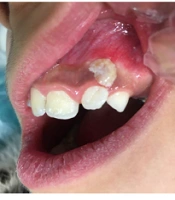
The situation may present a challenging diagnostic procedure for the clinician. For early clinical diagnosis, taking a thorough history is mandatory (1, 3). As with any other pathology, a detailed clinical examination using accurate observation, inspection, and palpation under standard circumstances is essential for proper diagnosis. Misdiagnosis, in addition to the neglected and asymptomatic state of the lesion, may delay treatment. Treatment consists of simple removal using dental gauze. However, it can sometimes be difficult to remove these foreign objects. It is mandatory to tilt the child's head to the right or left to prevent aspiration or the foreign body from falling into the digestive tract. This allows the chronic inflammatory reaction beneath the object to resolve gradually. In most cases, the attached foreign body is one half of a nut, which gradually suctions the gingiva by its inner raised edge when a vacuum is produced in the vestibule. The protruding margins stubbornly sink into the attached gingiva, creating a suction state in the position (Figure 1). Due to this marginal insertion, the situation of foreign body deposition becomes prolonged, leading parents to assume it is a sudden-onset lesion. After removal, the imprint of penetrating margins may be observed in the gingiva. As previously stated, nutshells, including pistachio nutshells, may deposit on the palate and create a tumor-resembling mass (5).

Figure 1.
A foreign body attached to gingiva
According to the authors, foreign body attachment can occur regardless of the child's physical and mental health condition. The clinical experience of the first author, who has visited a variety of inflicted attendees, confirms this claim. Although more research in this field is necessary and recommended. For prevention of lesion occurrence, regular dental visits by oral health-related workers are highly recommended. In this regard, the importance of optimal oral home care provided by parents or caregivers is clear.