
1. Background
Foreign body ingestion (FBI) represents a significant and potentially life-threatening medical emergency encountered worldwide, affecting individuals across all age groups but demonstrating a pronounced prevalence among specific populations. The FBI can occur either accidentally or intentionally, with the latter being more commonly observed in individuals with psychiatric disorders or developmental disabilities (1). Among accidental cases, children under the age of five years and elderly individuals, particularly those with dental impairments such as edentulism, are disproportionately affected (2, 3). This disparity underscores the vulnerability of these populations due to their anatomical, physiological, and behavioral characteristics, which predispose them to ingest foreign objects.
The ingestion of foreign bodies into the esophagus has been identified as a critical cause of morbidity and mortality across diverse demographic groups, including pediatric patients, the elderly, mentally challenged individuals, and those with mechanical or structural esophageal abnormalities (4). The spectrum of ingested foreign bodies is remarkably broad, encompassing both metallic and non-metallic items. Sharp objects such as glass shards, safety pins, fish bones, and needles pose a particular risk due to their potential to cause perforation or laceration of the esophageal mucosa. Conversely, round objects like coins, marbles, and small toys are frequently ingested by children, often becoming lodged at anatomical constrictions within the esophagus (5, 6).
The most common sites of foreign body impaction in the esophagus include the cervical esophagus near the cricopharyngeal muscle and the thoracic esophagus adjacent to the aortic arch (7). These locations correspond to natural anatomical narrowings that increase the likelihood of obstruction. Notably, children presenting to emergency departments due to FBI often exhibit no symptoms, with studies reporting that up to 50% of cases involving metallic objects remain asymptomatic (8). However, when symptoms do manifest, they vary widely depending on the object's location, shape, size, type, and duration of impaction. Common clinical presentations include cough, vomiting, wheezing, drooling, neck pain, and stridor, all of which necessitate prompt evaluation to prevent complications (9).
Ingestion of foreign bodies into the esophagus can lead to severe and potentially fatal complications within the upper digestive system. These complications include esophageal perforation, abrasion, soft tissue infection, mediastinitis, abscess formation, fistula development with adjacent organs, and injury to major vascular structures such as the aorta or pulmonary vessels, and peritonitis (1-3). For instance, disc-shaped batteries, also known as button batteries, represent a particularly hazardous category of foreign bodies. Upon exposure to moisture in the esophageal environment, these batteries release alkaline substances such as potassium or sodium hydroxide, leading to rapid tissue necrosis and perforation. Severe sequelae, including aortic rupture and esophageal-to-bronchial fistulas, highlight the critical importance of timely intervention (10). Delayed diagnosis or treatment may result in chronic complications such as fibrosis, esophageal stricture formation, and eventual obstruction following mucosal damage (11).
Understanding the types of foreign bodies and their precise locations within the esophagus is essential for selecting appropriate removal techniques. This knowledge is especially crucial in cases presenting with acute symptoms, where immediate diagnostic and therapeutic interventions, such as endoscopic retrieval, may be required (4-7). In pediatric patients and intellectually challenged individuals, obtaining reliable descriptions of symptoms or foreign body characteristics can be challenging, further emphasizing the need for a systematic approach to diagnosis and management. Additionally, scenarios in which a foreign body is not identified during endoscopy despite clinical suspicion warrant careful consideration. Such cases may involve spontaneous passage of the object or migration to adjacent anatomical structures, necessitating advanced imaging modalities for accurate localization (8).
2. Objectives
Given the notable incidence of FBI among children and the imperative for prompt diagnosis and effective treatment, this study aims to investigate the prevalence and treatment outcomes of FBI in pediatric patients presenting to the emergency department of Ali Ibn Abi Talib Zahedan Hospital in 2020. By analyzing demographic data, types of ingested objects, clinical presentations, and management strategies, this research seeks to contribute valuable insights into the epidemiology and optimal care pathways for this common yet potentially serious condition. The findings may inform clinical protocols and enhance patient outcomes, particularly in resource-limited settings where access to advanced diagnostic tools and specialized care may be constrained.
3. Methods
3.1. Study Design and Setting
This descriptive cross-sectional study was conducted at the emergency department of Ali Ibn Abi Talib Zahedan Hospital in 2020. The study included all children who presented with a confirmed diagnosis of FBI, determined through patient history or radiological findings.
3.2. Inclusion Criteria and Participant Recruitment
Children were eligible for inclusion if they had a documented history of swallowing foreign objects, including metallic and non-metallic items, sharp objects such as glass, safety pins, and fish bones, and round objects like coins and toys. Patients or their guardians who were unwilling to participate were excluded from the study. Upon obtaining informed consent, participants were enrolled. Each participant completed a structured information sheet detailing demographic data (age, sex), socio-economic status (parental occupation and education), initial symptoms, and subsequent treatment modalities. Patients requiring endoscopic intervention underwent the procedure based on clinical indications. Follow-up assessments were conducted over several months post-treatment.
3.3. Severity Classification and Treatment Outcome Analysis
To enhance the depth of our analysis, we incorporated a severity classification system for FBI cases. This system categorized cases based on the nature of the ingested object (e.g., sharp vs. blunt, metallic vs. non-metallic), the location of lodgment within the esophagus, and the presence of complications (e.g., perforation, infection). Each case was assigned a severity score, which was used to correlate with treatment outcomes and recovery times. Participants' initial symptoms were categorized into mild (e.g., asymptomatic, mild discomfort), moderate (e.g., cough, vomiting, neck pain), and severe (e.g., stridor, drooling, signs of perforation) groups. Treatment modalities were also classified into conservative management (e.g., observation, supportive care) and invasive procedures (e.g., endoscopic removal, surgery).
3.4. Data Collection and Analysis
Data were collected systematically using the structured information sheets and clinical records. In addition to descriptive statistics, inferential statistics were applied to analyze the correlation between severity scores, treatment modalities, and outcomes. Logistic regression models were employed to identify predictors of severe complications and prolonged recovery times. Collected data were inputted into SPSS 22 software for analysis. Descriptive statistics, including measures of central tendency (mean) and dispersion (standard deviation) for quantitative variables, and frequency distributions for qualitative variables, were employed to summarize the dataset. Percentages were utilized to characterize categorical data, providing insights into the prevalence and outcomes of FBI among the study cohort.
3.5. Ethical Considerations
The study was conducted in accordance with the ethical standards of the hospital's review board (ethical code: IR.ZAUMS.REC.1399.152) and with the 1964 Helsinki Declaration and its later amendments. Informed consent was obtained from all participants or their guardians. Confidentiality of the participants was ensured by anonymizing personal data during the data collection and analysis phases.
4. Results
This study investigated the prevalence, clinical presentations, and treatment outcomes of FBI in children treated at Ali Ibn Abi Talib Zahedan Hospital's emergency department in 2020. The analysis included 61 pediatric cases with an average age of 4.97 years (SD = 4.16). The majority of cases (57.4%) involved children aged up to 4 years, with a higher prevalence among males (60.7%). Mothers were the most frequent witnesses to the ingestion events (24.6%), while nearly half of the cases (44.3%) had no witnesses (Table 1).
Table 1.
Distribution of Witnesses of Foreign Body Ingestion in Children Referred to Hospital Emergency Room
| Witnesses | No. | % |
|---|---|---|
| None | 27 | 44.26 |
| Mothers | 15 | 24.59 |
| Fathers | 3 | 4.92 |
| Sisters | 1 | 1.64 |
| Brothers | 4 | 6.56 |
| Relatives | 5 | 8.20 |
| No response | 6 | 9.84 |
| Total | 61 | 100.00 |
Batteries were the most commonly ingested foreign body, accounting for 29.51% of cases, followed by coins (13.11%) and pins (9.84%). Other frequently ingested items included magnets (4.92%) and food bites (6.56%). Less common objects, such as beads, bobby pins, and fruit pits, each comprised 3.28% of cases, while rarer items like bleaching liquid, dried glue, and zippers were found in approximately 1.64% of cases (Table 2).
Table 2.
Distribution of the Type of Swallowed Foreign Body in Children Referred to Hospital Emergency Room
| Type of Swallowed Foreign Body | No. | % |
|---|---|---|
| Battery | 18 | 29.51 |
| Pack of drugs | 1 | 1.64 |
| Coin | 8 | 13.11 |
| Bobby pin | 2 | 3.28 |
| Magnet | 3 | 4.92 |
| Pomegranate seeds | 1 | 1.64 |
| Glass | 2 | 3.28 |
| Bite of food | 4 | 6.56 |
| Metal piece | 1 | 1.64 |
| Nails | 2 | 3.28 |
| Plastic ring | 1 | 1.64 |
| Pin | 6 | 9.84 |
| Bead | 2 | 3.28 |
| Key | 1 | 1.64 |
| Dried glue | 1 | 1.64 |
| Fruit's pit | 2 | 3.28 |
| Earrings | 2 | 3.28 |
| Fish bone | 1 | 1.64 |
| Bleaching liquid | 1 | 1.64 |
| Green tomato | 1 | 1.64 |
| Zipper | 1 | 1.64 |
| Total | 61 | 100.00 |
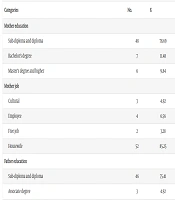
Most mothers (78.7%) had at least a high school diploma, with the majority being housewives (85.2%). Fathers predominantly held sub-diploma or diploma-level education (75.41%) and worked in free jobs (65.57%). A smaller proportion of parents held higher education degrees or were employed in formal sectors (Table 3).
Table 3.
Distribution of Mothers' and Fathers' Education and Job of Children with Foreign Body Ingestion in Hospital Emergency Room
| Categories | No. | % |
|---|---|---|
| Mother education | ||
| Sub-diploma and diploma | 48 | 78.69 |
| Bachelor's degree | 7 | 11.48 |
| Master's degree and higher | 6 | 9.84 |
| Mother job | ||
| Cultural | 3 | 4.92 |
| Employee | 4 | 6.56 |
| Free job | 2 | 3.28 |
| Housewife | 52 | 85.25 |
| Father education | ||
| Sub-diploma and diploma | 46 | 75.41 |
| Associate degree | 3 | 4.92 |
| Bachelor's degree | 6 | 9.84 |
| Master's degree and higher | 6 | 9.84 |
| Father job | ||
| Employee | 17 | 27.87 |
| Free job | 40 | 65.57 |
| Unemployed | 4 | 6.56 |
| Total | 61 | 100 |
Over half of the children (54.10%) presented with complaints related to the ingestion, while 6.56% were asymptomatic. Notably, 39.34% of cases lacked documented responses regarding symptoms, likely due to communication barriers with young or non-verbal children (Table 4). Among symptomatic cases, vomiting was the most prevalent symptom (60.61%), followed by refusal to eat (51.52%), excessive drooling (36.36%), and restlessness (33.33%). Other less common symptoms were also reported (Table 5).
Table 4.
Distribution of Patient Complaints of Foreign Body Swallowing in Children Referred to Hospital Emergency Room
| Patient Complaint | No. | % |
|---|---|---|
| Yes | 33 | 54.10 |
| No | 4 | 6.56 |
| No response | 24 | 39.34 |
| Total | 61 | 100.00 |
Table 5.
Distribution of Patient Complaints' Types of Foreign Body Swallowing in Children Referred to Hospital Emergency Room
| Patient Complaint | No. | % |
|---|---|---|
| Dripping | 12 | 36.36 |
| Refusal to eat | 17 | 51.52 |
| Vomit | 20 | 60.61 |
| Restlessness | 11 | 33.33 |
| Other cases | 7 | 21.21 |
| Total | 61 | 100.00 |
The majority of children (59.02%) were discharged within 24 hours after endoscopic removal, indicating efficient management of uncomplicated cases. However, 22.95% required a stay of 1 - 2 days, and 8.20% needed 2 - 5 days of hospitalization, likely due to complications or more complex cases. A small percentage (9.84%) remained hospitalized for over 5 days, reflecting severe incidents or complications requiring extended care (Table 6).
Table 6.
Distribution of Duration of Hospital Stay After Endoscopy of Children Swallowing a Foreign Body in Hospital Emergency Room
| Duration of Stay | No. | % |
|---|---|---|
| Less than 24 hours | 36 | 59.02 |
| 1 - 2 days | 14 | 22.95 |
| 2 - 5 days | 5 | 8.20 |
| More than 5 days | 6 | 9.84 |
| Total | 61 | 100.00 |
5. Discussion
This study investigated the prevalence, characteristics, and treatment outcomes of FBI in children treated at Ali Ibn Abi Talib Zahedan Hospital's emergency department in 2020. The findings align closely with existing literature on FBI in pediatric populations, reinforcing the importance of understanding demographic trends, risk factors, and clinical management strategies. The highest prevalence of FBI was observed among children aged up to 4 years, consistent with prior studies such as those by Litovitz et al. (9) and Lopez (12). This age group is particularly vulnerable due to their natural curiosity, tendency to explore objects orally, and limited awareness of potential dangers.
The male predominance in FBI cases reported in this study corroborates findings from Rodríguez et al. (10), Dereci et al. (11), and Oobudi et al. (13), who noted that boys are more likely to engage in activities leading to accidental ingestion. The significant role of mothers as witnesses in our study underscores the importance of maternal supervision in identifying and responding to FBI incidents, as highlighted by Shamsi (14). This observation emphasizes the need for targeted educational interventions aimed at caregivers, particularly mothers, to enhance awareness of FBI risks and preventive measures.
Button batteries and coins were the most frequently ingested foreign bodies in this study, a finding consistent with reports by Brumbaugh et al. (15) and Cheng and Tam (16). Button batteries, in particular, pose a grave risk due to their ability to cause chemical burns, electrical discharge injuries, and severe complications such as esophageal perforation and tracheoesophageal fistulas. Litovitz et al. (9) extensively documented these dangers, emphasizing the critical need for prompt localization and removal of button batteries, ideally within 2 hours of ingestion. For delayed diagnoses (> 12 hours), Mubarak et al. (17) recommend advanced imaging (e.g., CT scans) to assess for vascular injury before attempting battery removal. Even in asymptomatic cases, endoscopic evaluation is advised to rule out esophageal damage.
Coins, while less hazardous than batteries, remain a common concern due to their small size and accessibility to young children. Public health initiatives should focus on educating parents about the dangers of small objects and advocating for childproofing measures in homes to prevent access to such items. The socioeconomic profiles of families in this study revealed that most mothers had a diploma or sub-diploma education and were housewives, while fathers were predominantly self-employed. These findings align with those of Haider et al. (18), who noted that lower parental education levels may correlate with a lack of awareness about FBI risks and prevention strategies.
Socioeconomic factors play a crucial role in shaping healthcare-seeking behaviors and outcomes, as highlighted by Gregori et al. (19). Disadvantaged groups often face barriers to accessing information on FBI prevention, underscoring the need for targeted educational programs to raise awareness among socioeconomically vulnerable populations. Wang’s analysis (20) on accidental suffocation in children further emphasized the importance of product safety and parental education in mitigating risks associated with FBI. By addressing socioeconomic disparities, public health initiatives can reduce the incidence and severity of FBI cases.
The majority of children in this study presented with symptoms such as vomiting, refusal to eat, excessive drooling, and restlessness, consistent with findings by Khorana (21) and Shirkash (22). Vomiting emerged as the most common symptom, reported in 60.61% of cases, reflecting irritation or obstruction caused by the ingested object. Respiratory symptoms such as coughing, wheezing, and stridor were also observed, as noted by Haddadi (23), Farzizadeh (24), Naragund (25), and Kaur (26). These diverse clinical presentations highlight the diagnostic challenges associated with FBI and the importance of vigilance in pediatric emergency settings.
In line with Lee and Shim (27), the majority of cases in this study were managed medically, with many children discharged without requiring invasive procedures. However, the study identified complications, including perforation in 8.2% of cases, underscoring the need for timely and appropriate management. Wu et al. (28) similarly emphasized the importance of vigilance in preventing severe outcomes, particularly in cases involving high-risk objects like button batteries.
This study contributes to the existing body of knowledge by providing detailed insights into the demographic trends, types of ingested objects, and treatment outcomes specific to Ali Ibn Abi Talib Zahedan Hospital. The incorporation of a severity classification system allowed for a nuanced analysis of risk factors and outcomes, enhancing the understanding of FBI management. The findings reinforce the importance of public health initiatives aimed at preventing FBI through education, childproofing, and safe storage practices. Additionally, the study highlights the need for healthcare providers to be trained in recognizing and managing FBI promptly and effectively, utilizing established guidelines and protocols.
5.1. Conclusions
The FBI remains a significant pediatric emergency with the potential for severe complications. This study highlights the demographic trends, common types of ingested objects, and outcomes of treatment in a specific hospital setting. Continued efforts in prevention, education, and clinical management are essential to mitigate risks and ensure the safety and well-being of children. By addressing socioeconomic disparities and promoting awareness, healthcare providers and policymakers can work together to reduce the burden of FBI and improve outcomes for affected children.
5.2. Limitations
This study has several limitations. The relatively small sample size (n = 61) may limit the generalizability of our findings to wider populations. Additionally, the cross-sectional design restricts causal interpretation between variables such as foreign body type, demographic features, and treatment outcomes. Moreover, missing symptom data in approximately 39% of patients — likely due to communication challenges with non-verbal or very young children — may have affected the completeness of clinical assessment.
5.3. Recommendations
To enhance the reliability and applicability of future research, it is recommended that studies incorporate larger sample sizes and utilize designs that allow for causal inferences. Addressing the communication barriers with young or non-verbal children through improved data collection methods could also improve the accuracy of symptom documentation.
5.4. Future Research
Future studies with larger sample sizes and prospective designs could address these limitations and provide more robust evidence. Such research could explore the causal relationships between foreign body type, demographic features, and treatment outcomes, thereby contributing to a deeper understanding of FBI in pediatric populations.