1. Background
Attention Deficit/Hyperactivity Disorder (ADHD) is a common neurodevelopmental condition of childhood that affects about 5% of the population (1). ADHD is associated with significant impairment in social domains, peer relationships, and poor quality of life (2-5). Autism spectrum disorder (ASD) is a broad umbrella term used to refer to a group of similar conditions including autism, atypical autism, Asperger’s syndrome, and pervasive developmental disorder-not otherwise specified (PDD-NOS) (6, 7), which are severe developmental disorders characterized by deficits in language and social communication. Clinical observation of ASD symptoms in children diagnosed with ADHD as well as detecting hyperactivity and impulsivity in children with ASD is common (8-12). There are reports that poor functioning in ADHD children is more likely to be due to symptoms of ASD than due to ADHD per se (7). Currently, ADHD and ASD cannot be diagnosed together in a child based on two most commonly used classification systems such as ICD-10 (13) and DSM-IV TR (14). Children with ADHD and comorbid ASD are at risk of more severe impairment and might require different approach in care than traditionally given to those only with ADHD. Early recognition of the symptoms of ASD is important as early intervention can help such children (15). Modified Checklist for Autism in Toddlers (MCHAT) is a commonly used screening scale to identify children at risk of ASD (16). There is a lack of research and systematic assessing for the presence of comorbid ASD in children with ADHD in the South Asia and India. Furthermore, no study has assessed the utility of MCHAT in detecting children at risk of developing ASD. Conducting such prospective studies in developing countries such as India is difficult due to large catchment areas of Government hospitals and difficulty in ensuring follow-up. Hence, we aimed to assess the presence of ASD in children with ADHD based on the recalls by parents on MCHAT, which would help us to assess the future possibility of using MCHAT in early toddlerhood for predicting the later development of ASD.
2. Objectives
Current study aimed to answer two clinical queries: (a) What proportion of children diagnosed with ADHD would have ASD? (b) What was the diagnostic accuracy of MCHAT in early detection of ASD in such children?
3. Patients and Methods
3.1. Setting and Procedure
The present exploratory study was conducted at the Child Guidance Clinic (CGC) of a tertiary-care hospital in Southern India. The CGC was run twice a week by the Department of Pediatrics in collaboration with the Department of Psychiatry. The hospital is situated in the semi-urban area and caters for both referred as well as nonreferred population. Children were most often accompanied by their parents. The treatment seekers were mainly comprised of middle and lower socioeconomic status population in the region and the treatment was highly subsidized by the government.
Children aged 12 years or younger with a range of disorders including ASD, ADHD, and intellectual disability with behavioral problems, learning disorders, and mood and anxiety disorders are seen in this clinic. Diagnosis was made by the consultants through consensus clinical judgment using DSM IV TR criteria (12).
The present study recruited children with the diagnosis of ADHD according to DSM IV TR. Children were diagnosed with ADHD if they fulfill at least six criteria under inattention domain or hyperactivity-impulsivity domain or both for at least six months with functional impairment and onset of symptoms before the age of seven years; such symptoms should not be attributable to other conditions including pervasive developmental disorder. The list of children who had been diagnosed with ADHD during the two consecutive years before the study was drawn up, which included 140 children. Among them, a list of 50 children was randomly selected (simple random list of 50 cases was generated using Microsoft Office Excel). For pilot study, this number was considered adequate. These children were actively recruited and assessed as they came for follow-up. Informed consent was obtained from the parents. Data on sex, age, birth order, history of antenatal or postnatal complications, and medical illnesses were collected. Childhood Autism Rating Scale (CARS) (17) was used to document current symptoms and screen for the presence of ASD. Parent recall ratings on MCHAT were obtained for child’s behavior during 16 to 30 months old to identify those who were at risk of developing ASD. The study got Institutional Ethics Committee approval and data collection lasted from July 1, 2012 through December 31, 2012. Data for each case was collected in a single setting. The index test and the reference test were applied to all the 50 children. One of the authors (SK) applied the CARS and another one (VA) applied MCHAT. The two raters were aware of the diagnosis of ADHD in the children, but were blinded to the ratings of each other. Social quotient was ascertained as per Indian adaptation of Vineland Social Maturity Scale (VSMS) (18) and children functioning was assessed on Children’s Global Assessment Scale (CGAS) (19).
3.2. Instruments
CARS (15) includes 15 symptoms of behavioral and communication abnormalities that are typically seen in children with ASD. First 14 symptoms are rated based on symptom severity over last six months as noticed by the parents and on the observation of the child’s behavior during the interview. The 15th item assesses global severity of these behaviors. The items are rated on a scale of zero to four with higher scores showing more severe abnormality. Total scores can vary from zero to 60. Validation of this scale in Indian Children suggests a cutoff score of 33 (20). Children above this cutoff point are termed ASD+ and the rest as ASD-. The individual items on CARS were categorized as present or absent based on a cutoff score of three for this study purpose. MCHAT (21) is a 23-item checklist of behaviors of toddlers who aged between 16 months to 30 months and is rated as per parent report. Presence of each of the behavior could be answered as yes (pass/present) or no (fail/absent). Scores considered abnormal if there were overall three or more "No"s or two or more "No"s in six of the critical behaviors (items 2, 7, 9, 13, 14, and 15). Abnormal scores raised suspicion of the presence of autism and required further evaluation. Children with abnormal MCHAT (MCHAT+) were more likely to develop ASD or some other developmental problems. For this study purpose, we asked parents to fill the checklist from their recall of the child aged between 16 to 30 months. If there was difference of opinion on any item, both parents were asked to reach consensus before responding. To estimate the level of social development, Indian adaptation of the VSMS (16) was used to assess the level of adaptive tasks a child was capable of doing. It was used for evaluating social quotient of the child and showed a high correlation (0.80) with intelligence quotient. CGAS (17) is an adaptation of the Global Assessment of Functioning scale for children. It provides an estimate of child’s level of functioning irrespective of primary diagnosis or treatment. It is rated on a scale of one to 100 based on provided information by the parents. Higher CGAS score reflects better global functioning of the child. For this study purpose, we collected the best functioning status of the child in the preceding six months.
3.3. Analysis
Demographic and clinical data were presented as mean ± standard deviation for continuous data and as frequency (percentage) for categorical data. The data were also categorized into two groups of ASD+ and ASD- based on the overall score on CARS indicating current presence or absence of ASD. We examined any significant difference in sex, age, antenatal and postnatal complications, social quotient, functioning level, and for presence of individual symptoms of ASD using nonparametric tests. Based on MCHAT scores as recalled from toddlerhood, entire group was classified as being abnormal or normal, represented as MCHAT+ or MCHAT-, respectively. The groups were compared with each other using appropriate nonparametric tests due to small sample sizes. A P value of < 0.05 on two-tailed test was considered as statistically significant. To test the diagnostic accuracy of MCHAT in early detection of ASD (index test), CARS was used as a reference test. OpenEpi 3.01 software (www.openepi.com) for diagnostic screening test was used. Sensitivity, specificity, positive predictive value (PPV), negative predictive value (NPV), and diagnostic accuracy were computed. We did not use any statistical correction for the multiple tests performed.
4. Results
A total of 50 children who were diagnosed with ADHD were recruited through random sampling from a pool of 140 eligible children (Figure 1). The clinical and demographic information of the sample is shown in Table 1. Majority of the sample were boys, and about half of the sample reported postnatal complications. Medical comorbidities were noted in 20 children (40%) with seizures being the most common one (15 children). Thirty children had scored higher than the CARS cutoff suggesting the presence of current ASD (ASD+) (Table 1). Scores over cutoff point on CARS was associated with older age (P = 0.035), higher risk of medical comorbidities (P = 0.022), lower social quotient (P = 0.001), and poorer global functioning and (U = 145.5; P = 0.002). On correlation analysis, it was seen that total CARS scores were inversely correlated with social quotient (Spearman rho [rs] = - 0.466; P = 0.001) and functioning rated on CGAS (rs = - 0.503; P < 0.001).
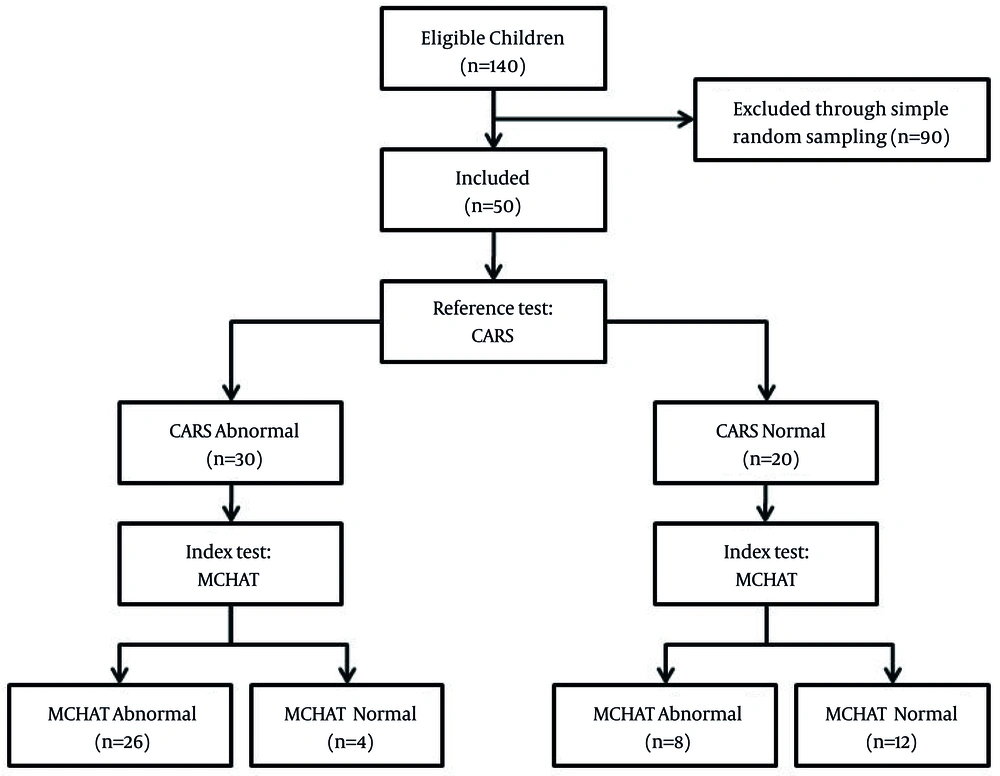
Figure 1.
Patient Recruitment and Screening Flowchart
The items on CARS, which differentiated ASD+ from ASD-, are shown in Table 2. Although most items on CARS reliably differentiated autistic symptoms in children with ADHD, "object use", "adaptation to change", and "taste, smell, and touch response and use" were not helpful. The mean scores on the CARS items are shown in Figure 2.
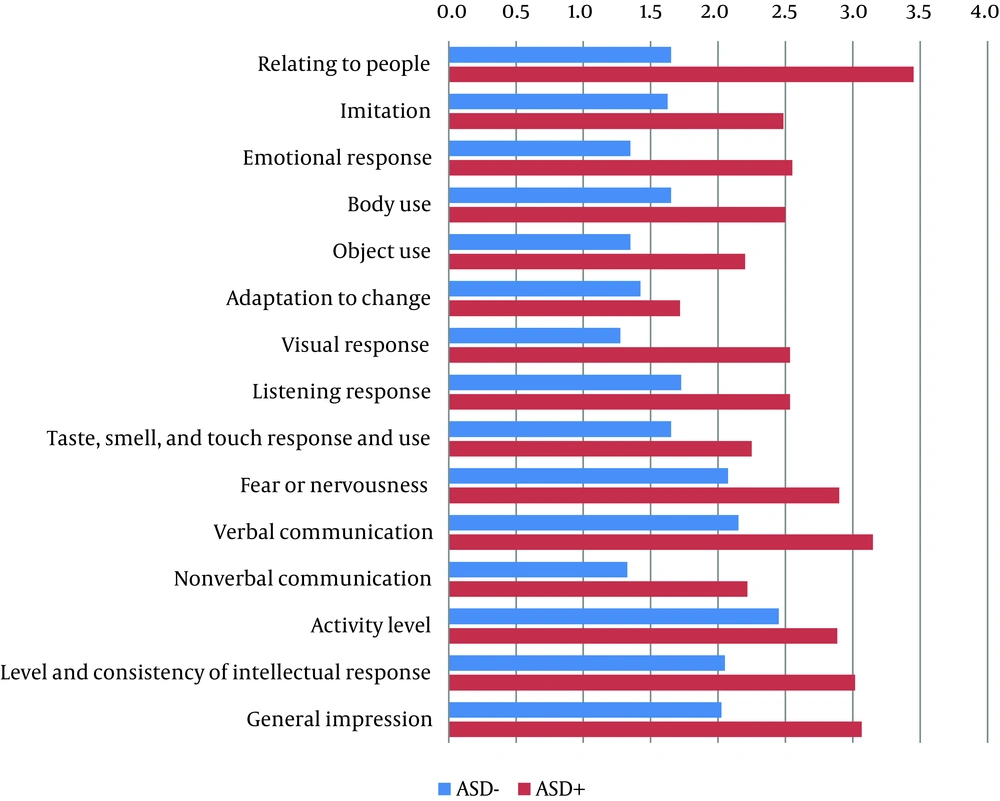
Figure 2.
ASD, autism spectrum disorder.
Finally, 38 children (76%) had abnormal scores on MCHAT as per parent recall (Table 3). Next, a diagnostic test comparing MCHAT as a screening instrument with CARS as a gold standard was conducted (Table 4). The MCHAT was associated with high sensitivity (86.7%), but low specificity (40.0%). The PPV and NPV were 68.4% and 66.7%, respectively, in this sample of children with ADHD.
Table 1.
| A | B | C | Comparison B vs. C (P Value) | |
|---|---|---|---|---|
| Total Sample (n = 50) | ADHD Children Over CARS Cut-off Scores (ASD+) (n = 30) | ADHD Children Below CARS Cut-off Scores (ASD-) (n = 20) | ||
| Male Sex | 43 (86.0%) | 25 (83.3) | 18 (90.0) | χ2 = 0.443 (0.687)c |
| Age in Months | 97.0 ± 35.8 | 105.7 ± 34.6 | 83.9 ± 34.3 | U = 193.5 (0.035)d |
| Birth Order | χ2 = 0.521 (0.470) | |||
| First | 30 (60.0) | 17 (56.7) | 13 (65.0) | |
| Second and Higher | 20 (40.0) | 13 (43.3) | 7 (35.5) | |
| Reported Antenatal Complication | 10 (20.0) | 5 (16.7) | 5 (25.0) | χ2 = 0.521 (0.470) |
| Reported Postnatal Complications | 22 (44.0) | 13 (43.3) | 9 (45.0) | χ2 = 0.014 (0.907) |
| Present Comorbid Medical Conditions | 20 (40.0) | 16 (53.3) | 4 (20.0) | χ2 = 5.556 (0.022) c,d |
| Social Quotient as per VSMS | 92.3 ± 18.0 | 86.0 ± 18.2 | 101.9 ± 13.2 | U = 132.5 (0.001)c |
| CGAS score | 50.4 ± 14.4 | 45.6 ± 15.0 | 57.6 ± 10.0 | U = 143.5 (0.002)c |
aAbbreviations: ADHD, attention deficit hyperactivity disorder; ASD, autism spectrum disorder; CARS, Childhood Autism Rating Scale; CGAS, Children’s Global Assessment Scale; and VSMS, Vineland Social Maturity Scale.
bData are presented as No. (%) or mean ± SD.
cP < 0.05.
dFisher’s exact test.
Table 2.
| CARS Item | ADHD Children | Odds Ratio (Confidence Intervals) | |
|---|---|---|---|
| Over CARS Cutoff Scores (ASD+) (n = 30) | Below CARS Cutoff Scores (ASD-) (n = 20), No. (%) | ||
| Relating to People | 25 (83.3) | 3 (15.0) | 28.33 [5.96-134.61] |
| Imitation | 17 (56.7) | 3 (15.0) | 7.41 [1.78-30.78] |
| Emotional Response | 16 (53.3) | 1 (5.0) | 21.71 [2.57-183.63] |
| Body Use | 14 (46.7) | 2 (10.0) | 7.88 [1.55-40.09] |
| Object Use | 8 (26.7) | 1 (5.0) | 6.91 [0.79-60.37] |
| Adaptation to Change | 5 (16.7) | 3 (15.0) | 1.13 [0.24-5.38] |
| Visual Response | 17 (56.7) | 1 (5.0) | 24.85 [2.93-210.46] |
| Listening Response | 15 (50.0) | 1 (5.0) | 19.00 [2.25-160.59] |
| Taste, Smell, and Touch Response and Use | 11 (36.7) | 3 (15.0) | 3.28 [0.78-13.77] |
| Fear or Nervousness | 19 (63.3) | 6 (30.0) | 4.03 [1.2-13.53] |
| Verbal Communication | 21 (70.0) | 5 (25.0) | 7.00 [1.95-25.13] |
| Nonverbal Communication | 13 (43.3) | 1 (5.0) | 14.53 [1.72-123.07] |
| Activity Level | 17 (56.7) | 4 (20.0) | 5.23 [1.41-19.43] |
| Level and Consistency of Intellectual Response | 20 (66.7) | 6 (30.0) | 4.67 [1.38-15.82] |
| General Impression | 23 (76.7) | 3 (15.0) | 18.62 [4.19-82.67] |
aAbbreviation: ADHD, attention deficit hyperactivity disorder; ASD, autism spectrum disorder; and CARS, Childhood Autism Rating Scale.
b Data are presented as No. (%).
Table 3.
| Children With Normal MCHAT Scores (MCHAT-) (n = 12) | Children With Abnormal MCHAT Scores (MCHAT+) (n = 38) | P Value | |
|---|---|---|---|
| Male Sex | 12 (100.0) | 31 (81.6) | Χ2 = 2.570 (0.174)a |
| Age, mo | 101.8 ± 34.8 | 95.5 ± 36.4 | U = 201 (0.540) |
| Birth Order | Χ2 = 0.397 (0.529) | ||
| First | 6 (50.0) | 24 (63.2) | |
| Second and Higher | 6 (50.0) | 14 (36.8) | |
| Reported Antenatal Complication | 3 (25.0) | 7 (18.4) | Χ2 = 0.247 (0.686) a |
| Reported Postnatal Complications | 5 (41.7) | 17 (44.7) | X2 = 0.032 (0.852) |
| Presence of Comorbid Medical Conditions | 5 (41.7) | 15 (39.5) | χ2 = 0.018 (0.892) |
| Social Quotient as per VSMS | 98.3 ± 13.6 | 90.4 ± 19.0 | U = 158 (0.112) |
| CGAS Score | 57.0 ± 11.6 | 48.3 ± 14.7 | U = 145 (0.058) |
| CARS Score | 29.0 ± 7.3 | 35.5 ± 8.0 | U = 123 (0.017)c |
| CARS Score Over Cutoff [ASD+] | 4 (33.3) | 26 (68.4) | χ2 = 4.678 (0.044)cd |
aAbbreviation: ADHD, attention deficit hyperactivity disorder; ASD, autism spectrum disorder; CARS, Childhood Autism Rating Scale; CGAS, Children’s Global Assessment Scale; MCHAT, Modified Checklist for Autism in Toddlers; and VSMS, Vineland Social Maturity Scale.
bData are presented as mean ± SD or No. (%).
cP < 0.05.
dFisher’s exact test used.
Table 4.
Comparison of Modified Checklist for Autism in Toddlers with Childhood Autism Rating Scale Based Autism Spectrum Disorder Status (CARS > 33)a
| Current ASD+ | Current ASD- | Total | Confidence Intervals | |
|---|---|---|---|---|
| Recalled MCHAT +, No. | 26 | 12 | 38 | |
| Recalled MCHAT -, No. | 4 | 8 | 12 | |
| Total | 30 | 20 | 50 | |
| Parameters, % | ||||
| Sensitivity | 86.7 | [70.3-94.7] | ||
| Specificity | 40.0 | [21.9-61.3] | ||
| Positive Predictive Value | 68.4 | [52.5-80.9] | ||
| Negative Predictive Value | 66.7 | [39.1-86.2] | ||
| Diagnostic Accuracy | 68.0 | [54.2-79.2] |
aAbbreviations: CARS, Childhood Autism Rating Scale; and MCHAT, Modified Checklist for Autism in Toddlers.
5. Discussion
According to the present study, a large proportion of children with the diagnosis of ADHD qualified for ASD. Presence ASD was associated with increased rates of medical illnesses, lower social quotient, and poorer global functioning level. ASD, defined by CARS score > 33, was present in about 60% of the children with ADHD. A study by Clark et al. (21) found that 65% to 80% of parents recalled presence of autistic symptoms in children with ADHD. This study used the Autism Criteria Checklist to make the diagnosis of ASD. Two widely differing rates of comorbid ASD were found in a study by Kochhar et al. (22); the rate of ASD among children with ADHD was 28% as defined by the Social Communication Questionnaire (SCQ), whereas the rate was as high as 62% when the Social Aptitudes Scale (SAS) was used. This difference would be probably because of the different construct and discriminant validity of these scales. Studies that assessed the presence of autistic symptoms among children with ADHD have also found higher rates of autistic symptoms in children with ADHD than in controls. These studies sought the presence of autistic symptoms as a dimension, which opposed attempts to make a categorical diagnosis of ASD (6, 23, 24). A similar operational definition of Autistic Traits (AT) was used by Kotte et al. (9) using three subscores (withdrawn, social, and thought problems) from the Child Behavior Checklist (7). The reasons for the high rates of coincidence of the ADHD and ASD in our study would be similarities in particular phenotypic behavioral manifestations such as difficulty in maintaining social relationships. The cause of difficulties in social relationships may be different with indifference to relationship in autism and difficulty in engaging in cooperative interaction in ADHD. Both of those manifestations might be captured as similar in structured instruments. The second reason for the high rate could be sharing of common vulnerability factors by these disorders. It has been suggested that overlap of symptoms might be at least partly genetic (25, 26). Our study did not find any difference in the rates of antenatal or postnatal complications between the ASD+ and ASD- groups, suggesting lesser role for environmental factors in the comorbid occurrence of ADHD and ASD. The finding that higher CARS scores are associated with poor social quotient and functioning were on the expected lines (27). Among the CARS items, "object use", "adaptation to change", and "taste, smell, and touch response and use" were not quite different between ASD+ and ASD- groups, which suggested that selected items were not good indicators of autistic behavior in this population of children with ADHD. Although MCHAT score was related to CARS score, MCHAT score per se was not significantly linked with social quotient or global functioning, which suggested that parents of children with ADHD might recollect autistic behaviors in their children even in the absence of current ASD. Critical items on MCHAT are specifically aimed at eliciting deficits in imitation, joint attention, and pointing abilities and have discriminating value in detecting autism. The age of child and recalled MCHAT score (rs = - 0.222, P = 0.121) showed poor correlation, which suggested a low likelihood of recall bias. This could explain the utility of MCHAT even in a retrospective study. As the child grows up, many of these "core" clinical features might improve while some other deficits might persist. This might explain the finding of MCHAT+ rate (76%) being higher than ASD+ rate using CARS cutoff score (60%).
This pilot study suggested that MCHAT had acceptable properties as screening instrument for early detection of children at risk for ASD in the Indian population. This representative clinical sample of children diagnosed with ADHD strengthens the recent change in DSM-5 which allows diagnosis of ADHD even in presence of autism spectrum traits (28). Same change might be required in upcoming revision of mental and behavioral disorder chapter in ICD-11. Limitations of the study included restricted sampling of a clinic-based population, lack of external control group, and lack of systematic assessment for family history of ASD. CARS score was used to define ASD and further structured clinical interviews were not used to confirm the diagnosis of autism. The rating on MCHAT was based only upon retrospective recall by the parents although other studies had also attempted to rate scores related to autistic behaviors retrospectively (29). It will be worthwhile to study how many children with early detection of ASD progress into full-blown ADHD symptoms. The findings of the study relate to a tertiary care center with child guidance facilities and extrapolation to other situations should be done carefully. To conclude, the present study suggested that ASD is present in a large proportion of children with ADHD and is associated with poor functioning. MCHAT can be a sensitive screening test for early detection of ASD in children diagnosed with ADHD. Prospective community-based screening studies are required to assess the usefulness of MCHAT to predict the development ASD in the population.