
1. Background
Attention deficit hyperactivity disorder (ADHD) is characterized by a persistent pattern of inattention, hyperactivity, and impulsive behavior. It is one of the most common psychiatric disorders that begins in childhood and often continues into adolescence and adulthood (1, 2). Attention deficit hyperactivity disorder is more prevalent in boys than in girls. Approximately 50% of children with psychiatric disorders and 3% to 5% of school-age children have ADHD (3, 4). The ADHD symptoms must cause clinical impairment and begin before the age of 12. Other symptoms, such as mood swings and frustration intolerance, are common in these patients (2).
The etiology of ADHD is not well defined, although both genetic and environmental factors play important roles (2). In recent years, significant progress has been made in understanding the nature of the disorder, with molecular and behavioral studies providing evidence for the role of genes in the disorder (5). Many family studies on ADHD have confirmed its strong familial association. In addition to the role of genetic factors in the occurrence of this mental disorder, family imbalance and other anxiety factors also play a role (1, 6). Family studies have reported a higher relative risk of ADHD in first- and second-degree relatives of those with ADHD. One study showed that 55% of families of children with ADHD have at least one parent with ADHD, and relatives of children with ADHD are also at risk for antisocial behavior, substance abuse, anxiety, and mood disorders. The presence of various psychiatric disorders in families of ADHD patients may indicate heritability (3).
Previous studies have shown that adults with ADHD are at increased risk of psychiatric disorders such as conduct disorder and oppositional defiant disorder (7). One of the major and effective factors in the course of the disease in children is the level of support, health, and social functioning of their parents. Additionally, parents of children with ADHD experience higher stress and more psychological problems than parents of children without ADHD (8, 9). Studies have shown that parental antisocial behavior, parental substance abuse, and low parental education are associated with behaviors such as aggression and delinquency in children (4).
2. Objectives
Given that few studies have been conducted on the types of psychiatric disorders in parents and their relationship to the occurrence of ADHD in their children, we decided to investigate the prevalence of psychiatric disorders in parents of children with ADHD in this study.
3. Methods
This is a descriptive cross-sectional study. Parents of children with ADHD who were referred to pediatric psychiatry and neurology clinics affiliated with Zabol University of Medical Sciences in 2017 were included based on the following inclusion criteria: (1) Having a child with ADHD confirmed by a physician interview; (2) consent to participate in the study; and (3) being literate. The exclusion criteria were: (1) Unwillingness to participate in the study; (2) mental retardation; and (3) clear medical disorders such as head trauma, visual and hearing impairment; and seizures.
The sample size required to determine the 44% frequency of mental disorders in mothers of children with ADHD was estimated based on the results of the study by Hamzehpour et al. (8), considering a 95% confidence level and a maximum error of 11%, resulting in a sample size of 78 patients with ADHD. The desired information was collected by the researcher in an accessible and facilitated manner from those visiting the psychiatric and neuropsychiatry clinics and offices.
After the proposal was approved by the research council of the medical school, the code of ethics was obtained, and necessary coordination was made with the management and psychiatric and neuropsychiatry clinics. The parents of children with ADHD who visited the clinic within a specific period were examined. The researcher arrived at the pediatric psychiatry and neurology clinic at the stated time and informed the clients about the study conditions by explaining the research objectives and possible benefits and harms. Clients could enter the study if they provided personal consent and met the inclusion and exclusion criteria.
Initially, the child was screened for ADHD using the Conners Parent Questionnaire (completed by a psychologist), and this diagnosis was confirmed by an interview with a psychiatrist according to DSM-5 criteria. Then, the parents of these children were included in the study if they did not meet the exclusion criteria, and a demographic information questionnaire was completed for them. Screening for psychiatric disorders was performed by a clinical interview with a psychiatrist.
The data collection method was based on a researcher-made checklist, the Conners Questionnaire, and interviews with parents. Information such as gender, age, level of education, employment status, number of children, socioeconomic status, marital status, and substance abuse was collected using a checklist. After collecting the data, the data were described using SPSS version 22 software in the form of frequency, percentage, mean, and standard deviation. Chi-square and Fisher's exact tests were used to determine relationships, with the significance level set at 0.05.
4. Results
In this study, parents of 78 children with ADHD who were referred to pediatric psychiatry and neurology clinics were examined. The mean age of the children was 7.38 years, with a standard deviation of 2.33 years. The ages of the children ranged from 3 to 12 years. The mean age of the fathers was 36.56 years, and the mean age of the mothers was 32.57 years (Table 1).
Table 1.
Average Age of the Studied Patients and Their Parents
| Variables (y) | Mean ± SD | Min - Max |
|---|---|---|
| Child's age | 7.38 ± 2.33 | 3 - 12 |
| Father's age | 36.56 ± 7.24 | 21 - 53 |
| Mother's age | 32.57 ± 6.48 | 22 - 46 |
This study shows that 50 (64.1%) of the hyperactive children were boys and the rest were girls (Table 2).
Table 2.
Frequency of Gender in the Studied Patients
| Gender | No. (%) |
|---|---|
| Boy | 50 (64.1) |
| Girl | 28 (35.9) |
In this study, 43 (55.1%) of the fathers and 33 (42.3%) of the mothers had secondary education. The rate of university education was 16.7% among fathers and 19.2% among mothers. Employment was reported by 64 (82.1%) of the fathers and 34 (43.6%) of the mothers, with the remaining parents being unemployed or housewives. Among the fathers, substance abuse included opium in 14 (17.9%), cigarettes in 12.8%, and alcohol in 6.4%, while 60.3% did not report substance use. Among the mothers, substance abuse included opium in 1 (1.3%), cigarettes in 3.8%, and alcohol in 1.3%, while 92.3% did not report substance use (Table 3).
Table 3.
Frequency of Substance Abuse in Parents of Patients by Category
| Substance Abuses and Subgroups | No. (%) |
|---|---|
| Absent | |
| Father | 47 (60.3) |
| Mother | 72 (92.3) |
| Opium | |
| Father | 14 (17.9) |
| Mother | 1 (1.3) |
| Cigarette | |
| Father | 10 (12.8) |
| Mother | 3 (3.8) |
| Alcoholic beverages | |
| Father | 5 (6.4) |
| Mother | 1 (1.3) |
| Other | |
| Father | 2 (2.6) |
| Mother | 1 (1.3) |
| Total | |
| Father | 78 (100) |
| Mother | 78 (100) |
This study shows that among the psychiatric disorders in fathers, 14 (17.9%) had depression, 9 (11.5%) had personality disorders, 7 (9%) had generalized anxiety disorder (GAD), and 4 (5.1%) had bipolar mood disorder (BMD), while 37 (47.4%) had no psychiatric disorder. Among the mothers, 22 (28.2%) had depression, 12 (15.4%) had GAD, and 6 (7.7%) had obsessive-compulsive disorder (OCD), while 26 (33.3%) had no psychiatric disorder. Schizophrenia was not observed in either parent. Regarding the number of children, 41% of parents had one child, 43.6% had two or three children, and the remainder had more than three children. In terms of socioeconomic status, most families (64.1%) were average, while 20.5% were poor and 15.4% were good. In 6 cases (7.7%), the parents were separated (Table 4).
Table 4.
Frequency of Other Qualitative Variables in Parents of Patients
| Variables and Subgroups | No. (%) |
|---|---|
| Number of children | |
| One | 32 (41) |
| Two or three | 34 (43.6) |
| More than three | 12 (15.4) |
| Status of social economic | |
| Good | 12 (15.4) |
| Medium | 50 (64.1) |
| Weak | 16 (20.5) |
| Marriage status | |
| Married | 72 (92.3) |
| Divorced or separated | 6 (7.7) |
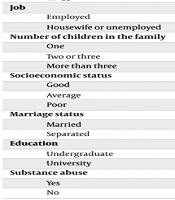
In this study, the frequency of mental disorders in fathers was observed to be 52% for boys and 53.6% for girls. However, this difference between the two sexes was not statistically significant (P = 0.894). The study also shows that the prevalence of mental illness in fathers of ADHD children who were employed was 46.9%, while in fathers who were unemployed, it was 78.6%. This difference was statistically significant (P = 0.031), indicating that unemployed fathers were more likely than employed fathers to have a history of mental disorder. Among fathers with good social status, 16.7% had psychiatric disorders, compared to 60% with moderate and 56.3% with weak social status. This difference was statistically significant (P = 0.02). Among married fathers, 48.6% had a psychiatric disorder, while among separated fathers, 100% had a disorder, which was statistically significant (P = 0.02). Additionally, 77.41% of fathers who had substance abuse issues had a psychiatric disorder, compared to 29.82% of those who did not, which was a significant difference (P < 0.001). There was no statistically significant difference between the presence of psychiatric disorder in the father and the variables of father's age, number of children in the family, and education (P = 0.86, P = 0.31, P = 0.26, respectively) (Table 5).
Table 5.
Examining the Relationship Between the Presence of Psychiatric Disorders in the Father and the Variables Under Study a
| Variables and Subgroups | Prevalence of Fathers with Psychiatric Disorders | P-Value |
|---|---|---|
| Children's gender | 0.89 | |
| Boy | 26 (52) | |
| Girl | 15 (53.6) | |
| Father's age (y) | 0.86 | |
| 21 - 30 | 10 (50) | |
| 31 - 40 | 18 (56.25) | |
| 41 - 53 | 13 (50) | |
| Job | 0.03 | |
| Employed | 30 (46.9) | |
| Housewife or unemployed | 11 (78.6) | |
| Number of children in the family | 0.31 | |
| One | 17 (53.1) | |
| Two or three | 20 (58.8) | |
| More than three | 4 (33.3) | |
| Socioeconomic status | 0.02 | |
| Good | 2 (16.7) | |
| Average | 30 (60) | |
| Poor | 9 (56.3) | |
| Marriage status | 0.02 | |
| Married | 35 (48.6) | |
| Separated | 6 (100) | |
| Education | 0.26 | |
| Undergraduate | 5 (38.5) | |
| University | 36 (55.4) | |
| Substance abuse | < 0.001 | |
| Yes | 24 (77.41) | |
| No | 17 (29.82) |
a Values are expressed as No. (%).
In this study, 41 fathers and 52 mothers had psychiatric disorders; however, this difference was not statistically significant (P = 0.2).
5. Discussion
In the present study, parents of 78 children with ADHD were examined. We observed that the majority of hyperactive children were male (64.1%). In Hamzehpour et al.'s study, the majority of affected children (76.8%) were male (8). The results of this study also showed that most hyperactive children were born into families of average socioeconomic status. Additionally, the majority of hyperactive children were born into families with two or three children, whereas in Hamzehpour et al.'s study, 60% of families had only one child (8).
In our study, most fathers and mothers had secondary education. Employment was reported by 82.1% of fathers and 43.6% of mothers. Substance abuse was observed in 39.7% of fathers and 7.7% of mothers. In six cases, parents were divorced or living separately. In similar studies, such as the study by Sajadian et al., 100% of parents were married, 47% were employed (more than in our study), and 16% had university education (10). Unlike our study, in the study by Okan Ibiloglu et al., 18.8% of parents lived separately, and 70.6% had substance abuse issues. Additionally, 77.6% of families had an average socioeconomic status (2).
Similar studies have shown that neuropsychological functioning in ADHD is significantly affected by family status (11), and the presence of ADHD in children is associated with impaired family functioning, increased levels of parental stress, and parental psychological distress (5). Maternal mental health is also significantly associated with the presence of ADHD in school-aged children (12).
In this study, we observed that the most common mental disorders in fathers of hyperactive children were depression and personality disorders, while the least common were panic disorder, schizophrenia, phobia, PTSD, and OCD. Among mothers, the most common mental disorders were depression and GAD, with the least common being BMD, panic disorder, and schizophrenia. Consistent with our study results, Ghanizadeh et al.'s study found that the most common psychiatric disorder in parents was mood disorder, with the prevalence of MDD in mothers and fathers being 48.2% and 43%, respectively. In this study, substance abuse in fathers was 16.6% (less than in our study), and the prevalence of OCD and phobia in mothers was 8.8% (less than in our study), while 5% had BMD and PTSD (more than in our study). The prevalence of GAD in mothers in our study (15.4%) was higher than in Ghanizadeh et al.'s study (7.5%) (4). In Hamzehpour et al.'s study, the most common comorbid disorder in parents was mood disorder, with depression being more common than other mood disorders (8). Steinlechner et al.'s study also showed that mothers exhibited higher rates of depression and anxiety disorders than fathers, while personality disorders were more common in fathers. These results were similar to those of our study (6). In a study by Shafaat and Tirgari, 40% of mothers of children with ADHD showed varying degrees of depression (13).
Our study showed that in families with poor and moderate socioeconomic status, fathers of children who were unemployed or abused drugs had a higher history of mental disorders, but this result was not observed in mothers. Therefore, it seems that there is a greater relationship between fathers' mental disorders and child hyperactivity in families with poor economy, unemployed fathers, or fathers who abuse drugs. In the study by Parvaresh et al., the frequency of hyperactivity disorder was also higher in children with substance-dependent parents, and there was a significant difference (1). Additionally, in our study, families where parents were separated had a higher history of fathers' mental disorders. It seems that in these families, there was a greater relationship between fathers' mental disorders and hyperactivity.
On the other hand, examining the educational status of parents of hyperactive children showed that mothers with lower education were more likely to have mental disorders than mothers with higher education. This was not observed in fathers of hyperactive children. In a similar study, a significant relationship was observed between depression and the level of education of mothers, such that depression decreased with increasing education level, but there was no relationship between depression and gender (13). Similar to our study, the Grayson and Carlson study reported the highest prevalence of ADHD in families with low socioeconomic status (14).
5.1. Conclusions
The final results of this study showed that psychiatric disorders are common in parents of children with ADHD. Additionally, psychiatric disorders in fathers were related to employment status, marital status, socioeconomic status, and substance abuse. The mother's education level also influenced the occurrence of psychiatric disorders. However, the presence of psychiatric disorders in parents of hyperactive children was not related to the gender of the child or parent, the age of the child and parents, or the number of children in the family.