1. Background
Sleep duration and quality play an important role in multiple aspects of the children life and their wellbeing (1). It has been shown that sleep deprivation can increase blood pressure (BP) in normotensive and hypertensive adults, through several mechanisms (2, 3). Activation of the rennin angiotensin aldosterone system (RAAS), high cortisol secretion, increased level of vasoactive hormones, such as endothelin, vasopressin and aldosterone, hyperactivity of the sympathetic system and imbalance of the sympathovagal tone may justify the correlation between sleep deprivation and hypertension (4-7).
In recent years, hypertension has been growing among children and adolescents (8). Among children, its incidence ranges around 5.42% to 19.4% (9). In a recent Iranian study in Birjand district, authors showed that prehypertension and hypertension had respectively, 10.95% and 7.75% prevalence for systolic BP (SBP), and the prevalence for diastolic BP (DBP) was 4.6% and 0.9%, respectively (10). The hypertensive children have a greater risk of experiencing hypertension in adulthood and the causative factors of high BP in adults may have origins during from childhood. Therefore, the screening of hypertension in children is significant for early diagnosis and prevention of adult complications of high BP, such as cardiovascular disorders (9).
2. Objectives
Considering the importance of prevention of hypertension in children and the shortage of evidences on the correlation of sleep quality and BP, we designed this study to investigate whether there is any relationship between sleep insufficiency and BP changes in this age group, via performing 24 hours ambulatory blood pressure monitoring (ABPM) and filling out Pittsburgh Sleep Quality Index (PSQ-I) questionnaire for sleep assessments.
3. Patients and Methods
From 2009 to 2011, 86 (68 Females, 18 Males) consecutive children aged 5 to 15 years old with previous history of urinary tract infection (UTI) that were referred to the nephrology clinic in Ali-Asghar Children’s Hospital, Tehran, Iran, were entered into the study without any randomization. A blood sample was drawn for blood urea nitrogen (BUN) and creatinin measurement, and a midstream clean catch urine sample was sent to rule out any infection, 3 days before initiation of measurements and another urine sample for the measurement of urinary albumin and creatinine excretion. None of the patients had active urinary tract infection at the time of study. Children with chronic kidney disease stage 2 or more, overweight or obese [body mass index (BMI) ≥ percentile 84], consuming sedative, hypnotic drugs, or any antihypertensive drug that disturb the sleep quality, patients with urinary symptoms and positive urinary culture with bacterial growth at the time of study, those with blood pressure higher than percentile 95 for age, gender and height with conventional methods were excluded. Full examination was performed for all cases to detect any possible nasal congestion, obstructive sleep apnea or extreme hypertrophic tonsils. Those with physician-diagnosed and parent-reported obstructive sleep apnea were excluded. Chronic kidney disease (CKD) was defined by glomerular filtration rate (GFR) and classified to GFR ≥ 90 mL/min/1.73 m2 as at risk or stage 1, GFR between 90 and 60 as mild or stage 2, range of 30 to 60 as moderate or stage 3, GFR from 15 to 30 as severe or stage 4, and less than 15 as end stage renal disease or stage 5. The research followed the guidelines of the declaration of Helsinki and Tokyo for humans and was approved by the institutional human experimentation committee of Iran University of Medical Sciences. After taking consent from the parents and patients, all cases underwent 24-hour ABPM. All ABPM were performed using validated device of Tiba Medical Ambulo 2400 Inc. (Portland, Oregon, USA) with oscillometric monitor and actigraphy. Appropriate cuff was used over non-dominant arm. The patient was requested to avoid excessive exercise and keep the arm still during measurements. The device was scheduled to measure blood pressure every 30 minutes for daytime and every hour for nighttime. At least 35 correct measurements were considered sufficient. Mean SBP, mean DBP, mean arterial pressure (MAP), SBP and DBP load during 24 hours, awakening time, and during sleep were measured separately. Mean BP were automatically calculated by the device as the total summation of measurements divided to the number of measurements. The MAP was automatically measured by the device and it was calculated by adding SBP to twice DBP, and dividing the sum by three. Blood pressure loads were the percentage of blood pressure measurements superior to the cut off points. We used normalized BP references produced by the German working group for defining 95% blood pressure (11). Systolic or DBP ≥ percentile 95 for age, gender and height was defined as high BP. Blood pressure load superior to 25% was interpreted as abnormal. A less than 10% SBP drop during sleep was considered non-dipper state (12, 13).
Persian translated PSQ-I questionnaire was filled-out by the patients or their parents and assessed subjective sleep quality of the past 4 weeks. Its reliability and validity were previously evaluated (14). It contains 19 self-rating questions and evaluates seven domains of sleep including latency, duration, quality, efficiency, disturbances, use of medication for sleep, and day time dysfunction (15). A high score indicates multiple sleep complaints. A global PSQ-I equal or more than 5 has a diagnostic sensitivity of 89.6% and specificity of 86.5% in distinguishing "poor sleepers" (PSQ-I ≥ 5) from "good sleepers" (PSQ-I < 5). A PSQ-I < 5 is considered good sleep quality (16). The researchers who interpreted BP parameters and assessed the sleep quality had been blind to the result of each other tests and the final statistical analysis. The frequency, mean, and correlation were evaluated by using Chi-square, Student’s t test, and Spearman correlation. For variables that were not normally distributed, median and nonparametric tests were used and P < 0.05 was considered significant.
4. Results
After excluding duplicate cases and those ABPM with insufficient data, 76 children were entered into the study (Figure 1). From 76 questionnaires that were filled, not very good sleep was reported by caregivers in 39 children. A number of 58 suffered of sleep latency disorder (score ≥ 1), 10 had abnormal sleep duration (< 7 hours), 60 had sleep disturbances (score ≥ 1), and 28 had day dysfunction due to sleepiness, while 46 had poor sleep efficiency (less than 85%). As it is shown in Table 1, demographic and basic data were similar in subjects with normal and abnormal sleep.
| Variables | Poor Sleeper, N = 28 | Good Sleeper, N = 48 | P Value |
|---|---|---|---|
| Gender (Female:male) | 20:8 | 37:11 | NS |
| Age, year | 7.7 ± 2.6 | 7.4 ± 2.7 | 0.69 |
| Weight, kg | 25.4 ± 9 | 25.2 ± 12 | 0.96 |
| Height, cm | 126 ± 14.7 | 124.2 ± 19.3 | 0.74 |
| BMI, kg/m 2 | 15.8 ± 3.7 | 15.5 ± 3.2 | 0.87 |
| Casual BP-systolic, mmHg | 101.8 ± 13.4 | 97.7 ± 12.4 | 0.18 |
| Casual BP-diastolic, mmHg | 65.5 ± 14.8 | 62 ± 9.6 | 0.22 |
| GFR, mL/min/1.73 m2 | 105.7 ± 24 | 116 ± 33 | 0.12 |
| UMAB, mg/grCr | 14.8 (3-347.5) | 14.8 (3-347) | 0.5 |
| VUR | 16 (57) | 24 (51) | 0.6 |
a Abbreviations: BMI, Body mass index; BP, blood pressure; GFR, Glomerular filtration rate; UMAB, urine microalbominuria; VUR, vesicoureteral reflux.
b Data are presented as mean ± SD, median (range) or No. (%)
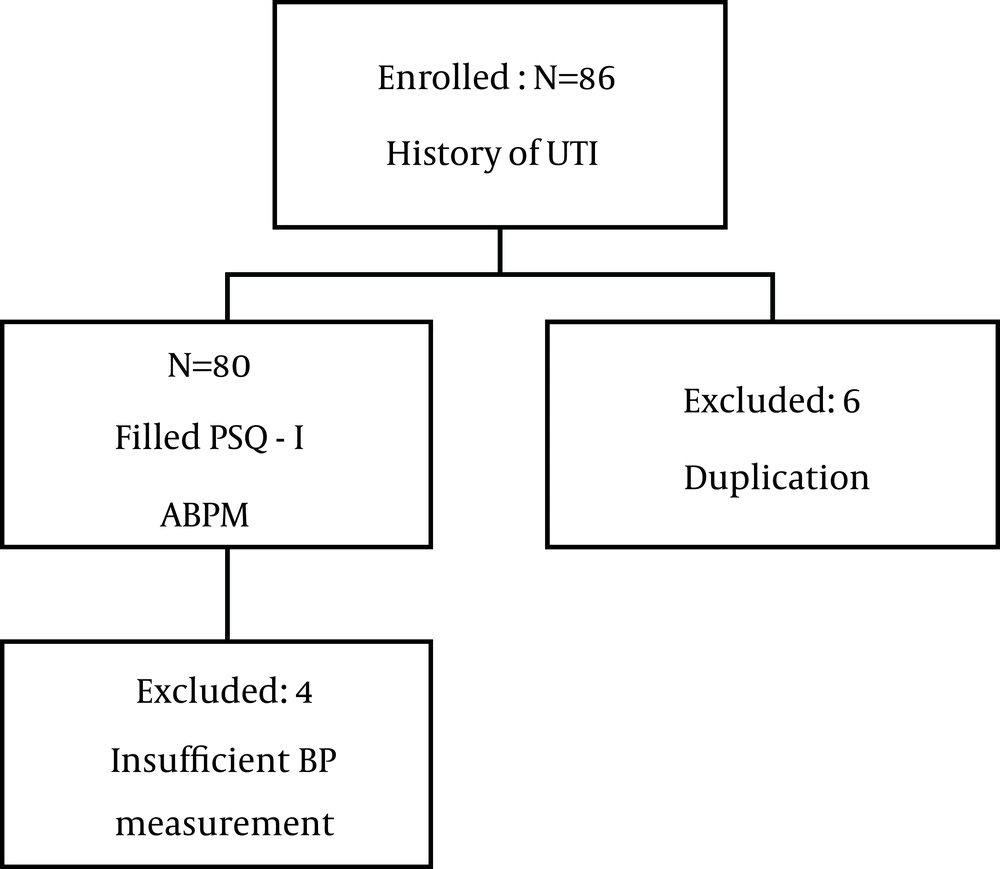
Figure 1.
Abbreviations: ABPM, ambulatory blood pressure monitoring; BP, blood pressure; PSQ-I, Pittsburgh Sleep Quality Index; UTI, urinary tract infection.
Sleep quality parameters and median (range) PSQ-I were not different between children with abnormal [4 (0-16) with mean (SD): 5 (2.83)] and normal [4 (0-14) with mean (SD): 4.2 (3.24)] blood pressure (P > 0.05). By dividing patients into good and poor sleepers, the mean ABPM parameters were not different between them by using independent student’s t test (Table 2). In addition, frequency of abnormal BP was not different between the two groups (Table 3). In Table 4, ABPM parameters based on sleep quality are compared using the ANOVA test. Furthermore, in our study, there was no correlation between abnormal BP and BMI, age, gender, familial risk factor, or sleep quality (P > 0.05).
| Poor Sleeper, N=28 | Good Sleeper, N=48 | P Value | |
|---|---|---|---|
| 24h-mean SBP, mmHg | 98.2 ± 7.6 | 100 ± 8.7 | 0.28 |
| 24h-SBP load | 16.2 (14.7) | 18 (15.6) | 0.54 |
| 24h-mean DBP, mmHg | 64 ± 6.3 | 64.2 ± 7 | 0.88 |
| 24h-DBP load | 21.7 (17.6) | 16.4 (13.3) | 0.18 |
| Awake-mean SBP, mmHg | 101 ± 7.1 | 104 ± 8.6 | 0.27 |
| Awake-SBP load | 19 (16.4) | 20.6 (18.4) | 0.6 |
| Awake-mean DBP, mmHg | 66.6 ± 6.9 | 66.2 ± 7.6 | 0.9 |
| Awake-DBP load | 26 (20.7) | 18.7 (15.5) | 0.12 |
| Sleep-mean SBP, mmHg | 91 ± 11.5 | 94.7 ± 10 | 0.2 |
| Sleep-SBP load | 7.4 (15.7) | 14 (18.8) | 0.13 |
| Sleep-mean DBP, mmHg | 58.3 ± 6.9 | 59.6 ± 8.6 | 0.54 |
| Sleep-DBP load | 14.8 (23.7) | 19 (27.6) | 0.47 |
| Systolic drop | 9.9 (8.8) | 9.3 ± 6.9 | 0.7 |
| Diastolic drop | 12.5 (8) | 10.8 (8.4) | 0.54 |
a Abbreviations: 24h, 24 hours; DBP, Diastolic blood pressure; SBP, systolic blood pressure.
b Data are presented as Mean ± SD or No. (%).
| Abnormal BP, N = 21 | Normal BP, N = 55 | P Value | |
|---|---|---|---|
| Overall Sleep Quality | NS | ||
| Very good | 8 (44) | 29 (51.7) | |
| Fairly good | 9 (50) | 22 (39.3) | |
| Fairly bad | 1 (12.5) | 2 (3.6) | |
| Very bad | 0 | 3 (5.35) | |
| Sleep latency | 0.5 | ||
| 0 | 9 (43) | 23 (42) | |
| 1-2 | 10 (47.6) | 17 (31) | |
| 3-4 | 2 (9.5) | 11 (20) | |
| 5-6 | 0 | 4 (7.3) | |
| Sleep efficiency | 0.7 | ||
| > 85% | 9 (43) | 21 (39) | |
| 75-84% | 3 (9.5) | 2 (3.6) | |
| 65-74% | 3 (14) | 9 (16.4) | |
| < 65% | 7 (33) | 23 (42) | |
| Duration of sleep | 0.5 | ||
| > 7 | 19 (90.5) | 47 (85.5) | |
| 6-7 | 0 | 2 (3.6) | |
| 5-6 | 0 | 3 (5. 5) | |
| < 5 | 2 (9.5) | 3 (5.5) | |
| Sleep disturbance | 0.3 | ||
| 0 | 6 (28.6) | 10 (18) | |
| 1-9 | 14 (67) | 36 (65.5) | |
| 10-18 | 1 (4.8) | 9 (16.4) | |
| Day dysfunction due to sleepiness | 0.5 | ||
| 0 | 15 (71.4) | 44 (88) | |
| 1-2 | 5 (24) | 6 (11) | |
| 3-4 | 1 (5) | 4 (7) | |
| 5-6 | 0 | 1 (2) |
a Abbreviations: BP, blood pressure.
b Data are presented as No. (%).
Table 4.
| Sleep Quality | 24H-DBP Load | Awake-DBP Load | Sleep-SBP | SBP Drop |
|---|---|---|---|---|
| Very good | 16.8 ± 13.6 | 18.7 ± 16 | 94.3 ± 10 | 9.7 ± 7 |
| Fairly good | 18.5 ± 15 | 23.3 ± 18 | 91.6 ± 10 | 11 ± 8.2 |
| Fairly bad | 44 ± 19 | 47.5 ± 17 | 106 ± 6.2 | 6.2 ± 3.5 |
| Very bad | 16.3 ± 8.4 | 23.6 ± 16.6 | 84.7 ± 7 | 7.3 ± 3.3 |
| P value | 0.019 | 0.045 | 0.022 | 0.009 |
a Abbreviations: DBP, diastolic blood pressure; SBP, systolic blood pressure.
b Data are presented as Mean ± SD.
5. Discussion
The present study showed no correlation between subjective sleep quality and ABPM parameters, similarly to the results of Martikainen et al. (17) who studied the correlation between poor sleep quality that was analyzed with actigraphy and 24h-ABPM in 321 children without sleep apnea disorder. Children with short duration of sleep had higher cardiac activity under stress and lower sympathetic activity. However, these changes were not correlated with ABPM parameters (8). In addition, in the study of Vozoris (15) on 12643 subjects, he did not find a significant association between insomnia symptoms and hypertension when sleep duration was not considered in the insomnia definition. Although he found that insomnia symptoms associated with short sleep time may cause hypertension, in his study, the criteria of hypertension were subjective and this probably biases the results. In contrast, Mezick et al. (18) measured 24-h ABPM and sleep quality and quantity with wrist actigraphy in 246 black and white adolescents. They found higher SBP of sleep to wake up ratio in white adolescents with short duration of sleep (10). Also, the prevalence of hypertension was 87.1% in "poor sleeper" versus 35.1% in "good sleeper" individuals in the study of Fiorentini et al. on adult subjects (19). They measured BP with ABPM and evaluated quality of sleep through the PSQ-I and found that the mean values of SBP and DBP were high in "poor sleepers". Poor sleep quality in adults is usually associated with primary sleep disorders, such as sleep apnea or insomnia, or is secondary to different comorbidities. Therefore, studies indicating a correlation between sleep insufficiency and hypertension in adults should be cautiously interpreted due to residual confounding factors (20). In a systematic review, Palagini et al. showed that in persons over 18 years old, sleep deprivation, short sleep duration, and persistent insomnia are associated with hypertension that may be related to inappropriate arousal due to an overactivation of stress system function (21). Finally, Javaheri et al. (22) found that poor sleeper adolescents had a 35 fold greater chance for prehypertension and hypertension, even after adjustment for BMI and gender. Also, they noticed that sleep quality had a greater impact on BP compared with sleep duration (9), while in our study, neither sleep quality nor sleep duration had correlations with hypertension. This may be due to the subjective measurement of sleep parameters in our study compared with the assessment by prolonged actigraphy monitoring, in the formerly mentioned study. Cappuccio et al. in a large prospective study, reported correlation between short sleep duration and hypertension only in women (23). We did not find any difference regarding gender in our study.
There is a decline in BP during nocturnal sleep that is partly related to the decrease in sympathetic activity. This decline is named as "nocturnal dipping" and normally is about 10‒20% decline in mean nocturnal BP. Absent or diminished nocturnal dipping is a significant predictor of cardiovascular diseases. Multiple disorders are associated with this condition, such as the secondary causes of hypertension like chronic kidney disease, obstructive sleep apnea and others (24). In our study, this parameter was significantly different when patients were divided into groups, according to the reported quality of sleep as very good, fairly good, fairly bad, and very bad, by parents. However, by dividing them into two group of good and poor sleep quality, ABPM parameters including SBP drop mean were not different. This discrepancy may be due to relying on recall to fill in the questionnaire.
The limitation of our study was the inability to compare the actigraphy report with total sleep quality score and their correlation with ABPM changes. Our study could not show any correlation between sleep quality and ABPM parameters in children with abnormal BP. However, we suggest a larger sample size, longer follow-up period and more objective measurement tools for acquisition of the more precise data.