
1. Background
The global epidemic of Covid-19 (coronavirus), as a pandemic, with a wide impact on educational, medical, economic, and social systems, has posed a fundamental challenge to many countries around the world (1). On the other hand, the best solution is to implement the measures reported by the World Health Organization and the national headquarters for dealing with the Corona crisis, based on personal protection measures. These measures include frequent hand washing, observing social distancing, and wearing a mask, which are recommended to prevent contracting and spreading this virus (2). Among these, wearing a mask is the most obvious method of prevention that, in addition to infected people, healthy individuals should also use when leaving home and during daily interactions (3).
In the recent pandemic, as a crisis, although its onset was unpredictable and inevitable, its continuation and expansion are largely controllable and dependent on policies and society's response. Non-observance of health protocols and the negligence of community members in following preventive recommendations increase the number of Covid-19 cases and place additional strain on medical centers (4). Cochrane, in an article about the effectiveness of quarantine during the Covid-19 pandemic, states similar findings to studies related to the SARS (Severe Acute Respiratory Syndrome) and MERS (Middle East Respiratory Syndrome) viruses. The findings in this research show that quarantine is significantly effective in reducing the spread of Covid-19, and its early implementation, combined with other public health measures, increases its effectiveness (5).
There is no doubt that the effective policies of governments regarding public health and society's adherence to these policies will have a significant impact on reducing the number of cases; however, in some societies, such a universal movement is not evident (6). Among other issues raised during quarantine, such as being under supervision or hospitalized, are some of the problems faced by people with Covid-19. In addition to enduring the pain and stress caused by the disease and the fear of death, patients sometimes experience negative feelings from others, such as rejection, humiliation, and various forms of social discrimination, which contribute to the disease becoming a social stigma (7). Social stigma can lead to behavioral disorders and negatively affect patients, doctors, nurses, and the patient's family (8). This means that the stigma associated with the disease can make controlling its spread more difficult (9).
To address this issue and prevent the spread of emerging diseases, including Covid-19, it is necessary to combat the consequences of such social stigmas by informing and educating the public. Because contracting emerging diseases, especially when the cause and modes of transmission are unknown, can spread quickly in society and turn into an epidemic, or sometimes even a global pandemic (10). Covid-19, with its various dimensions, has created a serious international crisis and has presented humanity with a new challenge. Without a doubt, the emergence of this virus has created challenges in the political, social, moral, economic, scientific, and medical fields. Among these challenges, it can be claimed that the most difficult is the moral challenge. The coronavirus has subjected all societies to moral tests, and no other disease has created such profound moral challenges with such speed and scope (11).
On the other hand, other factors also influence ethical considerations, including: Ethical commitment, which is one of the main concepts in behavioral fields and relates to an individual's personal and internal sense of responsibility toward ethical (or unethical) behavior when confronted with an ethical situation (12). A person's attitude toward a subject or behavior that obligates them to make a moral decision regarding that subject is referred to as moral obligation (13). Moral obligation exists when there is freedom to choose between doing what is morally right or not acceptable (14). Although social pressure can increase moral obligation, it may not have the same written guarantees and obligations as legal obligations (15). Ethical commitment, like any human attitude, is a driver of behavior and affects a person's decisions (16, 17). Responsibility is a personality trait that refers to a person fulfilling their obligations (18). Responsibility includes making appropriate and effective decisions within the framework of social norms and expectations that society has for an individual (19). Two responsibility can be categorized into two types: (1) individual responsibility, where a person feels accountable for themselves and the situation they are in (20); and (2) Social responsibility, which refers to a commitment to societal norms and altruism, with individual responsibility often forming the foundation of social responsibility (21). Cultural values, which include norms, beliefs, and opinions, are also key factors influencing consumer behavior (22). One important dimension of cultural values is the degree of individualism or collectivism (23).
In decision-making, individualistic people tend to focus more on their preferences and place less importance on collective and group values (24). These individuals are fully independent in their decisions and emphasize personal pleasures. In contrast, collectivist people prioritize group and collective values over their own individual values and place greater importance on the collective good. In collectivist cultures, people are expected to prioritize the group's needs and interests, and an individual's behavior is shaped by the group's expectations and desires (25). Based on this information, it seems that ethical considerations are crucial because managing and controlling epidemics is one of the most challenging tasks for the health system. The primary goal of the health system and medical staff is to protect the health of individuals and society. At the same time, maintaining ethics in the medical field is essential and necessary (26).
2. Objectives
Considering these points and the significant role of students in transferring these concepts, we decided to study the ethical considerations of establishing social restrictions to prevent and control the Covid-19 epidemic from the perspective of medical students at Kermanshah University of Medical Sciences.
3. Methods
The current research was a cross-sectional descriptive study conducted in the year 2020/21, and the statistical population studied was medical students in the basic sciences at Kermanshah Medical School. The sample size was 205 individuals, determined based on Cochran's formula (d = 0.05), and the sampling method was random sampling. To collect data, a researcher-designed questionnaire was developed based on current issues and approved by several professors. The questionnaire consisted of 25 questions, using a 5-point Likert scale ranging from "very much" to "very little." The face validity and content validity of the questionnaire were confirmed by the opinions of several expert professors. For reliability, the questionnaire was administered to a sample of students (twenty individuals) on two occasions, with appropriate time intervals, using Cronbach's alpha formula. This showed a satisfactory reliability coefficient for the questionnaire (0.83 Cronbach Alpha). After completion and collection (the questionnaire was distributed and returned electronically after an explanation from the researchers to the students), the data was entered into SPSS-21 software. Descriptive statistics (prevalence, mean, and standard deviation) and inferential statistics were used due to the non-normality of the data distribution (P = 0.02). The data were analyzed and compared using Mann-Whitney's non-parametric test.
4. Results
The number of students who completed the questionnaire was 205. The average age was 20.58 ± 2.41 years, with a minimum age of 18 and a maximum age of 36, and a mode of 20 years. Among them, 115 individuals (56.1%) were male, and 90 individuals (43.9%) were female. Of the participants, 198 individuals (96.6%) were single, while 7 individuals (3.4%) were homeless. A total of 36.8% were living in dormitories (non-native), and 63.2% were native. Regarding academic progress, 74 students (36.1%) were in their second semester, 22 students (10.7%) were in their third semester, and 53 students (25.9%) were in their fourth semester, with 56 students (27.3%) in their fifth semester.
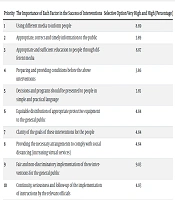
The effective factors in the interventions, ranked by importance according to the students' choices, are presented in Table 1.
Table 1.
Effective Factors in Interventions in Order of Importance
| Priority | The Importance of Each Factor in the Success of Interventions | Selective Option Very High and High (Percentage) |
|---|---|---|
| 1 | Using different media to inform people | 89.8 |
| 2 | Appropriate, correct and timely information to the public | 89.3 |
| 3 | Appropriate and sufficient education to people through different media | 87.8 |
| 4 | Preparing and providing conditions before the above interventions | 86.3 |
| 5 | Decisions and programs should be presented to people in simple and practical language | 85.3 |
| 6 | Equitable distribution of appropriate protective equipment to the general public | 84.4 |
| 7 | Clarity of the goals of these interventions for the people | 84.4 |
| 8 | Providing the necessary arrangements to comply with social distancing (increasing virtual services) | 84.4 |
| 9 | Fair and non-discriminatory implementation of these interventions for the general public | 83.9 |
| 10 | Continuity, seriousness and follow-up of the implementation of instructions by the relevant officials | 83.4 |
| 11 | Announcing the decisions made in a transparent manner to the people | 82.9 |
| 12 | Providing financial resources to prevent the financial losses of the people from the implementation of these interventions | 82.4 |
| 13 | Stability in decisions taken and accurate implementation of interventions | 80.7 |
| 14 | Cooperation and coordination of other organs of the country with the Ministry of Health to implement these interventions | 80.3 |
| 15 | Accountability of health policy makers to the decisions taken | 79.9 |
| 16 | Determining the effects of these interventions in improving the condition of the disease | 79.5 |
| 17 | Involving people in the implementation of preventive programs | 78.5 |
| 18 | The main priority of disease control is the above preventive interventions | 78.3 |
| 19 | Emphasizing the moral principle of not harming others as the basis of these interventions | 77.5 |
| 20 | Coercive measures for law breakers and those who do not follow the instructions | 75.0 |
| 21 | A single and specialized command to make decisions at the country level | 74.7 |
| 22 | Determining the importance and benefit of these interventions in relation to their problems | 69.8 |
| 23 | They localized the information and adapted it to each region and stratum | 67.3 |
| 24 | Involving people or their representatives in decision-making | 66.3 |
| 25 | Finding out that these interventions are the most appropriate and the only practical way to control this disease | 65.4 |
As shown in the above table, the factors considered most effective in the interventions, based on the students' choices, include: Using different media to inform the public, providing proper, accurate, and timely information, offering adequate and sufficient education to the public, preparing and providing conditions before the aforementioned interventions, presenting decisions and plans in simple and practical language, and ensuring the fair distribution of appropriate protective equipment. The factors deemed less important include: Coercive measures, single and specialized decision-making authorities, determining the importance and benefits of interventions, localizing information, involving the public in decision-making, and determining that these interventions are the most appropriate and the only practical way to control the disease.
Due to the non-normality of the data distribution, non-parametric tests (Mann-Whitney test) were used to analyze and compare the responses. It was found that there were no significant differences based on gender, marital status, or native versus non-native status (P > 0.05).
5. Discussion
The treatment of Covid-19 patients is a matter related to medical science, but the challenges created by this virus are not limited to the medical field. They have affected all aspects of human life, including political, economic, religious, and moral dimensions. The purpose of this research was to investigate the ethical considerations of establishing social restrictions in the prevention and control of the Covid-19 epidemic from the perspective of medical students. The study showed that the most effective factors in interventions, according to the students, were: Using different media for information dissemination, providing appropriate, accurate, and timely information, offering adequate and sufficient education, preparing and providing conditions before interventions, presenting decisions and plans in simple and practical language, and fairly distributing appropriate protective equipment to the public. The most important factors were related to informing, educating, and using the media, followed by government aid and arrangements, justice in distribution, transparency in decision-making, and the continuity of decisions. Factors considered less important included: Coercive measures, a single and specialized command to make decisions, specifying the importance and benefits of interventions, localizing information, involving people in decision-making, and clarifying that these interventions are the most suitable and only practical way to control the disease.
The findings highlighted the importance of media in the success of interventions, which aligns with the study by Rashidi and Mousavi, showing that the impact of social media on individual risk perception and the prevention of Covid-19 was significant. In recent years, social media has become an important information source for risk and crisis communication, particularly during infectious disease outbreaks. The acquisition and exchange of information through social media during such outbreaks can complicate communication, as emotions play a key role in shaping public risk perceptions and subsequent behaviors (27).
One of the categories emphasized by students in this research was coercive measures for lawbreakers and those who do not follow instructions. In this regard, Rafiee et al. conducted a study on the civil responsibility of doctors in the treatment of Covid-19 patients in Iranian law, compared to the American legal system, and concluded that facing an emergency requires the approval of emergency laws (28).
In Jokar’s study, which examined the jurisprudential foundations of the government's obligations to prevent and control infectious diseases (with a focus on Covid-19), the results indicated that the government is responsible for providing support to prevent the spread of infectious diseases. This implies that the government is fully accountable for establishing a comprehensive health system. Article 29 of the Constitution, in accordance with Islamic jurisprudence, reflects this principle. By using this legal principle, the government is obliged to protect the rights of the nation. This principle is also known as the principle of solidarity, where the government represents the people. The government should implement comprehensive measures to prevent the spread of contagious diseases like Covid-19. These measures should be coordinated by the Ministry of Health, Treatment, and Medical Education to fully control and eradicate the disease. One of the most fundamental and perhaps the most important actions in this field is to inform and raise public awareness through warnings. Investing in health education and knowledge is the most effective and least costly method in this regard, and our study emphasized the same. Other important government duties in preventing and eradicating infectious diseases include facilitating health-related matters. When a virus like Covid-19 spreads, people’s bodies, souls, and property are at risk. In this situation, actions such as allocating well-equipped medical centers, reducing medical expenses, improving insurance coverage, and providing health facilities such as medications and disinfectants can improve the process of controlling the disease and treating patients (29). All of these factors were emphasized in our results.
In the study by Valizadeh MM and Valizadeh A, which examined the ethical challenges of Covid-19 and solutions to address them, the results identified the following challenges in the field of medical ethics: (1) prescribing unproven and informal treatments, (2) disclosing a person’s illness, (3) lack of treatment facilities and resources, (4) quarantining patients and the lack of physical contact, (5) the cost of inpatient treatment, (6) healthcare workers quitting, (7) forced quarantine and use of sanitary supplies, and (8) prioritizing personal interests. Ethical solutions to these challenges were categorized into three areas: (1) patient behavior: Ensuring justice in the distribution of medical services and facilities, and kindness towards patients; (2) Societal behavior: Maintaining social health, unity, and empathy; (3) Individual behavior: Self-care and maintaining personal health. This study showed that dealing with Covid-19 requires more than just treatment efforts and compliance with health protocols. Without addressing the ethical challenges faced by healthcare and without applying ethical solutions, it will not be possible to effectively control the virus. Our findings on self-care, fair distribution of facilities and protective equipment, patient care, and public information and education were in line with these results (11).
Alijani Bahloul, in a study on environmental ethics and Covid-19, proposed that the irrational relationship between humans and the environment is the main cause of the spread of the virus. Most researchers and experts believe that Covid-19 is nature's reaction to destructive human behavior. Research has shown that human behavior has harmful effects on nature, which in turn affects human society. For effective control of the Covid-19 problem, environmental ethics must also be considered. This aspect of environmental ethics was not covered in our study (30).
5.1. Limitations
This study was conducted solely among medical students at Kermanshah University of Medical Sciences. Practical suggestions: As a practical solution, the use of media for education and public participation during pandemics should be strategically planned.
5.2. Conclusions
According to our results, the use of various media for informing, training, and preparing the public, as well as providing conditions before interventions, plays a crucial role. Therefore, policymakers and health planners should ensure they are adequately prepared in these areas to better control future epidemics.