
1. Background
In December 2019, an emerging disease caused by a new strain of coronavirus known as acute respiratory syndrome SARS coronavirus 2 (SARS-CoV-2) and commonly known as COVID-19, was first found in Wuhan city, Hubei Province, China. Infectious diseases have many prevalent ways, and the common methods are water, food, environment, or person-to-person. According to the COVID-19 pandemic, human contact is the most important method of transmission (1). Therefore, the COVID-19 outbreak increases public concerns (2, 3).
Many of the first cases of COVID-19 were linked to a ‘wet market,’ the seafood market in Wuhan, China. Many reports and evidence have shown that in traditional Chinese wet markets, people buy and sell vegetables and animals near each other while some animals are still alive and caged. Animals like bats, chickens, snakes, and even dogs were being transacted in that markets. Due to these factors, there is a high possibility of transmission of disease and contamination through various micro-organisms to food and vegetables in these markets (4).
Therefore, the concerns about the transmission of the virus through food are extreme. Although various activities have been carried out on vaccination, there is still a need for personal health awareness. Despite the development of food packaging in the world, there is still a great need to be aware of this issue (5, 6). Today, paying attention to food hygiene and safety is one of the most critical issues, and various studies have been conducted to address people’s concerns about food hygiene (7). Food hygiene and safety are essential for population growth and sustainable food provision, which is why the food consumption-production cycle has been challenged (8). As much as consuming healthy food is effective in maintaining health equally, it can be problematic if the food is unsafe and of good quality, especially in developing countries (9).
On the other hand, despite the development of management systems, the incidence of many pathogens has not decreased (10). The prevalence of any disease can affect by eating habits, and the coronavirus pandemic is no exception (11). Now considering the COVID-19 pandemic, the food industry and culture are facing new challenges (12).
Sufficient nutrition is vital because of reducing inflammatory responses and even prevents SARS-CoV-2 infection. Many studies have shown that some nutrients, such as minerals like fiber, essential fatty acid, selenium, and zinc, and vitamins like A, D, and E, can improve the immune system’s power. In addition, inadequate nutrition and poor health can lower resistance to diseases and make infection more severe (13, 14). In the meantime, less attention has been paid to food hygiene, although the possibility of transmission and survival of the virus through food is highly debated (15). In this situation, activities are essential to raise people’s knowledge and decrease their inattention to health protocols, and education is so important (16).
There is no doubt that medical staff, who are exposed to pathogens more than anyone, are the leading group that needs to know about COVID-19 infection and the possibility of its transmission via food (17).
2. Objectives
In the present study, we investigated the knowledge and attitude of Ardabil University of Medical Sciences (ARUMS) students about hygiene and food safety during the pandemic of coronavirus (SARS-CoV-2) disease.
3. Methods
3.1. Statistical Community and Sampling Method
The present study was cross-sectional and descriptive, and a pure questionnaire was used by random sampling. The sample size was 100 people, and the statistical population was the ARUMS students (Figure 1). The number of samples was determined using the formula:
where d = 0.05, α = 0.05, and the data were collected through a questionnaire using previous experiments. In this questionnaire, the tool’s validity was assessed using content validity. The statistical population of this remark includes all of the students of different colleges of ARUMS, Iran, in 2021. The inclusion criteria for the statistical population were to study in any field and level at Ardabil University of Medical Sciences. There is no specific exit criterion. A total of 100 college students were questioned. This vast range was chosen based on stratified random sampling from the colleges of the ARUMS. Thus, in this step, a positive share of them have been evaluated via way means of randomness with the wide variety of college students in every faculty. The questionnaire had four sections, and the primary phase changed to be associated with demographic information. The second section contained 21 questions about food hygiene status during the COVID-19 pandemic. Five items (unused, deficient, low, medium, and high) were considered for each question in this section. Regarding other areas, the questionnaire had 11 questions about knowledge and ten about attitude. This 21-item scale measures awareness and attitude about food health and safety.
The data for this study were collected using a web questionnaire to maintain social distancing. The Google form was used to design this questionnaire. In addition, the latest information based on WHO and valid related studies have been used in this research to design the questions. Links were sent to participants to collect answers through social media. After one month, about 100 responses were received from the participants, and Google Forms charts were used to extract the answers.
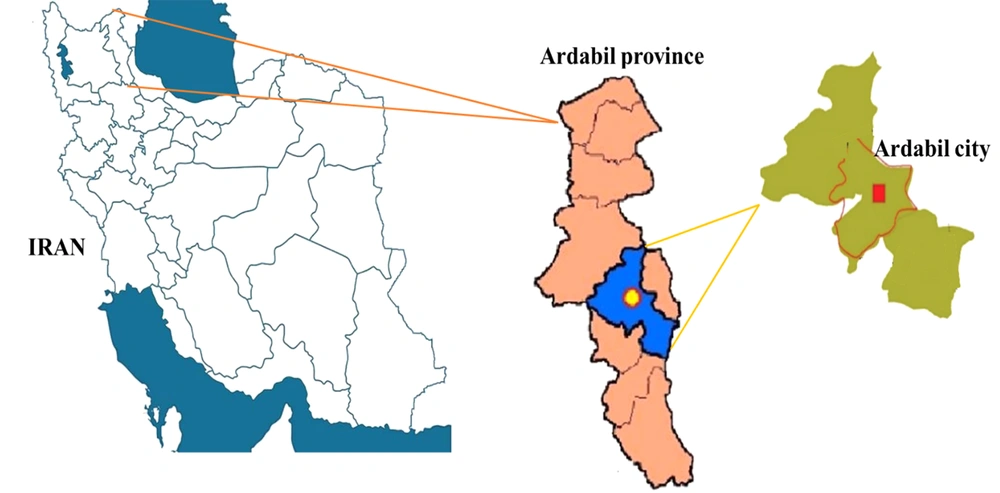
Figure 1.
The location of the investigated area (Ardebil city) in this study
3.2. Statistical Analysis
For statistical evaluation, parametric tests (descriptive statistics) and (analysis of variance, t-test, chi-rectangular test, 2. Fisher test) were used. Each individual has a rating for the common stage of understanding and behavior, which became the extent of knowledge and preferred behavior.
The retest method was used to determine the reliability of this study. In this test, first, a questionnaire was given to 10 students. Ten days later, the same people performed the test again, and the reliability of the questionnaire was evaluated using the Pearson correlation coefficient. Pearson correlation coefficient was 0.83 for knowledge and 0.75 for the attitude questionnaire.
4. Results
In this study, 100 students (59 females and 41 males) of ARUMS were studied. Regarding age, eight people were less than 20 years old, 69 people were 20 - 25 years old, and 23 were more than 25 years old. In terms of field of study, 15 people in medicine, 31 in health, three in dentistry, four in pharmacy, 29 in paramedical, and 18 in nursing were examined. In terms of educational level, 61 undergraduates, seven postgraduates, and 14 general and specialized medicine students were investigated (Table 1). In this study, three knowledge, attitude, and COVID-19 questionnaires were used.
Table 1.
Demographic Information of Students Participating in the Present Study
| Variables | No. (%) |
|---|---|
| Sex | |
| Female | 59 (59.0) |
| Male | 41 (41.0) |
| Total | 100 (100.0) |
| Age | |
| Less than 20 | 8 (8.0) |
| Between 20 and 25 | 69 (69.0) |
| More than 25 | 23 (23.0) |
| Total | 100 (100.0) |
| Weight | |
| Less than 50 | 5 (5.0) |
| Between 50 and 60 | 29 (29.0) |
| More than 60 | 66 (66.0) |
| Total | 100 (100.0) |
| Height | |
| Between 150 and 160 | 17 (17.0) |
| More than 160 | 83 (83.0) |
| Total | 100 (100.0) |
| Field of study | |
| Health | 31 (31.0) |
| Medical | 15 (15.0) |
| Nursing | 18 (18.0) |
| Pharmacology | 4 (4.0) |
| Dental | 3 (3.0) |
| Paramedical | 29 (29.0) |
| Total | 100 (100.0) |
| Grade | |
| Bachelors | 61 (61.0) |
| Masters | 7 (7.0) |
| General doctorate | 14 (14.0) |
| PhD | 18 (18.0) |
| Total | 100 (100.0) |
The results of the Table 2 show the highest frequency and percentage of correct questions for knowledge questions, which are 1, 4, and 12 with 81 (1.81), (0.78) 7.8, and (0.68) 68, and the highest frequency and percentage for False questions are indicated for questions 8 and 10 with (0.68) 68 and (0.22) 96 (Table 2).
Table 2.
Students’ Answers to Food Hygiene and Safety Awareness Questions a
| Questions | Correct | Incorrect | Total |
|---|---|---|---|
| 1. When buying food, we pay attention to its production and expiration date. | 81 (81.1) | 19 (0.19) | 100 (100.0) |
| 2. Fever and vomiting are symptoms of foodborne illness. | 22 (22.0) | 78 (78.0) | 100 (100.0) |
| 3. The appropriate temperature for storing food in the refrigerator is 1-5 degrees Celsius. | 61 (61.0) | 39 (39.0) | 100 (100.0) |
| 4. It is not necessary to use a refrigerator to store sterilized milk. | 32 (32.0) | 68 (68.0) | 100 (100.0) |
| 5. The safe temperature for pasteurizing milk is 72 degrees Celsius with a time of 15 seconds. | 20 (20.0) | 80 (80.0) | 100 (100.0) |
| 6. Meat spoils faster when minced. | 28 (28.0) | 72 (72.0) | 100 (100.0) |
| 7. A cold house with a temperature below zero is more suitable for storing cans. | 15 (15.0) | 85 (85.0) | 100 (100.0) |
| 8. The viscosity of the meat surface is not a sign of rotten meat. | 27 (27.0) | 73 (73.0) | 100 (100.0) |
| 9. In terms of health, plastic containers are more suitable for food. | 4 (4.0) | 96 (22.0) | 100 (100.0) |
| 10. Staphylococcus aureus enters food through pimples and nasal secretions. | 21 (21.0) | 79 (79.0) | 100 (100.0) |
| 11. Bacteria are the most important cause of diseases of food origin | 68 (68.0) | 32 (32.0) | 100 (100.0) |
a Values are expressed as No. (%).
Table 3 shows the results of the ten attitude questions. Frequency and percentage of choices were: I agree, I have no opinion, I disagree, and I am not sure. In the choice “I am not sure,” the maximum frequency and percentage for question 2 with (0.82) 82, and in the choice “I disagree” for question 1, with (0.49) 49, and in the choice “I have no opinion,” for question 6 with (0.34) 34 and also in choice “I agree” for question 10 with (0.33) 33 were reported.
Table 3.
Students’ Answers to Questions About Attitudes Toward Food Hygiene and Safety a
| Questions | Agree | No Comment | Disagree | Not Sure |
|---|---|---|---|---|
| 1. Knowing the hygiene and safety of food is important | 9 (9.0) | 21 (21.0) | 49 (49.0) | 21 (21.0) |
| 2. It is necessary to wash your hands with soap and water before cooking. | 3 (3.0) | 3 (3.0) | 12 (12.0) | 82 (82.0) |
| 3. Reheating food ensures its hygiene. | 26 (26.0) | 22 (22.0) | 29 (29.0) | 23 (23.0) |
| 4. Discard canned food with the lid of the carpentered. | 0 (0) | 32 (32.0) | 28 (28.0) | 40 (40.0) |
| 5. Food additives are not very important in food safety. | 1 (1.0) | 32 (32.0) | 30 (30.0) | 37 (37.0) |
| 6. Raw foods can be placed next to cooked foods. | 2 (2.0) | 34 (34.0) | 26 (26.0) | 38 (38.0) |
| 7. Pasteurized milk can be stored at room temperature overnight. | 10 (10.0) | 24 (24.0) | 24 (24.0) | 42 (42.0) |
| 8. There is no prowithem in putting bread in recycled bags. | 4 (4.0) | 11 (11.0) | 35 (35.0) | 50 (50.0) |
| 9. Drinking raw milk has a high risk of food poisoning. | 14 (14.0) | 13 (13.0) | 12 (12.0) | 61 (61.0) |
| 10. It is enough to wash vegetables with water. | 33 (33.0) | 22 (22.0) | 27 (27.0) | 18 (18.0) |
a Values are expressed as No. (%).
Table 4 examines the relationship between attitudes and awareness with demographic variables by chi-square and Fisher’s exact test. The results indicated a significant relationship between gender (male and female) with knowledge in three categories (poor, moderate, and good) (P = 0.048), but there was no significant relationship with attitude. There was a significant relationship between the variables of weight and the level of awareness, but there was no relationship between the variables of attitude. A significant relationship was reported between the levels of height, as well as knowledge and attitude. In the variable levels of the faculty, there was a significant relationship with the varying levels of knowledge and attitude, but no significant relationship was observed between the two variables of knowledge and attitude.
Table 4.
Investigating the Relationship Between Attitude and Awareness with Demographic Variables by Chi-square and Fisher’s Exact Test a
| Variables | Awareness | Attitude | |||||||||
|---|---|---|---|---|---|---|---|---|---|---|---|
| Weak | Averages | Strong | Total | Meaningfulness | Weak | Averages | Strong | Very Strong | Total | Meaningfulness | |
| Sex | 0.048 | 0.054 | |||||||||
| Female | 24 (40.7) | 28 (47.5) | 7 (11.9) | 59 (100.0) | 6 (10.2) | 26 (44.1) | 22 (37.3) | 5 (8.5) | 59 (100.0) | ||
| Male | 8 (19.5) | 26 (63.4) | 7 (17.1) | 41 (100.0) | 5 (12.2) | 21 (51.2) | 11 (26.8) | 4 (9.8) | 41 (100.0) | ||
| Weight | 0.019 | 0.060 | |||||||||
| Less than 50% | 3 (60.0) | 1 (20.0) | 1 (20.0) | 5 (100.0) | 0 (0.0) | 2 (40.0) | 3 (60.0) | 0 (0.0) | 5 (100.0) | ||
| 50 to 60 % | 10 (34.5) | 17 (58.6) | 2 (6.9) | 29 (100.0) | 4 (13.8) | 12 (41.4) | 10 (34.5) | 3 (10.3) | 29 (100.0) | ||
| More than 60 % | 19 (28.8) | 36 (54.5) | 11 (16.7) | 66 (100.0) | 7 (10.6) | 33 (50.0) | 20 (30.3) | 6 (9.1) | 66 (100.0) | ||
| Height | 0.047 | 0.012 | |||||||||
| 150 to 160 % | 7 (41.2) | 9 (52.9) | 1 (5.9) | 17 (100.0) | 2 (11.8) | 11 (64.7) | 4 (23.5) | 0 (0.0) | 17 (100.0) | ||
| More than 160% | 25 (30.1) | 45 (54.2) | 13 (15.7) | 83 (100.0) | 9 (10.8) | 36 (43.4) | 29 (34.9) | 9 (10.8) | 83 (100.0) | ||
| Faculty | 0.048 | 0.035 | |||||||||
| Health | 4 (12.9) | 22 (71.0) | 5 (16.1) | 31 (100.0) | 3 (9.7) | 11 (35.5) | 14 (45.2) | 3 (9.7) | 31 (100.0) | ||
| Pharmacy | 5 (33.3) | 9 (60.0) | 1 (6.7) | 15 (100.0) | 2 (13.3) | 7 (46.7) | 4 (26.7) | 2 (13.3) | 15 (100.0) | ||
| Nursing and midwifery | 8 (44.4) | 6 (33.3) | 4 (22.2) | 18 (100.0) | 4 (22.2) | 9 (50.0) | 5 (27.8) | 0 (0.0) | 18 (100.0) | ||
| Medicine | 1 (25.0) | 3 (75.0) | 0 (0.0) | 4 (100.0) | 0 (0.0) | 4 (100.0) | 0 (0.0) | 0 (0.0) | 4 (100.0) | ||
| Dentistry | 0 (0.0) | 2 66.7 () | 1 (33.3) | 3 (100.0) | 1 (33.3) | 2 (66.7) | 0 (0.0) | 0 (0.0) | 3 (100.0) | ||
| Paramedical | 14 (48.3) | 12 (41.4) | 3 (10.3) | 29 (100.0) | 1 (3.4) | 14 (48.3) | 10 (34.5) | 4 (13.8) | 29 (100.0) | ||
| Degree | 0.201 | 0.541 | |||||||||
| Bachelor | 21 (34.4) | 31 (50.8) | 9 (14.8) | 61 (100.0) | 7 (11.5) | 29 (47.5) | 21 (34.4) | 4 (6.6) | 61 (100.0) | ||
| Master | 2 (28.6) | 3 (42.9) | 2 (28.6) | 7 (100.0) | 0 (0.0) | 4 (57.1) | 3 (42.9) | 0 (0.0) | 7 (100.0) | ||
| PhD | 5 (35.7) | 8 (57.1) | 1 (7.1) | 14 (100.0) | 2 (14.3) | 7 (50.0) | 2 (14.3) | 3 (21.4) | 14 (100.0) | ||
| PHD | 4 (22.2) | 12 (66.7) | 2 (11.1) | 18 (100.0) | 2 (11.1) | 7 (38.9) | 7 (38.9) | 2 (11.1) | 18 (100.0) | ||
a Values are expressed as No. (%).
Table 5 compares the mean scores of attitude, awareness, and corona variables between males and females by t-test. The results of Table 6 indicated a significant relationship between the variables of attitude and COVID-19 in gender categories, but no significant relationship was observed with the variable of knowledge.
Table 5.
Investigating the Mean Score of Attitude and Awareness and Coronavirus Between Male and Female Gender by t-test
| Gender | Frequency | Standard Deviation | Test Statistics | Meaningfulness |
|---|---|---|---|---|
| Attitude | 2.570 | 0.05 | ||
| Female | 59 | 30.13 (3.78) | ||
| Male | 41 | 29.65 (4.55) | ||
| Coronavirus | 2.475 | 0.048 | ||
| Female | 59 | 73.59 (7.72) | ||
| Male | 41 | 72.87 (6.92) | ||
| Awareness | -1.472 | 0.144 | ||
| Female | 59 | 4.37 (1.56) | ||
| Male | 41 | 4.85 (1.66) |
Table 6.
The Relationship Between Attitude and Knowledge with Chi-square and Fisher Tests a
| Variables | Awareness | Meaningfulness | |||
|---|---|---|---|---|---|
| Weak | Average | Strong | Total | ||
| Attitude | 0.049 | ||||
| Weak | 5 (45.5) | 4 (36.4) | 2 (18.2) | 11 (100.0) | |
| Average | 13 (27.7) | 28 (59.6) | 6 (12.8) | 47 (100.0) | |
| Strong | 12 (36.4) | 17 (51.5) | 4 (12.1) | 33 (100.0) | |
| Very strong | 2 (22.2) | 5 (55.6) | 2 (22.2) | 9 (100.0) | |
| Total | |||||
| Meaningfulness | 32.0% | 54 (54.0) | 14 (14.0) | 100 (100.0) | |
a Values are expressed as No. (%) unless otherwise indicated.
Table 6 examines the relationship between attitude and knowledge with chi-square and Fisher’s exact test, which shows a significant relationship between the two variables of attitude and knowledge. Figure 2 shows the relationship between the variables of attitude and awareness and indicates a significant relationship between the categories. Table 7 determines the correlation between students’ knowledge and attitude variables with the Pearson correlation test that the intersection between health and safety variables with attitude, awareness, and COVID-19 is significant. However, a significant correlation between knowledge with attitude and COVID-19 was not reported. Reconciliation between COVID-19 and expertise was also insignificant.
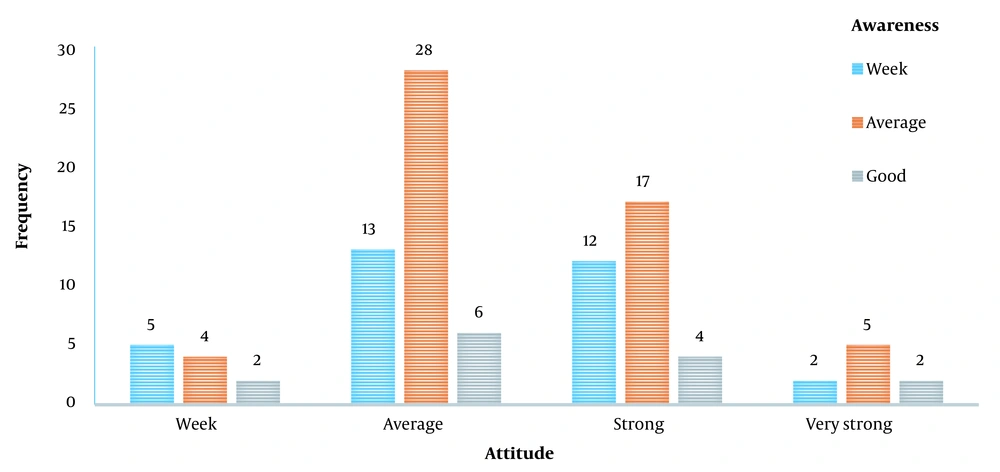
Figure 2.
The relationship between the variables of attitude and awareness
Table 7.
Determining the Correlation Between the Variables of Students’ Awareness and Attitude with Pearson Correlation Test
| Variables | Hygiene and Food Safety | Attitude | Awareness | Coronavirus |
|---|---|---|---|---|
| Hygiene and safety | 1 | |||
| Pearson correlation | 0.318 a | 0.430 a | 0.784 a | |
| Meaningfulness | 0.001 | 0.000 | 0.000 | |
| Attitude | 1 | |||
| Pearson correlation | 0.318 a | -0.012 | -0.180 | |
| Meaningfulness | 0.001 | 0.9070 | 0.073 | |
| Awareness | 1 | |||
| Pearson correlation | 0.430 a | -0.012 | 0.031 | |
| Meaningfulness | 0.000 | 0.907 | 0.761 | |
| Coronavirus | 1 | |||
| Pearson correlation | 0.784 a | -0.180 | 0.031 | |
| Meaningfulness | 0.000 | 0.073 | 0.761 |
a Correlation is significant at the 0.01 level (2-tailed).
5. Discussion
This study investigated the food safety and knowledge of ARUMS students during the COVID-19 pandemic. The responses of participants revealed that even though the study’s statistical population is the University of Medical Sciences students who are directly related to the issue of health, and their working conditions can also affect their health, there is still need for improvement.
As societies progressed and new habits were added to people’s daily lives, standards improved. This issue causes more and more people to pay attention to their eating habits and how they affect their health. Food safety has been frequently selected as research topic worldwide and has recognized as a critical national security issue (18, 19). Many studies have been conducted around the world showing this issue’s importance. Especially when the world is faced with a deadly pandemic, factors affecting health, one of which is nutrition, are constantly discussed and become very important. According to a study in the USA, the incidence of foodborne disease was detected to be at a high level. The severity of these diseases in high-risk groups is indicative of the importance of food safety education in their prevention. According to this study, suggestions from medical professionals regarding their diet and food ingredients are more likely to be accepted by patients when they have recently been exposed to a disease or believe they are in danger (20-23). Another study revealed that compared to before the COVID-19 pandemic, more medical professionals reported a short conversation with patients to help them understand food safety concepts (24, 25). In a study by Li et al., evaluation of the knowledge, attitude, and practice about the new coronavirus was done among more than 123,000 workers in various factories in China (26). The mean scores obtained for knowledge, philosophy, and approach were found to be as follows: 16.3, 4.5, and 5.8. In this study, about 68.8% of workers reported gargling with salt water as an effective way to protect against COVID-19 disease and had a positive opinion about it. Based on this study, on average, insufficient knowledge and practice about COVID-19 was detected among older and less educated people.
According to Min et al. who evaluated the effects of COVID-19 disease on the knowledge and practice of food consumers about food safety, people paid more attention to health protocols during the COVID-19 epidemic (27). In our country, after emergence of COVID-19, all citizens were obliged to follow the health guidelines for controlling and preventing the irreversible consequences of the disease, according to order of Iranian Ministry of Health and medical education. The awareness of the people has risen by applying these initiatives, and this pandemic has been effective on their knowledge and behavior toward food safety. This study showed that different elements could affect knowledge about food safety. Although there was less knowledge about this issue before the pandemic, research has shown that a substantial improvement in people’s understanding of relevant knowledge is observed after applying food safety and nutrition knowledge interventions, which is led to promote positive changes in attitudes and practices. Since in this situation, the people are more concern and pay more attention to their health situation, strengthening the education on safe and healthy lifestyles to the individual will be associated with better results.
5.1. Limitations of the Study
Since students were studying online during COVID-19 to comply with health protocols, this issue could cause bias in the results. In addition, it was impossible to explain directly to the statistical population in answering the electronic questionnaire. As a result, the statistical population may need to be better informed about the importance of conducting this study. Because the questionnaire was provided online and was designed electronically, there was a possibility of problems related to the type of questionnaire.
5.2. Conclusions
Collecting the data of this study was done using an electronic questionnaire, which can be used as primary data to control, monitor, and even train general knowledge to improve the users’ training level. Having appropriate behaviors and group knowledge about eating habits is so important for medical students who are constantly faced with high-risk environments regarding pathogens and need to strengthen their immune system and keep it at a desired level. These studies can decrease the health system costs on treatment and increase health workers’ knowledge as the frontline against COVID-19.