
1. Context
Whole slide imaging (WSI) has profoundly influenced medical research and diagnostic protocols with the advancement of digital pathology. By converting conventional glass slides into high-resolution digital images using advanced technology, WSI has enabled new insights into pathology. The adoption of this technology has facilitated faster and more accurate diagnoses and has provided robust digital archiving capabilities as an alternative to cumbersome physical slide storage. Nevertheless, continued engineering development remains a principal driver of progress in WSI and its effectiveness (1).
The impact of engineering on the development and application of WSI technology is substantial. The role of engineering in enhancing mechanical, optical, and imaging systems has been highlighted, offering valuable insights into the integration of WSI with picture archiving and communication systems. Similarly, Bashshur et al. emphasized the considerable potential of WSI for educational applications and underscored the need for advanced technical solutions tailored to the specific requirements of learning environments (2).
This narrative technical review examines the technical and technological foundations of WSI systems from a biomedical engineering perspective. We highlight key components of WSI, with particular emphasis on optical design, scanning strategies, and signal-processing methodologies. Among notable contributions to this field, Pantanowitz et al. systematically examined the process of converting glass slides into high-resolution digital images (3). Similarly, Hamilton et al. discussed the benefits, limitations, and expanding clinical and research applications of WSI (4). From an engineering standpoint, major bottlenecks in WSI systems include limitations of the optical subsystem, mechanical scanning precision, autofocusing performance, and image-processing efficiency. These challenges are explored in detail throughout this review. As a starting point, Figure 1 presents a comparative schematic illustrating differences between conventional analog pathology and modern digital pathology workflows, emphasizing structural distinctions and workflow transformations. Collaboration among engineers, clinicians, and scientists has significantly accelerated the development of WSI technologies, enabling rapid progress in precision medicine and computational pathology (5). In the following sections, we systematically analyze the core subsystems of WSI as the fundamental building blocks of modern digital pathology. This integrated perspective highlights the convergence of scientific rigor and technological innovation that is essential for advancing future diagnostic platforms.
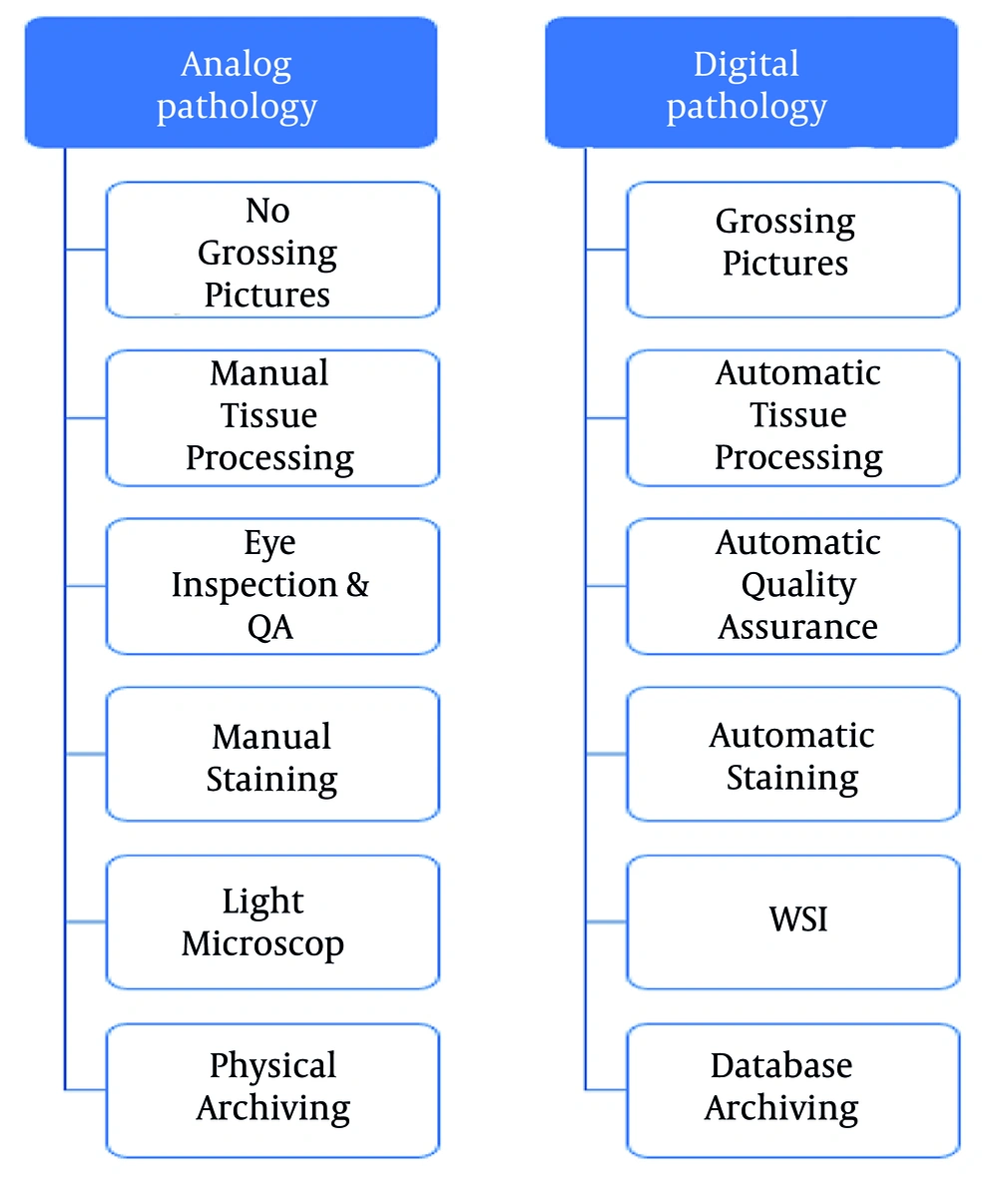
Figure 1.
Schematic diagram comparing analog and digital pathology pipeline blocks.
2. Evidence Acquisition
This article was prepared as a narrative technical review of WSI systems from a biomedical engineering perspective. The review focuses on the engineering, optical, and computational foundations of WSI technology, including optical design, lens and sensor optimization, scanning mechanisms, autofocusing techniques, and signal-processing methods. The aim is to clarify the key technological challenges and emerging approaches that influence image quality, diagnostic accuracy, and the clinical scalability of digital pathology.
3. Results
3.1. Optical Design Innovations
A critical aspect of WSI systems, closely linked to technological advancement, is optical design and engineering. WSI depends on the precise coordination of optical components, including illumination systems such as light-emitting diodes (LEDs), objective lenses such as Plan Achromat and Plan Fluorite lenses, and camera sensors such as charge-coupled device (CCD) and complementary metal-oxide-semiconductor (CMOS) sensors. The engineering design process focuses on optimizing each element to enhance overall system performance and improve the acquisition of pathology-relevant information (6). The optical pathway in a WSI system comprises a series of interconnected components that replicate the functionality of conventional microscopy used for glass-slide examination. Key elements include light sources, lenses, filters, and sensors (Figure 2). Each component plays an essential role in producing high-resolution, high-contrast images that accurately represent histological specimens and support reliable digital pathology analysis.
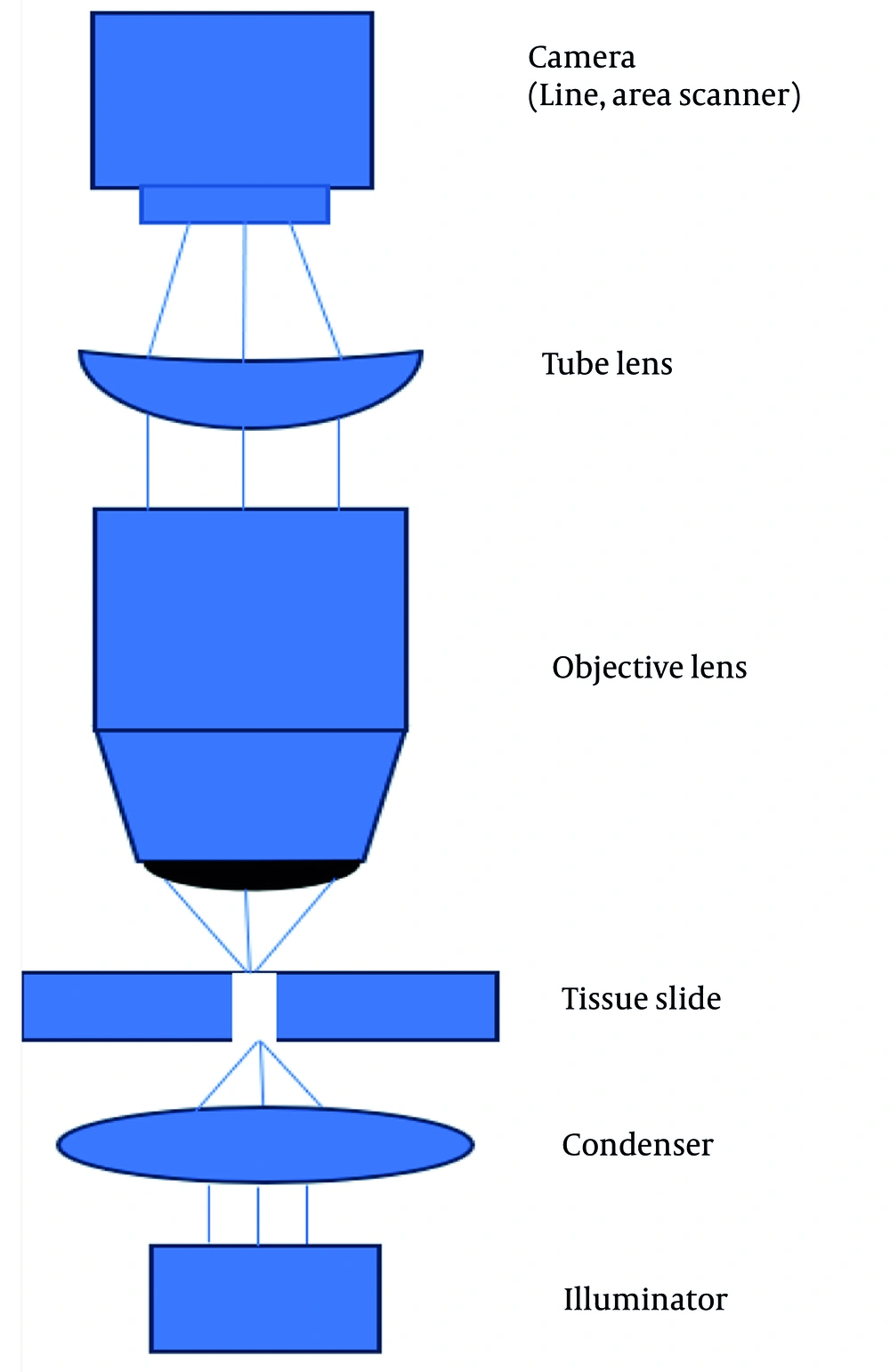
Figure 2.
Schematic representation of the optical pathway in digital pathology, illustrating the integration of essential optical components, including light sources, lenses, filters, and sensors, to simulate microscopic examination of glass slides.
3.2. Advancements in Lens Technologies and Sensor Optimization
Selecting an appropriate camera sensor is essential for achieving optimal performance in advanced WSI systems. The most commonly used sensor technologies in digital pathology include CCD, CMOS, and scientific CMOS (sCMOS). CCD sensors are widely recognized for high sensitivity and low noise, making them well suited for low-light imaging. In contrast, CMOS sensors offer higher readout speeds and lower power consumption, which are advantageous for high-throughput scanning workflows. sCMOS sensors combine the strengths of both technologies, delivering enhanced sensitivity, dynamic range, and speed (7, 8). Although CMOS sensors provide rapid scanning speeds suitable for high-throughput clinical workflows, CCD sensors remain superior for specific low-light research applications.
Modern digital pathology cameras also incorporate adaptive color-management capabilities, such as automated color-filter switching, which improves image quality under varying staining and illumination conditions. These digital transitions facilitate multispectral imaging without the need for physical filter changes, enabling more comprehensive pathological analysis (9, 10). Furthermore, sensor characteristics, including pixel size and sensor area, significantly influence image quality because larger sensors collect more light, thereby improving the signal-to-noise ratio (SNR) (7, 11).
Objective lenses are core optical components of WSI systems and play a decisive role in image quality. Key parameters, such as magnification and numerical aperture (NA), directly govern spatial resolution and image clarity (12). These lenses are broadly classified as Plan Achromat and Plan Fluorite types. Plan Achromat lenses reduce chromatic aberrations to ensure accurate color reproduction, whereas Plan Fluorite lenses incorporate fluorite elements to further minimize optical distortion (13, 14).
Finally, optimization of illumination systems is equally critical because it directly affects contrast, brightness, and overall image fidelity. A well-integrated system combining optimized sensors, high-quality objective lenses, adaptive color filtering, and controlled illumination ensures accurate digital representation of pathology specimens, thereby enhancing both clinical and research applications of WSI (12).
3.3. Scanning Mechanisms and Autofocusing Techniques in WSI
Scanning mechanisms and autofocusing techniques are two critical components of WSI systems and play pivotal roles in the precision and efficiency of image acquisition. This section discusses these mechanisms in detail. Specifically, it addresses two widely used pathology slide-scanning methods, namely line scanning and tile scanning, followed by an examination of two principal autofocusing algorithms.
3.3.1. Line-Based Scanning
In pathology WSI, line-based scanning is a systematic method in which the specimen is imaged line by line. In this technique, the camera captures continuous strips of tissue, enabling comprehensive and efficient digitization. The principal advantages of this technique are its simplicity and effectiveness. Rapid linear scans consecutively capture individual lines of the specimen, thereby accelerating image acquisition and eliminating the need for complex stitching algorithms. However, the precision and quality of the resulting images depend strongly on effective control of motion artifacts and careful optimization of illumination conditions (15, 16). Current research in this domain is directed toward developing more sophisticated hardware and algorithms to address inherent challenges associated with line-based scanning systems. The ultimate objective is to enhance the efficacy, speed, throughput, and reliability of WSI systems.
3.3.2. Tile Scanning
In contrast to line scanning, tile scanning involves dividing the specimen into smaller tiles that are individually scanned and then computationally stitched together to reconstruct the entire slide. Figure 3 compares line-based and tile-scanning approaches and highlights the key stages involved in each method for digitizing pathology specimens. Tile scanning offers more precise control over imaging parameters and reduced sensitivity to motion artifacts. It often yields superior image quality, particularly in high-magnification applications, although it may require longer acquisition times (7). Recent advances in image processing, including optimization of stitching algorithms, development of novel scanning patterns, and refinement of imaging parameters, have directly contributed to improvements in tile-scanning approaches. These efforts aim to enhance the robustness, efficiency, and versatility of tile scanning across diverse specimen types and imaging conditions.
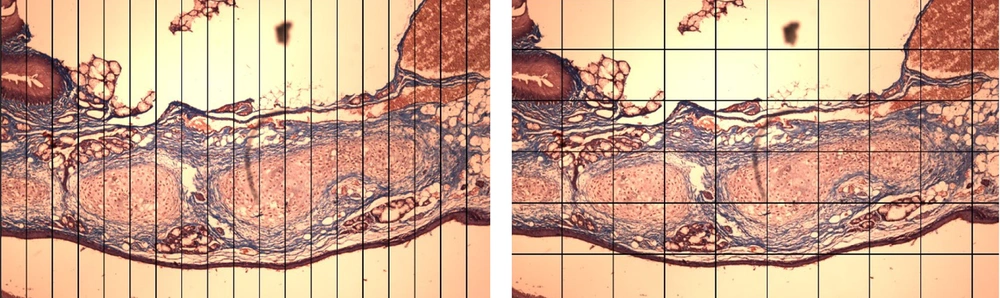
Figure 3.
Comparative depiction of scanning mechanisms in digital pathology, contrasting line-based scanning (left) with tile scanning (right). The illustration shows the divergent approaches used to capture and reconstruct pathology specimens.
3.3.3. Traditional Autofocusing
Autofocusing in WSI systems is a critical process that ensures the acquisition of high-quality, sharp digital images of tissue slides. Specifically, it ensures that all regions of the final whole-slide image remain sharp and free from blur despite inherent variability in tissue topography. Accurate autofocusing is essential for reliable digital pathology diagnosis and efficient scanning workflows. Conventional autofocusing techniques involve repeated adjustment of the focal plane to maximize image sharpness. This process may be performed offline before image acquisition or in real time through iterative image capture and focus evaluation. Despite their effectiveness, these methods can be time-consuming, particularly for large and complex specimens, high-magnification objective lenses, and variations in specimen height caused by tissue processing. Figure 4 illustrates the impact of inadequate focusing by presenting six images ranging from severely blurred to well focused. Traditional autofocus mechanisms also face substantial challenges in maintaining optimal focus across extensive whole-slide scans (17, 18). Numerous studies have proposed image-processing, machine learning, and artificial intelligence (AI)-based approaches to improve autofocus performance, with the aim of increasing speed while preserving accuracy and adaptability to diverse specimen characteristics (19, 20).
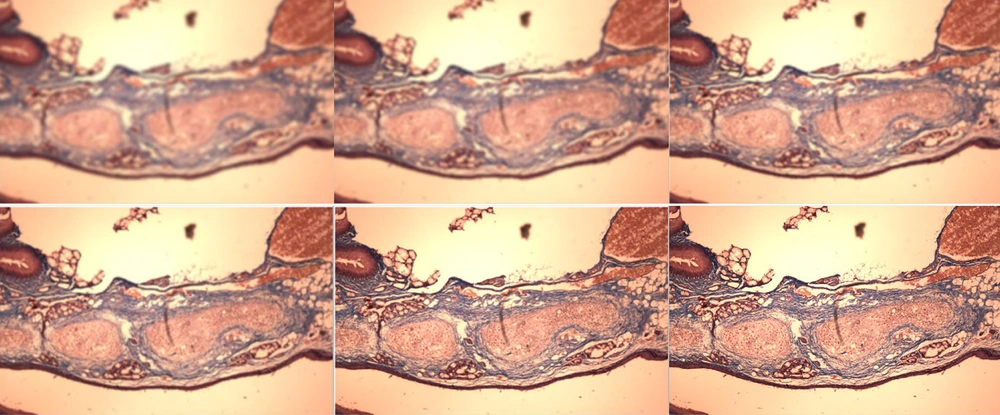
Figure 4.
Visual representation demonstrating the effects of lens-focusing variation on pathology specimen images. The series of images shows the continuum from substantial blurring to optimal focus, emphasizing the impact of autofocusing techniques on image quality.
3.3.4. Two-Sensor Autofocusing
As its name suggests, dual-sensor autofocusing is a more advanced technique that uses two image-capturing sensors simultaneously to determine the topography of the specimen under examination. In this approach, one sensor provides a relatively global overview of the field of view, whereas the other focuses on a specific local area based on information obtained from the first sensor. By combining and integrating data from both sensors, faster and more accurate autofocusing can be achieved, particularly in regions with variable topographic characteristics. This method ultimately results in a significant improvement in overall image quality (17, 21, 22).
Dual-sensor autofocusing technology enhances both the speed and quality of WSI systems, which is critical for clinical workflows. In doing so, it supports the integration of digital pathology into routine diagnostic practice by rapidly providing reliable, high-quality digital slide images. Essentially, this method addresses a fundamental challenge in WSI systems: balancing speed with focus accuracy. In summary, dual-sensor autofocusing in WSI enables rapid, continuous, and accurate focusing by separating the focusing and imaging tasks across two sensors operating in parallel, thereby substantially improving scanning speed and image quality compared with traditional autofocus methods.
3.4. Advanced Techniques in WSI Signal Processing
Signal processing plays a critical role in enhancing the accuracy and interpretability of digital pathology images and WSI outputs. This section examines advanced techniques in WSI image processing, focusing on three primary areas: noise reduction, image enhancement, and image mosaicking (23, 24).
3.4.1. Noise Reduction Techniques in WSI
Numerous factors can contribute to deterioration of WSI image quality. Because histopathological images are inherently complex, effective noise reduction is critical and has prompted the development and application of various denoising techniques in this field (25). This complexity typically arises from variations in staining processes, diverse tissue structures, and imaging artifacts. Scanning artifacts, often caused by hardware imperfections, can introduce distortions such as blurring, uneven illumination, and color variation (26). Staining discrepancies and inconsistencies across pathology laboratories further increase image heterogeneity. In addition, environmental factors, such as temperature and humidity fluctuations during slide preparation and scanning, can introduce unwanted noise and distortions (27).
To address these practical challenges, researchers have investigated various image-processing strategies. Traditional preprocessing techniques include digital filters, such as Gaussian filters for smoothing and adaptive filters for enhancing local contrast (26). To mitigate staining variation, histogram equalization is often used to normalize intensity distributions, while color-normalization algorithms are used to standardize color appearance across slides (28).
Deep learning, a subset of AI, has enabled more advanced denoising techniques. Convolutional neural networks (CNNs) have demonstrated the capacity to identify and reduce complex noise patterns while preserving critical diagnostic and morphological details (29). Furthermore, transfer learning, which involves fine-tuning pretrained models on pathology-specific data, has successfully enhanced noise-reduction performance by leveraging features learned from large-scale datasets (30-32). Consequently, advanced AI algorithms are continuously expanding the capabilities of WSI. These advances refine existing methods, support the development of novel algorithms, and adapt noise-reduction strategies to emerging digital pathology technologies, ultimately paving the way for more accurate and reliable WSI.
3.4.2. Image Enhancement Techniques for WSI
Contrast, sharpness, and color enhancement are primary image-processing techniques that improve the interpretability and diagnostic value of WSI in digital pathology. Contrast-enhancement approaches, such as histogram equalization, gamma correction, and contrast-limited adaptive histogram equalization (CLAHE), are widely applied to enhance the visibility of pathological tissue features under various staining conditions. Sharpness-enhancement techniques, including unsharp masking, Laplacian filtering, and wavelet-based sharpening, are used to emphasize cellular and subcellular boundaries, making pathological changes easier to identify. The primary objective of color enhancement is stain normalization. Methods such as Macenko's and Reinhard's algorithms are used to address color-variability challenges across slides and scanners. Stain deconvolution techniques based on optical density transformations represent another valuable class of contrast-enhancement methods used in WSI and digital pathology (33). Figure 5 illustrates the effects of red-green-blue (RGB) color filters on captured WSI scans. In addition to the aforementioned methods, tone mapping and contrast-stretching algorithms play a crucial role. These approaches improve the visual appearance of scans by increasing the visibility of fine details, features, and boundaries without compromising overall image quality.
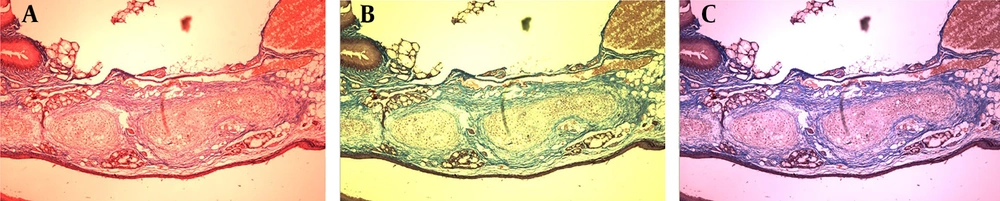
Figure 5.
Comparative analysis of the effects of RGB color filters on captured images. Subparts (A), (B), and (C) show the effects of color filters on image enhancement: A, red boosted; B, green boosted, and C, blue boosted. These subparts demonstrate the distinctive effects of individual color-channel adjustments on the visual attributes of pathology specimen images.
The development of machine learning (ML), and more specifically, deep neural networks (DNNs), has led to a paradigm shift in image enhancement in recent years. These ML and DNN algorithms can autonomously identify complex relationships within WSI data, enabling automatic feature extraction and targeted image enhancement. Recently, deep learning-based approaches, such as CNNs and generative adversarial networks (GANs), have been explored for adaptive, data-driven enhancement of histological content in whole-slide images. Such AI-based techniques improve visual quality and support more accurate diagnoses. Furthermore, they facilitate robust performance in downstream computational tasks, such as histopathological image segmentation and classification. In addition to conventional deep learning methods, sophisticated image-processing techniques have become increasingly popular. For example, image-fusion technologies enable characterization of tissue architecture by merging data from different imaging modalities or spectral channels. With the aid of these comprehensive approaches, pathological examinations can be performed with greater accuracy (34). By anticipating and adapting to emerging technologies, researchers aim to ensure that WSI remains at the forefront of clinical decision-making and pathology research while simultaneously addressing current needs in digital pathology.
3.4.3. Mosaicking and Stitching of WSI Images
Mosaicking, or stitching, is a digital process in WSI systems used to reconstruct a single large, high-resolution microscopic image from multiple smaller, overlapping image tiles captured from a physical pathology slide. Implementing an appropriate mosaicking algorithm creates a single, seamless digital slide from a physical specimen. The resulting virtual slide is well suited for analysis, archiving, and sharing in digital pathology and related fields.
Mosaicking or stitching in WSI involves integrating individual high-resolution image tiles so that the entire tissue specimen is visible in a single image. In digital pathology, microscopic examination of tissue slides is digitized to facilitate remote diagnostics and collaborative analysis. In these scenarios, mosaicking addresses the inherent limitations of microscopic imaging systems, namely a highly restricted field of view (FOV). This restricted FOV necessitates the assembly of multiple tiles into a unified whole-slide image (35, 36).
The fundamental challenge in developing an effective mosaicking workflow is achieving a robust registration algorithm capable of precisely aligning adjacent tiles. Traditional image-registration techniques, such as affine and elastic transformations, are often used to align tiles with high precision. Other approaches use feature-based matching algorithms. In these methods, distinctive features within images are identified and used for robust alignment. Ensuring spatial integrity during this alignment process is critical. Because accurate pathology interpretation and diagnosis are the primary goals of digital pathology, preserving the microscopic details of tissue structures is a vital function of registration in mosaicking approaches (37, 38).
In addition to registration, blending techniques are another fundamental component of the stitching process. Blending methods are applied to eliminate discontinuities at the borders of adjacent tiles, with the primary goal of creating visually seamless transitions. They also minimize artifacts that might otherwise compromise overall image quality. Various blending strategies, such as linear blending and gradient-based approaches, can be used to achieve smooth transitions and preserve the natural appearance of tissue features (8, 39).
The benefits of WSI mosaicking extend beyond improving visual coherence. The primary advantage of mosaicking is that it enhances the ability of pathologists to detect minute irregularities and deliver accurate diagnoses using whole-slide images reconstructed in a multiresolution format. These virtual slides provide pathologists with a comprehensive and readily accessible view of large specimens. Furthermore, mosaicking facilitates the use of automated image-analysis algorithms capable of evaluating the entire tissue specimen, enabling quantitative assessments and extraction of crucial data for research purposes (40, 41).
Enhancing the reliability of registration algorithms, improving blending techniques for diverse imaging settings and staining variations, and addressing challenges associated with image distortions are the primary focus of current research in WSI mosaicking. The continued development of these techniques is expected to have a significant impact on diagnostic workflows and pathology research through seamless integration into digital pathology procedures. This integration will ultimately pave the way for enhanced clinical decision-making.
4. Conclusions
A limitation of this narrative review is the absence of a systematic PRISMA-compliant search strategy, which inherently introduces the potential for evidence-selection bias. Furthermore, this manuscript primarily focuses on the engineering, optical, and computational aspects of WSI systems. Consequently, comprehensive evaluations of clinical outcome data, multicenter reader-concordance studies, and diagnostic sensitivity or specificity metrics are beyond the scope of this review.
Since its introduction, WSI has been validated for various applications in pathology, including diagnostics, education, and research. Recent US Food and Drug Administration approval of a WSI system for primary surgical pathology diagnosis is expected to expand its adoption in routine clinical practice.
Advances in the core technologies underpinning WSI continue to evolve rapidly. Researchers in optical design are investigating advanced materials and lens-manufacturing processes to improve lens resolution and light-collection capacity. A highly promising development in WSI systems is their potential integration with hyperspectral imaging. The application of electromagnetic wavelengths outside the visible spectrum, which relies on sophisticated sensor technology, could significantly enhance WSI recording capabilities (42). This approach may yield new insights into pathophysiology and tissue composition.
Progress is also being made in scanning mechanics and autofocus systems. The development of faster and more precise electromechanical components is expected to improve the speed, accuracy, and reliability of slide digitization. The integration of advanced automation and robotic tools could substantially simplify the scanning process and reduce the time required to acquire high-quality images. Furthermore, the application of AI algorithms to autofocusing methods can improve the sensitivity and adaptability of WSI systems. These capabilities enable scanners to traverse a wide variety of tissue samples with exceptional precision.
Equally vital to the future of WSI are advances in image and signal processing. The application of ML and DNNs can automate complex image-analysis tasks, thereby enabling the rapid and accurate detection of diagnostically relevant patterns and anomalies. Furthermore, advances in real-time processing could accelerate pathological decision-making and enhance the overall diagnostic workflow by providing instantaneous feedback during slide acquisition.
Looking ahead, standardization and interoperability will be central to the clinical scalability of WSI. The development of uniform protocols, data formats, and communication standards will enable seamless integration across diverse medical systems and institutions. By establishing these unified frameworks, WSI systems can promote enhanced cooperation among clinical platforms and organizations. This, in turn, facilitates the efficient transfer of vast datasets for research and educational purposes (43).