
1. Introduction
Headaches, or cephalgia, are common neurological conditions that can substantially disrupt daily functioning. They encompass various types, including migraine, tension-type headache, cluster headache, and other common forms. Globally, headaches affect approximately 40% of the population, with migraines accounting for nearly half of the total burden (1, 2). Tension-type headache is the most prevalent primary headache disorder, affecting approximately 20% of individuals and having a lifetime prevalence of 46% to 78% (3, 4). It is associated with substantial psychosocial and economic consequences (3, 4). Between 1990 and 2019, its prevalence increased in the Middle East and North Africa, where the burden exceeded global levels across all demographics despite unchanged incidence. Cluster headache, although the most common trigeminal autonomic cephalalgia, remains uncommon, affecting approximately 0.1% of the general population (5, 6). Given their high global prevalence, headaches remain an important focus of clinical care and public health research.
Tension-type headache, also called “muscle contraction,” “stress,” or “psychomyogenic” headache, often involves muscle tenderness that worsens with increasing headache frequency and severity (7). It is classified as episodic (frequent or infrequent) or chronic according to episode frequency. Its precise cause remains unclear, but genetic, environmental, nutritional, and muscular factors have been implicated (3, 7). Tension-type headache causes substantial disability and leads to more missed workdays than migraine. In addition to stress, disturbed sleep is a common trigger, with chronic tension-type headache often linked to sleep apnea and other sleep disorders (4, 7). Psychiatric conditions frequently coexist with tension-type headache and insomnia, complicating management. Evidence supports a bidirectional relationship: poor sleep can trigger episodic tension-type headache and promote progression to chronic forms, while many patients with chronic tension-type headache experience insomnia (3, 4, 7). Cluster headache affects approximately 0.1% of the population, making it rare and challenging to study (8). Nevertheless, it is considered one of the most severe headache types, highlighting the importance of timely diagnosis and treatment (5, 8). A genetic association has been reported, with first-degree relatives having an 18-fold increased risk, although the exact inheritance pattern remains unclear and varies between autosomal dominant and autosomal recessive patterns among different families (6, 8).
1.1. Rationale and Objective
Tension-type and cluster headaches are important causes of morbidity and are often associated with systemic conditions, making them key public health concerns (7, 8). Early diagnosis enables timely treatment and personalized management, potentially preventing long-term disability (7, 8). Despite their clinical importance, local data on the prevalence and characteristics of these headache types in Pakistan remain limited, underscoring the need for further research and awareness in this area. The objective of this study was to determine the frequency of tension-type headache and cluster headache among patients presenting with headache to the neurology department of a tertiary care hospital in Bahawalpur, Pakistan.
2. Methods
2.1. Study Design, Setting, and Duration
This cross-sectional observational study was conducted in the Neurology Department of Bahawal Victoria Hospital, affiliated with Quaid-e-Azam Medical College, Bahawalpur, Pakistan. The study was conducted over 6 months, from October 2024 to March 2025.
2.2. Study Population and Sampling
Patients presenting to the neurology outpatient department with headache as the primary complaint were eligible for inclusion. A non-probability consecutive sampling technique was used to recruit participants. Based on a 95% confidence level and a 5% margin of error, a minimum sample size of 281 patients was calculated using expected frequencies of 24% for tension-type headache and 0.25% for cluster headache (9). To increase study power, a total of 300 patients were enrolled. Patients with an altered level of consciousness, a history of seizures, any known neurological malignancy, or diagnosed psychiatric disorders were excluded.
2.3. Diagnostic Criteria
Tension-type headache and cluster headache were diagnosed according to the International Classification of Headache Disorders, 3rd edition (ICHD-3), criteria (10). These standardized guidelines were applied to ensure uniformity and diagnostic accuracy across all participants.
2.4. Data Collection Procedure
Demographic information, including age and gender, was recorded for each participant who met the inclusion and exclusion criteria. All patients underwent a detailed clinical evaluation by the neurology team to determine the presence or absence of tension-type headache or cluster headache based on the ICHD-3 criteria.
2.5. Statistical Analysis
All data were entered and analyzed using the Statistical Package for the Social Sciences (SPSS) version 23. Continuous variables were presented as mean and standard deviation, whereas categorical variables were presented as frequencies and percentages. Stratification was performed by age and gender, and associations were assessed using the chi-square test. A P value of ≤ 0.05 was considered statistically significant.
2.6. Ethical Considerations
The study was conducted in accordance with the ethical principles of the Declaration of Helsinki (1964, revised 2000). Written informed consent was obtained from all participants before enrollment, and strict confidentiality of patient information was maintained throughout the study.
3. Results
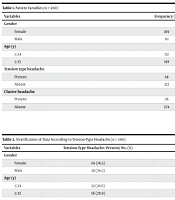
A total of 300 patients presenting with headache were included in this study. The mean age of the participants was 31.4 ± 16.7 years, and most (188, 62.7%) were aged ≥ 25 years, as shown in Table 1. Overall, 189 participants (63.0%) were female. Tension-type headache was observed in 88 patients (29.3%), whereas cluster headache was identified in 26 patients (8.7%), as shown in Table 1. Data stratification showed no statistically significant association between tension-type headache and gender (P = 0.258) or age (P = 0.920), as detailed in Table 2. However, a statistically significant association was found between cluster headache and male gender (P = 0.027) but not age (P = 0.737), as shown in Table 3.
Table 1.
Patient Variables (n = 300)
| Variables | Frequency (n) | Percentage (%) |
|---|---|---|
| Gender | ||
| Female | 189 | 63.0 |
| Male | 111 | 37.0 |
| Age (y) | ||
| ≤ 24 | 112 | 37.3 |
| ≥ 25 | 188 | 62.7 |
| Tension-type headache | ||
| Present | 88 | 29.3 |
| Absent | 212 | 70.7 |
| Cluster headache | ||
| Present | 26 | 8.7 |
| Absent | 274 | 91.3 |
Table 2.
Stratification of Data According to Tension-Type Headache (n = 300) a
| Variables | Tension-Type Headache: Present | Tension-Type Headache: Absent | P-Value |
|---|---|---|---|
| Gender | 0.258 | ||
| Female | 50 (26.5) | 139 (73.5) | |
| Male | 38 (34.2) | 73 (65.8) | |
| Age (y) | 0.920 | ||
| ≤ 24 | 32 (28.6) | 80 (71.4) | |
| ≥ 25 | 56 (29.8) | 132 (70.2) |
a Values are expressed as N (%).
Table 3.
Stratification of data according to cluster headache (n = 300) a
| Variables | Cluster Headache: Present | Cluster Headache: Absent | P-Value |
|---|---|---|---|
| Gender | 0.027 b | ||
| Female | 09 (4.8) | 180 (95.2) | |
| Male | 17 (15.3) | 94 (84.7) | |
| Age (y) | 0.737 | ||
| ≤ 24 | 08 (7.1) | 104 (92.9) | |
| ≥ 25 | 18 (9.6) | 170 (90.4) |
a Values are expressed as N (%).
b P < 0.05 was considered statistically significant.
4. Discussion
4.1. Prevalence of Tension-Type Headache and Comparison With Global Data
The present study evaluated the prevalence of tension-type headache among 300 patients presenting with headache. Most participants were female (63.0%) and aged 25 years or older (62.7%). Tension-type headache was observed in 29.3% of patients presenting with headache. This prevalence aligns with global and regional data, confirming that tension-type headache is the most common primary headache disorder. For instance, Schwartz et al. in the United States reported a prevalence of 38.3% for episodic tension-type headache, while Dissing et al. in Denmark reported a prevalence of 36.2% (11, 12). Regional data from Pakistan and Iran show similar findings, with Iqbal et al. documenting a prevalence of 24% in Lahore and Togha et al. reporting a prevalence of 32.1% in Iran (9, 13). No statistically significant associations were observed between tension-type headache and age or gender, indicating that this headache type affects a broad demographic range. These findings underscore the importance of early recognition and effective management strategies for tension-type headache, which contributes substantially to morbidity and productivity loss (3, 4, 7, 11).
4.2. Prevalence of Cluster Headache and Comparison With Global Data
Cluster headache was identified in 8.7% of patients in the present study, which is markedly higher than global prevalence estimates of approximately 0.1% (6, 8, 14). Ray et al. reported a pooled lifetime prevalence of cluster headache of 0.12% (14). El-Sherbiny documented that the prevalence of cluster headache in Egypt was 0.8% (15). In the study by Iqbal et al., only a single case (0.25%) of cluster headache was identified in the entire cohort of 400 patients with headache in Lahore (9). Several factors may explain this discrepancy. First, the study setting, a neurology department in a tertiary care referral hospital, likely contributed to an overrepresentation of rarer and more severe headache types. Patients with debilitating or refractory headaches, such as cluster headache, are more frequently referred to tertiary care centers, which may inflate the observed prevalence. Second, selection bias due to non-probability consecutive sampling may have further increased the likelihood of including patients with cluster headache; therefore, this rate should not be generalized to the wider population. Third, regional variations, diagnostic practices, and patient reporting patterns may contribute to differences in the observed prevalence (15, 16, 17).
4.3. Gender and Cluster Headache
Consistent with existing literature, cluster headache in this cohort showed a significant association with male gender (P = 0.027) (8, 18, 19). This male predominance may be influenced by hormonal factors, genetic predisposition, or differences in healthcare-seeking behaviors between men and women (6, 8). Although some recent studies suggest a shift toward increased prevalence among women, our findings support the traditional understanding that males are more commonly affected, highlighting the need for gender-sensitive diagnostic and management approaches (17, 20). Differences in gender distribution across regions may result from factors such as geography, altitude, cultural practices, and varying diagnostic or assessment methods, all of which can affect reported global and regional incidence rates.
4.4. Analysis of Demographic Factors
No significant associations were found between age and either tension-type headache or cluster headache, indicating that these primary headache disorders affect adults across a wide age range. This finding underscores the importance of considering these diagnoses regardless of age, as they can result in substantial morbidity and reduced quality of life. This finding is also consistent with global evidence suggesting that age alone is not a strong determinant of these headache types (7, 8). However, the observed gender difference in cluster headache emphasizes that demographic factors may contribute to specific headache subtypes and should be considered in clinical assessment and public health planning.
4.5. Implications for Clinical Practice and Research
The high prevalence of tension-type headache and the marked male predominance in cluster headache underscore the need for targeted strategies in diagnosis, management, and patient education. Clinicians should be particularly alert to the possibility of cluster headache in men presenting with severe unilateral headaches. Furthermore, local health systems should prioritize headache disorders as a public health concern and develop interventions that address gender-specific risk patterns, disability, and quality of life (21, 22). Although we did not examine the impact of headache on quality of life and productivity, the present study provides valuable local data on primary headache disorders in Pakistan and addresses a significant gap in the literature. Jennysdotter et al. documented that individuals with cluster headache experience significant sleep disturbances, which intensify during active episodes and may persist during remission (21). Schwartz et al. reported that 8.3% of patients with episodic tension-type headache lost workdays due to headaches, while 43.6% experienced reduced productivity at work, home, or school (11). Patients with chronic tension-type headache experienced a greater impact, with an average of 27.4 lost workdays and 20.4 reduced-effectiveness days (11). These findings highlight the importance of early recognition and tailored management, particularly for cluster headache. Increased awareness and gender-specific strategies may help improve diagnosis, treatment, and overall patient outcomes (20, 22).
4.6. Limitations and Recommendations
This study has several limitations that should be acknowledged. First, because it was conducted in a single tertiary care hospital, the findings cannot be generalized to the wider Pakistani population, thereby limiting external validity. Second, the study focused exclusively on assessing the prevalence of tension-type headache and cluster headache. No data were collected on underlying causes, precipitating factors or triggers, treatment response, or psychiatric comorbidities such as depression and anxiety, which are particularly common in patients with tension-type headache. In addition, the study did not examine disability levels or the impact of headaches on quality of life and productivity, which may influence, or be influenced by, tension-type headache and cluster headache. Furthermore, the cross-sectional design precludes assessment of causal relationships or long-term outcomes. Future research should address these gaps. To gain a more comprehensive understanding of the prevalence, risk factors, and clinical burden of these headache types in the Pakistani population, future studies should include larger and more diverse samples and investigate the role of environmental, psychological, and physiological contributors. Such studies would also help inform more effective management and prevention strategies. Multicenter studies with larger sample sizes are recommended to improve external validity and capture regional variations in headache prevalence. Additionally, study designs that allow assessment of risk factors, including family history, stress, sleep disorders, and psychiatric comorbidities, would provide a more comprehensive understanding of headache disorders. Such investigations could also examine the impact on quality of life, functional disability, and treatment response, particularly for tension-type headache, which is closely linked with psychiatric conditions and sleep disturbances.
4.7. Conclusion
In this study, tension-type headache was a common headache type among patients presenting to the neurology department, while cluster headache showed a significant association with male gender but not with age. No significant associations were observed between tension-type headache and age or gender. These findings highlight potential gender differences in the prevalence of certain headache types and underscore the need for targeted approaches to diagnosis and management. Based on these results, local health systems should prioritize awareness, early recognition, and tailored management strategies for primary headache disorders. In particular, clinicians should be alert to the high prevalence of tension-type headache and adopt gender-sensitive strategies when diagnosing and managing cluster headache to improve patient outcomes and reduce the burden of these disabling conditions.