
1. Background
Higher education is the main path to development and transformation in the society and human resources are focused on training specialists and universities play a significant role in this system as a critical social component. Universities can operate properly if they have a healthy and dynamic organization (1). Human resources are the most valuable capital of any organization, and the success of all organizations depends on the amount of effort put into their human resources (2). Faculty members form an integral part of any education system and their work quality depends largely on their dynamism in this system; therefore, faculty members’ abilities directly affect academic performances in higher education (3). The empowerment of human resources is important in educational institutions because they play a crucial role in the development and advancement of the society in many dimensions, and it is imperative for universities to adopt appropriate mechanisms for this empowerment (4, 5). The most important definition of empowerment is the delegation of authority and power, encouraging participation, instilling a sense of responsibility and creating motivation. Conger and Kanungo were the first researchers to examine empowerment from a psychological point of view and considered it effective in enhancing individual efficiency (6). Empowerment is an internal feeling and a management technique that can be applied among all organizations as a means of dealing with the needs of modern global careers (7). Psychological empowerment includes five cognitive domains, including (a) sense of meaning (sense of value), (b) sense of competence (occupational self-efficacy), (c) self-determination (occupational authority), (d) impact (understanding people’s ability to influence professional strategies, performances and results) and (e) trust (8). Empowerment in educational situations is comprised of opportunities for instructors to achieve independence, make choices, be held accountable and participate in decision-making. In addition, studies have shown that collaboration, professionalism, education, risk management, supervision, participatory management and reward-based performance are all related to personnel’s empowerment (9). Studies have shown that empowerment leads employees to improve their knowledge and skills and increases their motivation (10). The findings also showed that faculty member empowerment can help in problem-solving in the workplace (11). Empowerment is a multifaceted concept used in management, psychology, social anthropology, political sciences and medicine that is positively correlated with self-sufficiency and inversely correlated with emotional exhaustion (12). Studies have also shown that psychological empowerment is positively correlated with personal accomplishment and inversely with emotional exhaustion (13). Previous studies have shown that faculty members with better job adjustment are more psychologically empowered (9).
2. Objectives
Considering the increasing number of faculty members at Kermanshah University of Medical Sciences in recent years and the relationship between psychological empowerment and faculty satisfaction and efficiency, estimating the level of psychological empowerment in future years appears helpful for planning faculty training programs. The present study was therefore conducted to examine the psychological empowerment of faculty members and its relationship with some occupational variables at KUMS.
3. Methods
3.1. Participants
This descriptive-analytical cross-sectional study was conducted among 165 faculty members of KUMS in 2018. For sampling, first, different faculties were taken as the clusters and the participants were selected by simple random sampling with probability proportional to volume in each cluster. The required sample size was calculated using the following formula:
The sample size was estimated as 138 at the significance level of 95% and according to the findings of the study by Rahimi-Dadkan and Nastiezaie (8), but to take account of a potential sample loss of 20%, it was increased to 165.
3.2. Data Collection Tools
The data collection tool used in this study was a standard questionnaire with two parts completed by the faculty members as self-report. The reliability of the questionnaire was confirmed with Cronbach's alpha in a pilot study carried out among 30 faculty members similar to the participants of the main study.
3.2.1. Background Variables
The demographic part of the questionnaire inquired about seven items, namely age (in year), sex (male, female), employment status (permanent contracts, temporary contracts, mandatory service), faculty position (clinical, non-clinical), work experience (in year), use of research opportunities(inside the country, abroad, not applicable) and academic rank (instructor, assistant professor, associate professor or professor).
3.2.2. The Psychological Empowerment Questionnaire
Psychological empowerment was evaluated by a 12-item standard scale (14) with four domains, including Meaning, Competence, Self-Determination and Impact. Three items measured meaning (e.g., “occupational activities are meaningful for me”), three measured competence (e.g., “I have adequate mastery of my occupational skills”), three measured self-determination (e.g., “I can decide how to do my job”) and three more measured impact (e.g., “I have an important role in what is happening in my organization”). The items in this questionnaire were scored based on a Likert scale from “totally disagree” (1 point) to “totally agree” (5 points). The reliability coefficients for the domains were: meaning: α = 0.84; competence: α = 0.78; self-determination: α = 0.81; and impact: α = 0.85. The reliability coefficient for the entire questionnaire was 0.84.
3.3. Inclusion and Exclusion Criteria
The study inclusion criterion was being a faculty member of KUMS. The exclusion criteria consisted of unwillingness to participate in the study and returning incomplete questionnaires.
3.4. Ethics Approval
This study was approved by the ethics committee of KUMS (IR.KUMS.REC.1396.520). The participants were fully and separately briefed on the research objectives.
3.5. Statistical Analysis
Data were analyzed in SPSS-16 using the independent t-test, the one-way ANOVA and Pearson correlation test at the significance level of 95%.
4. Results
A total of 150 questionnaires were returned to and analyzed by the researchers and the response rate was 90.9%. Participants’ age range was 26 to 60 years with a mean of 40.16 ± 8.12. In addition, the range of work experience was 1 to 34 years with a mean of 11.75 ± 9.53. Table 1 presents the demographic characteristics of the study participants.
Table 1.
Demographic Variables of the Subjects
| Variables | No. (%) |
|---|---|
| Sex | |
| Female | 66 (44) |
| Male | 84 (56) |
| Academic rank | |
| Instructor | 41 (27.3) |
| Assistant professor | 89 (59.4) |
| Associate professor | 20 (13.3) |
| Employment status | |
| Formal | 58 (38.7) |
| Contractual | 29 (19.3) |
| Obligation | 63 (42) |
| Faculty status | |
| Clinical | 65 (43.3) |
| Non-clinical | 84 (56) |
| Non-answer | 1 (0.7) |
| Use of the study opportunity | |
| Inside the country | 90 (6.7) |
| Abroad | 17 (11.3) |
| Not used | 122 (81.3) |
| Non-answer | 1 (0.7) |
Table 2 presents the mean, standard deviation and maximum obtainable score (100%) of the domains of psychological empowerment and the correlation between these domains among the faculty members. As shown by the results, the meaning domain obtained the highest score and the impact domain the lowest. The mean total score of psychological empowerment was 47.44 ± 6.16, which indicates that the faculty members achieved 79% of the maximum obtainable score for psychological empowerment. The findings also revealed a significant positive correlation between the meaning plus impact domains of psychological empowerment and age and work experience among the faculty members.
Table 2.
Mean, Standard Deviation, Maximum Achievable Score of 100% of Domains, and Correlation Between Different Domains of Psychological Empowerment
| 1 | 2 | 3 | 4 | 5 | Mean ± SD | Maximum Achievable Score of 100% | |
|---|---|---|---|---|---|---|---|
| Meaning (1) | 1 | 13.77 ± 1.52 | 91.8% | ||||
| Competence (2) | 0.521a | 1 | 12.88 ± 1.72 | 85.8% | |||
| Self-determination (3) | 0.283b | 0.230b | 1 | 10.83 ± 2.52 | 72.2% | ||
| Impact (4) | 0.240b | 0.253b | 0.546b | 1 | 9.94 ± 2.73 | 66.2% | |
| Age (5) | 0.221b | 0.124 | 0.125 | 0.199a | 1 | 40.16 ± 8.12 | - |
| Job history (6) | 0.314b | 0.138 | 0.139 | 0.202a | 0.885b | 11.75 ± 9.53 | - |
aP < 0.05
bP < 0.01
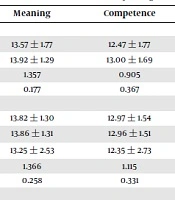
Table 3 presents the relationships between the background variables and the different domains of psychological empowerment among the faculty members. No statistically significant relationships were observed between psychological empowerment and variables including gender, employment status, faculty position, use of research opportunities and academic rank.
Table 3.
Relationship Between the Background Variables and the Different Domains of the Psychological Empowermenta
| Meaning | Competence | Self-Determination | Impact | |
|---|---|---|---|---|
| Sex | ||||
| Female | 13.57 ± 1.77 | 12.47 ± 1.77 | 10.78 ± 2.62 | 9.89 ± 2.76 |
| Male | 13.92 ± 1.29 | 13.00 ± 1.69 | 10.86 ± 2.45 | 9.98 ± 2.72 |
| t | 1.357 | 0.905 | 0.195 | 0.209 |
| P | 0.177 | 0.367 | 0.846 | 0.835 |
| Academic rank | ||||
| Instructor | 13.82 ± 1.30 | 12.97 ± 1.54 | 10.90 ± 2.58 | 10.04 ± 3.14 |
| Assistant professor | 13.86 ± 1.31 | 12.96 ± 1.51 | 10.91 ± 2.44 | 9.96 ± 2.51 |
| Associate professor | 13.25 ± 2.53 | 12.35 ± 2.73 | 10.35 ± 2.79 | 9.65 ± 2.87 |
| F | 1.366 | 1.115 | 0.421 | 0.147 |
| P | 0.258 | 0.331 | 0.657 | 0.863 |
| Employment status | ||||
| Formal | 13.77 ± 1.80 | 12.86 ± 2.20 | 10.74 ± 2.59 | 9.75 ± 2.98 |
| Contractual | 13.62 ± 1.34 | 12.89 ± 1.42 | 11.10 ± 2.35 | 10.62 ± 2.74 |
| Obligation | 13.84 ± 1.33 | 12.90 ± 1.34 | 10.79 ± 2.55 | 9.80 ± 2.46 |
| F | 0.205 | 0.010 | 0.211 | 1.101 |
| P | 0.815 | 0.990 | 0.810 | 0.335 |
| Faculty status | ||||
| Clinical | 13.64 ± 1.36 | 13.03 ± 1.57 | 10.85 ± 2.53 | 9.90 ± 2.89 |
| Non-clinical | 13.86 ± 1.65 | 12.78 ± 1.85 | 11.04 ± 2.51 | 10.02 ± 2.59 |
| t | 0.927 | 0.855 | -1.111 | -0.257 |
| P | 0.365 | 0.394 | 0.268 | 0.797 |
| Use of the study opportunity | ||||
| Inside the country | 13.50 ± 1.17 | 12.60 ± 1.64 | 11.10 ± 2.88 | 9.90 ± 4.09 |
| Abroad | 14.11 ± 1.40 | 13.05 ± 2.53 | 10.35 ± 2.91 | 10.47 ± 3.33 |
| Not used | 13.76 ± 1.56 | 12.87 ± 1.61 | 10.85 ± 2.44 | 9.84 ± 2.50 |
| F | 0.588 | 0.219 | 0.361 | 0.393 |
| P | 0.557 | 0.803 | 0.697 | 0.676 |
aValues are expressed as mean ± SD.
5. Discussion
The present study was conducted to examine the psychological empowerment of faculty members and its relationship with some occupational variables in the faculty members of KUMS. The results showed that the faculty members of KUMS obtained the highest score in the meaning domain and the lowest score in the impact domain. The faculty member’s obtained 79% of the maximum obtainable score for psychological empowerment. These findings are in line with the results of previous studies. For example, Rajaeepoor et al. reported a higher-than-average psychological ability in their study of the faculty members of Isfahan University of Medical Sciences (1). Rahimi-Dadkan and Nastiezaie also reported the psychological empowerment of the faculty members of the University of Sistan and Baluchestan as higher than average (8).
The empowerment of human resources is one of the effective tools for increasing the productivity and enabling the optimal use of individual and group capacities and capabilities for achieving organizational goals. When a faculty member performs duties independently and with freedom of action and feels that he/she can influence the goals of the university and the community, he will likely sense a greater psychological empowerment in the workplace. In the present study, the faculty members failed to obtain about 20% of the psychological empowerment score, which is an issue that necessitates further attention for the advancement of universities.
The findings also showed that age and work experience had a positive and significant correlation with the sense of meaning and sense of impact. Several studies have shown that faculty members’ participation in decision-making is an important empowering factor (15, 16). Empowering employee’s has a positive effect on their attitudes and organizational behaviors (17); therefore, awareness about the employees' ability or beliefs and emotions in an organization and the factors that increase and weaken them can be a step toward further job satisfaction, commitment and loyalty and can improve performances.
As for the promotion of psychological empowerment, Elloy proposed interest in one’s job as an important factor in job motivation and argued that interest in and desire for a job will lead to the best performance among employees (18). One study showed that the lack of trust and honesty and prioritizing individual success were the most important factors contributing to decreased psychological motivation among faculty members (19). A study by Gholifar and Gholami among faculty members showed those special skills, the organizational culture and management factors have the greatest impact on psychological empowerment (20). Studies have also proven the effective role of knowledge sharing among faculty members in their psychological empowerment (21). The sense of impact is also another important social need; in line with the present findings, the results of Brancato’s study of baccalaureate nursing faculty showed participants’ little influence over decision-making processes in their department (22). These results may be a warning to university directors and mandate further attention, especially by medical education development centers at universities.
The strengths of this study include the good cooperation of the faculty members with the researchers in completing the questionnaires and the use of a standard questionnaire with little items. The limitations of the study include data collection based on self-reporting, which is associated with a risk of recall bias.
5.1. Conclusions
The examined faculty members failed to obtain about 20% of the psychological empowerment score, which requires further attention in universities due to the importance of the subject in the development of medical education. The results showed a significant positive correlation between the meaning and impact domains of psychological empowerment and variables including age and work experience among the faculty members. Developing a program for the promotion of psychological empowerment among younger faculty members is therefore recommended.