
1. Background
Today, human resources play a key role in organizational changes and the higher education system of every country, both of which largely influence the development of the country (1). Universities are the most prominent manifestations of human resource investment and are essentially involved in the training and provision of efficient human resources in the community (2). Empowerment is essential to achieving the goals of sustainable development (3), while it is also a motivational and positive element in organizational commitment (4) that could increase the level of satisfaction and improve the quality of services (5).
Attention has been mostly paid to the professional growth and development of faculty members, laying the groundwork for the emergence of educational innovations, with universities playing a pivotal role in this regard (6). The experiences and perceptions of faculty members have a significant impact on the productivity of the faculty empowerment program (7). Furthermore, evidence attests to the necessity of the dynamism of university faculty members (8), and related research is crucial regarding the empowerment of the human resources of research organizations and institutions given their role in the development of the community (9). Faculty members also need to apply the learned research (10), so that the research findings resulting from research empowerment would ultimately improve community health (11).
The context, input, process, and product model (CIPP) was introduced in 1971 by Stafilbeam (cited in Gall et al.) is commonly used to assess educational programs systematically and comprehensively (12). Numerous researchers have exploited this model owing to the versatility of its components in the assessment of educational programs. Another important reason for the widespread use of the CIPP model is its suitability for the analysis of the strengths and weaknesses of various programs, which could ultimately improve performance quality (13-15). In a study in this regard, Poth et al. (16) applied the CIPP model to assess the competency-based evaluation course impacts, while Lee et al. (17) also executed the CIPP model to evaluate medical health education programs. The results of the aforementioned studies confirmed that CIPP is an appropriate model for decision-making to improve educational processes.
Considering that the universities of medical sciences are the backbone of research, the empowerment program of faculty members has recently attracted attention in Iran, while no detailed analysis has been provided to promote these programs and identify the influential components, which shows the lack of dynamism in this regard.
2. Objectives
The present study aimed to explore the components of the research empowerment program of university faculty members based on the CIPP model.
3. Methods
This qualitative study was conducted on 15 faculty members, who were recruited from different schools of Kermanshah University of Medical Sciences (KUMS) in Iran and selected via purposive sampling in 2020. The inclusion criteria of the study were membership as a faculty member of KUMS and participation in university research empowerment programs. For a comprehensive data collection, different participants were selected based on their academic rank, workplace, age, gender, and education level. Before the interview, the research objectives, duration of the interview, and confidentiality terms were clarified to the participants, and they were allowed to withdraw from the study at any given time. In addition, written informed consent was obtained from the participants prior to enrollment, and ethical issues were thoroughly addressed.
A question guide consisting of four main items (e.g. “What is the context of a research empowerment program?”) was used for the interviews. In order for a comprehensive data collection, several probes were also used. At the beginning of each interview, the participants were asked to provide their demographic data, and the interview questions were asked afterwards. The interviews were conducted in a comfortable office room in different schools. The duration of the in-depth, semi-structured interviews in the present study was approximately 30 minutes to one hour, and the interviews were recorded entirely.
After data collection, the interview contents were analyzed using MAXQDA 20 and the content analysis approach. Research codes were extracted by summarizing the meaning units related to each other and divided into different subcategories and main categories based on their differences and similarities. Following that, the extracted codes from the interview transcriptions were shared with the interviewees via phone call or in-person to ensure the trustworthiness of the developed codes. In case of disagreement, the necessary corrections were made. The data encoded by the researcher were provided to an expert in qualitative research to examine similar perceptions, and the data were re-examined. Finally, the obtained results showed a high agreement rate between the first and second extraction codes.
4. Results
In total, 15 faculty members of KUMS participating in the research empowerment program were interviewed, and 60% and 40% of the interviewees were male and female, respectively. In terms of the academic rank, the faculty members were lecturers (7%), assistant professors (33%), associate professors (47%), and professors (13%). Table 1 shows the extracted codes, subcategories, and main categories of the study regarding the context.
Table 1.
Extracted Codes of Context
| Main Categories | Subcategories | Primary Extracted Codes |
|---|---|---|
| Preparation | Need assessment | Need assessment |
| Prioritization | ||
| Unification of needs | ||
| Identification of needs | ||
| Motivation | Prerequisites | |
| Internal motivations | ||
| External motivations | ||
| Planning | Preparedness | Foresight |
| Interference | ||
| Electronic holding | ||
| Information | Information method |
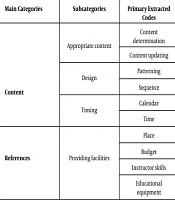
Table 2 shows the extracted codes, subcategories, and main categories of the study regarding the input component.
Table 2.
Extracted Codes of Input Component
| Main Categories | Subcategories | Primary Extracted Codes |
|---|---|---|
| Content | Appropriate content | Content determination |
| Content updating | ||
| Design | Patterning | |
| Sequence | ||
| Timing | Calendar | |
| Time | ||
| References | Providing facilities | Place |
| Budget | ||
| Instructor skills | ||
| Educational equipment |
Table 3 shows extracted codes, subcategories, and main categories of the study regarding the process component.
Table 3.
Extracted Codes of Process Component
| Main Categories | Subcategories | Primary Extracted Codes |
|---|---|---|
| Implementation | Education and documentation | Method |
| Multimedia | ||
| Documentation | ||
| Interaction | Participation | |
| Interaction | ||
| Control | Assessment | Monitoring |
| Checklist completion | ||
| Assessment |
Table 4 shows the extracted codes, subcategories, and main categories of the study regarding the product component.
Table 4.
Extracted Codes of Product Component
| Main Categories | Subcategories | Primary Extracted Codes |
|---|---|---|
| Performance | Attitude | Attitude |
| Motivation | ||
| Critical power | ||
| Quantity and quality | Research rank | |
| Level of research projects | ||
| Level of research articles | ||
| Correction | Feedback and correction | Feedback |
| Deficiency lift |
5. Discussion
The present study aimed to determine the most important influential factors in the quality of research empowerment programs for faculty members. According to the obtained results, the preparation and planning of the main categories were related to the context component in the research empowerment program, which has been emphasized in the previous studies as well. For instance, Mirzaei Karzan et al. (9) stated that essay writing and research ethics are the key components of preparation, which play different roles in the educational need assessment with the highest and lowest impacts, respectively. Furthermore, Puddester et al. (18) claimed that identifying the needs of stakeholders is essential, and Roumiani et al. (19) stated that the designated model for predicting the specialized abilities of faculty members could also be effective in achieving goals. Basically, no programs could be implemented successfully without preparation. Without planning, it is not possible to achieve goals, and the factors extracted in the present study may have significant effects on the preparation and planning of the research needs of faculty members.
Input is an important component of the research empowerment programs with two main categories of content and resources, which have been investigated in several studies so far. For instance, Heydari et al. (20) evaluated the effects of workshop performance on teaching and employees’ satisfaction using the program evaluation model, observing that the workshop was an effective method based on content component. On the other hand, Steinert et al. (21) reported that conscious educational design is an inherent element of every educational program. The study by Khanipour et al. (22) also indicated the appropriateness of the curriculum, teaching strategies, and their positive impact on the performance of faculty members and learners. In this regard, the findings of Saleh et al. (23) emphasized on the improvement of infrastructure and teaching facilities, along with the use of interactive teaching methods. Our findings in this regard are consistent with the previous studies, showing that content and resources are important requirements of every program, the lack of which disrupts the proper implementation and outcomes.
According to the results of the present study, implementation and control were the main categories of the process component in the research empowerment program, which have also been emphasized in the previous studies. Torkzade et al. (24) stated that the development and implementation of the empowerment program lays the groundwork for the growth and development of universities. Moreover, Asadi et al. (25) reported that faculty members placed greater emphasis on modern teaching methods due to their dedication to providing effective, high-quality teaching. Klinkmüller and Weber (26) also observed that the integration of expert feedback as an effective method could be used for the implementation of various educational processes. Another study by Banos et al. (27) showed that evaluation processes could be implemented effectively using digital instruments. Without implementation and control, the strengths and weaknesses of previous programs cannot be revealed, and further research programs based on these important categories could help researchers identify the opportunities, strengths, and shortcomings associated with these programs.
The results of the present study indicated that the two factors of performance and correction as the main categories of the study were related to the product component in the research empowerment program, which has also been denoted in the previous studies. In this regard, Mawlawi Diab (28) reported the effects of corrective feedback on specific forms of learners’ ability. In addition, Wilson Oliver et al. (29) claimed that key points such as performance and correction should be taken into account in education in order to improve the quality and quantity of the presented materials to the learners. The study by Olender et al. (30) also suggested that the sustainability of empowerment among faculty members gradually increases their performance over time, thereby improving the quality of education. In brief, a successful educational program must consider factors such as performance and correction as the key elements of the product component to achieve effective results.
5.1. Conclusions
In this study, eight main categories emerged, including preparation, planning, content, resources, implementation, control, performance, and correction. According to the results, these factors must be considered in enhancing the quality of research empowerment programs for faculty members.