
1. Background
Cancer diagnosis is not a life-threatening event for children and their families. Nearly 175000 new cancer cases in children under the age of 15 are diagnosed worldwide each year (1, 2). In 2021, the number of new cases was estimated at 61,090, and also 23,660 people died (3). Cancer is the second most cause of death in children aged 5 to 14 years worldwide (4, 5). In Iran, childhood cancer is also the second most cause of death in children aged 1 - 12 years. The most common type of childhood cancer is leukemia (6, 7). The main treatments for cancer are often chemotherapy, radiation therapy, and surgery.
Symptoms appear in children one hour after the start of chemotherapy, including itching, rash, hypotension, nausea, and vomiting. The most common and debilitating complication is inflammation of the oral mucosa, which can be prevented and managed by following health recommendations. By educating and empowering caregivers based on new educational methods, it is possible to significantly increase adherence to the treatment regimen, which leads to a reduction in the incidence of oral ulcers and an increase in the survival of children with cancer (6, 8). Identifying the needs of parents of their children with cancer in the areas of mental education, physical health, and medical information promotes the health and well-being of sick children (9). Children depend on family care, and the role of the active member in child care in the family is very effective in the process of treatment and recovery of the child. Psychological reactions, such as anxiety, depression, anger, and low self-esteem, are observed in the caregivers due to the fear of recurrence of the disease and the future of the child. Mothers, as the main source of support for children, can transfer anxiety and stress to the child. Parents usually suffer from a lack of knowledge about the cause and method of treatment and care, economic consequences of the child’s illness, child suffering during illness, separation from the child, unawareness about the disease's future, long-term care, frequent hospitalization, the unpredictability of the course of the disease, and the onset of complications of the disease and treatment. These issues can lead to stress and psychological and social problems while having adverse effects on the child and the treatment process (10). Awareness of parents about the disease is a vital part of child care and is essential for caring for and making appropriate decisions to support the diseased children (11, 12). The purpose of nursing interventions in family-centered care is to improve the abilities of family members in some areas to overcome the obstacles in the field of health and wellness. In this regard, the family-centered empowerment model has a great impact on family empowerment. Empowerment as a participatory educational approach requires looking at the family and its needs as the center and core of care (13, 14). The empowerment approach should be tailored to the caring conditions of a child with a chronic disease or disability (9). The family-centered empowerment model is designed with an emphasis on the effectiveness of the family role in the dimensions of motivation, psychology (knowledge, attitude, and perceived threat), performance (self-efficacy), and self-belief (self-esteem) and can simultaneously promote knowledge, skills, values, and beliefs of the patient and the family, and the main purpose of this model is to empower the family system to promote health (15). Through this model, patients and their families can identify their weaknesses and have enough power to alter their current situation, which is achieved through increased information, support, and skill development. In general, family-centered empowerment can be considered an important way to improve patient self-care and to involve family members (16). Evidence shows that educating sick children and their families strengthens their knowledge and skills (6). Hakim et al. showed that the empowerment model increases care knowledge and prevention of ostomy complications in children (17). One of the most important responsibilities of a nurse is to promote the level of health and empowerment of the family, and in this process, the education of the whole family is emphasized (6). Having children with chronic diseases can have adverse effects on other family members, especially mothers, and can reduce self-esteem and increase anxiety and stress.
2. Objectives
Due to the lack of codified education in this field, this study was carried out to show the impacts of the family-centered empowerment model on the knowledge and care performance of mothers of children with leukemia.
3. Methods
This study was a clinical trial (Iranian Randomized Clinical Trials 20200325046857N1), and the study population included mothers of children with cancer who were referred to the oncology wards of educational hospitals. The researcher sampled after receiving a written letter from the Ethics Committee of Ahvaz Jundishapur University of Medical Sciences and obtaining the consent of the study participants. The samples were selected based on inclusion criteria, such as the living of the primary caregiver with the patient, the child’s age ranging from 2 to 12 years, the willingness of the primary caregiver of the family to answer questions and to participate in the research and passing at least six months from the diagnosis of the child’s illness. Exclusion criteria were unwillingness to cooperate, not attending at least one training session, not completing questionnaires, and having acute problems, including bleeding, severe infection, and other issues that cause the patient and his partner not to cooperate. In this study, using the opinions of a statistical consultant and based on the following formula from the literature and the evaluations performed, the number of samples was estimated to be 62 people.
The samples were arranged numerically and then randomly divided into odd and even numbers in two test and control groups. Subsequently, a questionnaire was distributed among the samples, and after analyzing the data, the first stage (before the intervention) led to the identification of the limitations, needs, and weaknesses of the caregivers in various fields. After that, in the second stage, the intervention was performed using educational content.
The education was conducted in five sessions of 45 minutes (two sessions per week). At the end of each session, the prepared pamphlets were given to the patients and their families. No intervention was performed on the control group, but due to ethical considerations, they were provided with educational booklets and pamphlets related to each session. The implementation of the model involved four steps: The first step was to identify the perceived threat through education and group discussion, the second step was to promote self-efficacy through problem-solving, group problem-solving, and practical demonstration, and the third step was to increase self-confidence through public participation, and the fourth step was related to evaluation, which involved formative on-the-job evaluation and final evaluation with questionnaires and checklists.
Data collection tools included a questionnaire containing demographic information (age, sex, number of children, occupation, income, number of hospitalizations, and hospitalization history) and empowerment model components (self-efficacy, self-control, perceived sensitivity intensity, and perceived threat severity). To determine the validity of the questionnaire, the method of content validity was utilized. The questionnaire was given to ten faculty members of the School of Nursing and Midwifery. Data analysis was done using SPSS22 and independent t-test, and Chi-square test (Figure 1).
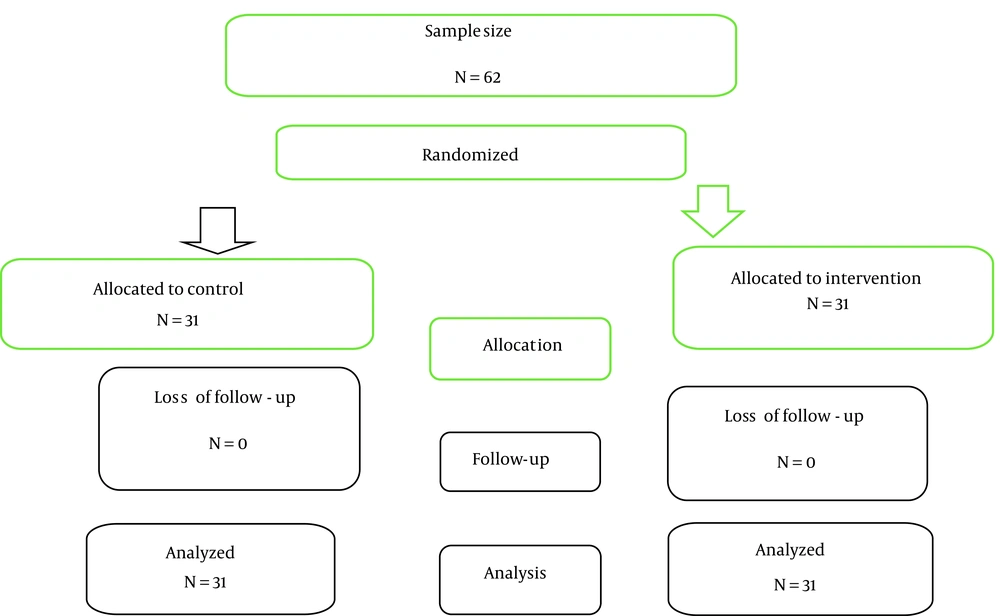
Figure 1.
Consort table
4. Results
In this study, the mean age of the considered children was 4.93 years in the intervention group and 5.41 years in the control group. The mean birth weight in the intervention and control groups was 3.27 and 3.36 kg, respectively. To compare age and birth weight, a t-test was used. There was no statistically significant difference between the two groups in terms of age and mean birth weight, and they were quantitatively homogeneous (Table 1). The Chi-square test showed that the demographic characteristics between the two groups were not statistically significant, and the groups were qualitatively homogeneous (Table 2). To compare the knowledge score of parents of children with leukemia in the intervention and control groups, a t-test was used, which showed that the two groups had a significant difference (P < 0.001) (Table 3). Based on the t-test results (P < 0.001), a significant difference was found between the intervention and control groups in terms of scores for measuring the knowledge of care performance in complications in mothers of children with leukemia (Table 4).
Table 1.
The Difference in Terms of Age, Birth Weight, and Current Age Between the Intervention and Control Groups a
| Variables | Control | Intervention | P-Value |
|---|---|---|---|
| Age | 5.41 ± 2.82 | 4.93 ± 2.95 | 0.512 |
| Birth weight | 3.36 ± 0.51 | 3.25 ± 0.58 | 0.505 |
| Current weight | 1.83 ± 7.18 | 17.56 ± 7.93 | 0.507 |
a Values are expressed as mean ± SD.
Table 2
. The Difference in Terms of Demographic Characteristics Between the Intervention and Control Groups a
| Variables | Control | Intervention | P-Value |
|---|---|---|---|
| Gender | 0.611 | ||
| Male | 17 (54.8) | 16 (51.6) | |
| Female | 14 (45.2) | 15 (48.4) | |
| Mothers’ education | 0.639 | ||
| Illiterate | 6 (19.4) | 5 (16.1) | |
| Primary | 6 (19.4) | 9 (29) | |
| Guidance school | 16 (51.6) | 16 (51.6) | |
| High school | 3 (9.7) | 1 (3.2) | |
| Fathers’ job | 0.3 | ||
| Employee | 5 (16.1) | 6 (19.4) | |
| Freelance | 9 (29) | 12 (38.7) | |
| Unemployed | 17 (54.8) | 13 (41.9) | |
| Family income | 0.277 | ||
| Low | 23 (74.2) | 19 (61.3) | |
| Medium | 8 (25.8) | 12 (38.7) | |
| Family history of leukemia | 1 | ||
| Yes | 3 (9.7) | 3 (9.7) | |
| No | 28 (90.3) | 28 (90.3) | |
| Number of children | 0.269 | ||
| One | 12 (38.7) | 13 (41.9) | |
| Two | 10 (32.3) | 14 (45.2) | |
| More than two | 9 (29) | 4 (12.9) |
a Values are expressed as No. (%).
Table 3.
Mean Knowledge Score of Parents of Children with Leukemia in the Control and Intervention Groups a
| Parent Knowledge | Control | Intervention | P-Value |
|---|---|---|---|
| Before | 2.53 ± 1.40 | 3.09 ± 1.10 | 0.002 |
| After | 3.22 ± 1.08 | 6.2 ± 0.82 | < 0.001 |
| Means difference | 1.19 ± 1.10 | 3.19 ±1.47 | < 0.001 |
a Values are expressed as mean ± SD.
Table 4.
Scores of Assessing Knowledge of Care Performance for Complications in the Control and Intervention Groups a
| Assessing Knowledge of the Performance of Care for Complication | Control | Intervention | P-Value |
|---|---|---|---|
| Before | 12.8 ± 1.66 | 16.09 ± 1.98 | < 0.001 |
| After | 14.9 ± 1.51 | 28.64 ± 1.51 | < 0.001 |
| Means difference | 1.29 ± 1.18 | 12.54 ± 2.01 | < 0.001 |
a Values are expressed as mean ± SD.
5. Discussion
The results showed that the mean score of parents' knowledge increased significantly after the family-centered educational model was implemented. In other words, the subjects in the intervention group achieved a better score than the control group. In this regard, Arief et al. showed that family-centered empowerment provides an opportunity for families to acquire the knowledge and skills needed to better manage their children's problems (18). Moreover, Hakim et al. showed that the family-centered empowerment model was effective on parental care knowledge (17), which is in concord with the results of the present study. This consistency between the results of the studies indicates the homogeneity of knowledge and practice of the mothers in the study group. Similar to previous studies, education had a significant role in increasing parental knowledge. In order to achieve change in the behavior of the parents, education should also be continuous. The results showed that the score of care knowledge in the control group increased significantly compared to the intervention group. In other words, the care knowledge in the intervention group highly increased. In this regard, some studies have shown that the implementation of the empowerment model increases care knowledge. The results of a study on the effect of the family-centered empowerment model on mothers of children with cancer showed that the implementation of the empowerment model reduces the effects of chemotherapy in children so that in this study, the average score of parental knowledge increased in the intervention group but did not differ significantly in the control group (19). The results of another study also showed that empowering caregivers reduces the incidence of wounds caused by chemotherapy, and after the implementation of the empowerment model, there was a statistically significant difference between the groups of intervention and control (20) which is in correlation with this study. This correlation between the results of this study and the previous studies indicates the homogeneity of the age group of children in the studies. The present study showed that the mean performance score of parents of children with leukemia increased significantly in the intervention group compared to the control group after the implementation of the family-centered educational model. In this regard, it has been shown that educating children with diabetes and their families to follow a treatment regimen through a family-centered educational program increases the awareness of children and their families (21). The results of this study are consistent with the present study, and the two groups were similar in terms of age (2 - 12 years), which shows that the use of a family-centered empowerment program can lead to better control and care of the disease, resulting in an improvement in the family function and an increase in the quality of care. The results of the present study indicated the effectiveness of the empowerment model in improving maternal care performance. In this regard, the results of a study showed that family-centered care improves skills in children with cerebral palsy and also leads to the well-being of caregivers and their mental health (22), which agrees with our study. Teymouri et al. showed that the implementation of a family-centered empowerment model can increase knowledge, self-worth, and self-efficacy and ultimately increase the life quality of children with asthma (23). In explaining these results, it can be said that the intervention group gained the necessary knowledge about changing their status during the educational sessions; thus, it can be expected that at the end of the educational program, the intervention group had a significant increase in knowledge level compared to the control group. The mean score of perceived severity of parents in the intervention group increased significantly compared to the control group after the intervention. In this regard, Wacharasins showed that the implementation of a family-centered empowerment model can increase awareness and change the attitude of families of children with thalassemia. According to the results of the mentioned study, after implementing this model, there was a significant difference in the level of children's awareness in all dimensions (24), which agrees with the results of the present study. In this study, a statistically significant difference existed between the two groups in terms of the mean score of perceived threat before and after the intervention. In other words, the results showed the effect of the educational program on the intervention group. The results obtained in this regard are consistent with the findings of Afzali et al. In their study, using the family-centered empowerment model, they were able to reduce the clinical signs of confrontational disobedience disorder in children (25). These results can confirm that by recognizing their situation towards this disease, the people feel that if they are taught the correct behavior and if the empowerment model is properly implemented, the ground for behavior will change, especially the behaviors that have become a habit, and ultimately it leads to better disease management. We observed a statistically significant difference between the intervention and control groups after implementing the family-centered empowerment model. In other words, the implementation of the empowerment model results in the self-efficacy of the individuals in the intervention group. In this regard, Moore et al. showed that the implementation of the family-centered model in children with brain injuries improves family care and helps their families (26), which is consistent with our results. Therefore, the health team, especially nurses, can improve the health of families by implementing a family-centered empowerment model in relevant medical institutions. One of the strengths of the results of the present study is that mothers, by gaining more knowledge about the disease, its severity, and complications due to the disease, better understand the health status of patients, and finally, they can provide the best care for their children with proper disease management. It should be noted that there were no specific restrictions for conducting this study.
5.1. Conclusions
The present study results can confirm that education based on the implementation of the family-centered empowerment model for mothers as the main caregivers of children can increase their self-esteem and self-confidence to change the situation and control the disease by sharing their experiences and information. Therefore, according to the results of this study, it is necessary for health managers to consider family-based education in relevant medical institutions because this educational method reduces the cost of care and improves the quality of care.