
1. Background
Death anxiety is a persistent and irrational fear of dying. This anxiety can create a sense of insecurity, and older adults may be unaware of this fear. Death anxiety negatively affects mental health and can lead to psychiatric disorders (1). In older adults, anxiety can adversely affect cognitive function (2) and quality of life (3). This condition is common and becomes more prominent after middle age (4). Pandemics, such as COVID-19, can heighten fear and anxiety about death and affect daily life. The prevalence of death anxiety among older adults has been reported to be high during the COVID-19 pandemic (5).
The COVID-19 pandemic began globally in December 2019 and resulted in 6.87 million deaths worldwide by May 2023. The World Health Organization (WHO) declared COVID-19 a pandemic on March 11, 2020. Since the beginning of the COVID-19 pandemic, international communities have worked to combat the disease and protect their populations. The number of deaths caused by COVID-19 has been reported to be high in developing countries (6). The mortality rate of COVID-19 in older adults is also high because these individuals are among the most sensitive and vulnerable groups (7). Approximately 80% of deaths related to COVID-19 in Korea occurred in patients aged > 70 years, and 90% of COVID-19 deaths in Italy occurred in patients aged > 60 years (8). In the United States, 80% of deaths related to COVID-19 were reported among people older than 65 years (9).
In 2019, the WHO reported that the population of individuals aged 60 years and older was one billion. This figure is projected to reach 1.4 billion by 2030. Developing countries will account for about 70% of the world’s older population. Almost 10% of the Iranian population is older than 60 years, and this proportion is predicted to increase to 31% over the next 25 years. The growing population of older adults directly affects economic, social, cultural, and health systems. Iran has an aging population and has implemented successful national programs to improve the quality of life of older adults.
According to reports from the Iranian Ministry of Health and Medical Education, about 7.6 million confirmed cases and 146.165 deaths were recorded up to May 12, 2023. In addition, 39.3% of COVID-19-associated hospitalizations and 63.5% of COVID-19 deaths occurred in older adults. The high mortality rate of COVID-19 in older adults may increase death anxiety in this large population. A 2021 study by Nafei et al. reported a high level of death anxiety among older adults during the COVID-19 pandemic. However, that study could not determine whether this anxiety was directly attributable to the crisis (4), and no other evidence is available.
2. Objectives
Accordingly, the objective of this study was to investigate the association between COVID-19 infection and death anxiety among older Iranian adults during the pandemic.
3. Methods
3.1. Design and Sampling
This study used data from a national survey conducted in 2021 - 2022 to investigate levels of death anxiety among Iranian older adults. The survey was administered online and targeted individuals aged 60 years and older who were living in Iran (4). Given the COVID-19 social-distancing restrictions, an online survey was used for data collection. Smartphones have been reported to be the most common device for online communication among older Iranian adults (10). Therefore, social networks such as Telegram, WhatsApp, and Instagram were selected as the primary platforms for sharing the questionnaire. Convenience sampling was used. The inclusion criteria were age 60 years or older, ability to read and write, and access to popular social media platforms in Iran. The exclusion criteria were incomplete questionnaires and lack of informed consent.
3.2. Data Collection
Data were collected using an anonymous online questionnaire consisting of 22 questions. It comprised three sections. The first section assessed respondents’ demographic characteristics, including age, gender, marital status, and education. The second section included questions related to COVID-19, addressing the extent of news follow-up and experiences of bereavement among family members, relatives, or friends. The final section included Templer’s Death Anxiety Scale (DAS), developed in 1970 to assess individuals’ concerns, fears, and apprehensions about dying. The instrument consists of 15 items answered with “YES” or “NO” responses. The total score, calculated as the sum of all items, was used for statistical analysis. The scoring system categorizes anxiety levels as mild (0 - 5), moderate (6 -7), and severe (8 - 15) (11). In this study, the Persian-language version of the Death Anxiety Questionnaire, previously translated and standardized by Rajabi in 2002, was used. It demonstrated a Cronbach’s alpha reliability coefficient of 0.73.
3.3. Data Analysis
After data collection and importation into SPSS software, version 22 (IBM Corp., Armonk, NY, USA), analyses were performed using descriptive statistics, including frequency distributions, mean, and standard deviation, and inferential statistics, including the Kolmogorov-Smirnov test, t-test, and analysis of variance (ANOVA). Listwise deletion was applied for missing responses. SPSS was used to calculate Cronbach’s alpha, with a threshold of 0.7 or higher considered acceptable.
3.4. Ethical Considerations
This study was part of a research project reviewed and approved by the Research Ethics Committee of the Avicenna Research Institute (approval ID: IR.ACECR.AVICENNA.REC.1403.009). Online informed consent was obtained from all participants. Participants’ personal information was kept confidential throughout the study.
4. Results
A total of 3,476 individuals viewed the questionnaire, and approximately 90% completed all questions. The mean questionnaire completion time was 195 seconds. The devices used were mobile phones (87%), tablets (3%), and computers (10%). Ultimately, 3,129 older adults from all provinces of Iran participated in this study.
Table 1 shows the frequency distribution of older adults by demographic variables and the distribution of participants by province.
Table 1.
Frequency Distribution of Older Adults According to Demographic Variables
| Variables | No (%) |
|---|---|
| Gender | |
| Women | 1868 (59.7) |
| Men | 1261 (40.3) |
| Age | |
| 60 < 65 | 2153 (67.8) |
| 65 < 70 | 513 (16.9) |
| 70 < 75 | 411 (13.9) |
| > 75 | 52 (1.7) |
| Marital status | |
| Single | 361 (11.9) |
| Married | 2768 (88.1) |
| Education level | |
| University | 1383 (42.3) |
| Primary to high school | 1746 (57.7) |
| Province | |
| East Azerbaijan | 133 (4.25) |
| West Azerbaijan | 100 (3.20) |
| Ardabil | 74 (2.36) |
| Isfahan | 107 (3.42) |
| Ilam | 52 (1.66) |
| Alborz | 126 (4.03) |
| Bushehr | 73 (2.33) |
| Tehran | 480 (15.33) |
| Chaharmahal and Bakhtiari | 69 (2.21) |
| South Khorasan | 66 (2.11) |
| Razavi Khorasan | 192 (6.14) |
| North Khorasan | 75 (2.40) |
| Khuzestan | 103 (3.29) |
| Zanjan | 90 (2.88) |
| Semnan | 53 (1.69) |
| Sistan and Baluchestan | 68 (2.17) |
| Fars | 106 (3.39) |
| Qazvin | 84 (2.68) |
| Qom | 65 (2.08) |
| Kurdistan | 68 (2.17) |
| Kerman | 119 (3.80) |
| Kermanshah | 104 (3.32) |
| Kohkiluyeh and Boyer-Ahmad | 64 (2.05) |
| Golestan | 92 (2.94) |
| Gilan | 105 (3.36) |
| Lorestan | 71 (2.27) |
| Mazandaran | 101 (3.23) |
| Markazi | 77 (2.46) |
| Hormozgan | 71 (2.27) |
| Hamadan | 80 (2.56) |
| Yazd | 61 (1.95) |
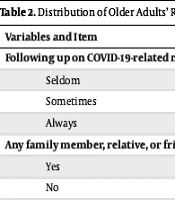
The findings indicated that 83.70% of older adults always or sometimes followed COVID-19-related news, and approximately 16.30% did not follow the news at all. Moreover, 21.6% reported that at least one family member, relative, or friend had died of COVID-19 (Table 2). The mean total death anxiety score was 8.35 (SD = 4.95). Among the participants, 1274 (40.7%) had mild symptoms, 529 (16.9%) had moderate symptoms, and 1326 (42.4%) had severe symptoms. The results suggested that the provinces of Ardabil, Kurdistan, and Semnan had lower levels of death anxiety. In contrast, the provinces of Qom, Kerman, and East Azerbaijan had the highest levels of death anxiety. The Kolmogorov-Smirnov test indicated that the death anxiety variable followed a normal distribution (P = 0.053).
Table 2.
Distribution of Older Adults’ Responses to COVID-19-Related Variables
| Variables and Item | No. (%) |
|---|---|
| Following up on COVID-19-related news | |
| Seldom | 510 (16.29) |
| Sometimes | 1261 (40.26) |
| Always | 1358 (43.44) |
| Any family member, relative, or friend died from COVID-19 | |
| Yes | 676 (21.6) |
| No | 2453 (78.4) |
Anxiety levels among women were significantly higher than those among men (t = 4.86, P < 0.001). In addition, death anxiety was significantly higher among single older adults than among married individuals (t = 4.12, P < 0.001). No significant relationship was found between education and death anxiety (t = -1.69, P = 0.091). The severity of death anxiety was significantly higher among older adults who had lost at least one family member, relative, or friend due to COVID-19 (t = 5.78, P < 0.001). ANOVA showed that anxiety in the age group of 60 to less than 65 years was significantly higher than that in the other age groups (F = 68.09; df = 3, 3125; P = 0.003). Following news about the COVID-19 pandemic was associated with higher levels of death anxiety among participants (F = 111.68; df = 2, 3126; P = 0.013) (Table 3). Cronbach’s alpha for Templer’s Death Anxiety Questionnaire was 0.85, which was within the acceptable range.
Table 3.
Relationship Between the Severity and Rate of Death Anxiety with Demographic and COVID-19 Variables (N, 3129) a
| Variables | Mean ± SD | Mild | Moderate | Severe |
|---|---|---|---|---|
| Gender | ||||
| Women | 8.99 ± 5.98 | 512 (16.37) | 295 (9.44) | 1061 (33.90) |
| Men | 7.90 ± 6.83 | 616 (19.67) | 75 (2.40) | 570 (18.22) |
| Age b | ||||
| 60 < 65 | 9.88 ± 5.63 | 821 (26.23) | 308 (9.86) | 1025 (32.76) |
| 65 < 70 | 8.13 ± 4.04 | 154 (4.92) | 51 (1.63) | 309 (9.88) |
| 70 < 75 | 7.18 ± 2.04 | 102 (3.25) | 154 (4.92) | 154 (4.92) |
| > 75 | 7.02 ± 3.74 | 51 (1.63) | 0 (0.00) | 0 (0.00) |
| Marital status | ||||
| Single | 8.14 ± 7.00 | 52 (1.66) | 52 (1.66) | 257 (8.21) |
| Married | 8.03 ± 6.92 | 1075 (34.36) | 462 (15.35) | 1231 (39.35) |
| Educational level | ||||
| University | 8.19 ± 6.94 | 410 (13.10) | 154 (4.73) | 819 (26.17) |
| Primary to high school | 8.34 ± 6.07 | 821 (26.24) | 360 (11.50) | 565 (18.06) |
| Following up on COVID-related news c | ||||
| Seldom | 4.88 ± 5.63 | 124 (3.96) | 119 (3.80) | 267 (8.53) |
| Sometimes | 7.06 ± 6.20 | 473 (15.12) | 143 (4.57) | 815 (26.05) |
| Always | 10.11 ± 7.19 | 369 (11.79) | 224 (7.16) | 819 (26.17) |
| Any family member, relative, or friend died of COVID-19 | ||||
| Yes | 9.99 ± 7.08 | 165 (5.30) | 223 (7.1) | 288 (9.2) |
| No | 8.19 ± 6.88 | 1255 (40.1) | 675 (21.60) | 523 (16.7) |
a Values are expressed as No. (%) unless indicated.
b Post hoc: F = 68.09; df = 3, 3125; P = 0.003.
c Post hoc: F = 111.68; df = 2, 3126; P = 0.013.
5. Discussion
The present study aimed to assess the relationship between COVID-19 infection and death anxiety among older Iranian adults during the pandemic, using data collected via online questionnaires. The findings indicated that approximately 60% of older adults experienced moderate to severe death anxiety. Death anxiety was significantly higher among older adults who had lost at least one family member, relative, or friend due to COVID-19. Individuals who followed COVID-19-related news had higher levels of death anxiety. Guner et al. (12) reported moderate death anxiety in Turkish older adults during the pandemic. Moreover, Rababa et al. (13) found that most older adults experienced severe death anxiety during the COVID-19 pandemic. In the current study, exposure to COVID-19-related news was associated with greater death anxiety in older adults, and anxiety was higher among individuals who experienced loss due to COVID-19. Chen et al. partially attributed this relationship to the mediating effects of empathy and sympathy (14). A study by Ng et al. revealed that older adults who closely followed media and COVID-19-related news had higher levels of depression and unhappiness. However, although media exposure may be negatively associated with mental well-being, the effects of negative and positive news may be interpreted differently (15).
As demonstrated in this study, intervention programs for older adults are essential to mitigate the psychological impact of this disease. Several countries that provide health services implemented intervention programs across all aspects of this disease, including mental health services, during the COVID-19 pandemic (16). The study by Rezaee et al. emphasized the need for practical guidelines to safeguard the mental health of older adults during pandemics such as COVID-19 (17).
In previous studies, depression, anxiety, negative psychological effects, panic attacks, psychomotor excitement, psychotic symptoms, delusions, and even suicidal tendencies were observed among SARS survivors (16, 18).
International health policymakers recommend public education via social media regarding the adverse psychological outcomes of the COVID-19 pandemic. These educational programs provide behavioral recommendations and advise people to educate themselves about this disease (19). Physical exercise programs and telemedicine have been reported as effective preventive measures to reduce the psychosocial impacts of the COVID-19 pandemic (16). Implementing spiritually oriented care programs has been suggested as a helpful intervention to overcome fear of COVID-19 during health disasters (20). To reduce death anxiety during pandemics, self-care education through telenursing has also been recommended as a non-pharmacological, low-cost intervention (21). As the first line of interaction with older adults, nurses play a crucial role in efficiently delivering telehealth programs (22).
The Ministry of Health and non-governmental organizations should strongly emphasize monitoring news about the COVID-19 pandemic and other natural disasters in virtual and public media. In this regard, Iran has relatively good internet and social network infrastructure, suggesting that the country’s health system can use the practical and valuable experiences of other countries. Education should be provided to older adults to reduce the adverse effects of death anxiety. The results of the present study also highlight the need to provide psychological and social support services to older adults who may face the consequences of potential health disasters in the future. Older adults should be informed about how to access these services during health disasters. Regular dissemination of accurate, trustworthy, and formal information by state authorities can help prevent the effects of unreliable and sometimes fake news in cyberspace.
5.1. Limitations
In this study, data were collected online using written questions. Oral interviews could not be conducted due to limitations related to the COVID-19 pandemic. Because an online convenience sampling method was used, our sample may not be representative of the broader population of Iranian older adults, particularly those with limited internet access or lower digital literacy.
5.2. Conclusions
This study highlighted death anxiety as a significant adverse psychological outcome associated with the COVID-19 pandemic. Our findings indicated that, during the pandemic, a substantial proportion of older adults experienced high levels of death anxiety. This underscores the need to address the mental health challenges faced by this vulnerable population. Older adults require increased support to manage these challenges; therefore, it is essential to enhance awareness programs and targeted interventions during pandemics.
Moreover, it is imperative to continue assessing levels of death anxiety among older adults even after the pandemic subsides. Long-term monitoring and support may help mitigate lingering psychological impacts and improve overall well-being. Future research should focus on developing comprehensive strategies to address death anxiety and other mental health issues among older adults after pandemics, ensuring that their unique needs are met with practical and sustainable solutions.