
1. Background
Aging is an inevitable reality and marks a transition from one stage of life to another (1). In recent years, with increased life expectancy and longer lifespans, older adults have come to constitute a substantial proportion of the population in many societies (2). As the global population of older adults grows, there is increasing attention to effective strategies for promoting their mental health and quality of life (3). Older adults are particularly vulnerable to various challenges, including physical decline, loneliness, the loss of loved ones, and concerns about the future (4, 5).
Studies indicate that older adults are more susceptible to chronic stress and environmental changes than are other age groups. Perceived stress and persistent anxiety in this population can lead to disorders such as depression, reduced quality of life, and even increased mortality rates (6). Therefore, aging involves a complex set of physical, psychological, and social challenges that require a balanced approach to acceptance and adaptation. One key component of this process is tolerance toward difficulties, which plays a vital role in maintaining mental health and life satisfaction in older adults (7). Psychological tolerance and personal spirituality have been shown to serve as powerful internal resources that can enhance the capacity to cope with adversity (4, 8, 9). This is particularly relevant because people, especially in old age, seek not only physical well-being but also spiritual peace and a deeper sense of meaning in life. Consequently, spiritual care not only supports mental well-being but may also contribute to improved physical health (10).
Among various approaches, spiritual self-care has emerged as an effective strategy for enhancing resilience and coping with challenges in older adults (11). Research shows that spiritual self-care can help older adults find meaning and purpose in life, reduce anxiety and depression, and increase life satisfaction (4). It is recognized as an effective method for managing stress and anxiety in this population (12). This form of care includes practices such as meditation, prayer, and the pursuit of meaning in life, all of which contribute to improved psychological health (13, 14). Studies further demonstrate that spiritual self-care reduces anxiety symptoms and enhances life satisfaction in older adults (15).
Despite this evidence, spiritual aspects are often overlooked in routine clinical care. This neglect may result in missed opportunities to promote mental health and improve the quality of life among older adults (2). Moreover, most existing studies have examined concepts such as spirituality and self-care quantitatively, while in-depth qualitative analyses of the strategies older adults use to enhance tolerance through spiritual self-care remain limited. Given that tolerance, as a psychosocial competency, can be strengthened within the context of spirituality, a deeper understanding of these lived experiences can support the development of effective, context-sensitive interventions tailored to the psychological and spiritual needs of older adults.
2. Objectives
The present study aimed to identify and analyze the lived experiences of older adults regarding how spiritual self-care contributes to the development of tolerance in the face of life challenges.
3. Methods
3.1. Study Design and Setting
This qualitative study used a conventional content analysis approach and was conducted in 2024. The study explored older adults’ perceptions of spiritual self-care and its role in fostering tolerance when facing life challenges. Data were collected in a northern city in Iran.
3.2. Participants and Sampling
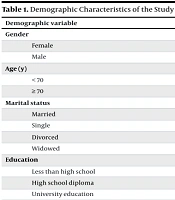
Participants were selected using purposive sampling with maximum variation to capture a broad range of experiences and perspectives. The inclusion criteria were age 65 years or older, Muslim and Iranian nationality, the ability to communicate verbally and visually, no diagnosis of terminal illness or cognitive impairment, and willingness to participate voluntarily. Sampling continued until data saturation was reached, defined as the point at which no new data or themes emerged in the final three interviews (Table 1).
Table 1.
Demographic Characteristics of the Study Participants
| Demographic variable | No. (%) |
|---|---|
| Gender | |
| Female | 9 (53) |
| Male | 8 (47) |
| Age (y) | |
| < 70 | 10 (58) |
| ≥ 70 | 7 (42) |
| Marital status | |
| Married | 13 (76) |
| Single | 2 (12) |
| Divorced | 1 (6) |
| Widowed | 1 (6) |
| Education | |
| Less than high school | 4 (23) |
| High school diploma | 7 (41) |
| University education | 6 (36) |
3.3. Data Collection
Data were collected through face-to-face, semi-structured, in-depth individual interviews with 17 participants, conducted by the first author, a doctoral student, between May 1 and October 10, 2024. Interviews were held in locations familiar and comfortable for the participants, including parks, mosques, health centers, and other public spaces. The time and place of each interview were coordinated with the participant in advance.
Before each interview, the researcher explained the purpose of the study, obtained written informed consent, and emphasized confidentiality. With participants’ permission, interviews were audio-recorded and lasted an average of 43 minutes (range, 23 - 45 minutes).
To build rapport and establish trust, each session began with introductory questions about participants’ daily lives, such as:
“How do you usually spend your day from morning to night?”
“What kinds of activities bring you joy or a sense of peace?”
The interviewer then gradually transitioned to the main open-ended questions, focusing on tolerance and spiritual self-care. Sample questions included:
“When faced with a problem in your life, how do you usually cope with it?”
“During times of emotional distress, what helps you feel better or calmer?”
“Have there been times when your faith, prayers, or relationship with God helped you handle challenges?”
“When you feel upset with someone, how do you usually respond?”
“What helps you maintain a positive outlook even during difficult times?”
“If you were to give advice to other older adults on living better and handling difficulties, what would you say?”
The interview guide was flexible and was adapted dynamically according to participants’ responses. During the interviews, the researcher also used a notebook to document nonverbal cues, including tone of voice, body language, and facial expressions, to enrich the analysis.
Interviews continued until data saturation was achieved. After the 14th interview, no new data or concepts emerged. To ensure saturation, three additional interviews were conducted, resulting in a total of 17 interviews.
3.4. Ethical Considerations
This study was approved by the Research Ethics Committee of Tarbiat Modares University (IR.MODARES.REC.1402.219). The purpose of the research was clearly explained to all participants. Participants were assured of the confidentiality of their information and were informed that they could withdraw from the study at any time during or after the interview. Both verbal and written informed consent were obtained, including permission to audio-record the interviews.
3.5. Rigor
To ensure the trustworthiness and accuracy of the qualitative findings, the four criteria proposed by Lincoln and Guba were applied:
Credibility: Achieved through prolonged engagement with the data, member checking by participants, and variation in time, setting, and sample characteristics.
Dependability: Ensured by thoroughly documenting all steps of the research process, allowing for auditability by other researchers.
Confirmability: Supported by having two independent qualitative researchers review and verify portions of the transcripts and coding.
Transferability: Facilitated by providing direct quotations, detailed demographic descriptions of participants, and a clear description of the study context to help readers determine the applicability of the findings.
3.6. Data Analysis
Data analysis was conducted using the inductive content analysis method described by Graneheim and Lundman (16). All interviews were transcribed verbatim shortly after completion and were read repeatedly by the research team to achieve immersion in the data and a deeper understanding of participants’ lived experiences. Each full transcript was treated as the primary unit of analysis.
During analysis, text segments conveying meaningful information relevant to the research objectives were identified and condensed while maintaining their underlying context and meaning. These condensed meaning units were interpreted and assigned preliminary codes. Codes were continuously compared within and across transcripts, and those reflecting similar underlying meanings were progressively organized into subcategories and broader categories. This process involved repeated movement between the original data, codes, and developing interpretations to ensure that the final structure accurately represented participants’ perspectives.
The research team engaged in ongoing analytical discussions throughout the process. Differences in interpretation or coding decisions were examined through critical dialogue, review of the original transcripts, and consensus among team members. Regular meetings were used to review coding consistency, challenge emerging interpretations, and enhance the depth and credibility of the findings.
Reflexivity was maintained throughout the analytical process. The researchers recognized that their professional backgrounds in nursing and their perspectives regarding spirituality could potentially influence the interpretation of the data. To address this, they actively reflected on their assumptions, documented analytical decisions, and used collaborative discussions to support a balanced interpretation of participants’ accounts.
An audit trail was maintained to ensure transparency and methodological rigor. The final analysis resulted in 19 subcategories that were synthesized into five overarching themes (Table 2).
Table 2.
Conceptual Dimensions and Thematic Categories of Tolerance Among Older Adults: Reflections of the Spiritual Self-Care Process
| Themes and Categories | Subcategory |
|---|---|
| Acceptance and Meaning Making of Suffering | |
| Acceptance of life’s realities | Acceptance of difficulties and suffering as part of the natural process; adapting to conditions |
| Giving meaning to suffering for others | Enduring hardships for the well-being of loved ones and escaping material concerns |
| Personal growth through suffering | Growth, learning from experiences, and development in older age |
| Self-reflection and life review | Reflecting on the past and personal transformations |
| Inner growth through hardship | Turning hardships into opportunities for self-reliance and responsibility |
| Healthy coping strategies | Patience, hope for resolution of hardships, and using emotional regulation techniques like prayer |
| Spiritual Self-Care and Emotional Regulation / Distancing from Sources of Tension | |
| Prayer and supplication | Talking to God in solitude; inner peace through prayer |
| Reliance on God | Trusting in divine support and wisdom during hardship |
| Daily religious practices | Prayer, fasting, and structuring life around spiritual routine |
| Participation in religious rituals | Active participation in religious gatherings and ceremonies |
| Engagement with sacred texts | Reading religious texts and deriving psychological calm and perspective adjustment |
| Controlling anger and preserving energy | Letting go of arguments and emotionally charged conflicts |
| Avoidance of mental and social disputes | Staying away from gossip and family tensions |
| Focus on personal values | Independence of thought; freedom from others’ judgment |
| Positive Outlook and Gratitude | |
| Positive attitude towards life | Focusing on the positive; attributing meaning to life’s events; hope for the future |
| Gratitude and appreciation | Acknowledging blessings and practicing gratitude |
| Seeing the bright side | Focusing on growth from hardship and maintaining optimism |
| Perceived Divine Support | |
| Spiritual companionship with God | Feeling God’s presence and support during distressing times |
| Mental presence during prayer | Spiritual focus; a sense of calm and centeredness during prayer |
4. Results
A total of 17 older adults participated in the study, including 9 women and 8 men. Participants were 65 to 84 years old, with a mean age of approximately 69.7 years. Regarding marital status, 13 participants were married, 2 were single, 1 was divorced, and 1 was widowed. Regarding education, 4 participants had less than a high school education, 7 had a high school diploma, and 6 had a university education (Table 1).
The thematic analysis of the 17 semi-structured interviews identified five main themes and 19 subcategories. These themes reflect various dimensions of tolerance in the face of aging-related challenges and highlight spiritual self-care as a key mechanism for promoting psychological resilience.
4.1. Acceptance and Meaning-Making of Suffering
Participants perceived suffering and life difficulties as a natural part of the aging process and as opportunities for personal growth and self-awareness. This theme comprised six subcategories: accepting life’s realities, personal growth through suffering, giving meaning to suffering for the sake of others, self-reflection and life review, inner growth through hardship, and healthy coping strategies.
Some participants described how accepting past hardships contributed to enhanced psychological strength:
“Life comes with both pain and comfort. I’ve learned to stop complaining, accept it, and move on.” (Participant 2)
Others found meaning in their suffering through service to their children or others:
“I endured everything for my children. Knowing that they’re comfortable is enough for me.” (Participant 4)
Reflecting on past experiences was also viewed as a pathway to self-discovery and life meaning:
“Sometimes I think about the past. I see that those hardships helped me understand who I am and what I’ve learned.” (Participant 3)
4.2. Spiritual Self-Care and Emotional Regulation
Participants used religious practices such as prayer, worship, fasting, and participation in religious ceremonies to manage emotions, reduce anxiety, and restore inner peace. This theme included five subcategories: prayer and supplication, daily religious practices, reliance on divine support, fasting and spiritual discipline, and participation in collective religious rituals.
For many older adults, religious rituals facilitated a deep inner connection with God:
“When I talk to God, I feel calm. It’s as if a burden is lifted off my shoulders.” (Participant 6)
Some viewed prayer not only as a form of worship but also as a means of organizing their thoughts and fostering inner peace:
“Prayer isn’t just worship; it’s like a schedule for my heart. It brings me order.” (Participant 8)
Participation in group ceremonies also helped strengthen social bonds and reduce feelings of loneliness:
“When I go to the religious gatherings, my heart calms down, and I don’t feel alone.” (Participant 7)
4.3. Distancing from Sources of Tension
To preserve their mental well-being, older adults adopted strategies such as avoiding unproductive arguments, regulating negative emotions, and focusing on personal values. This theme included three subcategories: avoiding distractions and gossip, steering clear of mental and social conflicts, and emphasizing inner values.
Many participants emphasized that consciously avoiding tension was essential for maintaining psychological peace:
“I don’t argue with anyone. If you know arguments lead nowhere, why continue?” (Participant 3)
This approach was particularly emphasized when dealing with family-related stress:
“I’ve distanced myself from family disputes and gossip. I feel more at peace.” (Participant 6)
There was also a notable sense of emotional independence and freedom from social judgment:
“What people think no longer matters to me, as long as I’m at peace with myself.” (Participant 2)
4.4. Positive Outlook and Gratitude
Maintaining a positive attitude, focusing on the brighter aspects of life, and practicing gratitude were identified as effective spiritual strategies for psychological regulation among older adults. This theme included three key components: optimism, appreciation of blessings, and hope for the future.
Ongoing gratitude was reported as a key contributor to inner peace and life satisfaction:
“Every day I thank God for my health and for having my family by my side.” (Participant 4)
Some participants viewed hardships as opportunities for personal growth and expressed gratitude for them:
“I thank God for everything I have—even the hardships, because they’ve made me stronger.” (Participant 10)
An optimistic outlook toward the future also helped alleviate aging-related concerns:
“You’ve got to see the glass half full—life is easier when you think positively.” (Participant 6)
4.5. Perceived Divine Support
Belief in continuous divine support and guidance strengthened participants’ psychological security in the face of life crises. This theme comprised two subcategories: the caring presence of God and trust in divine wisdom and guidance.
In difficult moments, the sense of companionship with God was described as a spiritual lifeline:
“Whenever I feel down, I sense that only God is truly by my side.” (Participant 10)
Faith in divine wisdom also played a vital role in reducing anxiety and promoting acceptance:
“I believe that whatever God gives has wisdom behind it—and that gives me peace.” (Participant 2)
5. Discussion
This study highlights that older adults develop tolerance through a complex process in which personal experiences, spiritual beliefs, and self-reflection interact. The findings extend previous knowledge by illustrating specific ways in which spiritual self-care helps older adults transform life challenges into opportunities for adaptation and inner growth.
The first theme shows that, by accepting suffering as a natural part of life and an opportunity for personal growth, older adults engage in spiritual development. This finding aligns with studies showing that acceptance of life’s realities and meaning-making of suffering, especially among older adults, contribute to greater resilience and reduced depression (17). The findings suggest that spirituality provides older adults with a framework for interpreting life experiences and reconstructing meaning when facing difficulties. Participants’ experiences showed that spiritual self-care helped them maintain emotional balance and develop a more peaceful perspective on suffering. These findings are consistent with qualitative studies indicating that spirituality in later life is experienced as a source of meaning, connection, and inner strength, supporting adaptation to age-related changes (18, 19). Individuals with higher levels of spirituality typically use more effective coping strategies and demonstrate a greater capacity to regain psychological balance under stress (14, 20).
Respecting older adults, tolerating generational differences, and adapting to their needs are not only signs of familial and social maturity but also moral and spiritual responsibilities. These values reflect compassion, mercy, and respect for older adults and contribute to emotional well-being and stronger family relationships (21).
The second theme highlights that older adults experienced spiritual self-care as a personal process of emotional regulation and meaning reconstruction. Participants described prayer, trust in God, and spiritual practices as resources that helped them reinterpret suffering, maintain inner balance, and respond to life challenges with greater acceptance. These findings are consistent with recent qualitative evidence indicating that spirituality in later life supports meaning-making, emotional adjustment, and adaptation to challenging experiences (22).
These findings also align with international research on the positive effects of spirituality and religiosity on the mental health of older adults. A study in Malaysia, for instance, found that participation in religious activities was associated with better quality of life and cognitive functioning (23). A systematic review further indicated that high levels of spirituality and religiosity are associated with fewer symptoms of depression and anxiety and greater life satisfaction among older adults (24). Such evidence underscores the role of spirituality as a resource for enhancing psychological resilience in later life (25).
The third theme, distancing from sources of tension, illustrates how older adults deliberately disengaged from unproductive conflicts, managed anger, and focused on core values to protect their mental energy. This withdrawal is not necessarily a sign of isolation but may represent a form of psychological self-care and preservation of dignity. Another study also noted that older adults can improve their mental health through effective coping strategies such as focusing on inner values and controlling anger (26).
Research suggests that meaning in life is associated with positive coping strategies such as positive reinterpretation, proactive planning, and self-efficacy in stress management. These findings support the idea that focusing on intrinsic values helps older adults navigate everyday stress (18). Other studies show that effective anger management plays a key role in maintaining psychological coherence and overall well-being in later life. Controlling anger reduces stress and enhances social relationships, thereby strengthening psychological resilience and reducing mental health problems (27).
Creating a calm and respectful environment is an important responsibility for caregivers, especially in emergency care for older adults. Environments characterized by patience and kindness may support physical health and foster emotional tranquility. Such compassionate care promotes human dignity and may contribute to improved quality of life and empowerment among older adults (28).
Positive thinking and gratitude also emerged as effective strategies for maintaining mental health. Gratitude, appreciation of blessings, and hope for the future increased participants’ satisfaction with life and enabled them to face hardships with optimism. This outlook served a protective psychological function and reflected the emotional maturity of older adults in challenging circumstances.
The findings of the present study are also supported by evidence showing that daily spiritual experiences can influence individuals’ perceptions of stress and their emotional responses to challenging situations. Hojjati et al. (30) reported that stronger daily spiritual experiences were associated with lower perceived stress, suggesting that spirituality may serve as an internal resource for managing emotional pressures and stressful life circumstances. Broader evidence has also linked spiritual practices with mental well-being (29). These findings highlight the role of religious coping in promoting positive social and psychological adaptation. Strengthening religious coping strategies, especially those aligned with ethical values and altruism, may serve as an intervention to reduce maladaptive behaviors and enhance mental well-being in older adults (30).
Finally, the theme of perceived divine support refers to a deep, ongoing relationship with God that, especially during crises, becomes a source of peace, hope, and meaning. This spiritual connection enabled older adults to overcome feelings of loneliness, helplessness, and abandonment and to maintain psychological security through trust in a higher power.
Several studies have emphasized the importance of understanding psychological, social, and spiritual needs in palliative care. Ashok et al. (31) identified important challenges and opportunities in providing palliative care to people with intellectual disabilities or serious mental illness, emphasizing the need for individualized and holistic approaches to care.
Based on these findings, spirituality and religion, as important psychological and social resources, may play a central role in helping older adults adapt to the challenges of aging. Considering these aspects in care and treatment planning can improve mental health and overall quality of life in this population (32). Studies also indicate that older adults with higher psychological well-being show slower cognitive decline and a lower risk of cognitive impairment, highlighting the importance of fostering optimism, self-esteem, and personal agency to preserve cognitive health (3).
Older adults with high levels of spirituality and intrinsic religiosity report fewer symptoms of depression and anxiety, greater life satisfaction, stronger social relationships, and a deeper sense of meaning. These findings support the view that spirituality and religion function as important sources of support during aging (24).
In summary, the findings show that spiritual self-care is an active, dynamic, and multifaceted process that enables older adults to maintain tolerance, peace, and psychological stability when facing challenges. Although these results align with previous literature, they emphasize the importance of strengthening spiritual resources in mental health policy for older adults. Designing spirituality-based psychosocial interventions may help empower this population to cope more effectively with life crises.
5.1. Limitations and Recommendations for Future Research
One limitation of this study was the relatively small sample size and the recruitment of participants from a specific geographic region. Moreover, the participants were Muslim Iranian older adults living in northern Iran; therefore, the findings should be interpreted within this specific cultural and religious context, and their transferability to older adults with different cultural, religious, and social backgrounds should be considered with caution. Future studies with larger and more diverse samples from different geographic regions are recommended to enhance the transferability of the findings. Exploring cultural and religious variations in experiences of spirituality and spiritual self-care among older adults may also contribute to a more comprehensive understanding of this phenomenon.
5.2. Conclusions
Spiritual self-care is an active and multifaceted process that helps older adults maintain resilience, inner peace, and mental well-being when facing life challenges. Strategies such as accepting and making meaning of suffering, participating in religious rituals, managing anger, distancing oneself from sources of stress, cultivating a positive outlook, and practicing gratitude are among the approaches used by older adults to enhance quality of life and psychological health. Recognizing the role of spirituality and religion in care and treatment planning may contribute to better mental health and greater adaptability in later life. Therefore, developing and strengthening spirituality-based psychosocial interventions may be a valuable approach to supporting older adults in coping with stress and psychological difficulties.