
1. Background
Throughout all communities and across all of recorded human history, the conviction in extraordinary operators has been found as an effective force (1, 2). Considerable research indicates that these beliefs encourage moral behavior and proliferate precisely due to the social utility served by these purported pro-social effects (3, 4). Further to this, each religion has its own unique history, as well as specific life way for its followers based on beliefs, traditions, rules, and values (2). Considering this point, religion may be considered an organized framework of convictions, hones, ceremonies, and images outlined to encourage closeness to a sacrosanct reality and to cultivate an understanding of one’s relationship and duty to others in living together in a community (5).
Islam, as the largest and fastest-growing religion in the world, has a complete way of life for Muslims (followers of Islam). Islam focuses on a perfect way to conduct individual, social, ethical, and spiritual affairs within the life of the person, society, and Muslims consolidate religion in all perspectives of their lives (6). Religion dimensions of life have been an essential component of health and well-being among people. Iranian Muslims follow Islamic concepts and traditions, and Islam plays a pivotal role in their life and culture (7). Always, the role of religion and spirituality in meeting care needs encompasses such practices as the use of prayer in preventing and healing disease. Many authors begin their writing with emphasizes the importance of bringing spirituality and prayer into the healing process (8, 9). Some evidence suggests that religion has an important role in meeting care needs of elderly people (10-12). These studies revealed that elderly people usually used religious practices as a coping strategy to reduce rates of depression and loneliness.
Although more research is needed to explore how religion plays a role in meeting the quality of life of older adults, administrators, and care providers are required to meet the religious care needs of their customers. Because religion or spirituality can be a source of comfort, and it may prove to be beneficial to their sense of satisfaction and value to encourage elderly people to participate in religious practices that employ symbols that are meaningful to them (13, 14). At the same time, religion may play a key role in a number of older persons dealing with life’s challenges; it serves as a conceptual framework for understanding the meaning and purpose of life. For this group of people, what is required is a sense of personal dignity and worthiness, which can capture through the presence of God in their lives (8).
Despite an increase in the quantitative and qualitative researches on the issues related to the elderly and their spiritual and religious activities (15-19). To date, no ethnographic research has focused on the aspects of elderly individuals’ religiosity and well-being within residential homes in Kerman province in Iran.
2. Objectives
The purpose of this study was to explore the lived experiences of older adults to determine the relationship between religiosity and subjective well-being among female institutionalized elderly people.
3. Methods
The current study employed a focus ethnographic research in Rose Institute (pseudonym) in the Kerman province (Iran) to elucidate the elderly people’s perspectives regarding their religious activities and its effect on their quality of life. Ethnographic methods are a type of qualitative approach that elicits the elderly residents’ care needs from their viewpoints to produce details of different social phenomena (11).
This type of qualitative research attempts to enter into the setting where the researcher spends an extended period of time to collect data on the experiences of elderly people in their natural setting. Ethnographic study assists researchers in seeing the world through the participants’ eyes and what they perceive as meaningful important subjects (20).
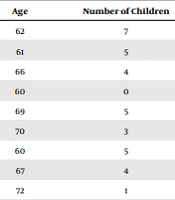
We purposefully recruited and interviewed ten female elderly people in 2019. Demographic characteristics of the participants are shown in Table 1. The age of all participants was between 60 and 72, with an average of 65.1 years.
Table 1.
Demographic Characteristics of the Participants
| Name (Pseudonym) | Age | Number of Children | Educational Level | Disease Diagnosis |
|---|---|---|---|---|
| Asra | 62 | 7 | High school | None |
| Fatemeh | 61 | 5 | Diploma | Stroke |
| Melika | 66 | 4 | High school | Heart disease |
| Neda | 60 | 0 | University | None |
| Negar | 69 | 5 | Primary school | High blood pressure |
| Raha | 70 | 3 | Primary school | Diabetic |
| Rosa | 60 | 5 | None | Asthma |
| Sara | 67 | 4 | Primary school | Diabetic |
| Shirin | 72 | 1 | Diploma | Stroke |
| Zahra | 64 | 6 | Primary school | Diabetic |
Median length of admission to the study setting was seven months. In terms of educational attainment of the elderly participants in this study, the majority had primary degrees.
At the beginning of the study, as a participant observer, principal researcher tied to remain an outsider, or a “fly on the wall.” After a few weeks, since the study took place, principal researcher assumed that he could establish rapport with key informants and more interaction with them to grasp more information regarding their daily life while keeping a certain distance.
Ethnographic research instruments used for data collection include in-depth interviews, participant observations, and field notes. Data collection process lasted about three months, most focusing on recording interactions and activities at the setting.
A semi-structured interview guide was used in this project. The sheet contains questions regarding demographic characteristics of informants, including their age and education, and the second part was related to the research questions. In-depth interviews were performed in the form of a conversation with five major guiding questions and a number of sub-questions:
- Please explain your religious activities in this setting.
- What are your religious care needs?
- Are you required to participate in religious activities here?
- Can you please tell me about your schedule for worship?
- Do you read the Quran or pray here? (If yes) what are your feelings after prayer?
Interviews were begun with demographic questions and developed into more open-ended exploratory questions related to research questions. The rationale for using semi-structured interviews was that this approach gives opportunities for the informants and researchers to explore unique experiences while still providing some framework for the interview (11). The average time of interviews with elderly people was about 42 minutes (30 - 55 minutes), depending on the participants' interests and abilities. All interviews were recorded on a digital voice recorder. Additional notes were recorded immediately following each interview by time and date to complete the information. Semi-structured interviews with participants were completed in one session, but one of them concluded during two sessions. We organized data to analyze them question-by-question to find meaningful units, develop codes, code data, find sub-categories and categorize. The interview and observation data of each participant were integrated.
Data were analyzed by drawing upon the principles of thematic analysis for emergent themes.
To this end, we used a systematic coding approach. The first level is open coding which concerns identifying, naming, categorizing, and describing phenomena found in the text. The second level is axial coding which is the process of relating codes to each other through a combination of inductive and deductive thinking. The final level is selective coding, which is a process of choosing one category to be the theme or core category and relating all other categories to those categories.
A computer software program (NVivo) was used to analyze the data to assign codes and data management. Moreover, establishing trustworthiness or rigor increases the confidence of the reader and ensures the findings are worthy of attention. In the current study, we employed four main types of triangulation: By source: Collecting data from different sources in Rose House, such as different participants at different times. By methodology: We utilized three data collection strategies, including participant observation, in-depth interviews, and field notes. By researcher: Our colleagues were asked to comment on the findings to eliminate any bias. By theories: We considered multiple theories and opinions during data analysis and interpretation.
4. Results
In our current ethnographic study, two themes emerged from participant observations, field notes, and interview transcripts: A, embedded beliefs: The religious world of key participants, religious activities, and religious faith; B, religiousness and personal beliefs: Spiritual well-being and religious concerns (Table 2).
Table 2.
Expectations of Religious Care Needs Fulfillment of Elderly People
| Themes/Axial Coding | Subtheme/Selective Coding |
|---|---|
| Embedded beliefs | The religious world of key participants; religious activities; religious faith |
| Religiousness and personal beliefs | Spiritual well-being; religious concerns |
4.1. A: Embedded Beliefs
Although religion played an important role in the lives of the Muslims, this factor seemed more pronounced and took on a new meaning for elderly people in the Rose Institute.
4.1.1. The Religious World of Key Participants
The structure and social atmosphere of the daily routine at Rose Institute reflect more on the presence of religious values among elderly people. Informants confirmed that, owing to their religious beliefs, they felt the need and obligation to help others in need.
I know what to put (on property documents) and what to give. Because here (in Iran), we have so many orphans, poor people, and old people. When I pass away, they can take (my belongings). I already signed (the papers). I have estates and pistachio gardens (Ms. Asra).
I like religious activities and giving alms. I want to do enough deeds in preparation for the next life. I have good fortune, so I give alms (Ms. Fatimah).
4.1.2. Religious Activities
The management organizes some religious activities at Rose Institute. Moreover, older persons also have their own schedule for religious practices to perform religious activities such as reciting the Quran or performing prayers. The key participants mentioned that these religious practices bring them closer to God, maintain a purpose for their lives, and prepare them for an easy death. They believed that performing extra prayer would help them overcome fear or anxiety about the past, present, and future.
We have religious talks in the morning every Monday. I have recitations of Quran every day. We also perform the usual prayers (Ms. Negar).
I will read the (whole) Quran in a month. During the fasting month, I will go for terawih prayers every night at my neighborhood mosque (Ms. Raha).
One of the elderly people stated that there was Quran reciting competitions held in her neighborhood’ mosque as a social and religious activity.
They used to have Quran reciting competitions, and for the first competition, I won the second prize, and for the second competition, I won the first prize (Ms. Rosa).
4.1.3. Religious Faith
Obviously, Islam plays an important role in everyday life of Muslims. In Muslim societies, the lives of persons, especially those who make it into old age, are full of meaning because they have a greater opportunity to pray. Since elderly people are alone in their later years, they tend to perform prayers as much as possible. This is the main activity for the majority of female to fill their idle time and draw themselves closer to God.
When I sit alone, what else can I do? I do Tasbih (Glorification of Allah); I can do hundreds or thousands. Sometimes I think I am happy because I can give alms, perform my prayers, and read the Quran because I am afraid of death. If I have enough preparation for the afterlife, then I will not be afraid to die. Even if I die today, it is fine (Ms. Sara).
I prefer to be alone, performing the prayer and reciting the Quran rather than chatting with others. I do not like to chat with them. I just talk when I think it is important (Ms. Shirin).
4.2. B: Religiousness and Personal Beliefs
Religiousness and personal beliefs were a major category in the older adults’ perceptions of religion. All informants (participants) believe that spiritual and religious beliefs have a powerful influence on their everyday life.
4.2.1. Spiritual Well-being
Religious tenets are highly personal and important to elderly people, especially at the end of their life. Additionally, all older adults who participated in the current study believed that praying can affect their feelings and make their hearts calm and peaceful, and enable them to cope with their problems in a peaceful way.
After prayer, I feel very peaceful, especially at night. You can forget all of your problems. It is only me and God (Ms. Melika).
Following this, there is a related example from one of field notes:
A woman who is a retired teacher mentioned that "when I was lying in bed I recite some Zikr”. She said “if I do not do that, I think I am wasting my time” (05.08.2019).
4.2.2. Religious Concerns
Elderly people had their own concerns regarding religious activities and also desired their life to be filled with religious activities without any disturbance to them.
I do not want anything. I just want people not to disturb me (laughs). That is all. Sometimes when I read the Quran, people come and disturb me. I do not like that (Ms. Neda).
Additionally, the prayer books and the Quran provided in the setting have small letters; thus, the elderly people cannot read them properly. Ms. Zahra, who participated in this study, acknowledged this:
I cannot read the Quran properly here because the letters are too small. I cannot see with my impaired eyes. If the letters were bigger, I could see and read them better.
5. Discussion
Spiritual care needs were found to be the most important theme related to the elderly people’ unmet care needs for this study. The key participants have asserted the significance of religious faith and spiritual well-being in their everyday life. For Muslims, religion functions as a crucial source of emotional support. Having stronger religiosity gives them a meaning of life and satisfies them with all components of life, a feeling like one has finished something in one’s life, and achieved peace and happiness (6, 21).
Religion, as a potential resource for well-being, has received increasing attention in the social science field in recent years. There is widespread agreement among researchers regarding a higher perceived capacity to cope among Muslims than adherents of other religions (21-23). These researchers believe that Muslims used religious coping methods such as reading the Quran or performing prayers after encounters with stress or loneliness to enhance their self-esteem and better navigate life’s challenges. These results are similar to the current study as informants acknowledged that reading certain Quranic verses as well as having religious practices helped them cope with stress and loneliness and made them persist despite trials happening in their lives. Performing extra prayers assist them in overcoming fear or anxiety about the past, present, or future.
Furthermore, there is widespread agreement among researchers about the positive mutual connection between religion and well-being (24, 25). They claim that individuals who attended religious activities had lower mortality rates than those who did not, and these results have a potential influence on health such that it significantly reduces depression and general distress among patients. During the data-collecting phase, we also found that elderly people believed in a variety of values. They pointed out that spirituality and belief in God strongly influence their well-being and are key factors. Similarly, another study tried to understand the relationship between religious activities and Iranian immigrants’ health in later life (26). Researchers suggest that “a spiritual sense of connection to family, others, and a spiritual sense of unity and beliefs about God and God’s will inspired their reflections and beliefs about life and the meaning of health and illness”. Therefore, the Rose Institute management must respect the values embedded in the elderly people’ minds regarding religion and make the environment comfortable and suitable for them to practice their faith.
Actually, for the Iranian, religion is a crucial source of support and gives them another meaning in life. In other words, the most important factors that play a role in Iranian people’s lives are religion and spiritual attitudes (26). In the present study, all participants stated that they attained a more positive attitude toward the future after performing religious practices. Although a body of knowledge relating to elderly people’s life is identified in the literature (18, 27), less is known about the actual process by which Iranian perform extra-religious activities and what their feeling are after performing these activities. Nonetheless, number of researchers indicated the significance of religious faith and spiritual well-being in improving older persons’ quality of life’ in other countries (28, 29). In another research done by Emami et al., the meaning of health was reviewed in the elderly Iranian immigrants. The main focus was on spirituality and its connection to health (30). The results were similar to the current study, as participants mentioned that spiritual and religious beliefs and practices play a significant role in their current lives and in their future.
Additionally, religion and personal beliefs were identified by the elderly persons as care needs important to them. Transcripts indicated that the significance and usefulness of this need were supported by statements from residents. Performing prayers was shown to have a positive influence on elderly people's everyday life and encouraged a feeling of being safe, calm, peaceful, and more confident (31, 32). In elderly people’s life, attending to their spiritual needs ensures that they have an opportunity to find meaning for the end of their life and draw themselves closer to God. Therefore, they attempt to participate in any formal and informal religious practices (33, 34). They believed that performing religious activities underpinned their way of life and effectively fed their spiritual well-being.
5.1. Limitations
The results of this study only captured the perspectives of the female elderly people who were living in the Rose House.
5.2. Conclusions
Influence of religion on older persons was found to be the most important theme in this study. The participants have asserted the significance of religious faith and spiritual well-being in their everyday life. For Iranian as Muslims, religion functions as a crucial source of emotional support. Having stronger religiosity gives them a meaning of life and satisfies them with all components of life, a feeling like one has finished something in one’s life, accomplished happiness and peace. Moreover, we also hope that this research may provide information to assist policy-makers and managers in making appropriate decisions on standards and regulations for residential homes to improve elderly’s quality of life.