
1. Background
In recent decades, chronic diseases have been recognized as major challenges facing health systems worldwide. Lifestyle changes, rapid urbanization, and advances in science and technology have contributed to a decline in communicable diseases; however, the prevalence of noncommunicable diseases continues to rise (1). Renal failure is a major chronic condition, and its incidence is increasing because of population aging and the high prevalence of diabetes and hypertension (2).
Chronic renal failure (CRF) is defined as a progressive and irreversible decline in kidney function. In advanced stages, the kidneys can no longer sustain life (3). It is a major health care challenge and a significant contributor to reduced quality of life (4). The global prevalence of chronic kidney disease is estimated to be between 8% and 16% (5).
The burden of chronic kidney disease is also substantial in Pakistan. Studies estimate that its prevalence ranges from approximately 12% to 15% among adults, largely driven by increasing rates of diabetes and hypertension (6).
Among patients with CRF, dialysis is the most common treatment used to compensate for reduced kidney function (7). Dialysis aims to prolong survival, reduce complications, and improve quality of life (8). Globally, more than 2 million patients rely on dialysis for survival. In Pakistan, more than 20,000 patients are estimated to receive regular dialysis, although many others lack access to adequate treatment because of financial and health care system constraints (9).
Despite its benefits, dialysis substantially affects patients’ physical, psychological, social, and emotional well-being. Common complications include stress, depression, hopelessness, denial, and poor treatment adherence (10). These problems can lead to dependency, occupational and social limitations, and ultimately to mental health problems and hopelessness. Many patients in Pakistan have difficulty maintaining regular treatment schedules, further contributing to feelings of hopelessness (11).
Depression is one of the most common psychological problems among patients undergoing dialysis. Studies indicate that approximately 25% to 50% of dialysis patients in Pakistan experience depressive symptoms (12). Hopelessness is also prevalent and negatively affects treatment outcomes (13). Conversely, hopefulness is a strong predictor of adaptation and plays a crucial role in rehabilitation (14). Interventions targeting patients’ attitudes may reduce psychological distress and enhance hope and treatment adherence.
Laughter therapy (LT) is a nonpharmacological intervention that can influence patients’ psychological status. Laughter is a psychophysiological activity that can positively affect emotional and cognitive states, improve attention, and promote mental well-being (15). Laughter therapy is increasingly used as a complementary, low-cost, safe, and effective intervention (16). It may help reduce depression by enhancing social interaction and improving physical health (17). Studies have also shown that laughter may boost immune function, lower blood pressure, and increase hopefulness (18).
Cognitive behavioral therapy (CBT) is considered one of the most effective psychological interventions for patients undergoing dialysis (19). It focuses on modifying dysfunctional thoughts, enhancing coping skills, and promoting a sense of control over life (20). Therapists use cognitive techniques to help patients identify and restructure negative thoughts, thereby facilitating adaptation to their condition (21).
2. Objectives
Given the importance of mental health and hopefulness for the quality of life of patients undergoing dialysis, this study aimed to compare the effects of LT and CBT on mental health and hopefulness in Pakistani dialysis patients.
3. Methods
3.1. Study Setting and Population
This quasi-experimental study was conducted in Pakistan in 2026. Participants were recruited by convenience sampling from among patients undergoing hemodialysis at a teaching hospital in Lahore. The study population comprised all patients with CRF receiving hemodialysis at the selected hospital. After eligibility screening and provision of written informed consent, eligible participants were enrolled and assigned to the LT, CBT, or control group.
Neither random sampling nor randomized allocation was used. Group assignment followed the study procedures and the practical conditions of the clinical setting. Therefore, the study was designed and conducted as a quasi-experimental study. The sample size was estimated for a three-group comparison using a one-way analysis of variance (ANOVA) framework. The calculation assumed a medium-to-large standardized effect size (Cohen’s f = 0.30), a two-sided significance level of 0.05, and 80% statistical power. Based on these assumptions, a minimum of 135 participants (45 per group) was considered adequate. Because the calculation was based on the primary between-group comparison, correlations between repeated measurements were not incorporated into the initial sample size estimate. To allow for possible attrition during follow-up, 145 participants were recruited.
3.2. Inclusion and Exclusion Criteria
Inclusion criteria were having a permanent medical record at the hospital, willingness to participate, ability to read and write in Urdu, no signs of intellectual disability, no concurrent use of medication for psychiatric disorders, no participation in other nonpharmacological psychological interventions, no reported severe stress during the preceding 3 months, no previous participation in similar interventions, and at least 6 months of dialysis treatment. Exclusion criteria were unwillingness to continue the intervention, absence from more than two intervention sessions, development of major physical or psychological conditions during the intervention that could affect study outcomes, and relocation from the study area.
3.3. Data Collection
To allow for possible attrition, 145 patients who met the inclusion criteria were initially recruited by convenience sampling. After the introductory session, all participants provided written informed consent and were enrolled. Participants were assigned to three groups: LT (n = 48), CBT (n = 48), and control (n = 49). During the intervention period, attrition occurred because of withdrawal and loss to follow-up. Three participants in the LT group, three in the CBT group, and four in the control group did not complete the postintervention assessment, leaving 135 participants who completed that assessment. During the 3-month follow-up, further attrition occurred because of death, kidney transplantation, and loss of contact despite telephone follow-up and home visits, resulting in a final follow-up sample of 121 participants. Attrition and missing outcome data were considered when interpreting the findings. The final analysis included participants with complete outcome data across all assessment time points (Figure 1).
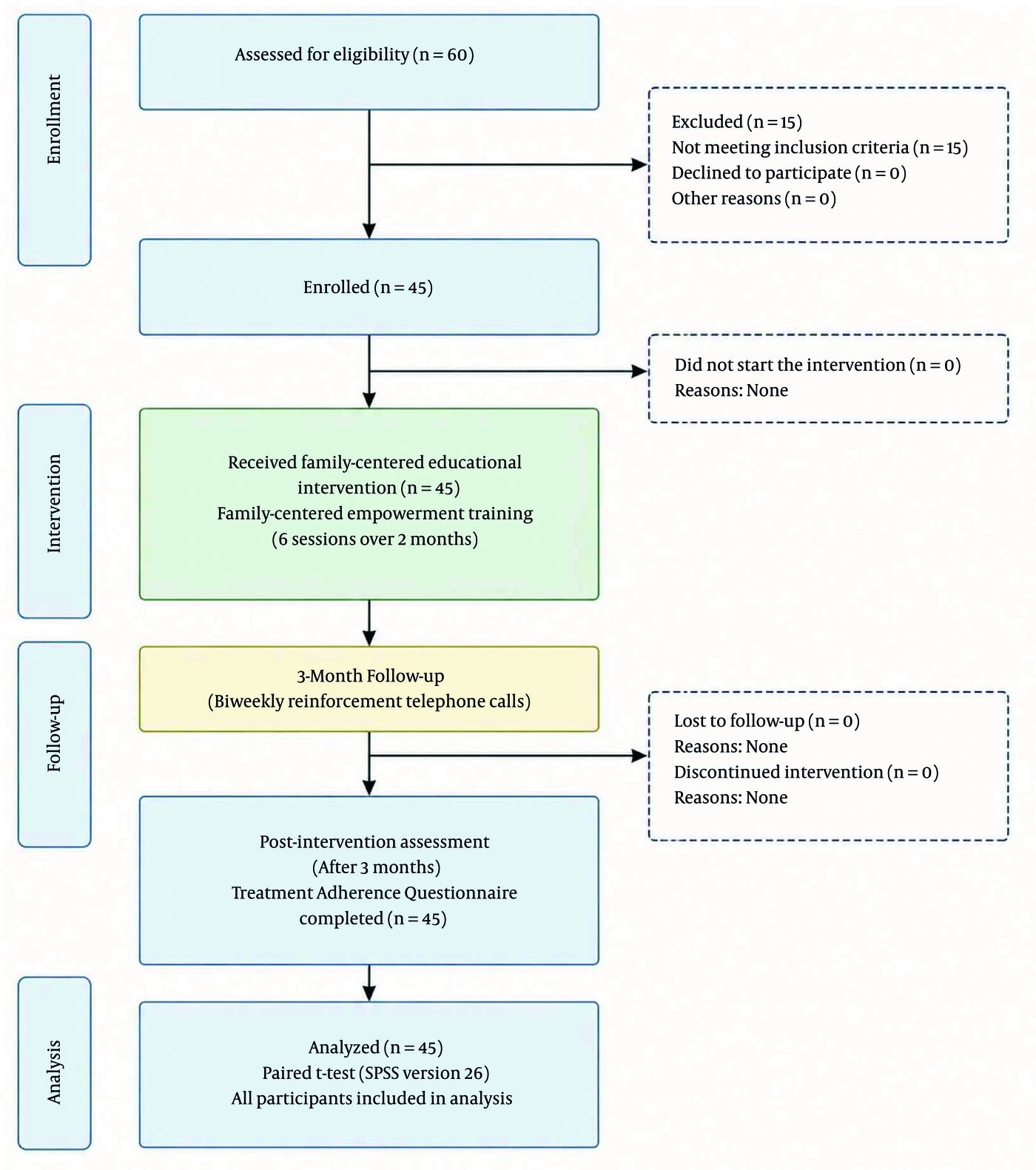
Figure 1.
CONSORT Flowchart
Data were collected in three stages. At baseline, eligible participants attended a 2-hour introductory session during which the study objectives and interventions were explained. Participants then completed the study questionnaires. The same instruments were administered immediately after the intervention to participants who completed treatment and again after 3 months to evaluate long-term effects.
A demographic questionnaire was used to collect data. The Symptom Checklist-90-Revised (SCL-90-R) was used to assess psychological symptoms (23). It measures nine dimensions: somatization, obsessive-compulsive symptoms, interpersonal sensitivity, depression, anxiety, hostility, phobic anxiety, paranoid ideation, and psychoticism. In addition to the subscales, the Global Severity Index (GSI) was used as the main outcome indicator. Responses are rated on a 5-point Likert scale from 0 (not at all) to 4 (extremely). The total or mean score is calculated by summing or averaging item responses. Higher scores indicate greater psychological symptom severity and poorer psychological status, whereas lower scores indicate fewer symptoms and better psychological well-being. The possible SCL-90-R score range depends on the number of items and the scoring method. In this study, the standardized GSI scoring procedure was used, in which a reduction in score indicates improved psychological status or decreased symptom severity. The instrument’s validity and reliability have been confirmed in previous studies (24). Cronbach’s alpha in this study was 0.863.
Hope was measured using the Snyder Hope Scale (SHS), based on Snyder’s hope theory (25). The scale is suitable for individuals aged 15 years or older and for populations with mental health conditions. It consists of 12 items rated on a 5-point Likert scale. Total scores range from 12 to 60, with higher scores indicating greater hope. The scale’s validity and reliability have been established in previous studies. Cronbach’s alpha in this study was 0.826.
Both LT and CBT comprised eight structured 1-hour group sessions in a hospital setting, with 8 - 10 participants per group. The first researcher, who held official CBT certification and had received formal training and certification in LT, facilitated both interventions. The intervention content was developed from standardized protocols and reviewed and approved by clinical psychologists. All sessions were conducted under professional supervision to maintain adherence to the intervention structure and consistency of delivery. To support intervention fidelity, each session followed a structured format: review of previous content, introduction of new material, guided practice, and assignment of home exercises. Fidelity was maintained using a session checklist and periodic supervision by clinical experts, although no external audit was conducted.
The LT intervention included deep-breathing exercises, clapping, gratitude activities, simulated laughter exercises (such as silent, loud, and prolonged laughter), light physical activity, and positive-thinking exercises. Content progressed from basic relaxation and engagement techniques to more interactive and sustained laughter practices aimed at improving emotional well-being. The CBT intervention was based on standard CBT principles and included psychoeducation about the A-B-C model, identification of automatic thoughts and core beliefs, cognitive restructuring, cognitive reframing, rational analysis, behavioral activation, and gradual exposure/desensitization techniques. Sessions were structured sequentially to support the progressive development of cognitive and behavioral coping skills.
The LT and CBT interventions were matched in duration, frequency, and therapist contact time to ensure equivalence between the two intervention groups. To ensure fairness, control-group participants were offered condensed versions of both interventions after completion of the postintervention and follow-up assessments.
Outcome assessors and data analysts were blinded to group allocation to reduce bias in assessment and analysis. Because of the nature of the interventions, participants and intervention providers could not be blinded. To minimize contamination, participants in each group attended separate intervention sessions at different times and were instructed not to share intervention content with participants in other groups during the study. Sessions were held in controlled hospital settings to reduce interaction between groups. The control group received routine hospital care and no structured psychological intervention during the study. No additional therapist contact beyond routine assessments was provided to the control group.
3.4. Data Analysis
Data were analyzed using SPSS version 26. Descriptive statistics, including means and standard deviations, were calculated for all study variables. The normality of continuous variables was assessed using the Shapiro-Wilk test. Changes in psychological symptom severity and hopefulness over time and between groups were examined using repeated-measures analysis of variance (RM-ANOVA), with time (baseline, end of therapy, and 3-month follow-up) as the within-subject factor and group (LT, CBT, and control) as the between-subject factor. Mauchly’s test was used to assess sphericity. When this assumption was violated, the Greenhouse-Geisser correction was applied. Significant interactions or main effects were followed by Bonferroni-adjusted post hoc comparisons. Effect sizes were reported as partial eta squared (ηp2), and 95% confidence intervals were calculated where appropriate. Statistical significance was defined as P < 0.05. Outcome data were missing because some participants did not complete the postintervention or 3-month follow-up assessments. Reasons for loss to follow-up included death, kidney transplantation, and loss of contact. Given the pattern and reasons for missingness, the data were not assumed to be missing completely at random. The primary analysis included participants with complete outcome data across all three assessments. The findings should therefore be interpreted cautiously because complete-case analysis may be affected by attrition-related bias.
3.5. Ethical Considerations
This study was not registered in a clinical trial registry because it was designed as a quasi-experimental study rather than a randomized controlled clinical trial. Ethical approval was obtained from the relevant institutional ethics committee, and the study was conducted in accordance with institutional ethical guidelines (UOL/IREB/26/21/03/0032). A letter of permission was also obtained from the University of Lahore to facilitate access to participants. All patients were fully informed about the study objectives, and written informed consent was obtained before participation. Participants were assured that their information would remain confidential and that they could withdraw at any time without consequences.
4. Results
Table 1 presents the demographic characteristics of participants who completed the intervention. The mean ages in the LT, CBT, and control groups were 48.11 ± 13.56, 49.00 ± 13.14, and 48.30 ± 13.38 years, respectively. The prevalence of coexisting hypertension and diabetes was 71.1%, 71.1%, and 80% in the LT, CBT, and control groups, respectively. Chi-square tests for categorical variables and one-way ANOVA for age indicated no statistically significant baseline differences among the groups (P > 0.05), confirming initial group homogeneity.
Table 1.
Descriptive Statistics for Sample Characteristics a
| Variables | LT | CBT | Control | P-Value |
|---|---|---|---|---|
| Gender | 0.808 | |||
| Female | 19 (42.2) | 17 (37.8) | 20 (44.4) | |
| Male | 26 (57.8) | 28 (62.2) | 25 (55.6) | |
| Marital status | 0.939 | |||
| Single | 8 (17.8) | 5 (11.1) | 7 (15.6) | |
| Married | 23 (51.1) | 27 (60.0) | 23 (51.1) | |
| Divorced/widowed | 14 (31.1) | 13 (28.9) | 15 (23.3) | |
| Education | 0.154 | |||
| ≤ high school | 30 (66.5) | 34 (75.7) | 34 (75.7) | |
| BSc degree | 14 (31.3) | 9 (19.9) | 9 (19.9) | |
| ≥ MSc degree | 1 (2.2) | 2 (4.4) | 2 (4.4) | |
| Job | 0.762 | |||
| Unemployed | 5 (11.1) | 9 (20.0) | 9 (20.0) | |
| Worker | 6 (13.3) | 6 (13.3) | 4 (8.9) | |
| Employee | 7 (15.6) | 8 (17.8) | 10 (22.2) | |
| Retired | 9 (20.0) | 3 (6.7) | 3 (6.7) | |
| Housewife | 9 (20.0) | 8 (17.8) | 7 (15.6) | |
| Other | 9 (20.0) | 11 (24.4) | 12 (26.6) | |
| Frequency of dialysis | 0.572 | |||
| Once a week | 17 (37.8) | 10 (22.2) | 14 (31.3) | |
| Twice a week | 17 (37.8) | 23 (48.9) | 21 (46.7) | |
| 3 times a week | 11 (24.4) | 13 (28.9) | 10 (22.2) | |
| History of dialysis | 0.979 | |||
| 6 (mo) up to 2 (y) | 14 (31.3) | 13 (28.9) | 15 (33.3) | |
| 2 - 4 (y) | 14 (31.3) | 15 (33.3) | 17 (37.8) | |
| 4 - 6 (y) | 11 (31.1) | 11 (24.4) | 8 (17.8) | |
| > 6 (y) | 6 (13.3) | 6 (13.3) | 5 (11.1) | |
| Kidney transplantation | 0.144 | |||
| Yes | 2 (4.4) | 1 (2.2) | 3 (6.6) | |
| No | 43 (95.6) | 44 (97.8) | 42 (93.4) |
a Values are expressed as No. (%). Abbreviations: LT, laughter therapy; CBT, cognitive behavioral therapy; BSc, Bachelor of Science; MSc, Master of Science.
Table 2 presents descriptive statistics for psychological symptom severity and hopefulness across the three study groups and assessment time points. Although between-group comparisons at individual time points are presented descriptively, the primary evaluation of intervention effects was based on the time × group interaction in the mixed-design RM-ANOVA. Intervention effectiveness was therefore interpreted according to differential changes over time among the groups rather than cross-sectional comparisons at individual postintervention or follow-up assessments.
Table 2.
Descriptive Statistics for Psychological Symptom Severity and Hopefulness Across Study Groups and Time Points a
| Variables and Phases | Mean ± SD | P-Value |
|---|---|---|
| Psychological symptom severity | ||
| Baseline | ||
| LT | 1.82 ± 0.23 | 0.602 |
| CBT | 1.84 ± 0.21 | |
| Control | 1.89 ± 0.32 | |
| End of therapy | ||
| LT | 1.67 ± 0.49 | 0.001 |
| CBT | 1.62 ± 0.48 | |
| Control | 2.13 ± 0.30 | |
| Follow-up | ||
| LT | 1.70 ± 0.54 | 0.001 |
| CBT | 1.65 ± 0.47 | |
| Control | 2.13 ± 0.31 | |
| Hopefulness | ||
| Baseline | ||
| LT | 37.22 ± 2.53 | 0.052 |
| CBT | 39.84 ± 3.13 | |
| Control | 40.06 ± 3.71 | |
| End of therapy | ||
| LT | 42.82 ± 4.63 | 0.001 |
| CBT | 42.40 ± 5.36 | |
| Control | 39.82 ± 2.30 | |
| Follow-up | ||
| LT | 42.00 ± 5.77 | 0.136 |
| CBT | 42.46 ± 6.01 | |
| Control | 39.03 ± 3.31 |
a Abbreviations: LT, laughter therapy; CBT, cognitive behavioral therapy; SD, standard deviation.
The mixed-design RM-ANOVA showed a statistically significant time × group interaction for psychological symptom severity (F = 12.714, P < 0.001, ηp2 = 0.300), indicating that changes over time differed significantly among the LT, CBT, and control groups. Both intervention groups showed reductions in symptom severity from baseline to the postintervention assessment, and these improvements were generally maintained at the 3-month follow-up. The control group did not show a similar pattern of improvement (Table 3).
Table 3.
Mixed-Design Repeated-Measures Analysis of Variance for Psychological Symptom Severity a
| Effect | df | F | P | ηp2 |
|---|---|---|---|---|
| Time | 2 | 18.642 | < 0.001 | 0.240 |
| Group | 2 | 16.385 | < 0.001 | 0.219 |
| Time × Group | 4 | 12.714 | < 0.001 | 0.300 |
a Time represents the within-subject effect across baseline, post-intervention, and 3-month follow-up. Group represents the between-subject effect among the laughter therapy, cognitive behavioral therapy, and control groups. Time × Group represents differences in changes over time among the three study groups. Abbreviations: df, degrees of freedom; ηp2, partial eta squared.
The mixed-design RM-ANOVA showed a statistically significant time × group interaction for hopefulness (F = 8.563, P < 0.001, ηp2 = 0.224), indicating that changes over time differed significantly among the three groups. Hopefulness increased in both intervention groups from baseline to the postintervention assessment and remained above baseline levels at the 3-month follow-up. The control group showed no comparable improvement over time (Table 4).
Table 4.
Mixed-Design Repeated-Measures Analysis of Variance for Hopefulness a
| Effect | df | F | P | ηp2 |
|---|---|---|---|---|
| Time | 2 | 15.927 | < 0.001 | 0.213 |
| Group | 2 | 4.286 | 0.016 | 0.068 |
| Time × Group | 4 | 8.563 | < 0.001 | 0.224 |
a Time represents the within-subject effect across baseline, post-intervention, and 3-month follow-up. Group represents the between-subject effect among the laughter therapy, cognitive behavioral therapy, and control groups. Time × Group represents differences in changes over time among the three study groups. Abbreviations: df, degrees of freedom; ηp2, partial eta squared.
5. Discussion
The baseline results regarding psychological distress in these patients were consistent with recent studies showing high levels of psychological distress among patients undergoing hemodialysis, including depression, anxiety, and stress (26, 27).
Baseline hopefulness scores indicated a moderate level of hope. Reduced hopefulness is a common complication among patients undergoing dialysis and can negatively affect quality of life and mental health. Low hopefulness in this population has been confirmed in previous studies (26, 28). As a powerful internal mechanism, hope can motivate individuals to cope with illness. Envisioning better conditions after recovery may also increase hope through a synergistic relationship. Goal setting and the pursuit of goals are common challenges for patients undergoing dialysis; strengthening their abilities may increase hopefulness and help address these challenges (29).
The results showed that LT reduced patients’ psychological distress and increased hopefulness, with benefits persisting at 3 months. Laughter therapy may reduce distress and maintain hope by increasing happiness and encouraging a focus on positive thoughts. As a respiratory exercise, laughter may promote relaxation. It may also help patients cope with depression by improving social interaction and physical health (30). Laughter may improve physical and psychological symptoms without imposing costs on caregivers. In LT, individuals are also encouraged to accept God as a source of strength, which may increase hope and facilitate adaptation to their circumstances. Caregivers and patients’ families may therefore use this approach to improve mood, increase hopefulness, and alleviate physical symptoms and psychological distress (31).
The results indicated that CBT improved psychological symptom severity and hopefulness at the end of therapy and at the 3-month follow-up. Cognitive behavioral therapy is a major intervention for psychological problems and is effective in reducing symptoms and preventing the recurrence of psychological distress (32). The effectiveness of hope therapy, as a component of cognitive interventions, in reducing depression, anxiety, and stress has also been confirmed in previous research (34).
Regarding the long-term effects of these interventions, psychological symptom severity increased slightly between the end of therapy and the 3-month follow-up in both intervention groups but remained below baseline. Hopefulness decreased slightly in the LT group and increased slightly in the CBT group during this interval, but remained above baseline in both groups. Comparison of LT and CBT across the three assessment stages indicated no significant difference in their effects on psychological symptom severity or hopefulness.
Several potential sources of bias should be considered when interpreting these findings. Because of the nature of the behavioral interventions, participants and therapists could not be blinded, potentially introducing performance and expectancy bias. Participants receiving LT or CBT may have expected improvement, which could partly explain the observed reductions in psychological symptom severity. Therapist expectations may also have influenced intervention delivery despite standardized protocols and supervision. Although sessions were held at separate times and interaction among participants was limited, information exchange between groups cannot be excluded. Self-reported outcomes may also have been affected by response bias related to participants’ perceptions and emotional states. The control group received routine care only and may therefore have received less attention than the intervention groups, potentially contributing to the observed between-group differences.
A limitation of this study was the lack of blinding of participants and intervention providers, which was unavoidable because of the nature of the behavioral interventions and may have introduced performance bias. Self-reported questionnaires may also have been affected by response bias related to participants’ emotional and psychological states at assessment. Despite separate sessions and efforts to limit interaction, information exchange between groups cannot be ruled out. Another limitation was the potential difference in attention received by the intervention and control groups, as the latter received routine hospital care without a structured psychological intervention. Attrition, particularly at the 3-month follow-up, was a further limitation. Some participants did not complete all assessments because of death, kidney transplantation, or loss of contact, and the final analysis included only participants with complete outcome data. Missingness may have been related to participants’ clinical conditions, so attrition-related bias cannot be excluded. The absence of a formal assessment of the missingness mechanism and sensitivity analyses further limits the certainty of the findings. Future studies should prospectively plan strategies for handling missing longitudinal data and conduct sensitivity analyses to assess the robustness of their findings.
5.1. Conclusions
In this quasi-experimental study, changes in psychological symptom severity and hopefulness over time differed significantly among the LT, CBT, and control groups. Both intervention groups improved from baseline to the postintervention assessment, and these improvements were generally maintained at the 3-month follow-up. The control group did not show a comparable pattern of improvement. However, the findings should be interpreted cautiously given follow-up attrition, complete-case analysis, and the limitations of the study design. Laughter therapy and CBT may have potential as supportive approaches to improving psychological outcomes and hopefulness among patients undergoing hemodialysis. Further well-designed studies with more rigorous control of attrition and appropriate longitudinal analyses are needed to confirm these findings.