
1. Background
Cardiovascular diseases remain a major global health burden and are a leading cause of mortality worldwide (1). Among these, coronary heart disease (CHD) is one of the most common causes of death, including among relatively younger populations (2, 3). In Pakistan, cardiovascular disease has become a major public health concern, with a reported prevalence of CHD of approximately 918 per 100,000 population and a mortality rate of approximately 358 per 100,000 population, both of which are higher than global averages (4). In addition to physical complications, patients with acute myocardial infarction (MI) frequently experience substantial psychological distress, including stress, anxiety, fear, and depression, during hospitalization and recovery (5-8).
Evidence suggests that psychological distress is highly prevalent after MI, particularly within the first weeks following the event, and may persist in a substantial proportion of patients (9, 10). These psychological reactions are clinically important because they are associated with poorer recovery, reduced quality of life, impaired self-care, an increased risk of adverse cardiac outcomes, and higher rates of hospital readmission (7, 8). Therefore, addressing psychological distress is an essential component of comprehensive cardiac care.
Nurses in cardiac care units play a central role in patient recovery through continuous monitoring, emotional support, and therapeutic communication (11, 12). Non-pharmacological interventions, such as supportive communication and environmental modifications, have been proposed to reduce stress and improve patient outcomes (13). One such intervention is white noise, a non-invasive auditory stimulus that may promote relaxation and improve sleep quality by masking disruptive environmental sounds (14).
However, despite growing interest in non-pharmacological strategies for stress reduction in cardiac patients, evidence regarding the effectiveness of white noise remains limited and inconsistent. Previous studies have primarily focused on psychological outcomes such as anxiety and depression, whereas the effects of white noise on perceived stress and objective hemodynamic parameters have received less attention. Furthermore, evidence from low- and middle-income countries, particularly Pakistan, remains limited. Differences in healthcare environments, available resources, and cultural and environmental factors may influence patients’ stress levels and their responses to non-pharmacological interventions.
Given the substantial burden of cardiovascular disease in Pakistan and the need for simple, low-cost, non-pharmacological approaches to support patients during hospitalization, evaluating feasible strategies for stress reduction is clinically relevant. The novelty of this study lies in the simultaneous assessment of perceived stress and objective hemodynamic parameters following a brief white noise intervention among hospitalized cardiac patients in Pakistan, where evidence regarding this intervention remains limited.
2. Objectives
The present study aimed to investigate the effects of white noise on stress levels and hemodynamic parameters among cardiac patients admitted to intensive care units in Pakistan. We hypothesized that exposure to white noise would reduce stress and improve hemodynamic stability in these patients.
3. Methods
3.1. Design and Participants
This quasi-experimental study included patients admitted to the cardiac care unit of a teaching hospital in Lahore, Pakistan, from January to March 2026. The sample size was calculated using Cochran's formula (n = Z2pq / d2), where Z = 1.96 corresponded to a 95% confidence level, p = 0.5, q = 1 - p, and d = 0.05. A total of 70 participants were recruited using convenience sampling. Participants were subsequently allocated to the intervention and control groups using a non-random allocation method. The flow of participants through the study is presented in Figure 1.
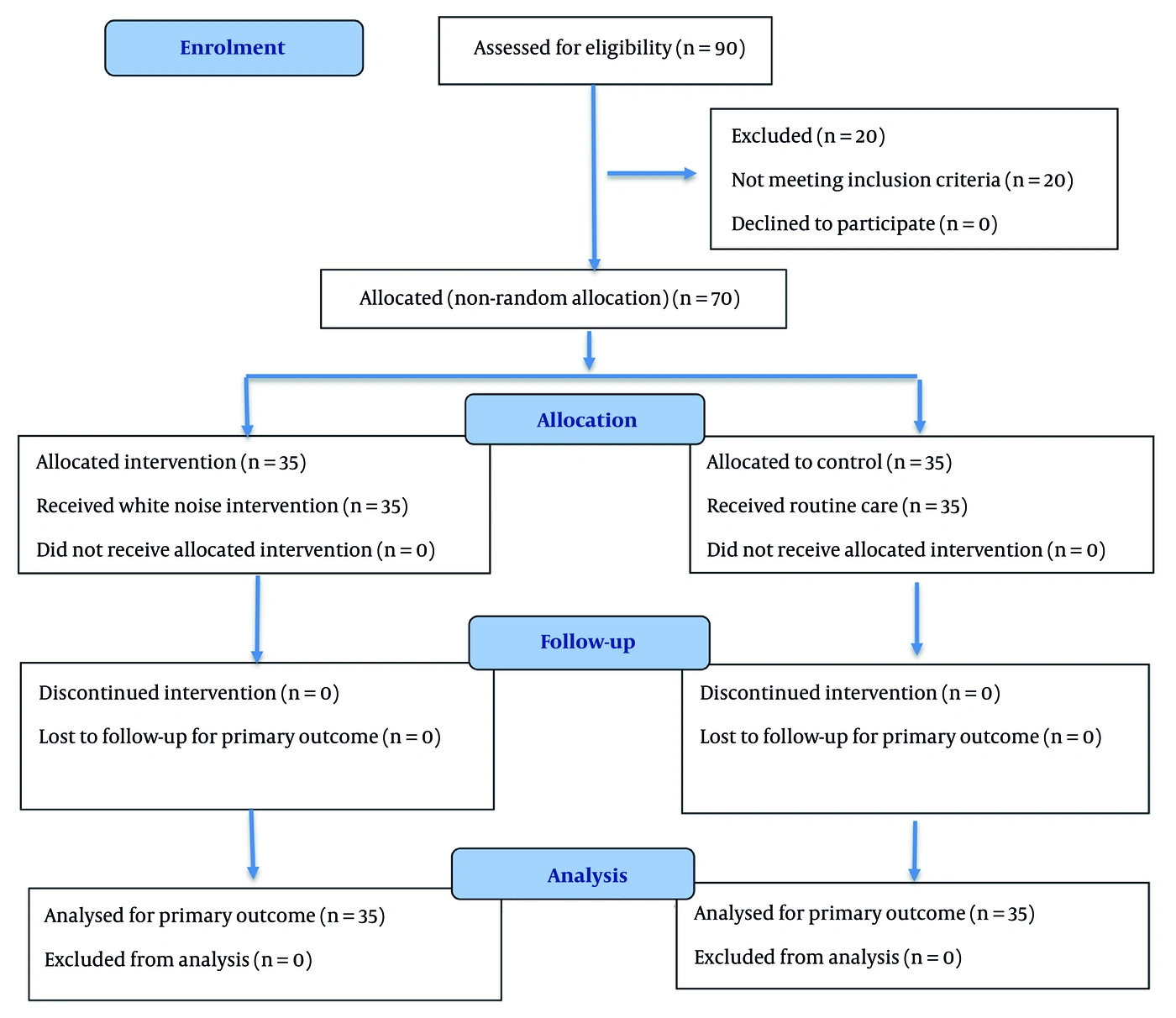
Figure 1.
Flow diagram of participant enrolment, allocation, follow-up, and analysis.
3.2. Inclusion and Exclusion Criteria
The inclusion criteria were age ≥ 18 years, ability to communicate verbally, absence of hearing impairment, no history of sedative or anti-anxiety medication use, admission to the cardiac intensive care unit on the first day of hospitalization, and a Depression Anxiety Stress Scale-21 (DASS-21) score of 15 or higher. The exclusion criteria included prescription of sedative or anti-anxiety medications after enrollment, impaired consciousness, dissatisfaction with participation, unwillingness to continue in the study, and discharge from or transfer to another ward before completion of the intervention.
3.3. Data Collection Instruments
A demographic characteristics questionnaire, a hemodynamic parameters checklist, and the DASS-21 were used to collect study data. The DASS-21 was developed by Lovibond and Lovibond in 1995 and consists of 21 items assessing three psychological dimensions: depression, anxiety, and stress (15). Each subscale contains seven items scored on a 4-point Likert scale ranging from 0 to 3. Because the DASS-21 is the short form of the original 42-item DASS, the summed scores for each subscale are multiplied by 2 for interpretation (16). In the present study, only the stress subscale was used as the psychological outcome because stress was the prespecified psychological outcome of interest. The depression and anxiety subscales were not analyzed or reported as study outcomes. Stress scores were categorized as normal, (0 - 14); mild, (15 - 18); moderate, (19 - 25); severe, (26 - 33); and extremely severe (> 33). Patients with stress scores of 15 or higher were eligible for inclusion. In a previous study, Cronbach's alpha coefficients for the depression, anxiety, and stress subscales were reported as 0.97, 0.92, and 0.95, respectively, with test-retest reliability coefficients of 0.79, 0.67, and 0.81, respectively (17). The Urdu version of the DASS-21 was used, and its validity and reliability have previously been confirmed in Pakistani populations (18).
Hemodynamic parameters, including systolic blood pressure, diastolic blood pressure, mean arterial pressure, heart rate, respiratory rate, and oxygen saturation, were measured using the same calibrated bedside monitoring device for all participants. Before each assessment, participants rested quietly in bed, after which all hemodynamic parameters were recorded simultaneously by trained nursing staff. Measurements were obtained at predefined time points immediately before and after the intervention.
3.4. Intervention
Before the intervention, the intensity of ambient noise in the cardiac unit, which was normally between 60 and 65 dB, was measured during the morning shift using a Bruel & Kjaer 2236 sound level meter in the presence of the researchers. All monitoring devices were calibrated by a biomedical specialist before data collection. Device reliability was evaluated at two different time points using the intraclass correlation coefficient (ICC) and coefficient of variation (CV). Devices with an ICC > 0.70 and a CV < 10% were considered acceptable.
Before the intervention, stress levels and hemodynamic indices in patients in both groups were measured and recorded. The DASS-21 questionnaire was completed by participants, and hemodynamic indices were assessed using bedside monitoring devices.
In the intervention group, white noise was administered once for 30 minutes on the first day of hospitalization during the morning shift in the cardiac unit. The white noise, consisting of natural sounds such as rain, forest, sea, and river waves with a uniform rhythm of 90 beats per minute, was delivered using external bedside speakers placed approximately 1 meter from the patient's head at bed level. Sound intensity was maintained at 50 - 60 dB, verified using a calibrated sound level meter at ear level, and adjusted as needed to ensure consistency. Environmental noise was minimized during the intervention. The control group received routine care and standard therapeutic programs without any intervention.
After completion of the intervention, stress levels, hemodynamic indices, and arterial oxygen saturation were reassessed in both groups. In the intervention group, post-intervention measurements were compared with baseline values, whereas the control group was evaluated at the same two time points without receiving any intervention. Finally, the DASS-21 questionnaire was completed again by participants in both groups, and all hemodynamic parameters were recorded for analysis.
3.5. Data Analysis
Data were analyzed using SPSS version 26. Descriptive statistics, including frequency, percentage, mean, and standard deviation, were used. Inferential statistical tests, including independent and paired t-tests, the chi-square test, and Fisher's exact test, were applied to compare variables between and within groups.
3.6. Ethical Considerations
The study objectives were explained to the participants by the researcher. Patients were informed that participation would not affect their treatment. The confidentiality of participants' information was maintained. Written informed consent was obtained from all participants, and all procedures were conducted in accordance with the Declaration of Helsinki (UOL/IREB/26/22/04/0013).
4. Results
Data from 70 participants were analyzed. Because the intervention was administered on the first day of hospitalization and completed within 1 day, there were no dropouts; therefore, the initially recruited sample was identical to the follow-up and analyzed sample. No significant differences were observed between the intervention and control groups in terms of age, marital status, or education. The distribution of cardiac disease types was comparable between the two groups, with no significant difference (P = 0.92) (Table 1).
Table 1.
Baseline Demographic and Clinical Characteristics of Participants in the Experimental and Control Groups a
| Variables | Experimental Group | Control Group | P-Value |
|---|---|---|---|
| Age | 55.71 ± 13.61 | 52.69 ± 14.16 | 0.36 |
| Gender | 0.80 | ||
| Male | 21 (60.0) | 23 (65.7) | |
| Female | 14 (40.0) | 12 (34.3) | |
| Education | 0.55 | ||
| Primary education | 3 (8.6) | 4 (11.4) | |
| High school | 15 (42.9) | 19 (54.3) | |
| Diploma | 10 (28.6) | 8 (22.9) | |
| Associate | 1 (2.9) | 2 (5.7) | |
| Bachelor | 6 (17.1) | 2 (5.7) | |
| Marital status | 1.00 | ||
| Married | 3 (8.6) | 4 (11.4) | |
| Single | 32 (91.4) | 31 (88.6) | |
| Type of cardiac disease | 0.92 | ||
| MI | 18 (51.4) | 17 (48.6) | |
| Unstable angina | 9 (25.7) | 10 (28.6) | |
| Heart failure | 6 (17.1) | 5 (14.3) | |
| ACS | 2 (5.7) | 3 (8.6) |
a Values are expressed as mean ± SD or No. (%). Comparisons between groups for categorical variables were performed using Pearson's chi-square test or Fisher's exact test, as appropriate, and comparisons for the continuous variable (age) were performed using the independent-samples t-test.
Table 2 presents comparisons of hemodynamic indices and stress scores between the control and experimental groups at baseline and post-intervention. At baseline, no statistically significant differences were observed between the two groups for most variables. After the intervention, statistically significant reductions were observed in diastolic blood pressure, mean arterial pressure, heart rate, respiratory rate, and stress scores in the experimental group (P < 0.05). However, systolic blood pressure and arterial oxygen saturation did not change significantly. The control group showed no significant changes over time. Mean ± SD values for all variables are presented in Table 2.
Table 2.
Comparison of Hemodynamic Parameters and Stress Scores Between the Experimental and Control Groups at Baseline and After the Intervention a
| Variables and Groups | First Time | Second Time | P-Value b |
|---|---|---|---|
| Systolic blood pressure | |||
| Control | 116.34 ± 15.32 | 116.54 ± 15.35 | 0.79 |
| Experimental | 120.14 ± 16.51 | 116.34 ± 13.74 | 0.16 |
| P-Value c | 0.22 | 0.75 | |
| Diastolic blood pressure | |||
| Control | 72.97 ± 11.15 | 74.46 ± 10.92 | 0.074 |
| Experimental | 76.52 ± 14.68 | 68.91 ± 17.30 | < 0.001 |
| P-Value c | 0.15 | 0.83 | |
| Arterial pressure | |||
| Control | 87.42 ± 11.08 | 88.54 ± 10.72 | 0.068 |
| Experimental | 91.07 ± 13.90 | 88.59 ± 11.93 | 0.015 |
| P-Value c | 0.12 | 0.78 | |
| Heart rate | |||
| Control | 87.94 ± 17.92 | 88.23 ± 18.45 | 0.24 |
| Experimental | 89.17 ± 22.28 | 86.51 ± 19.70 | < 0.001 |
| P-Value c | 0.70 | 0.80 | |
| Respiration rate | |||
| Control | 19.91 ± 1.96 | 19.94 ± 1.95 | 0.76 |
| Experimental | 20.97 ± 2.49 | 20.70 ± 2.41 | 0.046 |
| P-Value c | 0.05 | 0.13 | |
| Arterial oxygen saturation | |||
| Control | 96.20 ± 1.07 | 96.09 ± 1.04 | 0.47 |
| Experimental | 95.23 ± 1.66 | 95.31 ± 1.71 | 0.10 |
| P-Value c | 0.005 | 0.016 | |
| Stress score | |||
| Control | 9.37 ± 10.80 | 9.60 ± 10.73 | 0.25 |
| Experimental | 7.42 ± 6.53 | 3.65 ± 4.24 | < 0.001 |
| P-Value c | 0.26 | 0.003 |
a Values are expressed as mean ± SD.
b Paired t-test.
c Independent t-test
5. Discussion
The present study found that participants in the white noise group had lower stress scores after the intervention period than those in the control group. These findings are consistent with previous studies reporting favorable associations between auditory interventions and psychological outcomes. One study found that white noise significantly reduced aggressive behaviors in older adults with dementia (19), suggesting that continuous auditory stimulation may reduce environmental distractions and promote psychological calmness. Similarly, another study reported that music interventions reduced post-traumatic stress symptoms among critically ill patients (20). Although these studies examined different populations and interventions, they suggest a similar pattern of findings that may reflect shared mechanisms of auditory stimulation.
Another study also reported favorable findings for white noise in infants admitted to pediatric intensive care units (14). Although weight gain rather than stress was assessed, both studies suggest that white noise may be associated with better adaptation to stressful clinical environments by minimizing the disruptive effects of ambient noise.
In contrast, another study reported that music therapy produced less change than cognitive-behavioral interventions in improving resilience among cardiac patients. This discrepancy may be explained by differences in study objectives, interventions, and outcome measures. Because resilience is a complex psychological construct that often requires active cognitive engagement, stress reduction may be more readily influenced by passive auditory interventions such as white noise. Furthermore, differences in patient populations and intervention duration may have contributed to the divergent findings.
Similarly, a study found no significant effect of white noise on anxiety and hemodynamic parameters among operating room personnel (21). This inconsistency may be related to differences in the study population and clinical setting. Healthcare professionals are exposed to occupational stressors that differ substantially from those experienced by hospitalized cardiac patients and, therefore, may respond differently to auditory interventions. Another study also reported that although white noise reduced aggressive behaviors, it had no significant effect on mental status or activities of daily living among older adults with dementia (19), indicating that the effectiveness of white noise may vary according to the outcomes assessed.
Regarding physiological outcomes, participants in the white noise group showed different patterns of change in diastolic blood pressure, mean arterial pressure, heart rate, and respiratory rate compared with the control group. Although these observed differences may be related to reduced stress and autonomic regulation, the non-randomized design of the present study does not allow for causal inferences. Therefore, these findings should be interpreted cautiously and require confirmation in randomized controlled trials.
However, no significant between-group differences were observed for systolic blood pressure or oxygen saturation. The absence of a significant difference in systolic blood pressure may reflect the influence of multiple factors, including cardiac output, vascular stiffness, medication use, and underlying cardiovascular conditions. Therefore, short-term auditory interventions may be insufficient to detect measurable differences in this parameter. This finding is consistent with previous studies reporting no significant differences in systolic blood pressure following auditory interventions (22). In addition, oxygen saturation remained within the normal clinical range in most patients at baseline, limiting the ability to detect statistically significant changes. Because white noise primarily influences psychological stress and autonomic regulation rather than pulmonary gas exchange, substantial changes in oxygen saturation may not have been expected.
The observed changes in mean arterial pressure and heart rate are broadly consistent with findings reported in recent systematic reviews of auditory interventions in clinical populations (23, 24). However, given the differences in study populations, interventions, and designs, these similarities should be interpreted cautiously. Additional well-designed randomized controlled trials are needed to determine whether these observed associations reflect a true effect of white noise.
Overall, the findings of this quasi-experimental study should be considered exploratory rather than confirmatory. Given the non-randomized design and the potential for residual confounding, the observed associations require validation in adequately powered randomized controlled trials.
5.1. Study Limitations
First, the relatively small sample size and the conduct of the study in a single clinical setting may limit the generalizability of the results to other populations and healthcare centers. Second, the short follow-up period allowed assessment of only short-term effects; therefore, the long-term effects of white noise could not be evaluated. Third, potential confounding variables such as medication use, disease severity, and individual differences among patients were not fully controlled. In addition, the cardiac care unit environment and background noise levels may have influenced the study outcomes. The primary limitation of this study is its non-randomized, quasi-experimental design. The lack of random allocation increases the risk of selection bias and limits the ability to attribute the observed changes to the intervention. Therefore, the findings should be interpreted as preliminary and hypothesis-generating. Causality cannot be established based on this study design. Well-designed randomized controlled trials are needed to confirm these observations.
5.2. Future Research
Future studies should be conducted with larger sample sizes and at multiple centers to enhance the generalizability of the findings. Long-term follow-up studies are also needed to determine the sustainability of the effects of white noise over time. Moreover, future studies should more carefully control confounding factors such as disease severity, medication regimens, and patients' psychological status. Finally, comparing white noise with other non-pharmacological interventions, such as music therapy or relaxation techniques, may help identify the most effective approaches for reducing stress in cardiac unit patients.
5.3. Study Strengths
This study addresses an important and under-researched area by evaluating a non-pharmacological intervention (white noise) in critically ill cardiac patients, particularly in a resource-limited setting. It was conducted in a real clinical environment (a cardiac intensive care unit), which increases the ecological validity and practical relevance of the findings. The inclusion of a control group alongside an intervention group strengthens internal validity and improves the ability to attribute observed effects to the intervention. The study assessed both psychological outcomes (stress levels) and physiological outcomes (hemodynamic parameters), providing a more comprehensive evaluation of patient response. In addition, the intervention is simple, non-invasive, and does not interfere with routine clinical care, supporting its potential applicability in nursing practice. Finally, the study contributes context-specific evidence from Pakistan, where limited research has been conducted on environmental interventions in cardiac intensive care settings.
5.4. Conclusions
White noise may have a beneficial effect in reducing stress and improving certain hemodynamic parameters in cardiac patients admitted to cardiac care units. These findings suggest that environmental auditory interventions could be considered a complementary non-pharmacological approach in cardiac nursing care alongside standard medical management. However, the implementation of white noise in cardiac settings may be influenced by practical considerations such as equipment availability, staff training, patient preferences, and variability in clinical environments. Therefore, its routine application should be evaluated carefully within each clinical context. The findings of this study suggest that nurses may consider incorporating white noise as a complementary, evidence-informed intervention, where appropriate and feasible, to support patient comfort and potentially improve selected clinical outcomes. Nevertheless, these findings should be considered preliminary because of the study design and sample size. Further large-scale, multicenter randomized controlled trials are needed to confirm the effectiveness of white noise and establish its role in routine cardiac care.