
1. Context
Knowledge is widely recognized as a fundamental resource for advancing organizations and professions, enabling informed decision-making, effective problem-solving, and continuous improvement (1). Within the knowledge hierarchy, data are transformed into information through organization and contextualization, whereas information becomes knowledge through analysis and interpretation. The effective application of knowledge ultimately leads to wisdom and improved practice (1). In health care, where clinical decisions directly influence patient outcomes, generating, refining, and applying knowledge are essential to delivering high-quality care. In nursing and midwifery, knowledge provides the foundation for evidence-based practice, professional decision-making, and the continuous development of clinical care. Nursing knowledge has evolved in response to philosophical and epistemological developments, offering new perspectives for strengthening professional practice and advancing the discipline (2). Likewise, in midwifery, knowledge, together with clinical experience and professional support, is indispensable for providing safe, effective, and patient-centered care (3).
The development of scientific knowledge depends on well-defined concepts, which constitute the basic building blocks of theories. The clarity and precision of concepts directly influence the validity of research findings, theoretical development, and knowledge generation. Ambiguous or poorly defined concepts may lead to inconsistent interpretations, limit scientific communication, and reduce the applicability of research outcomes (4). As scientific inquiry advances, concepts evolve from broad, descriptive ideas into more refined and empirically supported constructs (5).
Conceptual clarity is particularly critical in chronic and long-term health care. In these settings, patients often experience persistent symptoms, changing functional abilities, psychosocial challenges, and prolonged adaptation to illness and treatment. Unclear or overlapping concepts may affect the consistency of assessment, communication, intervention planning, and evaluation of patient outcomes. Concept analysis can help establish clearer conceptual boundaries and relationships among these phenomena, thereby providing a stronger foundation for nursing and midwifery research, education, and clinical practice.
Concept analysis is an important strategy for clarifying the meaning, attributes, antecedents, consequences, and boundaries of concepts, thereby strengthening theory development and scientific inquiry (6, 7). Unlike concept definition, which primarily establishes the semantic boundaries of a term, concept analysis examines how concepts emerge, evolve, and function within theoretical, clinical, and social contexts. Consequently, it provides a more comprehensive understanding of complex phenomena and facilitates the development of disciplinary knowledge (4, 8, 9).
The usefulness of concept analysis has been demonstrated in nursing and midwifery research. For example, Heidari reported that the interchangeable use of concepts such as acceptance, coping, adaptation, and adjustment created conceptual ambiguity, whereas systematic clarification of these concepts provided a stronger basis for developing appropriate interventions for patients with an ostomy (10). Similarly, Fakhr Movahedi et al. identified the defining attributes, antecedents, consequences, and related concepts of pain anxiety, thereby improving conceptual clarity and distinguishing it from similar constructs (11). These examples are particularly relevant to chronic and long-term health conditions, in which patients frequently experience complex physical, psychological, and social challenges requiring sustained and individualized care. Clarifying concepts such as acceptance, adaptation, coping, pain, and quality of life can therefore support a more consistent understanding of patients' experiences and contribute to the development of evidence-informed nursing care for people living with chronic conditions.
Beyond individual studies, concept analysis also contributes to theoretical development by refining conceptual structures and strengthening relationships among concepts. Whereas terminology science focuses mainly on the classification and organization of concepts, nursing and midwifery emphasize understanding meanings and explaining human experiences. Integrating these perspectives can improve both conceptual rigor and theoretical understanding (12).
Although concept analysis has been widely used in nursing research, a comprehensive review demonstrated considerable variation in methodological approaches and highlighted the need for greater methodological rigor to maximize its contribution to nursing knowledge development (13). Furthermore, most existing publications have focused on analyzing individual concepts rather than providing an integrated understanding of the theoretical foundations, methodological approaches, practical applications, and overall contribution of concept analysis to knowledge development across nursing and midwifery, particularly in relation to complex and long-term health care. Therefore, this narrative review aimed to synthesize the available evidence and provide a comprehensive understanding of the nature of concept analysis, its theoretical foundations and methodological approaches, and its role in advancing nursing and midwifery knowledge relevant to chronic and long-term health care. To achieve this aim, the review addressed the following research questions:
1) What are the dominant methods of concept analysis currently applied in nursing and midwifery research?
2) What are the key concepts in chronic and long-term care that have been clarified through concept analysis, and what are their defining characteristics?
3) How has concept analysis contributed to the development of theoretical and practical knowledge in this specific domain?
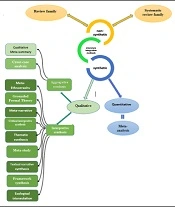
The conceptual relationships identified in this review are summarized in the conceptual framework presented in Figure 1.
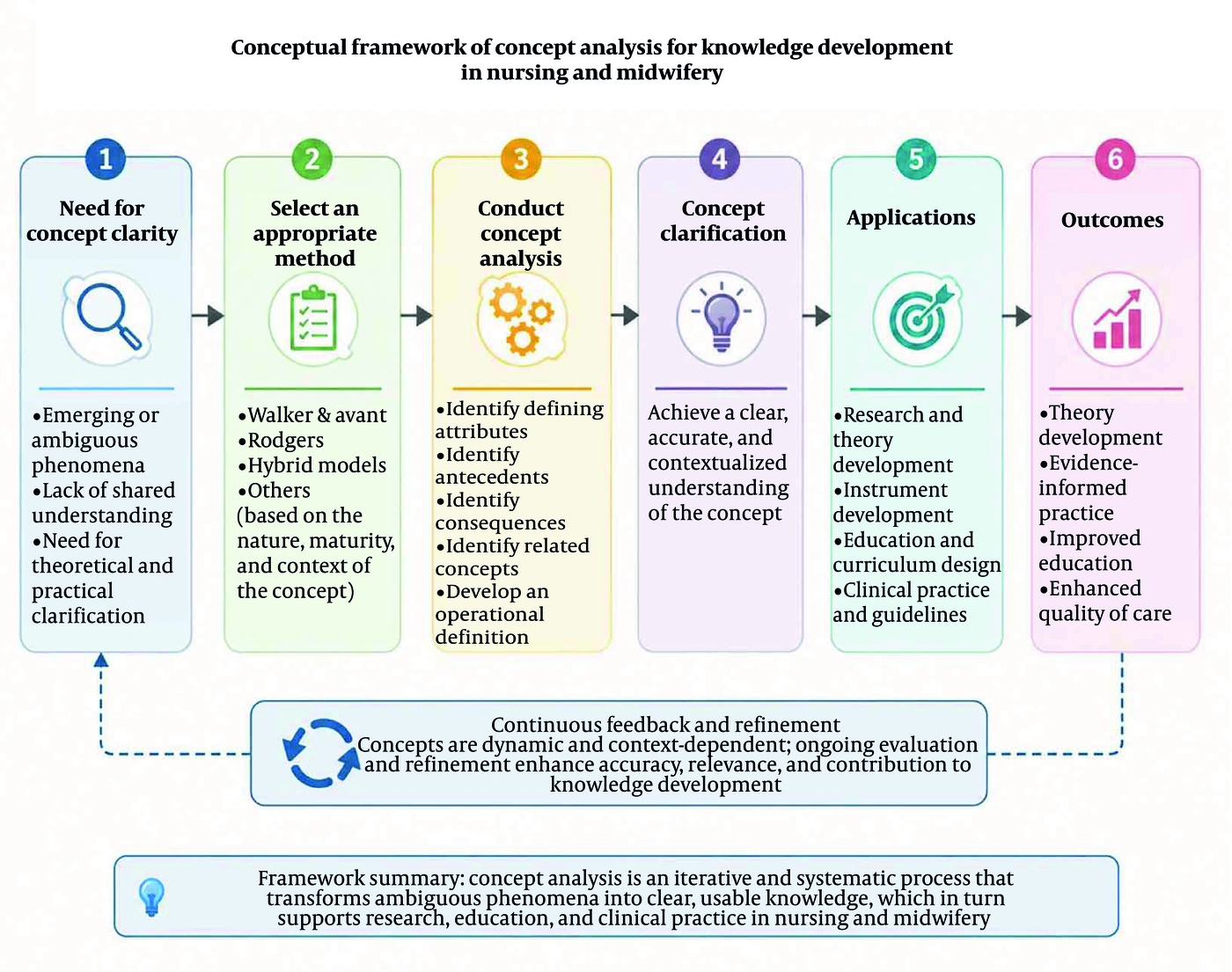
Figure 1.
Conceptual Framework of Concept Analysis for Knowledge Development in Nursing and Midwifery
2. Evidence Acquisition
2.1. Study Design
This study was conducted as a narrative review to provide an integrated overview of concept analysis and its contribution to knowledge development in nursing and midwifery, with particular attention to its relevance to chronic and long-term health care. A narrative review approach was intentionally selected. Although scoping and systematic reviews are highly rigorous approaches for answering narrow quantitative questions, a narrative review is uniquely suited to providing a broad, integrative, and theoretical overview of how concept analysis applies to the complex, evolving, and multidimensional landscape of chronic and long-term care. This approach allowed us to synthesize diverse types of evidence, including empirical concept analyses, methodological papers, and theoretical discussions, to provide a comprehensive understanding of the field.
2.2. Search Strategy
Relevant literature published between January 2000 and March 2025 was identified through systematic searches of major international and Persian databases, including PubMed, Scopus, Web of Science, Google Scholar, Scientific Information Database (SID), and Magiran. The search strategy combined keywords related to concept analysis, knowledge development, nursing, midwifery, and chronic care using Boolean operators (AND, OR). Example search strings included: ("concept analysis" OR "concept development" OR "concept clarification") AND ("nursing" OR "midwifery") AND ("chronic" OR "long-term" OR "chronic illness" OR "chronic disease"). The search was supplemented by a manual review of reference lists from key publications to identify additional relevant sources.
2.3. Inclusion and Exclusion Criteria
Publications were included if they: 1) were original concept analysis studies or methodological papers discussing concept analysis in nursing or midwifery; 2) were published in English or Persian between 2000 and 2025; 3) addressed concepts relevant to clinical practice, education, research, or knowledge development; and 4) were peer-reviewed journal articles, books, or book chapters. Publications were excluded if they: 1) were editorials, commentaries, or conference abstracts without full text; 2) focused solely on concept analysis in disciplines other than nursing or midwifery; or 3) did not provide sufficient detail on the concept analysis method or findings.
2.4. Study Selection and Data Extraction
Study selection was conducted in two phases. First, two reviewers (the first and second authors) independently screened titles and abstracts to identify potentially relevant publications. Disagreements were resolved through discussion and consultation with a third reviewer. Second, the full texts of selected publications were reviewed against the inclusion criteria. A standardized data extraction form was used to extract the following information from each included publication: author(s), year of publication, country, concept analyzed, concept analysis method used (e.g., Walker and Avant, Rodgers, or hybrid), study type (empirical concept analysis, methodological paper, or theoretical discussion), main findings, and relevance to chronic and long-term health care.
2.5. Data Synthesis
The extracted data were synthesized using an iterative thematic approach. Two reviewers independently coded the findings and identified common themes related to 1) theoretical foundations of concept analysis, 2) major methodological approaches, 3) applications in nursing and midwifery research, and 4) contributions to knowledge development in chronic and long-term health care. The coding process involved repeatedly reading the extracted data, identifying meaningful units, assigning initial codes, grouping codes into categories, and refining categories through discussion. Disagreements in coding or theme identification were resolved by consensus between the two reviewers, with final decisions made in consultation with the third reviewer. The synthesized findings were organized into four main thematic categories: Clinical decision-making, care and health care service delivery, human roles and relationships, and mental health and human experiences.
A total of 32 publications met the inclusion criteria and were included in the final synthesis. Of these, 19 were original concept analysis studies selected as representative examples and are presented in Table 1. The remaining 13 publications included methodological papers, theoretical discussions, and additional concept analyses that informed the thematic synthesis but were not included in the table because of space constraints. A complete list of all 32 included publications and their key characteristics is provided in Table S1 in the Supplementary File.
Table 1.
Representative Concept Analysis Studies Included in the Narrative Review
| Authors (Reference) | Concept | Concept Analysis Method | Study Type | Main Application / Key Findings |
|---|---|---|---|---|
| Bahmanpour et al. (7) | Critical thinking | Concept analysis | Original concept analysis | Defined critical thinking as the integration of emotional intelligence, clinical pattern recognition, and the nursing process to strengthen evidence-based nursing care. |
| Suryaningsih et al. (19) | Maternal–fetal attachment | Concept analysis | Original concept analysis | Clarified maternal–fetal attachment as a dynamic emotional bond supporting maternal involvement and prenatal care. |
| Heidary and Shirdelzade (20) | Chronic sorrow | Rodgers’ evolutionary method | Original concept analysis | Identified chronic sorrow as a natural response to life discrepancies with implications for psychological well-being. |
| Larkin et al. (18) | Childbirth experience | Rodgers’ evolutionary method | Original concept analysis | Described childbirth experience as an individual, multidimensional, and context-dependent phenomenon. |
| Sharifi et al. (14) | Nursing negligence | Concept analysis | Original concept analysis | Clarified the defining attributes of nursing negligence and emphasized legal and professional accountability. |
| Beecher et al. (21) | Woman-centered maternity care | Principle-based concept analysis | Original concept analysis | Conceptualized woman-centered maternity care as an individualized approach based on women's needs and expectations. |
| Heydari et al. (10) | Ostomy acceptance | Rodgers’ evolutionary method | Original concept analysis | Defined ostomy acceptance as adaptation to life with an ostomy and improved quality of life. |
| Gómez-Cantarino et al. (22) | Maternal role in pregnant adolescents | Concept analysis | Original concept analysis | Clarified the maternal role as a developmental process involving attachment, adaptation, and preparation for childbirth. |
| Fakhr Movahedi et al. (11) | Pain anxiety | Rodgers’ evolutionary method | Original concept analysis | Defined pain anxiety as a cognitive and behavioral response influencing pain perception and treatment adherence. |
| Van Otterloo and Connelly (23) | Maternal risk during pregnancy | Concept analysis | Original concept analysis | Clarified maternal risk perception to improve individualized maternity care and risk communication. |
| Eriksson et al. (24) | Wellness | Rodgers’ evolutionary method | Original concept analysis | Defined wellness as a holistic, multidimensional concept associated with health promotion. |
| Borimnezhad et al. (25) | Palliative care | Rodgers’ evolutionary method | Original concept analysis | Clarified the multidimensional nature of palliative care and its defining attributes in nursing. |
| Chen et al. (26) | Fear of childbirth | Concept analysis | Original concept analysis | Identified cognitive, emotional, and physical dimensions of fear of childbirth. |
| Najafi and Nasiri (15) | Uncertainty in nursing | Walker and Avant’s approach | Original concept analysis | Clarified uncertainty as a dynamic state affecting clinical decision-making. |
| Brady et al. (17) | Woman-centered care | Concept analysis | Original concept analysis | Identified core attributes including respect, empowerment, and shared decision-making. |
| Bahramnezhad et al. (27) | Futile care | Walker and Avant’s approach | Original concept analysis | Clarified futile care and highlighted its ethical implications for clinical decision-making. |
| Shrestha et al. (16) | Maternal role | Concept analysis | Original concept analysis | Defined the maternal role as a dynamic developmental process promoting maternal identity. |
| Alinejad-Naeini et al. (28) | Maternal role attainment | Hybrid concept analysis | Original concept analysis | Described maternal role attainment as an adaptive process integrating theoretical and empirical evidence. |
| Shoja et al. (29) | Accountability in nursing | Walker and Avant’s approach | Original concept analysis | Clarified accountability as responsibility for professional actions, quality of care, and patient safety. |
3. Results
Thirty-two relevant publications from 2000 to 2025 were reviewed and synthesized. Of these, 19 were original concept analysis studies (Table 1), and the remaining 13 were methodological papers, theoretical discussions, and textbooks that informed the thematic synthesis (listed in Table S1 in the Supplementary File). Regarding methodological approaches, Rodgers' evolutionary method was the most frequently applied (n = 8 studies), followed by Walker and Avant's approach (n = 5 studies), hybrid models (n = 2 studies), and other concept analysis methods (n = 4 studies). Based on the thematic synthesis, the identified concepts were organized into four broad categories: clinical decision-making (n = 6 studies), care and health care service delivery (n = 12 studies), human roles and relationships (n = 7 studies), and mental health and human experiences (n = 7 studies). Approximately 60% of the analyzed concepts (n = 19 studies) were directly relevant to chronic and long-term health conditions, highlighting the applicability of concept analysis in this domain.
3.1. Clinical Decision-Making
Six studies in this category focused on concepts that support evidence-based practice, professional accountability, and informed clinical judgment. In nursing, concept analysis was applied to critical thinking, nursing negligence, and uncertainty. Bahmanpour et al. (7) identified critical thinking as the integration of emotional intelligence, clinical pattern recognition, and the nursing process to strengthen evidence-based care. Sharifi et al. (14) clarified the defining attributes of nursing negligence, emphasizing legal and professional accountability to improve patient safety. Najafi and Nasiri (15) demonstrated that uncertainty is a dynamic state affecting clinical decision-making and that clarifying this concept can facilitate more consistent nursing practice. Although these concepts are not specific to chronic conditions, their clarification supports more consistent clinical decision-making across diverse care settings, including long-term care, where patients experience fluctuating symptoms and complex treatment trajectories.
3.2. Care and Health Care Service Delivery
This category included 12 studies addressing concepts related to the delivery and quality of health care services. In nursing, concept analyses addressed palliative care, futile care, pain relief, and wellness, whereas in midwifery, they addressed person-centered care, woman-centered care, respectful maternity care, and maternal health. Several of these concepts are particularly relevant to chronic and long-term health conditions. For instance, Borimnezhad et al. (25) clarified the multidimensional nature of palliative care, emphasizing its role in addressing ongoing physical, psychological, and social needs. Eriksson et al. (24) defined wellness as a holistic, multidimensional concept associated with health promotion, which is central to chronic care goals. Brady et al. (17) identified core attributes of woman-centered care, including respect, empowerment, and shared decision-making, which are essential for individualized chronic care. Beecher et al. (21) conceptualized woman-centered maternity care as an individualized approach based on women's needs and expectations. Bahramnezhad et al. (27) clarified the concept of futile care and highlighted its ethical implications for end-of-life decision-making in chronic conditions. These concepts provide important conceptual foundations for understanding and addressing the ongoing needs of people living with chronic or long-term conditions, for whom continuity of care, symptom management, quality of life, and individualized support are central to effective health care delivery.
3.3. Human Roles and Relationships
Seven studies in this category focused on concepts related to professional and maternal roles, as well as interpersonal relationships. In midwifery, concept analysis focused on the maternal role and woman-centered care. Shrestha et al. (16) described the maternal role as a dynamic developmental process that promotes maternal identity. Gómez-Cantarino et al. (22) clarified the maternal role in pregnant adolescents as a developmental process involving attachment, adaptation, and preparation for childbirth. Alinejad-Naeini et al. (28) described maternal role attainment as an adaptive process integrating theoretical and empirical evidence. Suryaningsih et al. (19) clarified maternal–fetal attachment as a dynamic emotional bond that supports maternal involvement and prenatal care. These findings highlight the importance of clearly defined roles and relationships in providing individualized, person-centered care. This is particularly relevant in chronic care contexts, where patients and families must adapt to changing roles and responsibilities over time.
3.4. Mental Health and Human Experiences
Seven studies in this category encompassed concepts related to psychological and lived experiences. In nursing, these included chronic sorrow and ostomy acceptance, whereas in midwifery, they included maternal–fetal attachment, childbirth experience, and fear of childbirth. Heidary and Shirdelzade (20) identified chronic sorrow as a natural response to life discrepancies with implications for psychological well-being. This concept is directly relevant to people living with chronic conditions who experience ongoing losses and adaptations. Heydari et al. (10) defined ostomy acceptance as adaptation to life with an ostomy and improved quality of life, reflecting the long-term psychological adjustment required in chronic conditions. Fakhr Movahedi et al. (11) defined pain anxiety as a cognitive and behavioral response that influences pain perception and treatment adherence, which is critical in chronic pain management. Larkin et al. (18) characterized the childbirth experience as a complex phenomenon influenced by personal and environmental factors. Chen et al. (26) identified cognitive, emotional, and physical dimensions of fear of childbirth. These concepts were consistently described as multidimensional and context-dependent, reflecting the ongoing psychological adaptation, changes in self-perception, and adjustment to persistent health-related challenges experienced by people living with chronic or long-term conditions.
4. Conclusions
4.1. Discussion
Overall, the reviewed evidence indicates that concept analysis may contribute to knowledge development in nursing and midwifery by improving conceptual clarity, facilitating theory and instrument development, and strengthening evidence-informed education, research, and clinical practice. As a useful methodological strategy, it has been widely applied to clarify complex concepts and establish conceptual consistency (8). Beyond defining terminology, concept analysis enhances understanding of how concepts evolve and function within scientific and professional contexts (9).
A critical appraisal of the reviewed studies reveals distinct patterns in methodological application. Walker and Avant's method was frequently applied to relatively stable concepts requiring operational clarification and the development of measurement instruments (15, 16, 27, 29). However, our synthesis revealed that several of these analyses relied heavily on hypothetical examples and lacked an empirical validation phase, reflecting a known limitation of classical approaches. In contrast, Rodgers' evolutionary approach was predominantly used for dynamic, context-dependent concepts relevant to chronic care, such as chronic sorrow, pain anxiety, and wellness (10, 11, 20, 24, 25). This approach better captured the temporal changes and multidimensional nature of long-term health experiences. Hybrid models were used less frequently but offered distinct advantages when both theoretical clarification and empirical field testing were required (28).
The relevance of conceptual clarity is particularly pronounced in chronic and long-term health care. Chronic conditions are characterized by fluctuating clinical status, prolonged treatment trajectories, and a heavy reliance on family caregivers. In this complex context, ambiguous concepts (e.g., 'adaptation' or 'quality of life') can lead to fragmented interprofessional coordination and inconsistent patient assessments. By clarifying concepts such as ostomy acceptance, palliative care, and chronic sorrow, concept analysis provides standardized terminology to support consistent assessment, shared decision-making, and the development of tailored, evidence-informed clinical guidelines for this vulnerable population.
The provisional conceptual framework presented in Figure 1 synthesizes these relationships and illustrates how concept analysis bridges theoretical foundations and clinical application in chronic care. This framework is descriptive and hypothesis-generating and is derived from the thematic synthesis of the included literature rather than empirical validation. Its primary utility lies in guiding researchers to align their research objectives with the most appropriate analytical approach, although future empirical testing is required to validate its practical application.
4.2. Limitations
This narrative review has several inherent limitations. First, the selective nature of narrative reviews may introduce selection bias because they do not employ the exhaustive, protocol-driven search and formal quality appraisal (e.g., CASP or AACODS tools) characteristic of systematic or scoping reviews. Second, the inclusion of both Persian and English databases, while valuable for capturing regional context, may limit the global generalizability of the findings. Third, the synthesis relies on the methodological rigor of the included primary studies, which varied considerably. Future research should consider conducting a scoping review with formal quality assessment to validate these findings.
4.3. Concluding Remarks
This narrative review addressed three key questions regarding concept analysis in nursing and midwifery. First, regarding the dominant methods, Rodgers' evolutionary approach and Walker and Avant's method remain the most frequently applied; the former is better suited to dynamic concepts in chronic care, whereas the latter is appropriate for stable concepts requiring operationalization. Second, concept analysis contributes to knowledge development by clarifying defining attributes, antecedents, and consequences, thereby reducing conceptual ambiguity. Third, in clinical practice, it supports the development of valid assessment tools, standardized terminology, and evidence-informed clinical guidelines, which are crucial for managing patients' complex, long-term needs.
From an educational perspective, concept analysis should be integrated into nursing and midwifery curricula to strengthen students' theoretical reasoning and critical thinking skills. For future research, we recommend prioritizing the analysis of emerging and indigenous concepts relevant to the Iranian health care context, such as 'Sabouri' (patience/endurance) or 'family resilience' in patients with chronic conditions, preferably using evolutionary methods such as Rodgers' approach to capture their cultural nuances. Ultimately, continued refinement and application of these methods will help bridge the gap between theory and practice and support more consistent and individualized care for people living with chronic and long-term health conditions.