
1. Background
In the early 1990s, with the emergence of evidence-based practice, it became apparent that clinicians urgently needed consultants or advisers to make informed, evidence-based decisions based on the results and evidence obtained from primary studies and synthesis summaries (1). Scientific knowledge is built upon the accumulated findings of previous studies in a given field, and new studies are expected to build upon these findings to help develop and expand knowledge in that field (2). The increasing volume of research and the vast amount of knowledge available have underscored the need for synthesizing existing research in a reliable and high-quality manner. Traditional reviews aim to critique existing research, provide an overview of research, and/or offer a suitable context for new studies. Research syntheses, on the other hand, seek to produce a result by aggregating the entirety of empirical research conducted on a specific topic (3). The use of the term “synthesis” varies widely in different areas and among different individuals. Webster’s Ninth Collegiate Dictionary provides three definitions for synthesis: (A) synthesis is the combination of parts to form a whole, (B) synthesis is the dialectical combination of thesis and antithesis, and (C) synthesis is the combination of often diverse concepts into a coherent whole (4).
Currently, researchers, faculty members, and students in the field of medical sciences, especially those in nursing and midwifery, have developed a preference for qualitative research. They favor this type of research because it allows them to gain a deep understanding of the phenomenon under investigation (5). It is evident that the growth of qualitative research necessitates the synthesis of included studies. Firouzkouhi et al. argue that one of the primary purposes of secondary studies is to provide scientific, context-based, and reliable evidence for decision-making. By accumulating and synthesizing the results of other qualitative studies, meta-synthesis studies can contribute to the development and enrichment of existing knowledge about the phenomenon (6).
The term “qualitative meta-synthesis” originates from an attempt to move the field of qualitatively derived understandings from “small islands of knowledge” toward sociological macro theories. In this context, a wide range of new meta-synthesis options has been introduced in the health research methodology literature, each with its interpretation. It is essential that researchers approach meta-synthesis thoughtfully and carefully consider the types of questions they can pose (7). Qualitative meta-synthesis aims to identify and characterize the ways in which healthcare experiences are structured over time, in interaction with different modes of service delivery, and how they lead to various patterns of participants’ evaluations (8).
Qualitative syntheses currently serve as valuable tools for exploring participants’ meanings, experiences, and perspectives, both in depth (due to the qualitative approach) and breadth (due to the integration of studies from different healthcare contexts and participants). They are used to identify research gaps, inform the development of primary studies, and provide evidence for the development, implementation, and evaluation of health interventions and psychological research (9). As the amount of qualitative research on chronic diseases increases and studies accumulate, it is necessary to begin consolidating the existing loose framework. Although this is unlikely to lead to the creation of a unified theory, we must advance the concepts in such a way as to enhance our sociological understanding of illness as a lived experience (10). Quantitative research has been widely used to document and describe patterns of chronic disease and related disparities. By conducting qualitative research with stakeholder engagement, with the explicit participation of communities experiencing disparities, and taking into account actors within the systems that produce or sustain these disparities, we can identify points of intervention and practical policies to address chronic disease disparities (11). Therefore, the main purpose of this article was to present the application of qualitative meta-synthesis in the field of chronic diseases.
2. Methods
The synthesis of qualitative studies provides a comprehensive insight into existing knowledge in a specific field. It directly defines evidence-based activities while highlighting ambiguities and weaknesses in the studies (6). The main question of this study revolved around the role of qualitative synthesis in the literature related to chronic disease. With this question in mind and drawing on significant related works, this study aimed to introduce qualitative meta-synthesis in greater detail. To achieve this, a narrative review was chosen as the methodology for the current study.
First and foremost, inclusion and exclusion criteria were established. An article was eligible for inclusion in the study if it met the criteria of being directly related to chronic disease, being published in English or Persian, providing an accurate and complete method, and being available in full text. Simple qualitative studies lacking clarity in methodology and quantitative studies were excluded.
A search across various databases, including PubMed, Google, Wiley, Elsevier, SID, Magiran, and Google Scholar, covering the period within 2010 to 2023 was conducted. The search utilized Boolean operators (AND, OR, and NOT), parentheses, and truncation. The keywords were qualitative Meta-synthesis, Meta synthesis, qualitative studies, synthesis, and chronic disease as single terms or in combination with others.
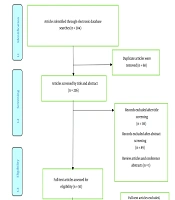
Initially, a total of 980 articles relevant to the scope of the study were identified. Subsequently, at least two independent researchers reviewed the titles and abstracts of all these articles using a standardized checklist form to exclude irrelevant studies. In the next step, approximately 750 records were excluded due to unrelated titles and/or abstracts, leaving us with full-text articles to assess for eligibility. The Critical Appraisal Skills Program (CASP) checklist was employed to evaluate article quality. Ultimately, 21 articles met the inclusion criteria for this study (Figure 1).
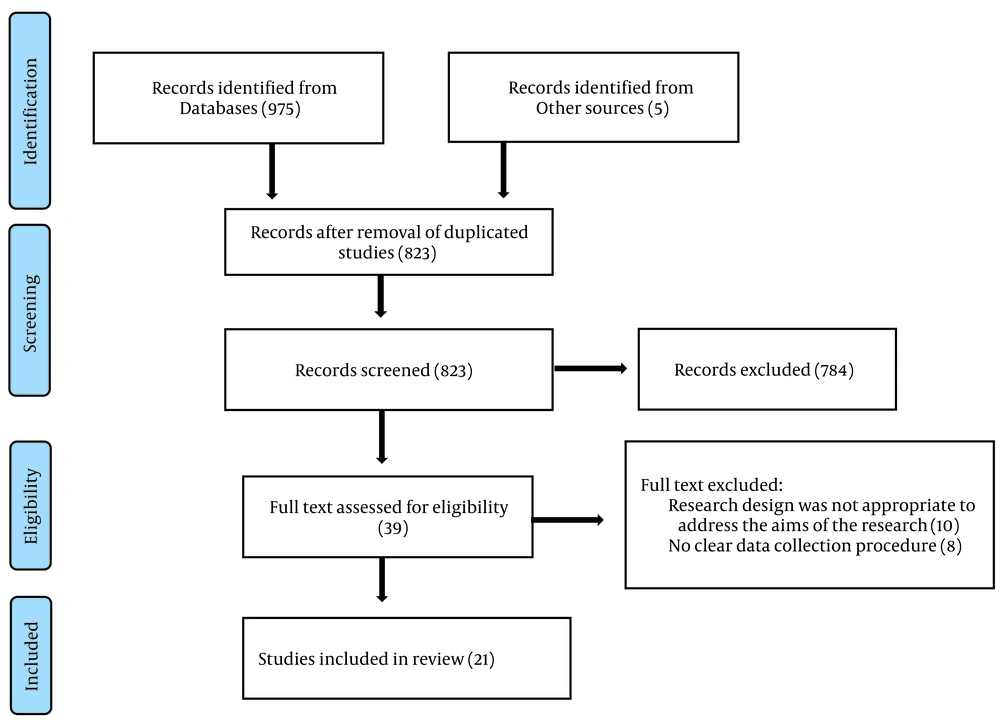
Figure 1.
PRISMA flow diagram of the search procedure for narrative review (12)
3. Results
The distinctive feature of any systematic review is the utilization of predetermined, structured protocols to search, present, assess, and summarize findings, all aimed at addressing a specific research question (7). Meta-synthesis, through an interpretive process, employs rigorous qualitative methods to synthesize existing qualitative studies, aiming to derive deeper meaning and understanding (13). Sandelowski and Barroso attribute the popularity of qualitative meta-synthesis to its alignment with evidence-based practice, making it an impressive motivation for integrating qualitative research with mixed research approaches (14). Chenail et al. considers this method remarkable because it offers a collective approach to observing research in a specific field and presenting the results in a format that is readily accessible and comprehensible (15).
Two broad approaches exist for this type of synthesis: Aggregative synthesis (meta-aggregation) and interpretive synthesis. In aggregative synthesis, the reviewer does not interpret the findings of the included studies but presents the original findings as reported by their authors. Nevertheless, interpretive synthesis, exemplified by methods such as meta-ethnography and basic formal theory, operates at a higher level of abstraction, involving a conceptual or theoretical process that generates new insights (16). For instance, Sun et al. conducted a qualitative meta-synthesis aiming to gain a more comprehensive understanding of the factors affecting the health of older adults, considering multiple perspectives, such as those of older, chronically ill patients. Their results differed from those of the initial 17 studies (17).
Long-Sutehall et al. views meta-synthesis as the secondary analysis of qualitative data involving the use of existing data to find answers to research questions distinct from those posed in the original research (18). Chrastina’s results posit that meta-synthesis is not merely a summary of the results and findings of qualitative studies. It encompasses a re-understanding of the findings and their interpretation to generate new insights. This process might lead to the creation of new theories, the development of conceptual models, the identification of research gaps, a deeper understanding and augmentation of existing knowledge, and the provision of evidence regarding the current state of knowledge (19). It is crucial to distinguish between the perspectives of these two authors (Chrastina and Long-Sutehall et al.) because the key point is to recognize that meta-synthesis is focused on results, not data. Furthermore, the process of meta-synthesis entails a new interpretation and understanding of the investigated phenomenon (18), 19.
Various approaches exist for conducting the meta-synthesis of qualitative studies, offering researchers a range of options (20). One of the most common approaches is described in Table 1 (7).
Table 1.
Types of Meta-synthesis with Their Introducers
| Year | Authors | Qualitative Meta-analysis Approach |
|---|---|---|
| 1988 | Noblit and Hare | Meta-ethnography |
| 1994 | Estabrooks et al. | Qualitative data aggregation |
| 1977 | Schreiber et al. | Qualitative meta-analysis |
| 1998 | Popay et al. | Qualitative systematic review |
| 2001 | Kearney | Grounded formal theory |
| 2001 | Paterson et al. | Meta-study |
| 2003 | Sandelowski and Barosso | Meta-summary |
| 2004 | Greenhaigh | Meta-narrative |
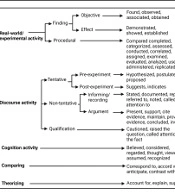
From Chrastina’s viewpoint, the common types of qualitative meta-synthesis are meta-narrative, critical interpretive synthesis, meta-study, meta-ethnography, grounded formal theory, thematic synthesis, textual narrative synthesis, framework synthesis, and ecological triangulation (19). Figure 2 shows the classification of integrated studies.
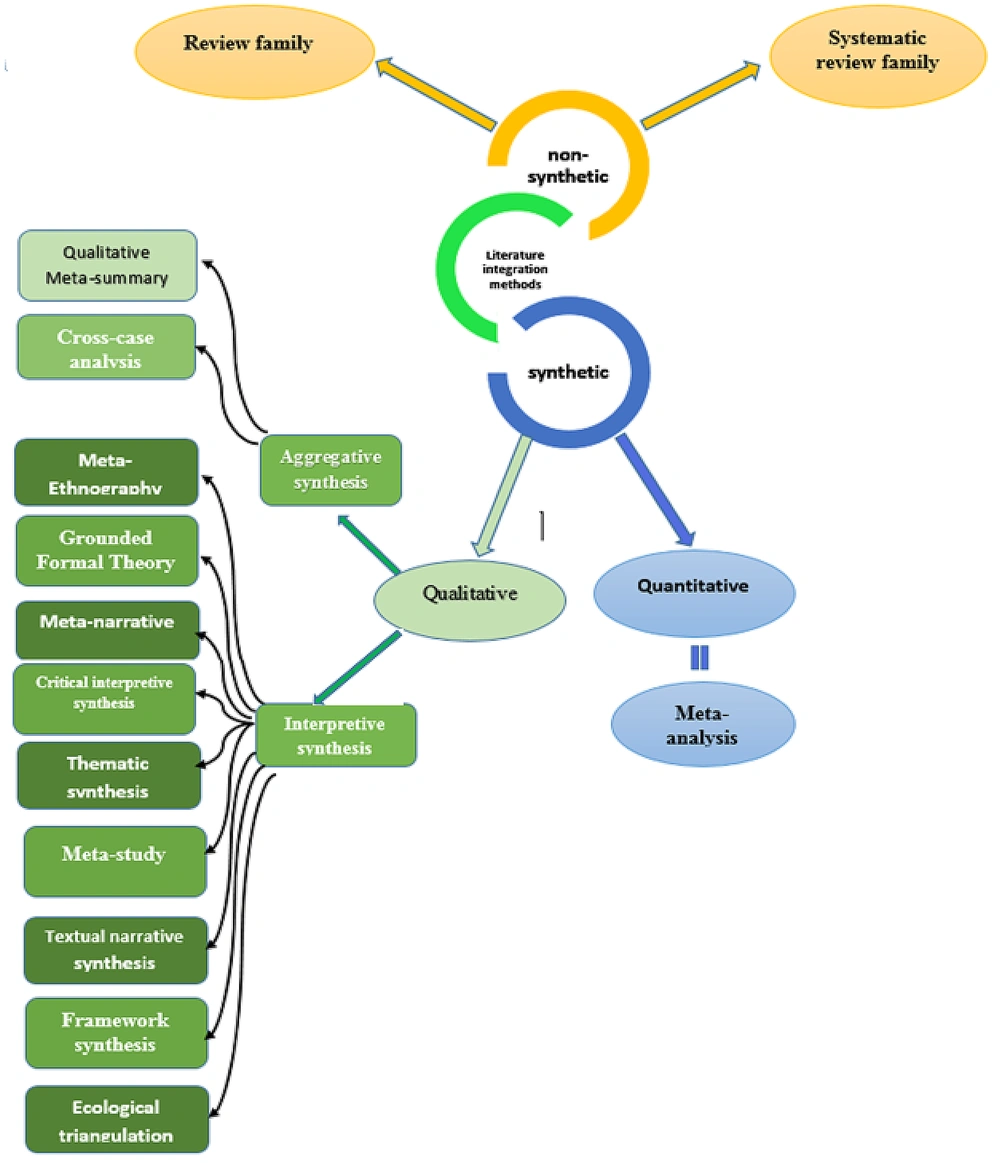
Figure 2.
Classification of integrated studies
3.1. Conducting Qualitative Meta-synthesis
The most common methods for meta-synthesis found in articles on chronic diseases are meta-ethnography and Sandelowski and Barroso’s method.
3.2. Meta-ethnography
The objective of this method is to create an inductive and interpretive form of knowledge synthesis. Meta-ethnography utilizes the findings of existing case studies, transitioning them toward reconceptualization. According to the prominent pioneers of this method, Noblitt and Heyer, “Meta-ethnography is the term we use to describe our approach to integrating the acquired knowledge from ethnographic narratives. Therefore, there is an analogy to meta-analysis”. They believe that meta-ethnography should be an interpretation in the form of mutual translation of studies to each other (21). They outline seven steps for conducting meta-ethnography as follows:
(1) Getting started
(2) Deciding what is relevant to the initial interest: (A) Defining the focus of the synthesis, (B) locating relevant studies, (C) decisions to include studies, and (D) quality appraisal
(3) Reading the studies
(4) Determining how the studies are related
(5) Translating the studies into one another: This is not a literal translation; however, the purpose is the explanation of a phenomenon. The translation process is based on Turner’s theory of social explanation, where social explanation is comparative and should be inductive.
(6) Synthesizing the translations
(7) Expressing the synthesis
3.3. Sandelowski and Barroso’s Method
This method is a structured model for the analysis of qualitative literature and the extraction of concepts used in the meta-integration method. It involves a seven-step process (Figure 3): Setting the research question, systematic literature review, searching and selecting appropriate literature, extracting concepts from articles, analyzing and combining the qualitative findings, quality control, and presenting the findings (15).
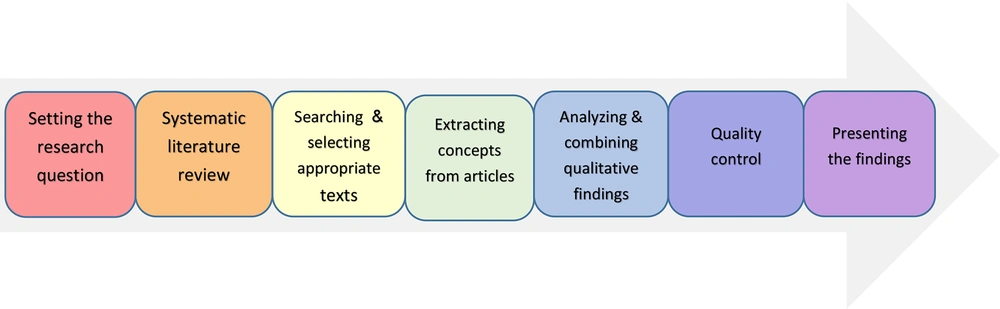
Figure 3.
Sandelowski and barroso’s method for conducting meta-synthesis
4. Discussion
This study aimed to investigate the application of meta-synthesis in qualitative research on chronic diseases and identify the frequently adopted methods in this regard. According to Edwards and Kaimal, meta-synthesis reporting is designed to support service development based on research findings that include service user perspectives, acknowledge the complexity of healthcare service delivery, and honor the often-unique nature of the settings in which services are provided (22).
There is a large volume of examples of qualitative meta-synthesis studies on chronic diseases that indicate the need for a deeper understanding of this method. In this regard, the results of a systematic review revealed a significant relationship between therapeutic correlation and adaptation in patients with various chronic diseases, indicating that therapeutic relationships are an important factor in subsequent treatment orders and improving the quality of life in these patients (23). Jaime-Lara et al. conducted a meta-synthesis to better understand fatigue and patients’ experiences with fatigue in five chronic diseases, finding that adults suffering from these illnesses commonly experience fatigue and a drastic decrease in energy. They also observed that fatigue is often a misunderstood phenomenon that has not received sufficient scholarly attention (24). The results of a qualitative meta-synthesis conducted on rural patients with chronic diseases living in outlying areas demonstrated three concerns in these patients: The need to traverse long distances to access healthcare, the availability of specialists, and the impact of rural culture, as they often feel out of place in hospitals and clinics located in urban areas (25).
Another study investigated the coping strategies of elderly individuals with chronic pain, and the researchers identified three themes: Adjusting to diseases without using drugs, the necessity of adapting to diseases, and the importance of support in managing the disease (26). In another study, the authors concluded that there are similarities in the experience of chronic pain among patients with a wide range of conditions, which has important implications for the development of pain management strategies and interventions (27). In a qualitative meta-analysis, DeJean et al. examined depression and anxiety in patients with chronic diseases and emphasized the need to address the screening of depression and anxiety and to conduct more qualitative research (28). Huang et al. conducted a qualitative meta-synthesis, which showed that family adaptation to chronic disease is a complex, multifaceted, and dynamic process. Therefore, identifying the characteristics of families can provide practical interventions for families with chronically ill children (29). In a qualitative meta-synthesis reviewing 20 articles, Holmen et al. stated that chronically ill patients put pressure on healthcare systems and healthcare professionals (30).
In all of the above-mentioned articles, results different from those reviewed in earlier studies were obtained. Thorne draws an analogy between the interest of the qualitative health research community in meta-synthesis and the excitement mountain climbers have when climbing Mount Everest. He maintains that in qualitative meta-synthesis research, the results are genuine, complex, and intact. According to Thorne, in this type of research, the final product is evaluated using criteria derived from both art and science (31).
In general, researchers in the field of qualitative meta-synthesis, especially in health-related studies that involve chronic patients, seek the following objectives:
(1) bridging the gap between research and practice, (2) improving decision-making in evidence-based practice, (3) representing how participants view the world, behave, feel, believe, and experience, (4) understanding the responses of patients to different interventions, (5) comparing various healthcare contexts to obtain more solid results (since the source of evidence is provided from several different researchers and primary studies), and (6) generating novel primary research and knowledge (32)
4.1. Conclusions
There is a noticeable progressive shift toward the adoption of evidence-based medicine in the medical community, as indicated by the increasing number of qualitative studies in the field of medical sciences, particularly for patients suffering from chronic diseases. This highlights the need for further studies addressing meta-synthesis. It is important to keep in mind that the purpose of this method is to gain an understanding beyond mere summaries and to provide new interpretations of the findings of original studies. It is a method for integrating the results of studies, reinterpreting the findings, and ultimately creating new insights beyond what is obtained from individual studies.