1. Context
Migraine is a common chronic, disabling, debilitating and progressive intermittent neurovascular headache disorder (1, 2). This disorder is characterized by severe recurrent headache, nausea, vomiting, sensitivity to light and sound, neck pain and muscle tension, as well as photophobia and phonophobia (3, 4). Migraine headaches are one-sided throbbing that usually last between four to 72 hours (5, 6). Based on the International Headache Society (IHS) criteria, there are two major classes of migraine: Migraine with Aura (MA) and Migraine without Aura (MOA) (7). These two subtypes have the same symptoms, yet 25% of patients with migraine perceive an aura, which is a transient disturbance in visual, sensory, language, or motor function and define it as a signal of headache occurrence (8).
The etiology of migraine is unknown, but it has been shown that genetic and environmental factors including Methylenetetrahydrofolate Reductase (MTHFR) mutation (9), inflammatory factors (10), obesity and inappropriate dietary patterns (11) are involved in the etiology of this disease.
Recent studies have indicated that one in every four American adults has frequent or severe headaches including migraines (4). The precise prevalence of migraine is unknown and based on previous reports, the prevalence of this disorder is different around the world. One large epidemiological study in the United States reported the prevalence of this disorder as 13.2%, 8.6% and 17.5% for the total population, males and females, respectively (12). In addition, evidences have shown a prevalence of 14.7% in European adults and 3% and 10% in Asian males and females, respectively (13, 14). In Iran, as an Asian country, different prevalence of migraine has been reported. Epidemiological studies reported the highest prevalence (18.11%) of migraine in adults residing in Tehran (15) and the lowest prevalence (1.7%) was reported for primary-school children in Shiraz (16). Unfortunately, no comprehensive study has been conducted to determine the prevalence of migraine in different parts of Iran, and most studies have been done in one city or area. Therefore, due to the above-mentioned reasons and since no study has reviewed published studies about the prevalence of migraine in Iran, we aimed to review published studies about the prevalence of migraine in different regions of Iran in order to help public health authorities understand the magnitude of the problem, and consequently improve diagnostic and therapeutic methods to reduce this burden.
2. Evidence Acquisition
In this review article, we performed an electronic search on articles published from 1st of January 1998 to 30th of December 2014, on PubMed, Science Direct, Embase, Web of Science, Medline, Scopus for English language articles, and on Iran Medex, Magiran and Scientific Information Database (SID) for Persian (Farsi) language articles, using the following keywords as Medical Subject Headings (MeSH): “Migraine Disorders”, “headache”, “prevalence” and “Iran”. The references of retrieved items were also searched to identify additional items about this topic. In addition, reference lists of journal papers were searched by hand for relevant papers. We included articles that examined the prevalence of migraine in different regions of Iran in patients aged ≥ 6 years with a standard method for diagnosis of migraine and original data about the prevalence of migraine. We excluded studies that focused on headache; tension-type headache and chronic pain. Moreover, we excluded letter and review articles.
The relevance of articles was determined by the assessment of titles, abstracts and full text of papers. In total, we found 58 items (including duplication). After careful reading of titles, abstracts, and full texts (when available), 52 articles were initially selected, yet after further reading, 45 studies that met the eligibility criteria were included. We excluded 29 of these 45 articles due to evaluation of headache, tension-type headache and chronic pain (25 items), invalid method for diagnosis of migraine (three items) and being a letter (one item). Therefore, 16 studies were finally included in this review. The information gathered from the articles was summarized in tables based on a fixed protocol as follows: leading author, year of publication, assessed city, sample size, mean or range of age, the number of migraine patients and their prevalence rate in the total population and both genders. In addition, the prevalence of migraine in each region was visualized by figures.
3. Results
Among the 16 evaluated studies, 10 studies were done on adults (15, 17-25) and six studies were conducted on children and adolescences (16, 26-30). Of the 10 reviewed studies on adults, two studies were conducted in Zahedan (22, 23) and one study was conducted for each of the following cities, Tehran (15), Isfahan (19), Bandar Abbas (20), Shiraz (16), Kerman (18), Zanjan (21), Ardabil (24) and Ilam (25). Of the six reviewed studies on children and adolescences, two studies were conducted in Shiraz (16, 26) while in Yazd (27), Brijand (28), Rasht (29) and Shahrkord (30) only one study was done. Sample sizes of studies ranged from 210 to 3655 and age of the samples ranged from 6 to 100 years. Most studies (15-25, 27-29) were conducted on both genders while two studies (26, 30) were performed only on females. Among reviewed studies, eight studies (15-17, 24, 25, 28-30) were published in the English language and eight studies (18, 21, 22, 24, 25, 28-30) were published in the Persian (Farsi) language. In all suites, IHS criteria were used for diagnosis of migraine. The information obtained from these studies is presented in Tables 1 and 2. In addition, the prevalence of migraine in each region is indicated in Figures 1 and 2.
Table 1.
Prevalence of Migraine in Iranian Adults
| Reference | Year of Publication | City | Age Range, y or Mean ± SD | Total | Migraine a | Total Males | Males’ Migraine a | Total Females | Females’ Migraine a |
|---|---|---|---|---|---|---|---|---|---|
| Shahbeigi et al. (15) | 2013 | Tehran | 10 - 95 | 3655 | 662 (18.11) | 1206 | 127 (10.6) | 2449 | 535 (22) |
| Ghorbani et al. (19) | 2013 | Isfahan | 18 - 31 | 480 | 68 (14.2) | 258 | 27 (10.5) | 222 | 41 (18.5) |
| Yazdanparast and Abrishamizadeh (20) | 2013 | Bandar Abbas | 21.28 ± 2.78 | 350 | 57 (16.3) | 114 | 29 (25.4) | 236 | 28 (11.9) |
| Ayatollahi and Khosravi (16) | 2006 | Shiraz | 25 - 50 | 1023 | 115 (11.2) | 310 | 18 (5.8) | 713 | 97 (13.6) |
| Bahrampour and Mobashe (18) | 1998 | Kerman | 10 - 100 | 1029 | 107 (10.4) | 556 | 40 (7.2) | 473 | 67 (14.2) |
| Yusefy (21) | 1999 | Zanjan | 17 - 45 | 554 | 61 (11.01) | 350 | 33 (9.4) | 204 | 28 (13.7) |
| Shahraki et al. (22) | 2006 | Zahedan | 35.7 ± 6.55 | 1539 | 149 (9.7) | 616 | 41 (6.6) | 923 | 110 (11.9) |
| Shahrakai et al. (23) | 2011 | Zahedan | 20 - 30 | 210 | 15 (7.14) | 94 | 5 (5.3) | 116 | 10 (8.7) |
| Hashemilar et al. (24) | 2004 | Ardabil | 20.78 | 631 | 46 (7.3) | 147 | 5 (3.4) | 484 | 41 (8.4) |
| Modara (25) | 2008 | Ilam | 21.5 ± 2.2 | 309 | 25 (8.1) | 69 | 6 (8.9) | 213 | 19 (8.9) |
a Values are presented as No (%).
Table 2.
Prevalence of Migraine in Iranian Children and Adolescences
| Reference | Year of publication | City | Age range, y or Mean ± SD | Total | Migraine a | Total Males | Males’ Migraine a | Total Females | Females’ Migraine a |
|---|---|---|---|---|---|---|---|---|---|
| Ayatollahi and Khosravi (16) | 2006 | Shiraz | 6 - 13 | 2226 | 38 (1.7) | 1171 | 16 (1.4) | 1055 | 22 (2.1) |
| Fallahzadeh and Alihaydari (27) | 2011 | Yazd | 12 - 14 | 930 | 114 (12.3) | 469 | 73 (15.61) | 461 | 41 (8.9) |
| Ayatollahi et al. (26) | 2002 | Shiraz | 11 - 18 | 1868 | 114 (6.1) | ||||
| Khazaie et al. (28) | 2011 | Birjand | 15.81 ± 1.02 | 723 | 50 (6.9) | 317 | 24 (7.6) | 406 | 26 (6.4) |
| Ghayeghran and Fathe (29) | 2004 | Rasht | 15.3 ± 1.11 | 1965 | 174 (8.8) | 1075 | 68 (6.3) | 890 | 106 (11.9) |
| Mirzaei (30) | 2004 | Shahrekord | 14 - 20 | 550 | 73 (13.3) |
a Values are presented as No (%).
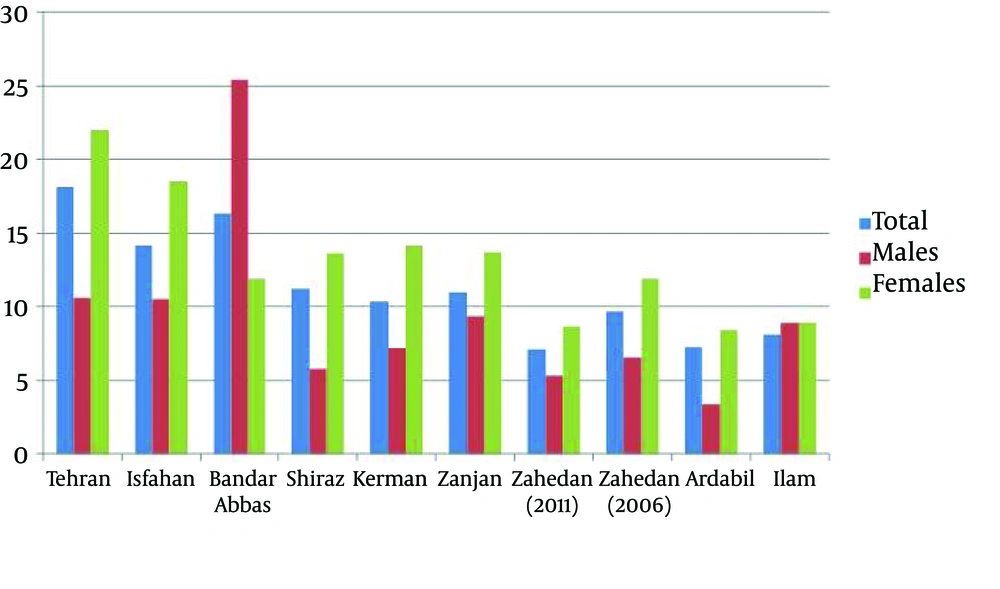
Figure 1.
Prevalence of Migraine in Adults
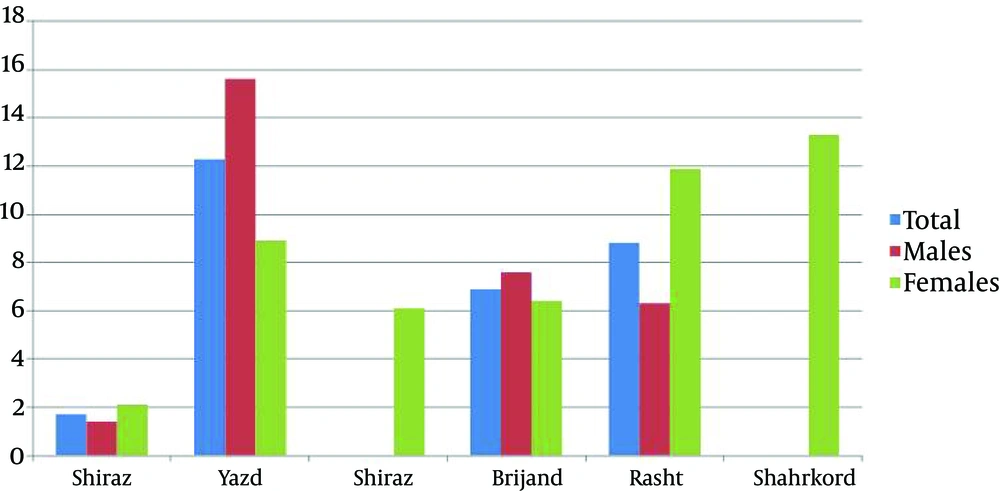
Figure 2.
Prevalence of Migraine in Children and Adolescences
In most evaluated studies, migraine was the most prevalent in middle-age individuals and women. The prevalence of migraine in adults varies from 7.14% to 18.11%, and the maximum and minimum prevalence was reported from Tehran (capital of Iran) (15) and Zahedan (southeast of Iran) (23), respectively. In children and adolescences, the prevalence varied from 1.7% to 12.3%, and the lowest and the highest prevalence were from Shiraz (southwest of Iran) (16) and Yazd (southeast of Isfahan) (27), respectively.
4. Conclusions
In this study, we found a high prevalence of migraine in evaluated studies. The prevalence of migraine in adults varied from 7.14% to 18.11% while in children and adolescences it varied from 1.7% to 12.3%. Consistent with our results, a review of all epidemiological studies in European countries indicated that the prevalence of migraine among adults ranged 8% to 17.6%, while among children and adolescence it ranged 5.2% to 9.1% (31). In another systematic review and meta-analysis, it was shown that 5.6% to 8% of children and adolescence had migraine over periods ranging from three months to a lifetime (32). There are many factors that may be the reason for the high prevalence of migraine in this study compared to the two mentioned review studies. A large number of studies proved the effect of dietary factors including consumption of coffee, monosodium and tyramine-containing foods and high fat diet on incidence or exacerbation of migraine; these dietary products are high in Iranian diets (33). In addition, nutritional deficiencies such as vitamin D in the Iranian population may be another reason for high prevalence of migraine in Iran (14). Furthermore, high prevalence of obesity (9-11, 34, 35), psychological difficulties (36), low educational level and marital status (37) are other factors which can contributed to the high prevalence of migraine in Iran.
Our results showed that among adults, the maximum prevalence was reported from Tehran and the minimum from Zahedan. In children and adolescence, the lowest prevalence was found in Shiraz and the highest prevalence in Yazd. The prevalence differences between cities may be due to the combination of genetic mutations and environmental factors including dietary patterns, lifestyle, culture, socio-economic factors and education level.
Our results showed that migraine was the most prevalent in middle-age individuals and women. In a large population-based study in Latin American countries, migraine predominantly affected women aged 30 to 50 years (38). In addition, one meta-analysis showed that migraine prevalence increases from adolescence to around the age of 40 years and higher prevalence of migraine was found in females when compared to males (31). One of the main reasons which can explain the high prevalence of migraine among females is female sex hormones that affect the sense of pain (39).
Despite wide differences in the prevalence of migraine in different epidemiological studies among adults or children and adolescence in Iran, a clear and reliable estimate of the problem is difficult since we have no data on the prevalence of migraine in other provinces of Iran. Above all, all evaluated studies were done in urban areas, and no data is available for the prevalence of migraine in rural areas. Therefore, we cannot have an overall conclusion about the prevalence of migraine in Iran. Thus, further studies especially large population-based studies, which consider all Iranian provinces, are needed to find the real prevalence of migraine in Iran.
Based on the current findings, the prevalence of migraine in evaluated studies was high. Therefore, it is recommended for public health authorities to detect the reasons for the high prevalence of this disease and present appropriate strategies to prevent this disorder.