
1. Background
Headaches are the most common disorders and causes of disability in general population [1]. Approximately half of the population worldwide suffers from kinds of headaches. So, prevalence of active migraine is estimated 11% in world [2]. In Asia, the general prevalence of migraine ranges is 8.4 - 12.7% and Tension-Type Headache (TTH) ranges is 15.6 - 25.7% [3]. Headache has a significant impact on the personal and social lives of patients through reduced quality of life, loss of work and reduce productivity and on economic conditions through use of resources [4]. Headache is the ninth common reason for referring physician [5]. In terms of age, headache is more common in the 25 - 34 years age groups [6]. This is more common in females than males [7].
The most reliable estimates of headache were international classification of headache disorders (ICHD) that established by international headache society (IHS) after 1988 [8]. Several studies have estimated the prevalence of migraine and TTH based on the criteria of the IHS. The prevalence of migraine have been reported in studies done in Iran and different countries such as Germany (10.6%), Spain (12.6%), and Brazil (22.1%); hospital staff of Shiraz in Iran (11.2%) [9-12]. Also, the prevalence of TTH reported in other studies such as Brazil (22.9%) and hospital staff (19.5%), teachers (24%) and students of Shiraz (32%) [11-14]. Migraine is one of the most frequent neurologic disabilities worldwide. Diagnosis criteria for international headache society for migraine are: unilateral location, pulsating quality and moderate or severe intensity; aggravated by physical activity and associated with nausea and/or vomiting, photo and phonophobia. Headache lasting 4 to 72 hours and in 15 - 20% of patients, migraine is preceded by aura: a mostly visual reversible focal neurological symptom that has duration of no longer than 1 hour [15].
TTH has a large prevalence in the general population with attacks lasting from 30 minutes to 7 days. Pain characteristics are include bilateral, pressing and mild or moderate intensity, not aggravated by physical activity nor associated with nausea or vomiting. If the headache occurs more than 15 days/month for at least 6 months, the TTH is chronic and in this form the presence of mild nausea is possible [15].
Several studies have shown that most migraineurs had not consulted with a physician for treat their disease and approximately half of them never received the optimal treatment [16]. Many factors affect on headaches and can lead to headache relief while most of them are modifiable such as sleep disorder, stress, obesity, medication overuse, caffeine overuse that are modified directly by improving and behavioral treatment [17].
For example, population-based studies have shown that a direct correlation exists between the prevalence of sleep problems and frequent of headaches. Kelman and Rains [18] showed a correlation between sleep and migraine. They showed that the improvement in sleep duration will reduce migraine headache. So the earlier diagnosis of headache and medical treatment and behavioral modification can prevent the incidence of headache. So headache should diagnose before the occurrence to reduce the severity of headache by using preventive medications [4].
2. Objectives
This study was conducted to determine the prevalence of migraine and TTH among up to 15 years old.
3. Patients and Methods
This descriptive-analytic study was conducted in Yazd city in Iran to evaluated prevalence of migraine and TTH. The sample size was calculated as 500 individuals based on a prevalence of 20% with a migraine and error of 2% and a confidence interval of 95%. Sampling was conducted based on the cluster method. Seventeen clusters and each cluster included 30 households in different sections of the city were selected. The statistical framework used to select households was based on the list of health centers in Yazd province. Population in each clusters were collected in one day by a group of three interviewers. At first, the number of households and then sampling interval for each area was computed. Families from each cluster were randomly selected and invited to participate in the study.
Data were collected by screening questionnaire applying the IHS classification for migraine and TTH. The interview began with socio-demographic variables self-reported including sex, age, educational level (Illiterate, Diploma and lower, University) marital status, income level, profession, kind of housing (homeowner, tenant). The number of fast foods consumed in a month and amount of physical activity in a month. Physical activity was measured using the IPAQ-SF (International Physical Activity Questionnaires-short form) that was classified as low, moderate, and high. Validity and reliability of IPAQ-SF has been identified in various countries [19, 20].
A question about kind of headache was based on the criteria of the IHS (Table 1) [15]. At baseline, this question was asked of those “in the past month, how many times have you headaches?” and “how long does your average headache in each attack”. Then the other questions were asked about location and quality of pain, severity of pain, aggravated by routine physical activity and sign and symptoms (occurrence of nausea, vomiting, photophobia, phonophobia and visual or sensory aura) which are based on IHS criteria and exacerbation by exposure to the sunlight. The participants were met in their homes by researcher and explained to team the aim of the study and briefed them on the voluntary nature of the participation. Questionnaires were completed by participants and if they were not able to complete, questions were read to them by interviewers and responses were recorded. Statistical analyses were performed using SPSS 16. The χ2 tests were used to test the significance of difference for nominal variable. The independent t-test was used for quantitative variables. The 5% level of statistical significance was considered. A logistic regression analysis was performed to asses of relations migraine and TTH with each variable.
Table 1.
Diagnostic Criteria for Tension-Type Headache and Migraine Adapted From the International Headache Society
| Parameter | Tension-Type Headache | Migraine Headache |
|---|---|---|
| At least 10 previous attacks | At least 5 attacks | |
| From 30 minutes to 7 days | 4 to 72 hours(2 to 48 in children) | |
| Pressing (non pulsating) quality | Unilateral location | |
| Mild or moderate intensity (may inhibit but does not prohibit activities) | Moderate or severe intensity (inhibits or prohibits daily activity) | |
| Bilateral location | Pulsating quality | |
| Not aggravated by climbing stairs or similar routine physical activity | Aggravated by climbing stairs or similar routine physical activity | |
| Both “No nausea or vomiting” and “Photophobia and phonophobia are absent, or only one is present” | At least 1 of the followings: “Nausea or vomiting, or both” or “Photophobia and phonophobia” |
4. Results
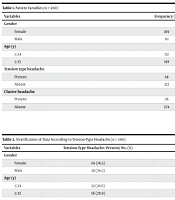
This study investigated the prevalence of migraine and tension headaches and related factors in a population of 500 people from Yazd. Migraine and TTH prevalence were respectively 6% and 4.9%. Results showed that migraine was significantly higher in women than men (P = 0.03), but there was not statistical significant difference between the prevalence of TTH and sex. The prevalence of migraine and TTH according to age is shown in Table 2. The prevalence of migraine and TTH was significantly higher in married than single people, but there was not statistical significant difference. The prevalence of migraine and TTH was higher in illiterate, but this was only significant in migraineurs. So the rate of migraine was decreased with increasing education level (P = 0.02). Among people with migraine only 44.4% were aware of their disease, and this difference was statistically significant (P = 0.001). Mean of headache frequency in the past month and the mean duration of headache in each attack are shown in Table 3.
Abnormal sleep patterns (trouble falling asleep, waking up frequently during the night, nightmares and dread in sleeping, sleepwalking, coughing, or snoring loudly, difficulty breathing) was seen in 66.7% of migraineurs and 59.1% of people who suffer from TTH and this relationship was significant in migraineurs (P = 0.0008). Results showed that the prevalence of migraine will increase with increasing consumption of fast foods, although, significant differences were not observed. All of 48.1% of migraineurs have attacks with visual aura (P = 0.012) and also 48.1%, have attacks with sensory aura. Pain characteristics in patients with TTH were pressing quality (68.2%), bilateral location (71.4%), mild or moderate intensity (54.5%) and not aggravated by routine physical activity such as walking or climbing stairs (68.2%); also pain characteristics in patients with migraine were pressing quality (51.9%), unilateral location (63%), moderate or severe pain intensity (85.2%) and aggravation by routine physical activity (63%) (Table 4).
The incidence of nausea and vomiting during migraine were respectively 55.6% and 40.7%. Photophobia and phonophobia respectively reported 55.9% and 85.2% in migraineurs. All of 70.4% of migraineurs and 50% of patients with TTH said that, when they place in sunlight or extreme heat, they has more severe headache, but there was not statistically difference. Also all of 65.4% of patients with migraine and 28.6% of patients with TTH have absented of their work and school because of headache in last year and this was a significant relationship (P = 0.008). Ten percent of migraineurs and 6.1% of patients with TTH visited by physician, but this was significant for migraine headaches. Logistic regression has been used to determine related factors with the prevalence of migraine and TTH. The results are shown in Table 5.
Table 2.
Age-Specific Prevalence of Migraine and Tension-Type Headache
| Type of Headache | < 25 y | 26 - 35 y | 36 - 45 y | 46 - 55 y | 56 - 65 y | 66 - 75 y | Total | P-Value |
|---|---|---|---|---|---|---|---|---|
| 3 (11.1) | 4 (14.8) | 7 (25.9) | 8 (29.6) | 4 (14.8) | 1 (3.7) | 27 (100) | 0.02 | |
| 5 (22.7) | 4 (18.2) | 5 (22.7) | 2 (9.1) | 2 (9.1) | 4 (18.2) | 22 (100) | 0.001 |
a Values are presented as No. (%).
b P < 0.05 was considered significant.
c Trend χ2.
Table 3.
Comparison of Headache Factors in Different Headache by t-test a
| Headache Factors | Migraine | Tension-Type | P-Value |
|---|---|---|---|
| 10.59 ± 7.5 | 17.81 ± 8.4 | 0.002 | |
| 18.6 ± 19.8 | 5.8 ± 10.7 | 0.006 |
a P < 0.05 was considered significant.
b Data are presented as Mean ± SEM.
Table 4.
Distribution of Headache Characteristics in Migraine and Tension-Type Headache
| Variables | Migraine | Tension-Type |
|---|---|---|
| Quality | ||
| Pulsating | 7 (25.9) | 3 (13.6) |
| Pressing | 14 (51.9) | 15 (68.2) |
| Lancinating | 6 (22.2) | 4 (18.2) |
| Mild | 4 (14.8) | 3 (13.6) |
| Moderate | 8 (29.6) | 9 (40.9) |
| Severe | 15 (55.6) | 10 (45.5) |
| Unilateral | 17 (63) | 6 (28.6) |
| Bilateral | 10 (37) | 15 (71.4) |
| Occipital | 5 (18.5) | 3 (13.6) |
| Frontal | 14 (51.9) | 8 (36.4) |
| Generalized | 8 (29.6) | 11 (50) |
| Nausea | 15 (55.6) | 5 (22.7) |
| Vomiting | 11 (40.7) | 1 (4.5) |
| Phonophobia | 23 (85.2) | 13 (59.1) |
| Photophobia | 15 (55.6) | 7 (31.8) |
| Anorexia | 8 (29.6) | 5 (22.7) |
| Abdominal pain | 0 (0) | 1 (4.5) |
| Yes | 17 (63) | 7 (31.8) |
| No | 10 (37) | 15 (68.2) |
a Values are presented as No. (%).
Table 5.
| Parameter | Headache Type | |||||
|---|---|---|---|---|---|---|
| Migrane | Tension | |||||
| Age, y | ||||||
| < 25 | 1 | 1 | ||||
| 26 - 35 | 1.06 | 0.93 | (0.22 - 4.98) | 0.71 | 0. 62 | (0.18 - 2.78) |
| 36 - 45 | 2.4 | 0.22 | (0.58 - 9.87) | 1.2 | 0.78 | (0.32 - 4.44) |
| 46 - 55 | 2.2 | 0.26 | (0.53 - 9.94) | 0.46 | 0.39 | (0.07 - 2.74) |
| 56 - 65 | 1.6 | 0.55 | (0.31 - 8.78) | 0.75 | 0.75 | (0.12 - 4.65) |
| 66 - 75 | 0.8 | 0.88 | (0.006 - 10.78) | 5.6 | 0.08 | (0.8 - 38.9) |
| Female | 1 | 1 | ||||
| Male | (0.2-1.56) | 0.27 | 0.56 | 0.59 | (0.2 - 1.69) | 0.32 |
| Illiterate | 1 | 1 | ||||
| Diploma and lower | 0.47 | 0.19 | (0.15 - 1.44) | 0.69 | 0.64 | (0.14 - 3.16) |
| University | 0.37 | 0.17 | (0.09 - 1.54) | 1.19 | 0.83 | (0.23 - 6.05) |
| (1 - 1.6) | 0.046 | 1.12 | (0.95 - 1.69) | 0.09 | 1.27 | |
a Abbreviations: CI: Confidence Interval, OR: Odds Ratio.
b P < 0.05 was considered significant.
5. Discussion
The prevalence of migraine estimated 6% in our study that is almost equal to previous studies on women in Iran (6.1%), general population in Finland (6.5%) and Iranian girl students (8.6%) [21-23]. The prevalence of migraine estimated between 8.4 - 12.7% in a study in the Asian region [3].
The prevalence of migraine have been reported in studies done in different countries such as Germany (10.6%), Spain (12.6%), adolescents 11 - 18 years old of Nigeria (13.5%), Turkish primary school students (3.4%) and Brazil (22.1%) [9-11, 24, 25]. Also, several studies have been conducted in Iran such as students in Yazd (12.3%) students in Iran University (8.1%), hospital staff of Shiraz (11.2%) [12, 26, 27]. The prevalence of TTH was 4.9% in present study that is lower than the prevalence reported in other studies such as general population in Brazil (22.9%), police of Turkey (25.9%) and hospital staff (19.5%), teachers (24%) and students of Shiraz (32%) [11-14, 28].
In this study, the prevalence of migraine had a significant relationship with sex. Odds ratio for women was 5.6 times higher than men. This finding was consistent with other studies [29]. Society expectations, social limitations and stress of life issues can help to explain this difference. Some studies considered the role of female hormones in the prevalence of migraine in women [30].
Prevalence of migraine rose up to age 55 so that its peak was between ages 46 - 55 years and after that, the trend declined (Figure 1). Also, Lipton and Bigal showed that the prevalence of migraine rose between ages 25 - 55 years and then, trend was declining [31]. TTH prevalence was higher in less than 25 years and 36 - 45 years. Kachoui et al. showed that poor sleep, tiredness and stress are the main factors for migraine [30]. Therefore, higher levels of life challenges and stress in this age group can explain this difference.
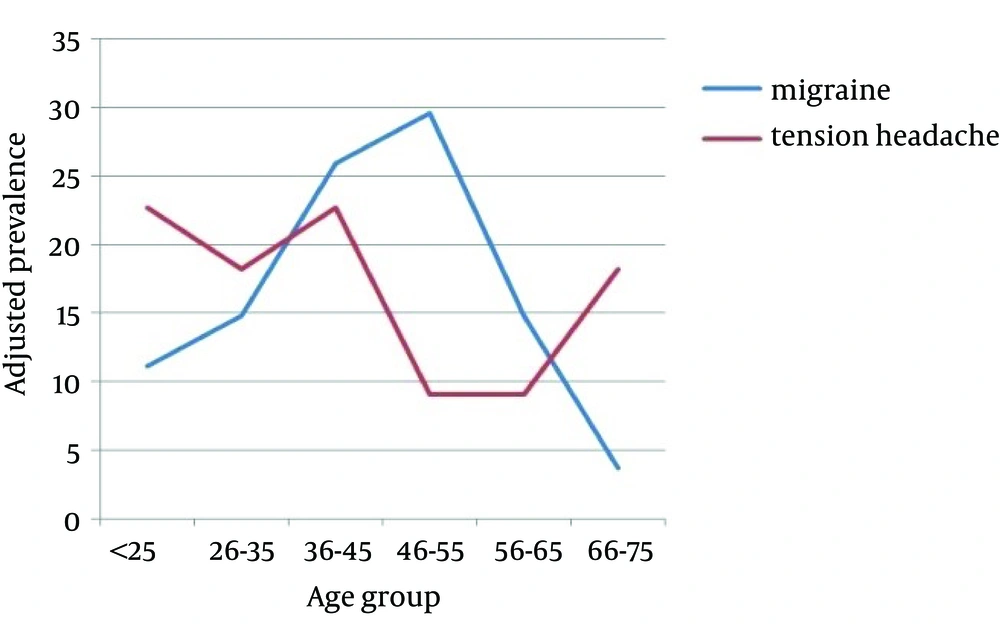
Figure 1.
Adjusted Prevalence of Migraine by Age
In this study, migraine and TTH were higher in married than single people, but there was no significant relationship which was consistent with some studies [32, 33]. Ayatollahi and Cheraghian’s study showed a significant relationship between headache and marital status [13]. This difference can be caused by stress of married life such as concerns about the economic problems, children’s future and routine disputes.
The results showed an inverse statistically relationship between education level and migraine. Stang et al. showed that the headache rose with increasing education level [34], but Queiroz et al. did not show any significant relationship in this field [11]. Results showed that the frequency of TTH was significantly more than migraine but, the duration of migraine was significantly more than TTH that these results were consistent with Ayatollahi et al. study [35].
Having nausea and vomiting, phonophobia, photophobia and aggravating of headache by routine physical activity with moderate or severe intensity were present in the majority of migraineurs which these results were consistent with the results of some studies in this field [36, 37]. The pressing headache with mild or moderate intensity and not aggravated by routine physical activity, existed in the majority of patients with tension-type headache; these results were consistent with some studies [20, 37]. Unilateral headache found in 63% of migraineurs; this was consistent with the criteria of the IHS and Lee’s study [15, 36]. Bilateral headache was found in 71.4% of patients with TTH which was consistent with the criteria of the HIS [15] and Gallai et al. study [37].
In this study, 65% of the migraineurs had visual aura; this was statistically significant, also 66.7% of the migraineurs had sensory aura. In a study conducted on students in Yazd showed that visual and sensory auras were respectively 23.4% and 25.3% in migraineurs; this difference was significant [25]. This study showed a significant relationship between sleep pattern and migraine. It seems that abnormal sleep pattern is a strong risk factor for migraine. This relationship has been demonstrated in several studies done around the world. It was concluded from previous studies that odds ratio for migraine in school children; students and teachers in Shiraz with abnormal sleep pattern were respectively 4.2, 2.5, and 2.7 times higher than those with normal sleep that this was a significant relationship [13, 14, 38]. The results of some studies in Iran [25, 26, 30] and other countries [39, 40] is consistent with results of this study. In Kachoui et al. study that examined risk factors in migraine attacks on 300 patients, showed that insomnia was the most common reason in men with odds ratio of 3.2 and the prevalence of 69%; also, it was the second factor in women with the prevalence of 63.1% [30]. However, the natural sleep pattern is an important factor in improving migraine and can be considered as a protective factor. Also, medical treatment of insomnia may help to reduce the frequency and severity of attacks. Potter and Perry believe that sleep and rest are effective in maintaining and improving physical and mental health [41].
Masoud and Taghadosi examined the relationship between sleep disorders and migraine. He showed that the incidence of migraine after sleep disorders was reported in 87.8% of patients and the headache improved in 81.4% of patients after sleep and rest [42]. Also, Boardman et al. showed that sleep problems are associated with different types of headache and sleep disorders may increase the severity of the headache [39]. This may be due to changes in hormone level. Peres et al. showed that melatonin level was lower in patients with migraine and cluster headache that had sleep disorders; this difference was due to melatonin's role in regulating the sleep cycle [43].
In this study, more than half of patients with migraine and TTH believed that prolonged exposure to the sunlight and extreme heat make their headaches worse. Some studies have reported a significant relationship [44], but the others did not show a significant correlation; this was consistent with the results of present study [33]. Also, the results indicating that more than half of migraineurs reported absence from work or classroom. Migraine is usually severe and decreases efficiency in individual and social life and ultimately affects the quality of life. In this context, Ayatollahi et al. showed that 21.7% of employees with migraine and 8.5% of employees with tension headache missed their work [12]. Fallahzadeh et al. [26] represented that the headache caused the student’s absence from school and this will lead to the educational failure and lower confidence. So people with migraine should be identified early and referred to a physician.
Results showed that only 10% of migraineurs had consulted a physician about their disease. This difference can be explained by the lack of awareness of the disease. Lipton et al. study showed that 31% of patients with migraine had never consulted because of their headache with a physician [45]. In Fallahzadeh et al. study, 26.5% of migraineurs and 4% of patients with TTH did not refer to the doctor for treatment of their headaches [26]. Also, in a study conducted in Spain found that one third of migraineurs did not refer to the doctor for diagnosis of migraine [10]. Design of present study in form of cross-sectional and self-reporting was limiting factor. Another limitation was lack of the clinical examination by physician.
Migraine and TTH prevalence rate were relatively low in this study. However, effective measures should be taken to reduce it continuously. Reduce stress in the workplace and life can be effective for headache relief. Also attempts to improve sleep through medical treatment, relaxation techniques and having enough sleep can reduce the frequency and severity of migraine. It is suggested that more studies be conducted on bilateral relationship between headaches and sleep disorders. However, people with migraine and TTH should be identified and optimally treated.