
1. Background
Community-acquired pneumonia (CAP) is a leading cause of morbidity and mortality worldwide and a major public health hazard for Chinese children (1). According to the China’s mortality monitoring system, under-five mortality rate is 153.2 deaths per 100,000 live births (2). Rigorous estimation of disease severity is critical to clinical decision-making. Staphylococcus aureus can cause many different infectious diseases, including fatal pneumonia (3). Staphylococcus aureus can be classified into methicillin-resistant Staphylococcus aureus (MRSA) and methicillin-sensitive Staphylococcus aureus (MSSA) based on the sensitivity to antibiotics. The evolution of bacteria and the overuse of antibiotics have enhanced drug resistance of MRSA and incremental infection trends, making clinical anti-infection therapy more formidable (4).
At present, sputum culture is the most economical method to detect pathogens in patients with CAP and evaluate their drug resistance to antibacterial drugs (5). Research from the China antimicrobial resistance surveillance system indicated that sputum was the main specimen of hospitalized patients who participated in respiratory departments in China (6). Despite the proliferation of antibiotic resistance, rigorous administration of appropriate therapeutic drugs can significantly reduce mortality associated with the disease (7). Biomarkers in pneumonia may be indicators of inflammation or be specific markers released after lung injury due to infection (8). Therefore, it is critical to acquire the microbial spectrum and biomarkers of patients with MRSA pneumonia in order for guiding timely and appropriate empirical treatment of MRSA pneumonia.
2. Objectives
This retrospective study aimed to examine the clinical manifestations and microbial spectrum of MRSA pneumonia, as well as to determine drug sensitivity and direct timely and appropriate empiric therapy.
3. Methods
3.1. Study Design and Population
Community-acquired pneumonia was diagnosed according to the clinical practice guidelines of the Paediatric Infectious Diseases Society of America (9). A total of 1372 children with S. aureus pneumonia and hospitalized between January 2017 and December 2021 in the Department of Paediatrics of Linyi People’s Hospital and respiratory department of Children’s Hospital of Soochow University were included in this study. Community-acquired pneumonia was diagnosed based on the presence of fever, cough, dyspnoea, and other signs of respiratory distress combined with new pulmonary infiltrates on chest X-ray (9). Exclusion criteria were as follows: Patients who were under antimicrobial treatment within the last 14 days during data collection and had incomplete medical records, as well as patients with comorbidities at the time of admission (e.g., immunosuppression, congenital heart defect, pulmonary developmental malformation, etc.). It should be noted that Linyi People’s Hospital is a tertiary general hospital, and Children’s Hospital of Soochow University is a provincial children's hospital accommodating 4082 and 1306 beds, respectively.
3.2. Specimen Preparation
All specimens were sent for examination within two hours, and strains isolated from the same patient several times were not recounted. All cultured specimens were evaluated by Gram staining before culture analysis. Thus, sputum specimens with at least 25 polymorph-nuclear leukocytes and less than 10 epithelial cells per low power field, and more than 10 bacteria per high-powered field were processed for culture (10, 11). The bacteria were cultured for 24~48 hours at 37°C in a completely humidified atmosphere with 5% CO2.
3.3. Detection of Antimicrobial Susceptibility Analysis
The experiment was conducted by using the dilution method (Biotechnology Companies, Merrier, French) and Kirby-Bauer disk diffusion test (K-B method) (Oxoid, Hampshire, UK) in accordance with the regulatory guidelines and standards published by the Clinical and Laboratory Standards Institute (CLSI) (12).
3.4. Laboratory Quality Control
Staphylococcus aureus ATCC29213 and ATCC25923 were selected as positive and negative controls, respectively. Sensitivity to antimicrobial agents was judged according to the antimicrobial chemosensitivity standards of the American Society of Antimicrobial Chemotherapy (13).
3.5. β-Lactamase Detection
To this end, 30 μL of cefdinalothiophene was added to a clean glass plate or a microporous plate, and a ring of fresh moss was added to the plate. The results were observed after 30 minutes. A lack of colour change indicated a negative result, while a colour change to red indicated a positive result (14).
3.6. Data Analysis
Statistical analyses were performed using SPSS 23.0 (IBM, SPSS, Chicago, IL, USA). Demographic and clinical information of cases were expressed by the means of frequencies, percentages, and proportions. Descriptive continuous outcome variables were shown as the medians (25% to 75%). To compare the data about patients with MRSA and MSSA pneumonia, the χ2 test was applied to categorical variables, Fisher’s exact test for small sample sizes (n < 5), and the non-parametric test (Mann-Whitney U test) for continuous variables; P < 0.05 was considered significant.
4. Results
4.1. Demographic Characteristics
Out of 1372 patients with S. aureus pneumonia, 608 (44.31%) were MRSA and 764 (55.69%) were MSSA. The results form comparison of sex, age, and sampling time of the patients with MRSA and MSSA pneumonia are shown in Table 1. However, the percentages of males to females, age, and sampling time revealed no significant differences (P-values 0.718, 0.110, and 0.614, respectively) (Table 1). The ratios of male to female patients with MRSA and MSSA pneumonia were 2.45 and 2.35, respectively (P > 0.05), and the median age was three and four months, respectively (range, 1 month to 10 years, P > 0.05) (Table 1). As for the age, patients with MRSA and MSSA pneumonia were categorized into the infancy group (1 m - 1 y, 58.55%, 356 versus 62.83%, 480), toddler group (1 - 3 y, 18.42%, 112 versus 18.06%, 138), preschool group (3 - 6 y, 15.63%, 95 versus 11.26%, 86), and school group (6 - 14 y, 7.40%, 45 versus 7.85%, 60). There were no significant differences among four groups regarding age (P > 0.05) (Table 1). Patients with MRSA and MSSA were divided into four groups based on sampling times: Spring (24.01%, 146 versus 25.13%, 192), summer (18.76%, 114 versus 16.24%, 124), autumn (14.47%, 88 versus 13.87%, 106), and winter (42.76%, 260 versus 44.76%, 342). No significant differences were detected between two groups in terms of sampling times (P > 0.05) (Table 1).
Table 1.
Characteristics of 1372 Included Paediatric Patients with Staphylococcus aureus Pneumonia a
| Characteristics | MRSA (n = 608) | MSSA (n = 764) | χ2 | P-Value |
|---|---|---|---|---|
| Sex | 0.131 | 0.718 | ||
| Male | 432 (71.05) | 536 (70.16) | ||
| Female | 176 (28.95) | 228 (29.84) | ||
| Age | 6.027 | 0.110 | ||
| 1 m - 1 y (infancy group) | 356 (58.55) | 480 (62.83) | ||
| 1 - 3 y (toddler group) | 112 (18.42) | 138 (18.06) | ||
| 3 - 6 y (preschool group) | 95 (15.63) | 86 (11.26) | ||
| 6 - 14 y (school group) | 45 (7.40) | 60 (7.85) | ||
| Sampling time | 1.806 | 0.614 | ||
| Spring (from March to May) | 146 (24.01) | 192 (25.13) | ||
| Summer (from June to August) | 114 (18.76) | 124 (16.24) | ||
| Autumn (from September to November) | 88 (14.47) | 106 (13.87) | ||
| Winter (from December to February) | 260 (42.76) | 342 (44.76) |
Abbreviations: MRSA, methicillin-resistant Staphylococcus aureus; MSSA, methicillin-sensitive Staphylococcus aureus.
a Values are expressed as No. (%) unless otherwise indicated.
4.2. Antimicrobial Sensitivity Tests
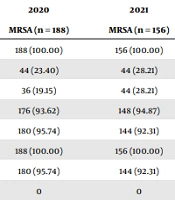
The distributions of the drug sensitivity tests of MRSA and MSSA in the previous five years are presented in Tables 2 and 3. The results revealed that all MRSA and MSSA isolates were susceptible to vancomycin, tigecycline, linezolid, teicoplanin, and ceftaroline. MSSA was also found to be completely sensitive to oxacillin. The sensitivity rate of MRSA to rifampicin was 95.74% in 2020, and that of MSSA to rifampicin was 92.45% in 2021; and they were completely sensitive in the remaining four years (Tables 2 and 3). It was also discovered that MRSA was completely resistant to penicillin and oxacillin, while MSSA was less sensitive to penicillin (Tables 2 and 3). The resistance rate of MSSA to penicillin was 100% in the first three years and decreased to the lowest level (94.44%) in the last two years (Tables 2 and 3). MRSA and MSSA both showed high sensitivity rates to gentamicin, sulfamethoxazole-trimethoprim, levofloxacin, and moxifloxacin, with the exception of clindamycin and erythromycin (Tables 2 and 3). The sensitivities of MRSA and MSSA to moxifloxacin and levofloxacin were higher than 91.67%, and those of MRSA and MSSA to sulfamethoxazole-trimethoprim were unstable, ranging from 92% to 95.74% and 69.70% to 81.13%, respectively (Tables 2 and 3).
Table 2.
The Number and Susceptibility of Methicillin-Resistant Staphylococcus aureus to Antibiotics from 2017 to 2021 a
| Antimicrobial Agents | 2017 | 2018 | 2019 | 2020 | 2021 |
|---|---|---|---|---|---|
| MRSA (n = 64) | MRSA (n = 100) | MRSA (n = 100) | MRSA (n = 188) | MRSA (n = 156) | |
| Ceftaroline | 64 (100.00) | 100 (100) | 100 (100) | 188 (100.00) | 156 (100.00) |
| Clindamycin | 12 (18.75) | 28 (28) | 4 (4) | 44 (23.40) | 44 (28.21) |
| Erythromycin | 12 (18.75) | 20 (20) | 4 (4) | 36 (19.15) | 44 (28.21) |
| Gentamicin | 64 (100.00) | 100 (100) | 92 (92) | 176 (93.62) | 148 (94.87) |
| Levofloxacin | 60 (93.75) | 96 (96) | 100 (100) | 180 (95.74) | 144 (92.31) |
| Linezolid | 64 (100.00) | 100 (100) | 100 (100) | 188 (100.00) | 156 (100.00) |
| Moxifloxacin | 64 (100.00) | 96 (96) | 100 (100) | 180 (95.74) | 144 (92.31) |
| Oxacillin | 0 | 0 | 0 | 0 | 0 |
| Penicillin | 0 | 0 | 0 | 0 | 0 |
| Rifampicin | 64 (100.00) | 100 (100) | 100 (100) | 170 (90.43) | 156 (100.00) |
| Sulfamethoxazole-trimethoprim | 60 (93.75) | 92 (92) | 92 (92) | 180 (95.74) | 148 (94.87) |
| Teicoplanin | 64 (100.00) | 100 (100) | 100 (100) | 188 (100.00) | 156 (100.00) |
| Tigecycline | 64 (100.00) | 100 (100) | 100 (100) | 188 (100.00) | 156 (100.00) |
| Vancomycin | 64 (100.00) | 100 (100) | 100 (100) | 188 (100.00) | 156 (100.00) |
Abbreviations: MRSA, methicillin-resistant Staphylococcus aureus; MSSA, methicillin-sensitive Staphylococcus aureus.
a Values are expressed as No. (%).
Table 3.
The Number and Susceptibility of Methicillin-Sensitive Staphylococcus aureus to Antibiotics from 2017 to 2021 a
| Antimicrobial Agents | 2017 | 2018 | 2019 | 2020 | 2021 |
|---|---|---|---|---|---|
| MSSA (n = 132) | MSSA (n = 168) | MSSA (n = 108) | MSSA (n = 144) | MSSA (n = 212) | |
| Ceftaroline | 132 (100.00) | 168 (100.00) | 108 (100.00) | 144 (100.00) | 212 (100.00) |
| Clindamycin | 24 (18.18) | 40 (23.81) | 32 (29.63) | 48 (33.33) | 48 (22.64) |
| Erythromycin | 6 (18.18) | 36 (21.43) | 28 (25.93) | 52 (36.11) | 32 (15.09) |
| Gentamicin | 104 (78.79) | 132 (78.57) | 92 (85.19) | 124 (86.11) | 192 (90.57) |
| Levofloxacin | 132 (100.00) | 164 (97.62) | 100 (92.59) | 132 (91.67) | 208 (98.11) |
| Linezolid | 132 (100.00) | 168 (100.00) | 108 (100.00) | 144 (100.00) | 212 (100.00) |
| Moxifloxacin | 132 (100.00) | 164 (97.62) | 104 (96.30) | 132 (91.67) | 212 (100.00) |
| Oxacillin | 132 (100.00) | 168 (100.00) | 108 (100.00) | 144 (100.00) | 212 (100.00) |
| Penicillin | 0 | 0 | 0 | 8 (5.56) | 8 (3.77) |
| Rifampicin | 132 (100.00) | 168 (100.00) | 108 (100.00) | 144 (100.00) | 196 (92.45) |
| Sulfamethoxazole-trimethoprim | 92 (69.70) | 120 (71.43) | 84 (77.78) | 104 (72.22) | 172 (81.13) |
| Teicoplanin | 132 (100.00) | 168 (100.00) | 108 (100.00) | 144 (100.00) | 212 (100.00) |
| Tigecycline | 132 (100.00) | 168 (100.00) | 108 (100.00) | 144 (100.00) | 212 (100.00) |
| Vancomycin | 132 (100.00) | 168 (100.00) | 108 (100.00) | 144 (100.00) | 212 (100.00) |
Abbreviations: MRSA, methicillin-resistant Staphylococcus aureus; MSSA, methicillin-sensitive Staphylococcus aureus.
a Values are expressed as No. (%).
The overall sensitivity of MRSA to gentamicin has declined from 100% to 92% over the last five years, and it is still higher than that of MSSA (Tables 2 and 3). The sensitivity of MRSA to moxifloxacin and levofloxacin has fluctuated and decreased to the lowest level (92.31%) in the last two years, while the sensitivity of MSSA to these two drugs initially declined and, then increased to more than 98% in 2021 (Tables 2 and 3). The results further demonstrated that the sensitivity of MRSA to gentamicin and sulfamethoxazole-trimethoprim was significantly higher than that of MSSA (P < 0.05) (Table 4). The sensitivity rate of MRSA was significantly lower than that of MSSA to levofloxacin, moxifloxacin, rifampicin, clindamycin, and erythromycin (P > 0.05) (Table 4).
Table 4.
The Number and Susceptibility of Methicillin-Resistant Staphylococcus aureus and Methicillin-Sensitive S. aureus Isolated from Children with Pneumonia a
| Antimicrobial Agents | MRSA (n = 608) | MSSA (n = 764) | χ2 | P-Value |
|---|---|---|---|---|
| Ceftaroline | 608 (100.00) | 764 (100.00) | - | - |
| Clindamycin | 132 (21.71) | 192 (25.13) | 2.196 | 0.138 |
| Erythromycin | 116 (19.08) | 172 (22.51)212 | 2.407 | 0.121 |
| Gentamicin | 580 (95.39) | 644 (84.29) | 43.359 | 0 |
| Levofloxacin | 580 (95.39) | 736 (96.34) | 0.765 | 0.382 |
| Linezolid | 608 (100.00) | 764 (100.00) | - | - |
| Moxifloxacin | 584 (96.05) | 744 (97.38) | 0.149 | 0.7 |
| Oxacillin | 0 | 764 (100.00) | - | 0 |
| Penicillin | 0 | 16 (2.09) | - | 0 |
| Rifampicin | 590 (97.04) | 748 (97.91) | 1.051 | 0.305 |
| Sulfamethoxazole-trimethoprim | 572 (94.08) | 572 (74.87) | 22.541 | 0 |
| Teicoplanin | 608 (100.00) | 764 (100.00) | - | - |
| Tigecycline | 608 (100.00) | 764 (100.00) | - | - |
| Vancomycin | 608 (100.00) | 764 (100.00) | - | - |
Abbreviations: MRSA, methicillin-resistant Staphylococcus aureus; MSSA, methicillin-sensitive Staphylococcus aureus.
a Values are expressed as No. (%) unless otherwise indicated.
4.3. Clinical Symptoms and Laboratory Examination of Pneumonia Children with Methicillin-Resistant Staphylococcus aureus and Methicillin-Sensitive Staphylococcus aureus
Children with MRSA pneumonia had a longer median hospital stay than children with MSSA pneumonia (9.00 days versus 8.00 days, P < 0.05) (Table 5). No significant differences were found between two groups in terms of the median duration of symptoms before admission (5.00 days versus 6.00 days, P > 0.05) (Table 5). The common symptoms of children with S. aureus pneumonia are fever, cough, and wheezing. Children with MRSA pneumonia had more fever, while the symptoms of cough and wheezing were lower than those of children with MSSA pneumonia. There was no significant difference between two groups regarding these three symptoms (47.37% versus 43.98%, 83.55% versus 84.29% and 61.84% versus 63.09%), respectively (all P > 0.05) (Table 5).
Children with MRSA pneumonia had significantly higher white blood cells (WBCs), C-reactive protein (CRP), and procalcitonin (PCT) than children with MSSA pneumonia [9.16 × 10⁹/L (6.77, 12.58) versus 8.84 × 10⁹/L (6.78, 11.25), 5.20 mg/L (2.30, 10.00) versus 3.40 mg/L (2.60, 8.28), and 0.38 ng/mL (0.18, 1.12) versus 0.34 ng/mL (0.17, 0.63)], respectively (all P < 0.05) (Table 5). There was no significant difference between two groups regarding other laboratory findings. No significant differences were also revealed between two groups in terms of the imaging manifestations of single lateral infiltration and bilateral infiltration (16.12% versus 18.32% and 83.88% versus 81.68%, P > 0.05) (Table 5).
Table 5.
Clinical Features of Pneumonia Children Hospitalized with Methicillin-Resistant Staphylococcus aureus and Methicillin-Sensitive S. aureus [M (P25, P75)] a
| Clinical Features | MRSA (n = 608) | MSSA (n = 764) | χ2/Z | P-Value |
|---|---|---|---|---|
| Personal history | ||||
| Length of stay (days) | 9.00 (8.00, 12.00) | 8.00 (7.00, 11.00) | -4.662 | 0.000 |
| Symptom duration prior to admission (days) | 5.00 (3.00, 7.00) | 6.00 (4.00, 7.00) | -1.897 | 0.058 |
| Clinic presentation | ||||
| Fever | 288 (47.37) | 336 (43.98) | 1.569 | 0.210 |
| Cough | 508 (83.55) | 644 (84.29) | 0.138 | 0.710 |
| Wheezing | 376 (61.84) | 482 (63.09) | 0.225 | 0.635 |
| Laboratory findings | ||||
| White blood cell count (×109/L) | 9.16 (6.77, 12.58) | 8.84 (6.78, 11.25) | -3.049 | 0.002 |
| NE% | 29.20 (19.90, 46.83) | 29.40 (21.50, 46.50) | -0.611 | 0.541 |
| LY% | 56.90 (37.80, 68.90) | 56.20 (39.90, 67.10) | -0.735 | 0.462 |
| CRP (mg/L) | 5.20 (2.30, 10.00) | 3.40 (2.60, 8.28) | -2.434 | 0.015 |
| PCT (ng/mL) | 0.38 (0.18, 1.12) | 0.34 (0.17, 0.63) | -2.389 | 0.017 |
| PLT (×109/L) | 351.00 (267.00, 418.00) | 339.00 (245.00, 421.75) | -1.357 | 0.175 |
| CKMB (ng/mL) | 3.70 (2.19, 5.38) | 3.56 (2.39, 5.09) | -1.480 | 0.139 |
| ALT (U/L) | 22.75 (15.60, 35.78) | 23.10 (15.80, 32.60) | -0.606 | 0.545 |
| Imaging manifestation | 1.149 | 0.284 | ||
| Single lateral infiltration | 98 (16.12) | 140 (18.32) | ||
| Bilateral infiltration | 510 (83.88) | 624 (81.68) |
Abbreviations: NE%, neutrophil percentage; LY%, lymphocytes percentage; CRP, c-reactive protein; PCT, procalcitonin; PLT, platelet count; CKMB, creatine kinase myocardial band; ALT, alanine aminotransferase: MRSA, methicillin-resistant Staphylococcus aureus; MSSA, methicillin-sensitive Staphylococcus aureus.
a Values are expressed as No. (%) unless otherwise indicated.
5. Discussion
Staphylococcus aureus pneumonia has become increasingly frequent, and is associated with significant morbidity and mortality (15). A considerable cohort of community-associated S. aureus cases hospitalized in two hospitals in the previous five years was retrospectively reviewed in our study. There were more male patients than female patients in the two groups. Most of our patients were young infants, and the median ages were three and four months, which was in accordance with the documentation by Doudoulakakis et al., who reported a median age of 4.3 months among patients with S. aureus pneumonia (16). Age differentiation is considered to be associated with the immature immune function of infants. Staphylococcus aureus pneumonia mostly occurred in winter and less in spring; however, comparing two groups in terms of sex, age, and sampling time showed no significant differences.
The evolution of bacteria and the overuse of antibiotics have enhanced drug resistance of MRSA and MSSA, making clinical anti-infective treatment more formidable (4). When community-associated MRSA (CA-MRSA) infections are under suspicion, primary empiric antimicrobial therapy, including vancomycin or clindamycin, is put into practice (17). Recent research has demonstrated that S. aureus is more susceptible to linezolid and vancomycin. The results of the antimicrobial susceptibility test indicated that linezolid and vancomycin were suitable drugs for treating CA-MRSA pneumonia in children (18, 19). Our results were consistent with those reported in the literature suggesting that all MRSA and MSSA isolates were susceptible to vancomycin, tigecycline, linezolid, teicoplanin, and ceftaroline. Our study also revealed that MSSA was completely sensitive to rifampicin and oxacillin. As for CAP caused by MSSA, the first-line treatment is usually cefazolin, oxacillin, or ceftaroline (20). The reason that MRSA and MSSA isolates are susceptible to ceftaroline may be attributed to the rare application of this antimicrobial agent. Linezolid has been proposed for dealing with CA-MRSA pneumonia (21).
It is recommended that panton-valentine leukocidin (PVL)-positive MRSA patients should receive clindamycin or rifampicin under the premise of vancomycin or teicoplanin (22). The sensitivity rate of MRSA to rifampicin was 95.74% in 2020, and that of MSSA to rifampicin was 92.45% in 2021, and they were completely sensitive in the remaining four years. The study demonstrated that the above-mentioned antibiotics had good antibacterial activity against S. aureus and may have been used for its clinical treatment. Community-associated MRSA strains are resistant to β-lactams and cephalosporins but are mostly sensitive to several non-β-lactam antibiotics (18, 19). Our study results determined that MRSA was completely resistant to penicillin and oxacillin, while MSSA was less sensitive to penicillin. The results also suggested that the resistance of S. aureus to β-lactam antibiotics was extremely serious and may have been related to its universal application in the clinic. Resistance is usually generated by acquiring a non-native gene encoding a penicillin-binding protein (PBP2a), which has significantly lower affinity for β-lactams. This resistance allows cell-wall biosynthesis, the target of β-lactams, to continue even in the presence of typically inhibitory concentrations of antibiotics (23).
According to our study results, MRSA and MSSA both maintained high sensitivity rates to gentamicin, sulfamethoxazole-trimethoprim, levofloxacin, and moxifloxacin. Our results further demonstrated that the sensitivity of MRSA to gentamicin and sulfamethoxazole-trimethoprim was significantly higher than that of MSSA. These drugs cannot be suitable for the treatment of paediatric patients with S. aureus pneumonia due to their adverse side effects. However, our study revealed that MRSA and MSSA both showed low susceptibility to clindamycin and erythromycin from 4% to 28.21% over the last five years.
A study determined that MRSA and MSSA had low susceptibility to erythromycin (18.4%) and clindamycin (40.8%). Its results further indicated that clindamycin may not have been the optimal empirical medication for CA-MRSA and MSSA in Shanghai (24). Low susceptibility to erythromycin and clindamycin resistance (54.4% and 41.8%, respectively) was seen in isolates from the Nepal Medical College and Teaching Hospital (25). Erythromycin and clindamycin are two important antibiotics for clinicians. However, resistance to erythromycin induced by clindamycin may often occur during the application of the two antibiotics (26). This may be due to the non-standardized application of antibiotics in our country, which has increased the drug-resistant strains.
Clinical presentations vary depending on the age and health status of the child, the responsible pathogen, and the severity of the disease. The clinical manifestations are non-specific in that no sole symptom or physical sign is characteristic of pneumonia (27, 28). Common symptoms are fever, cough, and dyspnoea (28). In this study, the main symptoms of S. aureus pneumonia were fever, cough, and wheezing, which may have been due to the immature development of the lung and the imperfect development of the surface mucosal system. Biomarkers are considered to be an important approach to detecting a patient's response to infection by predicting disease severity and therapeutic outcome (29). Biomarkers in pneumonia may be indicators of inflammation or be specific markers released after lung injury due to infection (8). In recent years, numerous investigations have demonstrated that WBCs, CRP, and other biomarkers are effective in the selection of bacterial pneumonia (30). Huang explored the relationship between WBC levels and positive bacterial sputum cultures (31).
The results indicated that a higher WBC count was associated with a greater possibility of acquiring a positive bacterial culture (31). C-reactive protein is a sophisticated biomarker for more complex acute phase features. The application of sole measurements of CRP for diagnosing CAP has not produced positive results constantly (32). However, continuous monitoring of CRP levels is potentially useful for the early prediction of CAP and response to antibiotics (33). In the circumstances of bacterial infection, procalcitonin is produced in large quantities by macrophages and monocytes throughout the body (34). Procalcitonin has been shown to significantly decrease the initiation and duration of antibiotic therapy in pneumonia (35). Additionally, PCT may be a superior diagnostic biomarker for detecting S. aureus pneumonia in paediatric patients and may contribute to early β-lactam therapy (36). In this research, children with MRSA pneumonia had significantly higher WBCs, CRP, and PCT levels than children with MSSA pneumonia.
These results suggested that children with MRSA pneumonia experienced more severe infections and, therefore, these indicators may have reflected the severity of the infection. The median hospital stay among children with MRSA pneumonia was higher than that among children with MSSA pneumonia. Our study results also indicated that MRSA cases required more medical resources, resulting in higher economic and social burdens.
Our study faced certain limitations. First, it was difficult to identify colonized bacteria in sputum culture in some cases. Therefore, whether the isolated strains of sputum specimens were colonized bacteria or infectious pathogens was not confirmed. Second, no outside antibiotic history associated with index diseases was obtained, which may also have influenced sputum culture for antimicrobial susceptibility testing.
5.1. Conclusions
Methicillin-resistant S. aureus and MSSA were found to mainly occur in infants. No significant differences were detected regarding sex, age and sampling time. The results of antimicrobial sensitivity test in sputum culture of MRSA and MSSA isolates may have shown the sensitivity of antibiotics and guided the application of clinical antibiotics. The common symptoms of children with S. aureus pneumonia were fever, cough, and wheezing. Infectious biomarkers, including WBCs, CRP, and PCT may have reflected the severity of infection and guided the prognosis.