
1. Background
Neutropenia is determined by decreased neutrophil levels below the recommended hematologic reference (1). Neutropenia is a common complaint in outpatients and is seen in 3-9% of children referred to medical centers (2). An absolute neutrophil count (ANC) of less than 1.5 × 10⁹ (ANC < 1500 cells/μL) is defined as neutropenia. The normal count of neutrophils can vary according to age and race (3). Fever in neutropenic patients is generally defined as an episode of oral temperature greater than 38.3°C (4). Neutropenia is the strongest factor related to infection in patients, and fever is the most obvious sign of infection in patients (3). In addition to ANC, neutrophil function, the duration of neutropenia, the ability of the bone marrow to respond to infection, and the immune system’s overall function also affect the risk of infection. A direct correlation has been observed between the infection rate and neutropenia severity (5, 6). Many studies have addressed febrile neutropenia in immunocompromised children, and the management of these patients is well described (7-9).
Previously healthy children can experience transient neutropenia secondary to bacterial and viral infections. Limited reports have examined infections creating neutropenia in such healthy children, and fever and neutropenia in these individuals remain challenging (10). Nevertheless, viral infection is the most prevalent cause of acquired neutropenia, followed by drugs and autoimmune neutropenia (11). Cytomegalovirus (CMV), parvovirus-B19, influenza virus, and hepatitis-A virus were the most detected (12). Considering the association between neutropenia and viral infection, follow-up of children with isolated neutropenia is recommended. Neutropenia in viral infections is transient and resolves within a week or two (13, 14).
2. Objectives
There is still limited information about neutropenia and fever in children without a history of underlying diseases. So, this study aimed to identify the most common viral causes of fever and neutropenia in hospitalized children in Abuzar Children’s Medical Center in Ahvaz, southwest Iran.
3. Methods
This descriptive-analytical study was conducted on 92 children hospitalized at Abuzar Children’s Medical Center in Ahvaz. Inclusion criteria were pediatric patients aged more than 28 days and under 18 years referred to the pediatric emergency ward with fever as the chief complaint and neutropenia in their complete blood count (CBC) test result. But those with a positive bacterial culture, patients with immunodeficiency, malignancy, or other underlying diseases were excluded from the study.
This study was done in two stages before the coronavirus disease 2019 (COVID-19) pandemic and during the COVID-19 pandemic. After obtaining parental consent, 5 cc of blood was collected from all patients and transferred to the virology laboratory. Then, the serum was separated after centrifugation and kept at -70°C. Ribonucleic acid (RNA) and deoxyribonucleic acid (DNA) from the virus were extracted. DNA and RNA extraction was done with the SinapureTM viral kit from SinaClon, Iran. From 20 children during the pandemic, pharyngeal and nasopharyngeal samples were taken for the severe acute respiratory syndrome coronavirus 2 (SARS-CoV-2) reverse transcription polymerase chain reaction (RT-PCR) test.
The viral enzyme-linked immunosorbent assay (ELISA) test included the detection of antibodies against the following viruses: Epstein-Barr virus (EBV) and CMV. PCR was done for adenovirus, enterovirus, and herpes simplex virus (HSV). Data collected included demographics, clinical symptoms, and severity of neutropenia. The severity of neutropenia was classified as mild: ANC 1000 to 1500 cells/μL; moderate: ANC 500 to 1000 cells/μL; and severe: ANC < 500 cells/μL. This study investigated the frequency of the mentioned viruses before and after the COVID-19 pandemic, the correlation of viruses with neutropenia, and demographic factors.
3.1. Statistical Analysis
Statistical analysis was performed by SPSS software version 22. Kolmogorov-Smirnov and Shapiro-Wilk tests were used to test the distribution. The chi-square test was applied to compare proportions. A P-value less than 0.05 was considered statistically significant.
4. Results
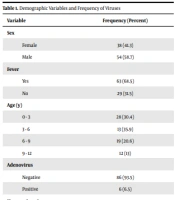
Out of 92 children recruited in this study, 72 cases were before the COVID-19 pandemic, and 20 were during the pandemic. Out of all evaluated patients, 41.3% were female. About 68.5% of patients had a fever at the beginning of hospitalization, but 31.5% had a fever before attending hospital. In other words, all patients had a fever at the beginning of their illness. Most of the patients (35.9%) were in the 3 - 6 years age group. Among the total cases, 19 cases were positive in terms of virus investigation, including adenovirus (6.5%), enterovirus (5.4%), CMV (3.3%), EBV (3.3%), followed by Herpes virus 6 (2.2%) (Table 1). Also, no significant correlation was found between any of the viruses with age and/or gender (P > 0.05).
Table 1.
Demographic Variables and Frequency of Viruses
| Variables | No. (%) |
|---|---|
| Sex | |
| Female | 38 (41.3) |
| Male | 54 (58.7) |
| Fever | |
| Yes | 63 (68.5) |
| No | 29 (31.5) |
| Age (y) | |
| 0 - 3 | 28 (30.4) |
| 3 - 6 | 13 (35.9) |
| 6 - 9 | 19 (20.6) |
| 9 - 12 | 12 (13) |
| Adenovirus | |
| Negative | 86 (93.5) |
| Positive | 6 (6.5) |
| Herpes virus 6 | |
| Negative | 90 (97.8) |
| Positive | 2 (2.2) |
| Enterovirus | |
| Negative | 87 (94.6) |
| Positive | 5 (5.4) |
| EBV | |
| Negative | 89 (96.7) |
| Positive | 3 (3.3) |
| CMV | |
| Negative | 89 (96.7) |
| Positive | 3 (3.3) |
| COVID-19 | |
| No PCR | 72 (78.3) |
| Negative | 17 (18.5) |
| Positive | 3 (3.3) |
Abbreviations: EBV, Epstein-Barr virus; CMV, cytomegalovirus; COVID-19, coronavirus disease 2019.
According to Table 2, a significant correlation was seen between enterovirus and neutropenia (P = 0.005); but there was no relationship between neutropenia and other viruses (P > 0.05). Based on Table 3, there was no remarkable correlation between the cases with positive results of the SARS-CoV-2 RT-PCR test and the frequency of adenovirus, herpes virus, enterovirus, EBV, and CMV. Table 4 shows the frequency and severity of neutropenia in cases evaluated by the SARS-CoV-2 RT-PCR test. No significant correlation was found between the severity of neutropenia and COVID-19 infection (P = 0.34).
Table 2.
Correlation Between the Studied Viruses and Neutropenia Before the Pandemic a
| Type of Virus and Classification | Neutropenia | P-Value | ||
|---|---|---|---|---|
| Moderate | Mild | Severe | ||
| Adenovirus | 0.73 | |||
| Negative | 36 (94.7) | 29 (90.6) | 2 (100) | |
| Positive | 2 (5.3) | 3 (9.4) | 0 (0) | |
| Herpes virus | 0.53 | |||
| Negative | 38 (100) | 31 (96.9) | 2 (100) | |
| Positive | 0 (0) | 1 (3.1) | 0 (0) | |
| Enterovirus | 0.005 | |||
| Negative | 38 (100) | 29 (90.6) | 1 (50) | |
| Positive | 0 (0) | 3 (9.4) | 1 (50) | |
| EBV | 0.27 | |||
| Negative | 38 (100) | 30 (93.8) | 2 (100) | |
| Positive | 0 (0) | 2 (6.3) | 0 (0) | |
| CMV | 0.24 | |||
| Negative | 38 (92.1) | 32 (100) | 2 (100) | |
| Positive | 0 (7.9) | 0 (0) | 0 (0) | |
Abbreviations: EBV, Epstein-Barr virus; CMV, cytomegalovirus; COVID-19, coronavirus disease 2019.
a Values are expressed as No. (%).
Table 3.
Correlation Between Cases with Positive Results of Severe Acute Respiratory Syndrome Coronavirus 2 (SARS-CoV-2) Reverse Transcription Polymerase Chain Reaction (RT-PCR) Test and Frequency of the Studied Viruses a
| Type of Virus and Classification | Result of SARS-CoV-2 RT-PCR Test | P-Value | |
|---|---|---|---|
| Positive | Negative | ||
| Adenovirus | 0.15 | ||
| Negative | 17 (100) | 2 (66.7) | |
| Positive | 0 (0) | 1 (33.3) | |
| Herpes virus 6 | 0.85 | ||
| Negative | 16 (94.1) | 3 (100) | |
| Positive | 1 (5.9) | 0 (0) | |
| Enterovirus | 0.15 | ||
| Negative | 17 (100) | 2 (66.7) | |
| Positive | 0 (0) | 1 (33.3) | |
| EBV | 0.85 | ||
| Negative | 16 (94.1) | 3 (100) | |
| Positive | 1 (5.9) | 0 (0) | |
| CMV | - | ||
| Negative | 17 (100) | 3 (100) | |
| Positive | 0 (0) | 0 (0) | |
Abbreviations: SARS-CoV-2, severe acute respiratory syndrome coronavirus 2; RT-PCR, reverse transcription polymerase chain reaction; EBV, Epstein-Barr virus; CMV, cytomegalovirus.
a Values are expressed as No. (%).
Table 4.
Association Between the Severity of Neutropenia and Coronavirus Disease 2019 (COVID-19) Infection a
| Type of Virus and Classification | Results of SARS-CoV-2 RT-PCRTest | P-Value | |
|---|---|---|---|
| Positive | Negative | ||
| Neutropenia | 0.34 | ||
| Moderate | 11 (64.7) | 1 (33.3) | |
| Mild | 6 (35.3) | 2 (66.7) | |
| Severe | 0 (0) | 0 (0) | |
Abbreviations: SARS-CoV-2, severe acute respiratory syndrome coronavirus 2; RT-PCR, reverse transcription polymerase chain reaction.
a Values are expressed as No. (%).
5. Discussion
The cause of secondary neutropenia is heterogeneous. Drug-induced reduction of neutrophil production, enhanced neutrophil destruction, for example, viral infections, and a combination of these factors are the mechanisms of acquired neutropenia. The clinical importance of neutropenia varies based on the pathophysiological mechanism and specific elements. Many studies have been conducted on autoimmune and chronic benign neutropenia in children and adults. However, the clinical significance of transient neutropenia in previously healthy hospitalized children has not been investigated (15, 16).
This study aimed to evaluate the most common viral causes of fever and neutropenia in children hospitalized at Abuzar Children’s Medical Center, Ahvaz. The present results indicate that enteroviruses are the prominent causes of transient neutropenia in previously healthy children. We also found significant correlations between enteroviruses, neutropenia, and fever, while no correlations between these symptoms and other viruses have been identified. On the other hand, no significant correlation was found between COVID-19 infection and infections caused by adenovirus, herpes virus 6, enterovirus, EBV, and CMV. Moreover, no notable correlation was found between the severity of neutropenia and COVID-19 infection.
In the study of Husain et al., enteroviruses and HHV6 have been reported as the main causes of transient neutropenia in previously healthy children in Kuwait (12), which is also confirmed in the present study. A previously published report of neutropenia caused by enterovirus infection in an infant (17). In Alexandropoulou et al.’s study, in all age groups, neutropenia was of short duration (one-month duration), mild to moderate in severity, and mostly associated with viral infections (14). The results of Karavanaki et al.’s study reported that HHV6 infection had been linked with bone marrow suppression in bone marrow transplant patients and had been associated with neutropenia in 2 of 24 previously healthy children (10).
Nguyen et al.’s study showed that febrile neutropenia was common in children under two years and is usually caused by viruses (18). Like the present study, Turhan et al. reported that viral agents were detected in 30.1% of febrile neutropenia episodes, and the most commonly isolated viruses were coronavirus, influenza B, and adenovirus (19). Vlacha and Feketea’s study showed that non-malignant neutropenia was mild to moderate in hospitalized children (2), which is consistent with the results of this study. In the present study, 97.8% of patients had mild and moderate neutropenia.
In Vlacha and Feketea’s study, all patients had a benign clinical course, and interestingly, the patients were not suspected of having a septic bacterial infection, and none of them needed specific therapeutic intervention to increase neutrophils (2). The median time from fever to neutropenia was less than one week. The mean duration of neutropenia was three days, and most recovered completely. The mild severity of neutropenia and the short duration helped greatly to the benign clinical course of neutropenic children in these patients (2). In total, 26% of the patients were neutropenic at the beginning of hospitalization, and one-third had a fever. In our study, although 68.5% of patients had a fever at the beginning of hospitalization, others developed a fever at the beginning of their illness. Vlacha and Feketea’s study showed that viral infections and hypothyroidism were the most profound causes of neutropenia in some patients, and the cause of neutropenia could not be determined in some patients (2).
The present study is one of the few investigations on neutropenic patients without any underlying diseases hospitalized due to fever before and throughout the COVID-19 pandemic. However, it has a few limitations: This study included only inpatients and no outpatients, resulting in a small sample size. Also, the number of patients with mild viral neutropenia may have been underestimated. The duration of neutropenia was ignored. Also, the impossibility of examining other uncommon viruses was another limitation of this study.
5.1. Conclusions
The most common viruses found in febrile neutropenic children hospitalized without underlying diseases were adenovirus and enterovirus, respectively. Considering the dominant viral etiology, good general condition, and relatively quick recovery in this category of patients, it is suggested to avoid prescribing broad-spectrum antibiotics, and careful follow-up should be carried out. To identify the viral etiology of febrile neutropenia in pediatrics, we recommend conducting a further multicenter study with a larger sample size and screening a broad spectrum of viruses. Also, studies are needed to assess the prevalence and causes of accidental neutropenia in clinically healthy children.