
1. Background
Since the beginning of COVID-19 pandemic in December 2019, over 765 million people have been infected, and more than 6.90 million have died from the disease, which was caused by SARS-CoV-2 (1). Also, the emergence of novel variants of concern (VOCs), such as the alpha, beta, gamma, delta variants and subvariants, has presented significant challenges to the control and prevention of SARS-CoV-2 infections, as these VOCs have exhibited the ability to escape antiviral immunity induced by vaccination and caused breakthrough infections (2-4).
Three different types of COVID-19 vaccine (inactivated virus, protein subunits, and recombinant adenovirus vectors) have been approved by National Medical Products Administration (NMPA) and widely used in China, and vaccination is also proven to be one of the most effective methods for reducing severe or even death in COVID-19 (5, 6). In Anhui province, COVID-19 vaccines have been widely used since May 2021. People, in order of age group (first adults, followed by the old and the young), were sequentially vaccinated with more than 130 million doses of COVID-19 vaccines; and a total of 54.30 million people (54.30/63.66, 85.30%) were vaccinated in Anhui province by March 29, 2022 (7). Although there was high coverage of COVID-19 vaccination in the population in Wuhu city, Anhui province, there was still a COVID-19 outbreak caused by Omicron subvariant BA.2 in Wuhu city from March to April 2022.
The SARS-CoV-2 Omicron variant was first reported in South Africa in November 2021, which has become the dominant variant for the global COVID-19 pandemic now (1, 8). In Mainland China, the Omicron variant was first identified in Tanjin city in November 2021 and has spread widely since COVID-19 outbreak in Shanghai city in late February 2022 (9-11). To successfully combat these VOCs, it is critical to understand the epidemiological features of COVID-19 caused by different SARS-CoV-2 variants and subvariants in different regions (12, 13).
2. Objectives
In this report, we study the epidemiological features of COVID-19 epidemic in Wuhu city in 2022, which may partly reflect the characteristics of Omicron subvariant BA.2 circulated in mainland China in 2022. Also, it provides insights into developing effective strategies, such as high coverage of COVID-19 vaccination, lockdown policies, Ankang code, and population-bases COVID-19 screening, for successfully controlling the potential COVID-19 outbreaks caused by Omicron or future novel SARS-CoV-2 variants in the medium-sized city like Wuhu.
3. Methods
According to Novel Coronavirus Pneumonia Diagnosis and Treatment Plan (trial version 9), a confirmed COVID-19 case was defined as a positive result in qRT-PCR assay of nasal and pharyngeal swab samples. Mild cases of COVID-19 were defined as those who had mild clinical symptoms, and there was no sign of pneumonia on imaging. Asymptomatic cases of COVID-19 were defined as cases who were infected with SARS-CoV-2 but experienced no clinical symptoms. On January 20, 2020, the Chinese National Health Commission announced that COVID-19 was classified as a Class B infectious disease and should be managed as Class A, and all confirmed COVID-19 cases were required to be reported within 24 hours to the National Notifiable Infectious Disease Surveillance System.
The data on the number of confirmed COVID-19 cases from March 3 to April 26, 2022, were collected from the Health Commission of Wuhu city, including 7 centers (www.wuhu.gov.cn/content/column/6795451), and the case data included geographic location, age, sex, epidemiologic risk factors, date of confirmation, etc. Population data of Wuhu city in the year 2021 were obtained from the Bureau of Statistics of Wuhu city (https://tjj.wuhu.gov.cn/zhsj/tjnj/index.html) (Appendix 1 in the Supplementary File) (14). All data were collected from publicly available sources, and all confirmed COVID-19 cases were fully anonymized before we had access to the data. The data were coded and transferred to Microsoft Excel (2010) for analysis. Statistical analysis was performed by SPSS software (version 21.0).
4. Results
4.1. COVID-19 Outbreaks Caused by Omicron Subvariant BA.2 in Wuhu City in 2022
In late February 2022, COVID-19 outbreaks caused by Omicron variant occurred in Shanghai and spread rapidly to other regions in China (10, 11, 15). Both Shanghai and Wuhu cities are located in the Yangtze River Delta region in eastern China, and Wuhu city has a busy human mobility flow with Shanghai (Figure 1A). COVID-19 case was imported from Shanghai to Wuhu (in Fanchang district) on March 23 and confirmed on March 24 in Wuhu city. On the same day, the Wuhu government implemented policies for close management of villages and communities in the Fanchang district, respectively. In addition, rounds of large-scale COVID-19 tests were carried out for all populations in the Fanchang district, and several epidemiological investigation teams were quickly established to perform close contact tracking management on March 24. The virus strain was quickly identified to belong to Omicron subvariant BA.2 on March 26 (16). No new COVID-19 cases were reported after April 5, and on April 21, 2022, close management was removed with reopening of governmental offices, supermarkets, stores, and schools (Figure 2A).
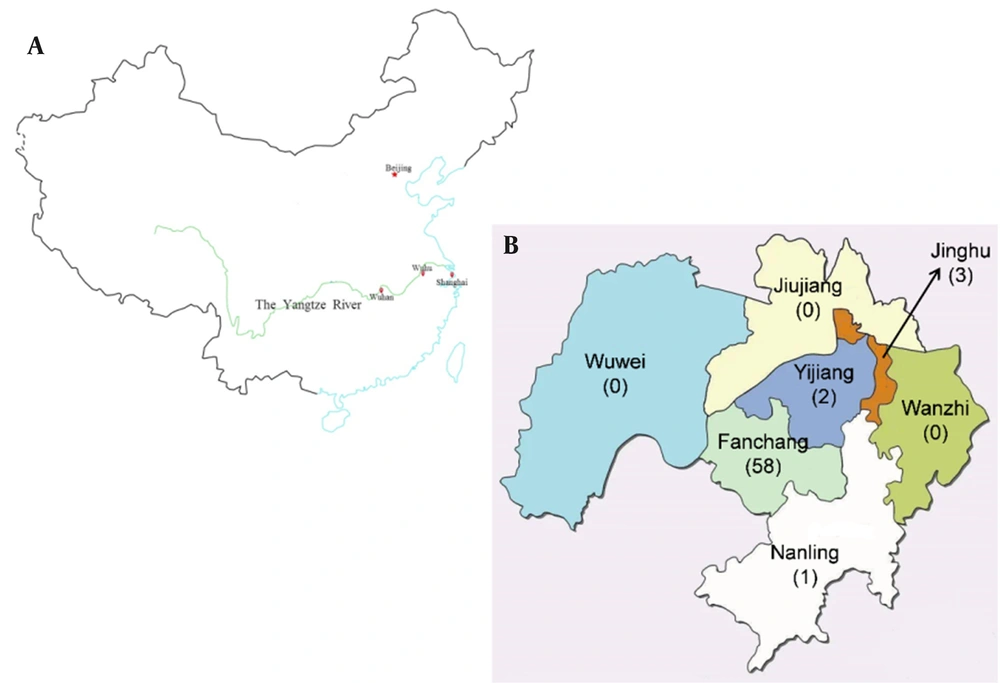
Figure 1.
A, Geographic location of Wuhu and Shanghai cities in China; B, The number of confirmed COVID-19 cases in each district of Wuhu city from March 3 to April 26, 2022
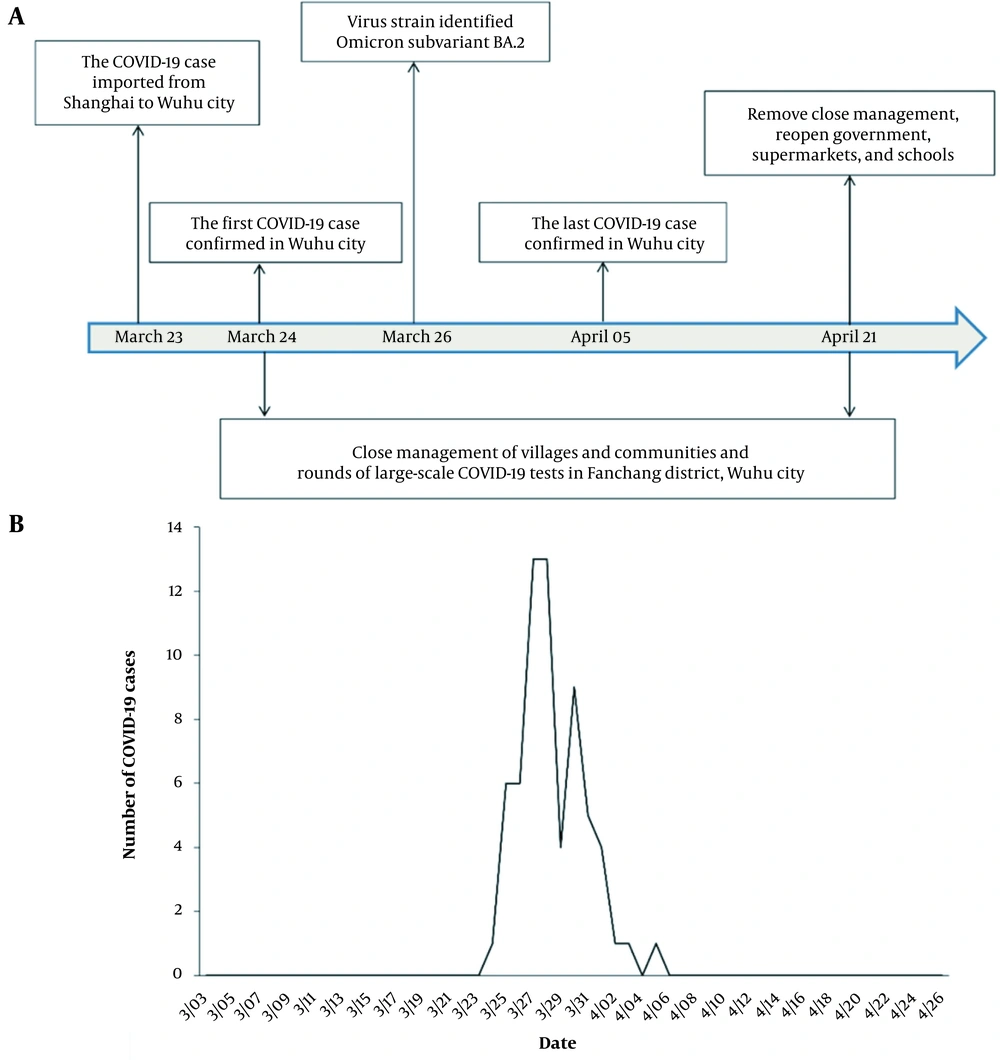
Figure 2.
A, Timeline of the key events and major responses taken by the Wuhu government for controlling the spreading of COVID-19 in 2022; B, Daily trend of confirmed COVID-19 cases in Wuhu from March 3 to April 26, 2022
4.2. Daily Trends of COVID-19 Cases in Wuhu City in 2022
Sixty-four confirmed COVID-19 cases were reported in Wuhu city between 3 March and 26 April 2022. The first COVID-19 case was confirmed on March 24. The incidence of COVID-19 substantially increased, with cases peaking on March 28, and then showed a downward trend. The last COVID-19 case was reported on April 5 (Figure 2B). The period of COVID-19 outbreak in Wuhu spanned from March 24 to April 5, 2022 (13 days), which was shorter than COVID-19 outbreak in 2020 in Wuhu city (14).
4.3. Geographic Characteristics of COVID-19 Cases in Wuhu City in 2022
Wuhu is one of the medium-sized cities in China, with a population of about 3.67 million and an area of 6,026 square kilometers divided into 7 districts (Figure 1B). Of the 64 COVID-19 cases reported in Wuhu, the districts of Fanchang, Jinghu, Yijiang, and Nanling accounted for 90.62% (58/64), 4.69% (3/64), 3.13% (2/64), and 1.56% (1/64). No COVID-19 cases were identified in the districts of Wuwei, Jiujiang, and Wanzhi (Figure 1B). The distribution of COVID-19 cases was highly concentrated, 90.62% of infections were identified in the Fanchang district, and COVID-19 confirmed in other districts of Wuhu city were also directly related to Fanchang district, including 3 cases in Jinghu, 2 cases in Yijiang, and 1 case in Nanling district (Appendix 2 in the Supplementary File).
4.4. Gender and Age Ratios of COVID-19 Cases in Wuhu City in 2022
Of the 64 confirmed COVID-19 cases reported in Wuhu, 27 cases were male and 37 cases were female. The sex proportion in male cases (infected male/male population, 0.14‰) was less than in female cases (infected female/female population, 0.21‰) (Figure 3, Table 1 and Appendix 1 in the Supplementary File). The mean age of the confirmed COVID-19 cases was 39.57 ± 16.39 years, ranging from 0.5 to 85 years old (Table 1). The proportions of confirmed COVID-19 cases in different age groups were obviously different, which include people of 15 - 59 years old (infected cases/population, 0.23‰), young people (age < 14 years) (0.10‰), and elderly people (age > 60 years) (0.05‰) (Figure 3, Table 1 and Appendix 1 in the Supplementary File).
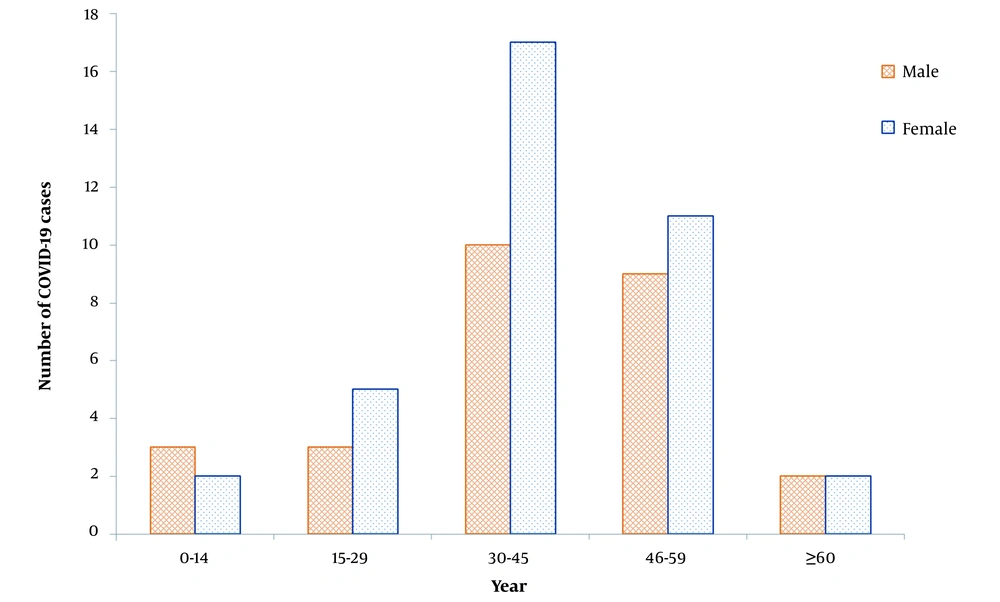
Figure 3.
Age distribution and sex patterns of the confirmed COVID-19 cases in Wuhu from March 3 to April 26, 2022
Table 1.
Clinical Characteristics and Epidemiological Risk Factors Among Confirmed COVID-19 Cases in Wuhu, from March 3 to April 26, 2022
| Characteristic | Cases (n = 64) |
|---|---|
| Age (y) | |
| Mean ± SD | 39.57 ± 16.39 |
| Range | 0.5 - 85 |
| Age group (y) | |
| 0 - 14 | 5 |
| 15 - 29 | 8 |
| 30 - 45 | 27 |
| 46 - 59 | 20 |
| ≥ 60 | 4 |
| Sex | |
| Male | 27 |
| Female | 37 |
| Clinical Outcome | |
| Mild COVID-19 cases | 6 |
| Asymptomatic COVID-19 cases | 58 |
| Epidemiologic risk category | |
| Close contact with the first COVID-19 case imported from Shanghai | 37 |
| Identified in the lockdown zone | 27 |
4.5. Epidemiological Links Between COVID-19 Outbreaks in Wuhu and Shanghai Cities in 2022
Wuhu is about 350 kilometers from Shanghai, which has become the epicenter of COVID-19 in mainland China since late February 2022 (10). Wuhu and Shanghai cities are closely linked by high-speed rail and expressway within 2.5 hours (Figure 1A). To explore the epidemiological links of COVID-19 outbreaks between Wuhu and Shanghai cities, COVID-19 cases in Wuhu were divided into two groups for their links to the first COVID-19 case in Wuhu who imported from Shanghai. As shown in Table 1, 37 cases had close contact with the first COVID-19 case (the first group) (37/64, 57.81%), and 27 cases were identified from people in the lockdown zone in Wuhu (the second group) (27/64, 42.19%). The cases in the first group dominated at the beginning of COVID-19 epidemic from 24 March to 28 March. After 29 March, all confirmed COVID-19 cases belonged to the second group (Appendix 2 in the Supplementary File).
5. Discussion
In late February 2022, COVID-19 outbreaks caused by Omicron variant occurred in Shanghai (10, 11, 15). Although strict control measures were implemented between Shanghai and Wuhu cities, a few COVID-19 cases were imported from Shanghai, which led to COVID-19 outbreak in Wuhu. This report focuses on a descriptive epidemiological analysis of COVID-19 outbreak caused by Omicron subvariant BA.2 in Wuhu between March and April 2022.
Several unique aspects of COVID-19 outbreak in Wuhu were found in our studies. First, the geographic distribution of COVID-19 cases was highly concentrated in Wuhu city in 2022, most infections (58/64, 90.62%) were identified in the Fanchang district, and COVID-19 confirmed in other districts of Wuhu city were also directly related to Fanchang district (Figure 1B). Second, the mean age of COVID-19 cases in this study was 39.57 ± 16.39 years old, which was younger than COVID-19 cases reported in Wuhan and Wuhu cities in 2020 (14, 17). Third, a relatively independent outbreak pattern in Wuhu city, cases in the first group (37/39, 94.87%) dominated at the beginning of the Wuhu COVID-19 epidemic, and all confirmed COVID-19 cases belonged to the second group since March 29. These data suggest COVID-19 epidemic occurred in Wuhu was directly imported from Shanghai (the first group) and then transmitted to communities in Wuhu city (the second group).
In this study, Omicron subvariant BA.2 may occur more frequently in young individuals of 15-59 years old but not the young or elderly age groups in Wuhu city in 2022 (Figure 3). These results are similar to COVID-19 epidemic data reported in Shanghai city in 2022, which was younger than COVID-19 cases identified in Wuhan and Wuhu cities in 2020 (14, 17, 18). Also, Omicron subvariant BA.2 infections occurred more frequently in females than males in Wuhu city (Figure 3). The results are different from COVID-19 outbreaks reported in Shanghai city in 2022 or Wuhan and Wuhu cities in 2020 (14, 17, 18).
After COVID-19 epidemic outbreak in Wuhu in 2022, the Wuhu government take actions rapidly and effectively to control COVID-19 epidemic (Figure 2A). First, each region is divided into low-, medium-, and high-risk according to the different COVID-19 epidemic situations, and the communities and villages were divided into “grids” to achieve segmented management, which made self-isolation and lockdown policies more refined and comprehensive (19). Second, a three-color-based health QR code system (green, yellow, and red), as known as Ankang code in Anhui province, based on big data and GPS positioning technology, was used across China public for identifying COVID-19 close contacts and breaking the chain of SARS-CoV-2 transmission in a timely manner (19). Moreover, rounds of large-scale COVID-19 testing were adopted freely for the local population (19). Wuhu city successfully controlled COVID-19 epidemic within 13 days (March 24 to April 5, 2022), which was shorter than COVID-19 outbreak in Wuhu in 2020 (14).
In our studies, most of the cases (58/64, 90.63%) were asymptomatic, with only a few cases (6/64, 9.37%) exhibiting mild symptoms. Furthermore, no severe or death COVID-19 cases were reported in Wuhu in 2022 (Table 1). Besides, most of the severe or death COVID-19 cases were reported in elderly patients with comorbidities or without COVID-19 vaccination (20). Therefore, one probable reason was that the confirmed COVID-19 cases were young in this study. Another explanation is probably due to the high COVID-19 vaccination rate among all the population in Wuhu city.
There are some limitations in this research. First, all of the data used in this study were downloaded from public websites, and no detailed clinical information was provided. Second, it is hard to get COVID-19-positive samples for biosafety reasons, so we cannot sequence and analyze the whole genome of Omicron subvariant BA.2 circulated in Wuhu. Third, only 64 COVID-19 cases were reported in this study, and it is not suitable to estimate R0 with this limited and small size (13).
5.1. Conclusions
This study illustrates the epidemic of COVID-19 in Wuhu city between March to April 2022, and our result provides valuable information into COVID-19 outbreak caused by omicron subvariant BA.2. It also provides insights into developing effective strategies, such as high coverage of COVID-19 vaccination, lockdown policies, Ankang code, and population-bases COVID-19 screening, for successfully controlling the potential outbreaks caused by Omicron or future novel SARS-CoV-2 variants in the medium-sized city like Wuhu.