
1. Background
Infections are important causes of morbidity and mortality during neutropenia in children undergoing cancer treatment. The management of neutropenic fever in this setting, in which patients receive toxic and intensive chemotherapy, requires special attention (1). Major clinical guidelines use risk stratification systems for chemotherapy regimens, classifying them as high risk (> 20%), intermediate risk (10% - 20%), or low risk (< 10%) according to the likelihood of inducing neutropenic fever (2, 3).
Most individuals acquire infections with viruses such as cytomegalovirus (CMV), herpes simplex virus type 1 (HSV-1), herpes simplex virus type 2 (HSV-2), human herpesvirus 6B (HHV-6B), and human herpesvirus 7 (HHV-7) during childhood. In immunocompetent children, CMV may present as heterophile-negative mononucleosis, whereas HHV-6B is commonly associated with roseola infantum, also known as exanthem subitum or sixth disease. Human herpesvirus 7 is implicated in a smaller proportion of roseola cases. Primary infections with these viruses are often asymptomatic or mild and may present with fever, lethargy, and transient liver enzyme abnormalities (4-7).
In contrast, primary infection or reactivation of CMV in immunocompromised hosts, such as patients receiving chemotherapy or organ transplantation recipients, can cause pneumonia, colitis, hepatitis, pancytopenia, and fever. Human herpesvirus 6, which has 2 variants, HHV-6A and HHV-6B, with different cell tropisms, also tends to reactivate after transplantation (8). Human herpesvirus 6 DNA can be detected in the saliva of healthy individuals, and infection is highly common; nearly all children are infected by 3 years of age (8, 9). The HHV-6B variant is more commonly associated with pathogenicity and exanthem subitum (10, 11). Human herpesvirus 7, which is closely related to HHV-6, has also been reported in exanthem subitum and febrile illnesses and is highly prevalent in adults (11), although its role in immunocompromised patients is less well defined.
After primary infection, these viruses can persist latently and reactivate when immunity is impaired. During cancer chemotherapy or after transplantation, herpesviruses can reactivate and cause febrile illness and, in some cases, life-threatening conditions such as pneumonia, encephalitis, bone marrow suppression, or graft rejection (12). Reactivation during chemotherapy-induced neutropenia or after bone marrow transplantation may also cause severe mucositis (8). In addition to their direct effects, herpesviruses may exacerbate disease when they occur with other infections, including fungal pathogens.
The risk of infection among pediatric cancer patients is well recognized, and substantial efforts have focused on identifying and treating bacterial and fungal infections associated with fever and neutropenia. However, viral causes have received comparatively less attention (13). In Ahvaz, one of the few local pediatric studies reported CMV, Epstein-Barr virus (EBV), and HHV-6 as common viral infections among immunocompetent children (19). This finding highlights the importance of viral testing in pediatric oncology patients, but it also underscores substantial gaps in local viral surveillance data, particularly in southwest Iran. Despite the growing recognition of viral infections in this population, data on the prevalence and impact of herpesvirus infections such as CMV remain sparse compared with those on bacterial and fungal infections. The absence of large-scale multicenter studies limits a comprehensive understanding of viral epidemiology in this region. In addition, limited resources and financial constraints have hindered the collection of larger sample sizes, and the present study did not include serologic or quantitative PCR analyses that could have correlated viral activity more precisely with clinical outcomes. Addressing these gaps could improve clinical management and decision-making, reduce unnecessary use of broad-spectrum antibiotics, and ultimately improve patient outcomes.
2. Objectives
This study aimed to investigate herpesvirus infections, particularly CMV, in hospitalized pediatric cancer patients with neutropenic fever in Ahvaz, Iran.
3. Methods
3.1. Study Design, Setting, and Participants
This cross-sectional study was conducted from May 2022 to May 2023. Whole blood samples (5 mL) were collected from 41 pediatric patients with various malignancies who presented with neutropenic fever. All participants were hospitalized pediatric cancer patients with neutropenic fever, and the diagnosis was confirmed by an oncologist. Neutropenia was defined as an absolute neutrophil count (ANC) < 1.5 × 10⁹/L (< 1500 cells/μL), and fever was defined as an oral temperature > 38.3°C (18). Samples were obtained from Baghaei Hospital, Ahvaz. Based on the medical histories, patients had not received antiviral therapy targeting herpesviruses. Written informed consent was obtained, and the study was approved by the ethics committee (IR.AJUMS.REC.1401.111).
3.2. Peripheral Blood Mononuclear Cell Isolation
Peripheral blood mononuclear cells (PBMCs) were isolated using a Ficoll density gradient. Briefly, 5 mL of phosphate-buffered saline (PBS) was added to dilute the whole blood, which was then carefully layered over 2 mL of Ficoll to avoid mixing. After centrifugation at 2000 rpm for 20 minutes, the buffy coat was collected and washed by centrifugation at 10,000 rpm for 1 minute to remove residual Ficoll. The cell pellet was resuspended in 200 µL of lysis buffer and stored at -20°C for further analysis. PBMC isolation was performed to increase DNA yield, as this approach typically uses 3 - 5 mL of blood compared with approximately 200 µL for direct whole-blood extraction.
3.3. DNA Extraction
DNA was extracted using a commercial kit (Sina Pure One, SinaClon BioScience, Iran). Extracted DNA was stored at -20°C for long-term preservation.
3.4. Polymerase Chain Reaction for Herpesvirus Detection
Herpesvirus DNA was detected using universal primers HSV-P1 (5’-GTGGTGGACTTTGCCAGCCTGTACCC-3’) and HSV-P2 (5’-TAAACATGGAGTCCGTGTCGCCGTAGATGA-3’) (14), which detect HSV-1/2, CMV, EBV, and human herpesvirus 8 (HHV-8). Each reaction contained 1 µL of each primer (10 pmol), 12.5 µL of PCR master mix (Amplicon, Denmark), 2.5 µL of template DNA, and nuclease-free water to a final volume of 25 µL. The cycling conditions were as follows: initial denaturation at 95°C for 15 minutes, followed by 45 cycles of 94°C for 1 minute, 62°C for 1 minute, and 72°C for 1 minute in a Bio-Rad thermal cycler (USA). Ten microliters of each reaction were analyzed on a 1% agarose gel at 100 V for 45 minutes. A visible band of approximately 526 bp was considered positive using a Vilber gel documentation system (France). Weak bands were retested and considered positive if they were reproducible and showed greater intensity. DNA extraction and PCR setup were performed in separate dedicated areas, including a laminar hood and a PCR workstation. Distilled water served as the negative control, and a herpesvirus-positive control from Vero cell culture was included.
3.5. Polymerase Chain Reaction for Cytomegalovirus Detection
Samples positive with the universal herpesvirus primers were tested for CMV using specific primers (forward 5’-CAA GCC ATC CAC ATC TCC CGC-3’; reverse 5’-GCG GCA TAG AAT CAA GGA GCA CAT-3’), which produced a 222-bp amplicon. The cycling conditions and the master mix were identical to those described above, except that the annealing temperature was 50°C and 35 cycles were used.
4. Results
The mean age of the patients was 7.24 ± 3.8 years (95% CI, 6.04 - 8.44). Thirty patients were male (30/41, 73.2%; 95% CI, 57.1% - 85.8%), and 11 were female (11/41, 26.8%; 95% CI, 14.2% - 42.9%). Acute lymphoblastic leukemia (ALL) was the most common malignancy (48%). Other malignancies are shown in Figure 1.
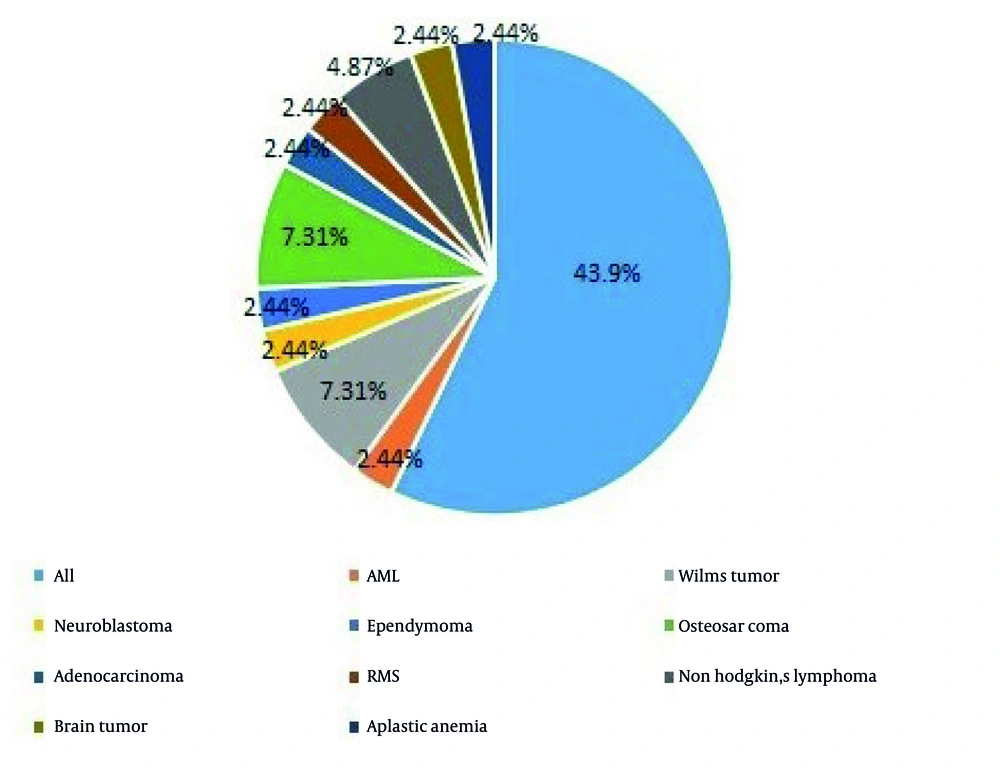
Figure 1.
Frequency of different kinds of malignancies enrolled in the study. ALL, acute lymphoblastic leukemia; AML, acute myeloid leukemia; RMS, rhabdomyosarcoma.
Five patients tested positive using universal herpesvirus primers (5/41, 12.2%; 95% CI, 4.1% - 26.2%) (Figure 2), and all 5 were CMV-positive using CMV-specific primers; 3 are shown in Figure 3.
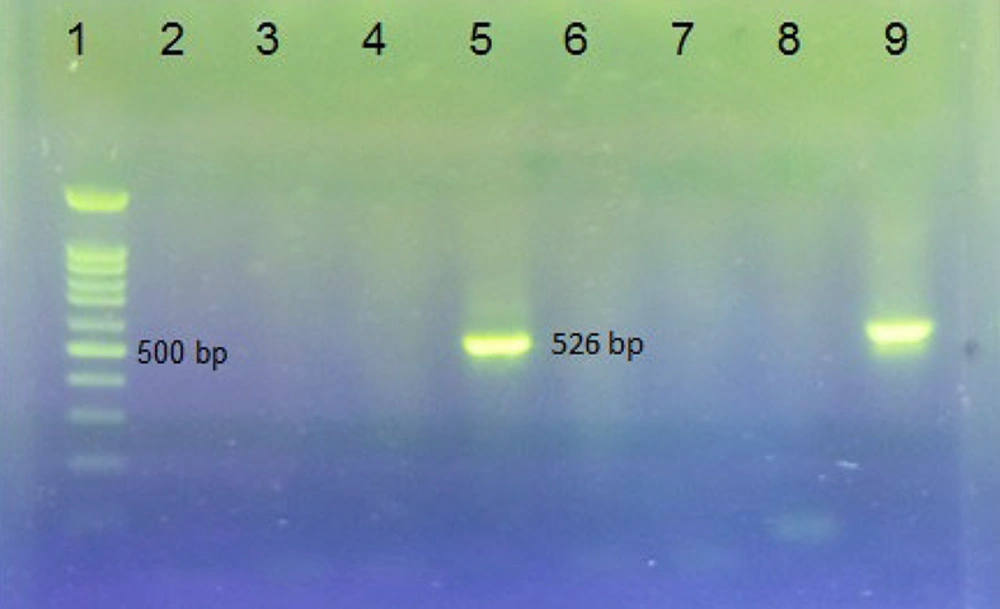
Figure 2.
Polymerase chain reaction results of patients' samples using herpesvirus universal primers HSV-P1 and HSV-P2 with an approximately 526-bp PCR amplicon. Lane 1, 100-bp PCR ladder; lanes 2 - 7, patient samples; lane 8, negative control; lane 9, positive control.
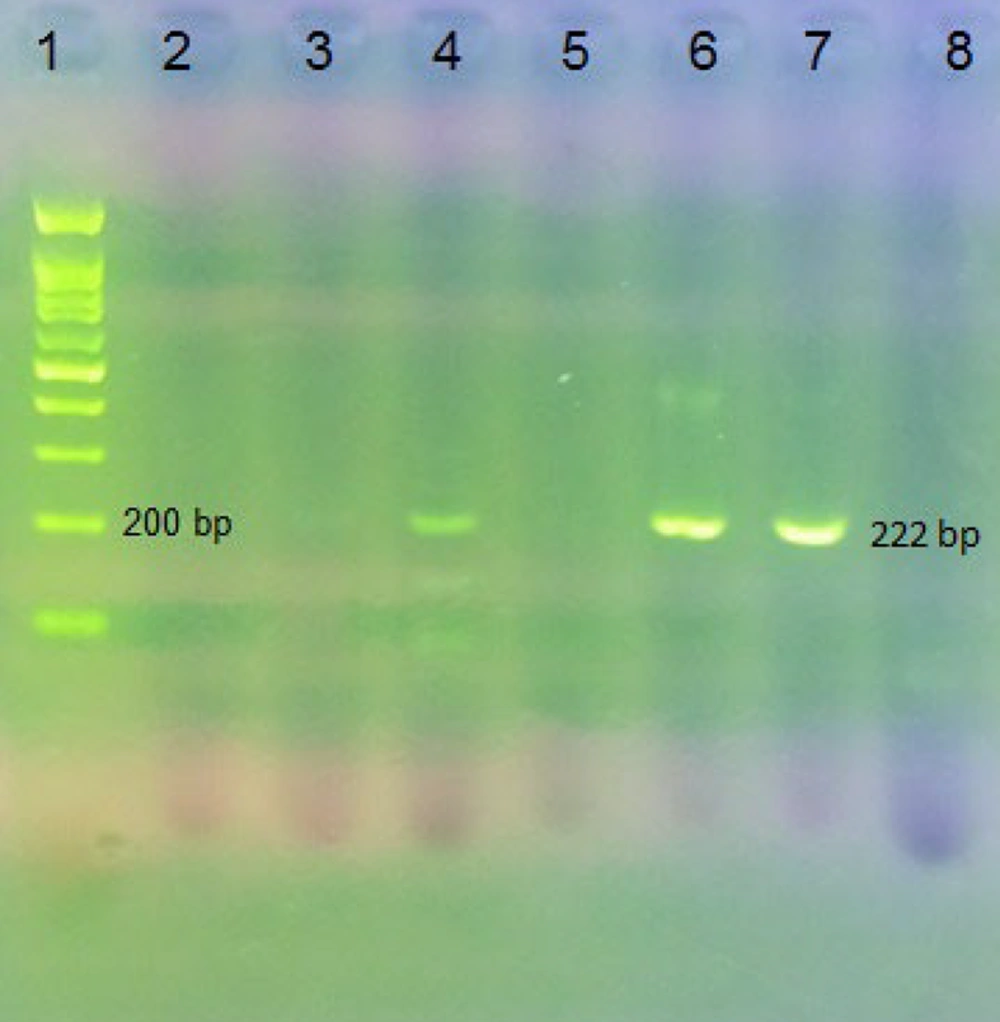
Figure 3.
Polymerase chain reaction results of 5 herpesvirus-positive patients using CMV-specific primers with an approximately 200-bp PCR amplicon. Lane 1, 100-bp PCR ladder; lanes 2 - 6, patient samples; lane 7, negative control; lane 8, positive control. Samples 2, 3, and 5 were negative or weakly positive in this figure. After retesting, these samples showed positive results.
The mean age of CMV-positive patients was 6.25 ± 4.5 years (95% CI, 0.66 - 11.84). Three CMV-positive patients had ALL and 1 had rhabdomyosarcoma (RMS); 3 were male and 2 were female (Table 1).
Table 1.
Demographic Data of Positive Cases a
| Gender | Age | Malignancy | PCR Result |
|---|---|---|---|
| Female | - | - | CMV-positive |
| Male | 4 | ALL | CMV-positive |
| Female | 4 | RMS | CMV-positive |
| Male | 13 | ALL | CMV-positive |
| Male | 4 | ALL | CMV-positive |
a Abbreviations: ALL, acute lymphoblastic leukemia; AML, acute myeloid leukemia; CMV, cytomegalovirus; PCR, polymerase chain reaction; RMS, rhabdomyosarcoma.
5. Discussion
Children with malignancy often experience immunosuppression and leukopenia due to chemotherapy, which predisposes them to various infections, including the reactivation of latent viruses (15, 16). Neutropenic fever is a common complication in this population, and an accurate etiologic diagnosis is essential for appropriate management and antibiotic stewardship (17). Cytomegalovirus persists latently mainly in cells of the myeloid lineage, such as progenitor cells and monocytes, with viral gene expression epigenetically repressed. Reactivation is closely linked to myeloid differentiation, including differentiation toward macrophages and dendritic cells, which permits immediate-early gene expression. Chemotherapy-related mucosal damage, infections, and systemic inflammation generate cytokine signaling that can directly stimulate CMV lytic transcription programs; tumor necrosis factor alpha-linked pathways, such as nuclear factor kappa B activity, are well-described triggers of CMV reactivation in myeloid models (18).
In our evaluation of 41 neutropenic febrile patients with malignancy, 5 were CMV-positive by PCR. These findings regarding the prevalence of CMV among pediatric oncology patients with neutropenic fever in Ahvaz provide important insight into the viral etiology of this condition. Although CMV is a well-known pathogen in immunocompromised individuals globally, its specific impact on pediatric cancer patients in Iran has been less well documented. Previous regional studies, such as those conducted by Shamsizadeh et al., have highlighted the presence of viral infections such as CMV, EBV, and HHV-6 in febrile neutropenic children at hospitals in Ahvaz. However, these studies have not fully explored the role of herpesviruses in the context of malignancies such as ALL, which was the most common cancer in the present study. By situating our results within the broader landscape of Iranian and regional data, this research underscores the need for routine viral testing and targeted antiviral strategies to improve outcomes in pediatric cancer patients with neutropenic fever (19).
Shamsizadeh et al. reported viral infections in 19 of 92 febrile neutropenic children at Abuzar Children’s Hospital in Ahvaz, with CMV accounting for 3 cases (3.3%), which is broadly comparable with our findings (19). Differences may reflect population characteristics: our patients were immunocompromised due to malignancy, whereas the previous study included febrile neutropenic patients without the same degree of immunodeficiency. Obrová et al. evaluated 237 febrile neutropenic chemotherapy patients and detected EBV, CMV, and HHV-6 viremia; 6 CMV cases were reported, including 5 pediatric cases and 1 adult case (20). Another study involving 241 patients reported that approximately 63% of neutropenic fever episodes in children had a viral cause, which, as in our study, indicates a high proportion of viral infections. Wang et al. found that among 107 cancer patients with CMV viremia, approximately 70% had solid tumors and 30% had hematologic malignancies (21). In our study, 3 of 5 CMV-positive cases had ALL and 1 had a solid tumor, a distribution that may reflect the small sample size and the regional prevalence of leukemia. Indeed, leukemia is among the most frequent and increasingly common pediatric cancers in the United States (22), and the incidence of ALL among children in Khuzestan Province has been reported to be approximately 5 times that of acute myeloid leukemia (AML) (23). Moreover, CMV infection has been associated with increased cancer-related mortality (24). Sato et al. reported a CMV rate of 5.5% (13/236) among lymphoma patients who had not undergone hematopoietic stem cell transplantation, which is similar to our findings (25). Cytomegalovirus reactivation has also been reported after chemoradiotherapy in esophageal cancer, including a rate of 14% in one cohort. Optimizing antiviral strategies, such as synergistic combinations, alternating nucleoside and non-nucleoside agents, and therapeutic drug monitoring, may improve outcomes in immunocompromised patients (26).
This study, together with the reviewed literature, highlights the importance of investigating viral infections, particularly latent viral infections, in vulnerable patients such as those with cancer. Because of the immunosuppressive effects of anticancer treatments, these patients are highly susceptible to various infectious diseases. Accurately distinguishing viral from bacterial infections is also crucial for guiding treatment strategies. Integrating viral screening into the diagnostic algorithm could help clinicians more accurately identify the etiology of fever in neutropenic patients and distinguish viral from bacterial causes. This approach could improve diagnostic precision and support antibiotic stewardship by reducing unnecessary broad-spectrum antibiotic use. Targeted antiviral therapy could also be initiated more promptly in patients with confirmed viral infections, while unnecessary antibiotics could be minimized, ultimately helping prevent antibiotic resistance.
This study also underscores the importance of multicenter collaborations, both in Iran and internationally, to develop more comprehensive and representative datasets. However, the study had several limitations. Time and budget constraints prevented the collection of a larger sample size, which might have yielded more robust findings. In addition, we were unable to assess patients for other viral, bacterial, or fungal infections. More detailed clinical and serologic correlation, including viral load and IgM/IgG levels, would have clarified the causal relationship and helped differentiate reinfection from new infection, but this was not possible because of financial limitations. Another limitation was the absence of longitudinal follow-up, leaving the potential correlation between CMV detection and clinical outcomes unclear.
5.1. Conclusions
Cytomegalovirus was the predominant herpesvirus detected among febrile neutropenic children with malignancy in Ahvaz. Routine consideration of viral testing in this population may support an etiologic diagnosis and guide antimicrobial stewardship. Future studies should include quantitative PCR or serologic assays and larger multicenter cohorts to better correlate viral activity with clinical outcomes.