
1. Background
Cytomegalovirus (CMV) is an enveloped virus with a large double-stranded DNA genome encoding more than 200 proteins. It is classified within the Herpesviridae family and the Betaherpesvirinae subfamily (1, 2) and is also referred to as human cytomegalovirus (HCMV). CMV can infect individuals of all ages and, similar to other members of this family, including Epstein-Barr virus, varicella-zoster virus, herpes simplex virus types 1 and 2, and Kaposi sarcoma-associated herpesvirus, establishes lifelong latency (3).
Virus transmission occurs through body fluids such as blood, urine, milk, and saliva, as well as via intrauterine, perinatal, and postnatal routes. The virus can persist latently in the host for prolonged periods without clinical signs or symptoms (4). HCMV infection has been reported among women of childbearing age, posing a substantial risk of perinatal and neonatal transmission (5).
Although latency often results in asymptomatic infection, viral reactivation can cause symptoms including fever, encephalitis leading to seizures and coma, pneumonia with hypoxemia, hepatitis, large ulcers, shortness of breath, and visual problems. HCMV infection may also present with a sore throat, fatigue, a mononucleosis-like illness, and lymphadenopathy (3). Infected pregnant women can transmit the virus to the fetus through blood circulation in utero or to the newborn through genital secretions during delivery (6, 7).
Congenital CMV, an intrauterine infection, occurs in approximately 0.7% to 4.1% of all pregnancies. Women of lower socioeconomic status generally have higher seropositivity than those of higher socioeconomic status (6). Transmission during the first trimester poses the greatest risk, with rates of 30% to 40%, and decreases in subsequent trimesters (7). CMV is one of the most prevalent viral fetal infections and can cause central nervous system and extracranial anomalies, often associated with long-term deficits. Congenital CMV is recognized as the most common nongenetic cause of fetal neurosensory hearing loss and has severe effects on neurological development. In addition to congenital infection, CMV may lead to miscarriage and spontaneous abortion due to placental impairment. Birth abnormalities are observed in 10% to 15% of infected fetuses, while CMV-related diseases may manifest later in life in up to 25% of cases (8).
2. Objectives
In the present study, we aimed to evaluate the incidence of acute and chronic HCMV infection in women with spontaneous abortion compared with pregnant women without abortion in Iraq.
3. Methods
3.1. Sample Collection
Four hundred blood samples were obtained from women with spontaneous abortion (300 samples) after curettage procedures performed by gynecologists and from pregnant women without abortion (100 samples). The sampling method was hospital-based consecutive sampling. Samples were collected from women referred to maternity and children’s hospitals in Al-Muthanna Province, Iraq, between November 2023 and May 2025. Individuals with underlying diseases, including diabetes mellitus, chronic hypertension, thyroid disorders, autoimmune diseases such as systemic lupus erythematosus, thrombophilia, or infections known to cause miscarriage, such as toxoplasmosis, rubella, HIV, and hepatitis B or C, were excluded. Clinical signs were recorded by physicians, including gestational age, body temperature, sweating, bleeding, and abdominal or back pain. Blood samples were centrifuged at 3000 rpm for 10 minutes to obtain serum for serological assays. Serum samples were stored at -20 °C until enzyme-linked immunosorbent assay testing. Whole blood was used for DNA extraction.
3.2. Antibody Detection
HCMV IgG and IgM antibodies were detected using a sandwich enzyme-linked immunosorbent assay. All samples were tested for serum antibody levels using a commercial kit (NovaTec, Germany) with a sensitivity and specificity of 95%. The procedure was performed according to the manufacturer’s instructions. IgG and IgM levels were measured at an absorbance of 450 nm. Samples were considered positive if the absorbance value exceeded the cutoff by more than 10%.
3.3. DNA Extraction
The Sinapure viral DNA extraction kit (Sinaclon, Iran) was used to extract DNA from blood samples according to the manufacturer’s instructions. To confirm successful DNA extraction, all samples were screened for the presence of the human β-globin housekeeping gene as an internal control using polymerase chain reaction (PCR), which amplifies a 110-bp product. The primers used are listed in Table 1. PCR reactions and conditions were applied according to the study by Saiki et al. (9).
Table 1.
Sequences of Primers Used for the Internal Control and Nested Polymerase Chain Reaction Assay
3.4. Detection of HCMV
Nested PCR was used to detect viral DNA. The outer and inner primers are listed in Table 1. Viral glycoprotein B was targeted by nested PCR. In the first PCR, a 450-bp fragment was amplified, whereas in the second PCR, an internal 220-bp fragment was amplified. PCR reactions were performed as described by Noorbakhsh et al. (10). The PCR mixture consisted of 12.5 μL of PCR Master Mix (Ampliqun, Denmark), 2 μL of external primers at a concentration of 0.8 μM, 5 μL of DNA, and 5.5 μL of sterile water. The PCR conditions were as follows: 94 °C for 2 minutes; 35 cycles of 94 °C for 30 seconds, 58 °C for 45 seconds, and 72 °C for 60 seconds; and 72 °C for 5 minutes. Subsequently, the second PCR was performed under the same conditions, using 2 μL of the first PCR product as the template, internal primers, and an annealing temperature of 55 °C.
3.5. Statistical Analysis
SPSS version 17 was used for data analysis. To calculate the sample size, post hoc power analysis was performed using G*Power software. For the observed IgM prevalence of 8% versus 0% (11), with an alpha level of 0.05, the required sample size to achieve 80% power in a 1:1 case-control design was approximately 95 participants per group. To increase the confidence margin, the numbers of case and control samples were set at 300 and 100, respectively. Categorical variables were compared using the χ2 test when the assumptions of the test were met. Specifically, the χ2 test was applied when expected cell frequencies were ≥ 5 in at least 80% of cells and no cell had an expected count less than 1. When these assumptions were not satisfied, Fisher’s exact test was used. All observations were independent. A P value < 0.05 was considered statistically significant.
4. Results
4.1. Serological Results
The enzyme-linked immunosorbent assay showed that, among 300 women with spontaneous abortion, 220 (73.3%) and 30 (10%) tested positive for anti-HCMV IgG and IgM antibodies, respectively. In contrast, among 100 women without abortion, 20 (20%) were positive for IgG, whereas IgM antibodies were not detected. Statistical analysis indicated a significant difference in the frequency of HCMV IgG and IgM seropositivity between women with and without abortion (P < 0.05) (Table 2).
Table 2.
Seroprevalence of Anti-HCMV IgG and IgM Antibodies in Women with and Without Spontaneous Abortion (N = 100) a
| Variables | Women with Abortion | Women Without Abortion | P-Value |
|---|---|---|---|
| Anti-HCMV IgG positive | 220 (73.3) | 20 (20) | < 0.001 |
| Anti-HCMV IgM positive | 30 (10) | 0 (0) | 0.001 |
a Values are expressed as No. (%).
4.2. Distribution of Anti-HCMV Antibodies According to Age Group
The mean age of women with and without abortion was 23 ± 0.6 and 24 ± 0.8 years, respectively. Among women with abortion, those aged ≥ 35 years had the highest HCMV IgG antibody levels compared with other age groups, and this difference was statistically significant (P < 0.05). In contrast, among pregnant women without abortion, those younger than 25 years showed the highest antibody levels, whereas no antibodies were detected in women older than 35 years (P < 0.05). None of the pregnant women without abortion tested positive for HCMV IgM. Furthermore, in the abortion group, HCMV IgM levels did not differ significantly across age groups (P > 0.05) (Table 3).
Table 3.
Seroprevalence of Anti-HCMV IgG and IgM Antibodies in Women with and Without Spontaneous Abortion According to Age Group a
| Age, y | Total No., with Abortion | Total No., Without Abortion | Anti-HCMV IgG Positive, with Abortion | Anti-HCMV IgG Positive, Without Abortion | P-Value | Anti-HCMV IgM Positive, with Abortion | Anti-HCMV IgM Positive, Without Abortion |
|---|---|---|---|---|---|---|---|
| < 25 | 92 (30.7) | 37 (37) | 62 (67.4) | 13 (35.1) b | 0.002 | 10 (10.9) | 0 |
| 25 - 29 | 100 (33.3) | 24 (24) | 75 (75) | 5 (20.8) | < 0.001 | 10 (10) | 0 |
| 30 - 34 | 75 (25) | 11 (11) | 51 (68) | 2 (18.2) | 0.003 | 6 (8) | 0 |
| ≥ 35 | 33 (11) | 28 (28) | 32 (97) c | 0 (0) b | < 0.001 | 4 (12.1) | 0 |
a Values are expressed as No. (%). Abbreviations: HCMV, human cytomegalovirus; IgG, immunoglobulin G; IgM, immunoglobulin M.
b P < 0.005.
c P < 0.05.
4.3. Distribution of Anti-HCMV Antibodies According to Place of Residence
Among women with abortion, 224 (74.7%) lived in rural areas; of these, 163 (72.7%) and 22 (9.8%) were positive for IgG and IgM, respectively. Among pregnant women without abortion, 15 (19.7%) living in rural areas and 5 (20.8%) living in urban areas were positive for IgG, whereas HCMV IgM was not detected. IgG levels did not differ significantly between women with abortion living in rural versus urban areas (P > 0.05); however, women with abortion in both regions had significantly higher IgG levels than women without abortion (P < 0.05) (Table 4).
Table 4.
Seroprevalence of Anti-HCMV IgG and IgM Antibodies in Women with and Without Spontaneous Abortion According to Place of Residence a
| Place | Total No., with Abortion | Total No., Without Abortion | Anti-HCMV IgG Positive, with Abortion | Anti-HCMV IgG Positive, Without Abortion | P-Value | Anti-HCMV IgM Positive, with Abortion | Anti-HCMV IgM Positive, Without Abortion |
|---|---|---|---|---|---|---|---|
| Rural areas | 224 (74.7) | 76 (76) | 163 (72.7) | 15 (19.7) | < 0.001 | 22 (9.8) | 0 |
| Urban areas | 76 (25.3) | 24 (24) | 57 (75) | 5 (20.8) | < 0.001 | 8 (10.5) | 0 |
a Values are expressed as No. (%). Abbreviations: HCMV, human cytomegalovirus; IgG, immunoglobulin G; IgM, immunoglobulin M.
4.4. Distribution of Anti-HCMV Antibodies According to Number of Children
Evaluation of HCMV IgG levels among women with abortion showed that those with 1 child had the highest IgG levels compared with women without children and those with 2 or more children (P < 0.05). Among pregnant women without abortion, the highest IgG levels were detected in those experiencing their first pregnancy, whereas women with 2 or more children had the lowest levels (P < 0.05). Comparison of antibody levels indicated that women with abortion who had 1 or more children exhibited significantly higher IgG levels than women without abortion (P < 0.05). In addition, HCMV IgM levels were statistically significant among women with abortion who had 1 child (P < 0.05) (Table 5).
Table 5.
Seroprevalence of Anti-HCMV IgG and IgM Antibodies in Women with and Without Spontaneous Abortion According to Number of Children a
| Number of Children | Total No., with Abortion | Total No., Without Abortion | Anti-HCMV IgG Positive, with Abortion | Anti-HCMV IgG Positive, Without Abortion | P-Value | Anti-HCMV IgM Positive, with Abortion | Anti-HCMV IgM Positive, Without Abortion |
|---|---|---|---|---|---|---|---|
| 0 | 68 (22.7) | 18 (18) | 48 (70) | 13 (72.2) b | - | 3 (4.4) | 0 |
| 1 | 105 (35) | 20 (20) | 86 (81.9) b | 6 (30) | < 0.001 | 21 (20) | 0 |
| 2 | 66 (22) | 25 (25) | 47 (71.2) | 1 (4) c | < 0.001 | 4 (6.1) | 0 |
| ≥ 3 | 60 (20) | 37 (37) | 38 (63.3) | 0 (0) b | < 0.001 | 2 (3.3) | 0 |
a Values are expressed as No. (%). Abbreviations: HCMV, human cytomegalovirus; IgG, immunoglobulin G; IgM, immunoglobulin M.
b P < 0.005.
c P < 0.05.
4.5. Distribution of Anti-HCMV Antibodies According to Number of Abortions
Statistical analysis showed that women without a history of abortion had significantly higher IgG levels than those who had experienced abortion (P < 0.05), whereas women with 3 or more abortions exhibited the lowest IgG levels (P < 0.05). IgM levels were significantly higher in women with 1 abortion than in other groups (P < 0.05), whereas women without a history of abortion and those with 3 or more abortions showed the lowest IgM levels (P < 0.05) (Table 6).
Table 6.
Seroprevalence of Anti-HCMV IgG and IgM Antibodies According to Number of Abortions a
| Number of Abortions | Total No. | Anti-HCMV IgG Positive | Anti-HCMV IgM Positive |
|---|---|---|---|
| 0 | 48 (16) | 48 (100) b | 1 (2.1) c |
| 1 | 108 (36) | 82 (75.9) | 19 (17.6) b |
| 2 | 95 (31.7) | 69 (72.6) | 9 (9.5) |
| ≥ 3 | 49 (16.3) | 22 (44.9) b | 1 (2.0) b |
a Values are expressed as No. (%). Abbreviations: HCMV, human cytomegalovirus; IgG, immunoglobulin G; IgM, immunoglobulin M.
b P < 0.005.
c P < 0.05.
4.6. Distribution of Anti-HCMV Antibodies According to Time of Abortion
IgG and IgM levels were statistically higher in women who experienced abortion during the first trimester of pregnancy than in other groups (P < 0.05), whereas those with abortion in the third trimester exhibited the lowest IgG levels (P < 0.05) (Table 7).
Table 7.
Seroprevalence of Anti-HCMV IgG and IgM Antibodies According to Time of Abortion a
| Time of Abortion | Total No. | Anti-HCMV IgG Positive | Anti-HCMV IgM Positive |
|---|---|---|---|
| First trimester | 167 (55.7) | 134 (80.2) b | 22 (13.2) c |
| Second trimester | 103 (34.3) | 70 (68) | 7 (6.8) |
| Third trimester | 30 (10) | 16 (53.3) b | 1 (3.3) |
a Values are expressed as No. (%). Abbreviations: HCMV, human cytomegalovirus; IgG, immunoglobulin G; IgM, immunoglobulin M.
b P < 0.005.
c P < 0.05.
4.7. Molecular Detection of HCMV
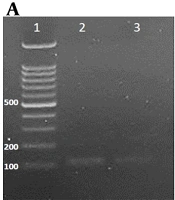
All samples tested positive for the β-globin gene, indicating successful DNA extraction (Figure 1A). Of these, 3 samples from women with abortion were positive for the gB gene, confirming the presence of HCMV (Figure 1B). In contrast, all samples from healthy women were negative for this gene based on nested-PCR analysis.
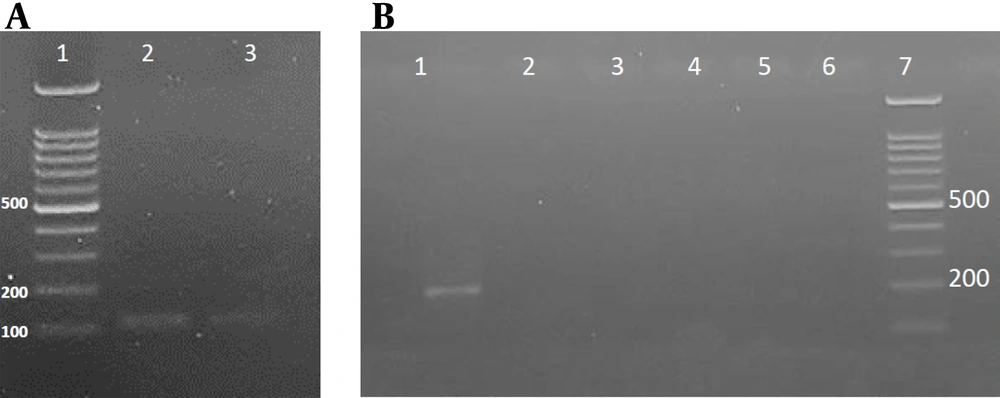
Figure 1.
Amplification results of the β-globin gene as an internal control and the gB gene of HCMV. A, β-globin gene: Lane 1, 100-bp ladder; lanes 2 and 3, positive samples. B, gB gene of HCMV: Lane 1, positive sample; lanes 2 - 6, negative samples; lane 7, 100-bp ladder.
5. Discussion
Spontaneous abortion can be caused by viruses through fetal infection via transplacental or ascending routes. HCMV, which can cause maternal infection, has a high tropism for the placenta and cervical mucosa. This virus has been proposed as a potential cause of recurrent spontaneous abortion. During pregnancy, the virus can reach the placenta through several routes, including via the cervix or through primary or recurrent maternal infection and viremia. The virus may subsequently lead to vascular insufficiency, tissue damage, placental detachment, transmission to the fetus, and ultimately fetal death (12-14). HCMV is transiently present in the placenta and amniotic fluid and does not persist throughout the entire pregnancy. However, due to the chronic nature of the virus, infection remains a concern.
In the present study, comparison of HCMV IgG and IgM levels in women with and without spontaneous abortion showed a significant correlation between the presence of both antibodies and abortion. The presence of IgM indicates primary or active infection, whereas the presence of IgG reflects past or recurrent infection. However, the results of previous studies regarding the potential role of HCMV in abortion remain controversial. Gao et al., Tarokhian et al., Sherkat et al., Sifakis et al., and Spano et al. reported high levels of HCMV IgG in abortion cases, indicating evidence of CMV in abortion samples (15-20). In contrast, some studies, such as those by Charostad et al. in Tehran, Iran; Yan et al. in China; and Yarabbi et al. in Iran, found no significant association between HCMV infection and an increased risk of miscarriage (21-23).
Several studies have investigated HCMV seroprevalence and its association with the incidence of abortion among Iraqi women. Ghailani and Mohammed reported 37% IgG and 1% IgM seropositivity among women with pregnancy loss in Kirkuk city (24). Al-Mishhadani and Abbas found 90.4% IgG and 6.1% IgM seropositivity among women with abortion in western Iraq, which was higher than that in the control group (82.7% for IgG and 3.6% for IgM) (25). A case-control study conducted by Ali in Erbil, Iraq, among women with abnormal pregnancies reported HCMV IgG and IgM seroprevalence rates of 8% and 100%, respectively, and found an association between CMV-specific IgM seroprevalence and a history of abortion (11). Overall, a meta-analysis reported HCMV IgG and IgM prevalence ranging from 0% to 100% and 0% to 93%, respectively, in Iraq between 2008 and 2022. According to this review, several studies found an association between HCMV infection and the frequency of spontaneous abortion among Iraqi women (26).
Discrepancies between our findings and those reported in studies from other geographic regions, as well as the variability reported across Iraqi studies, may be attributable to several factors. First, differences in study design, sample size, sample type, gestational age at sampling, diagnostic assay type (serological versus molecular detection), and population characteristics, such as age distribution, hygiene practices, parity, and socioeconomic status, may contribute to heterogeneity in findings. Second, variations in diagnostic methods and in test sensitivity and specificity, for example, the use of enzyme-linked immunosorbent assay for IgG or IgM detection versus PCR-based molecular techniques, can substantially influence reported prevalence rates. Serological assays may reflect past exposure rather than active infection, whereas PCR detects current viral DNA, leading to differences in interpretation. Regional differences in socioeconomic conditions, household crowding, and early-life exposure patterns may additionally influence HCMV transmission dynamics within the Iraqi population.
In the present study, statistical analysis revealed that the seroprevalence of HCMV IgG in women with abortion increased with age. This is probably due to greater exposure to the virus and latent infection before pregnancy. However, IgM seroprevalence did not change significantly across age groups. An increased incidence of primary infection and reactivation of latent HCMV in women older than 35 years has been reported by Naame et al. (27) and Kalaf et al. (28).
The highest HCMV IgG and IgM seropositivity in women with abortion was observed during the first trimester of pregnancy. Women who have previously been exposed to the virus are likely, due to its latent nature, to experience viral reactivation. These findings are consistent with other studies, including those by Spano et al., Enders et al., Lassen et al., and Yarrabi et al., which reported an association between an increased risk of first-trimester spontaneous abortion and HCMV infection (19, 23, 29, 30).
Statistical analysis revealed that HCMV IgG positivity was higher in women without a previous history of abortion than in those with recurrent spontaneous abortion, suggesting that this virus may play a lesser role in recurrent spontaneous abortion in the present study. Increasing the number of children among women with a history of abortion did not increase the likelihood of HCMV infection. Although a previous study (20) reported a significant impact of socioeconomic factors on disease outcomes, in our study, HCMV seroprevalence was not associated with place of residence among women with abortion.
Although several samples tested positive for IgM, suggesting active infection, viral DNA was detected in only 3 samples, indicating a low viral load. Sifakis et al. and Zhou et al. did not detect CMV in spontaneous abortion samples by PCR (18, 31). We analyzed patients’ blood for the presence of viral DNA; however, HCMV can also infect the fetus via vertical transmission through ascending infection from the genital tract. The virus may be transiently present in the placenta and amniotic fluid without being detectable in the blood. Several studies have reported viral DNA in a small number of samples. Ali et al. and Kalaf and Jameel detected HCMV DNA in 11.2%, 10%, and 0.4% of samples, respectively (28, 32, 33). The sample type used for viral DNA detection, molecular techniques such as PCR, nested PCR, and quantitative PCR, and primer design can affect the final results. Some findings have shown that, in addition to HCMV infection of gestational tissue as a pathogenic mechanism of CMV-induced recurrent spontaneous abortion, an immune-mediated process may occur that leads to abortion (34, 35). Therefore, HCMV infection should be investigated from multiple perspectives in relation to abortion.
Although molecular detection of HCMV DNA was limited to a small number of samples in the present study, this does not necessarily exclude a pathogenic role. HCMV has a known tropism for placental trophoblasts and endothelial cells, and infection may be localized within gestational tissues without persistent viremia detectable in peripheral blood (6, 7, 36, 37). Even transient or low-level infection may induce local inflammatory responses, including the production of proinflammatory cytokines and apoptosis of trophoblastic cells, potentially disrupting placental development and vascular remodeling (34). Such immune-mediated processes or structural alterations could contribute to pregnancy loss, even in the absence of sustained detectable viral DNA in blood. Therefore, the absence of a high viral load or widespread molecular positivity does not rule out a possible biological impact during early placental development.
The present study has some limitations. Participants were recruited from specific healthcare centers, which may limit the generalizability of the findings and introduce selection bias. The sampling method was hospital-based rather than randomized sampling from the general pregnant population. Because the study was conducted in referral hospitals, more complicated or severe cases may have been overrepresented. Additionally, women who experienced miscarriage at home and did not seek hospital care were not accessible. Therefore, the findings should be interpreted within the context of a hospital-based population and may not be fully generalizable to all pregnant women in the province. Although major medical conditions known to cause miscarriage were excluded, residual confounding cannot be completely ruled out. Variables such as socioeconomic status, parity, prior CMV exposure history, geographic factors, clinical factors, referral-hospital factors, and environmental risk factors were not fully controlled and may have influenced the observed associations. Serological testing cannot precisely determine the timing of infection, and molecular detection was limited to a small number of cases using nested PCR rather than quantitative PCR. The low power for PCR-positive cases is a limitation of our study. We did not have access to tissue samples from aborted fetuses, the placenta, or amniotic fluid, which reduces the likelihood of detecting the virus by molecular tests. Finally, the case-control design limits the ability to establish a definitive causal relationship between HCMV infection and pregnancy loss. Prospective longitudinal studies with comprehensive molecular assessment are recommended to further clarify this association.
5.1. Conclusions
The potential role of HCMV in spontaneous abortion remains controversial. However, our data suggest an association between HCMV infection and pregnancy loss in the studied Iraqi population. The highest HCMV IgG and IgM seropositivity rates were observed in women who experienced abortion during the first trimester of pregnancy, which may indicate recent or reactivated infection during early pregnancy. However, given the study design and limited molecular confirmation, these findings should be interpreted with caution. Further large-scale prospective studies incorporating quantitative molecular techniques are needed to better clarify the causal relationship of this virus in spontaneous abortion in Iraq. Routine testing during pregnancy, education of women about HCMV risks, increased awareness, and improved health standards may help reduce the risk of HCMV infection.