1. Background
Healthcare-associated infections (HAIs), also known as nosocomial infections, are among the most critical challenges facing healthcare systems worldwide. They contribute substantially to prolonged hospitalization, increased healthcare costs, and increased morbidity and mortality among hospitalized patients (1). This burden underscores the importance of continuous patient monitoring and rigorous infection-control measures in healthcare settings. The burden of HAIs is disproportionately higher in developing countries, where prevalence rates have been reported to exceed 30% in some settings (2). This finding highlights the substantial clinical, economic, and social consequences of HAIs in these regions and emphasizes the need for comprehensive epidemiological investigations to identify prevalent microbial agents, characterize genetic determinants, and determine antimicrobial resistance patterns. Among the different types of HAIs, bloodstream infections, urinary tract infections (UTIs), ventilator-associated pneumonia, and surgical site infections are frequently encountered and are often associated with severe clinical outcomes.
In recent years, the emergence and rapid dissemination of multidrug-resistant (MDR) pathogens, including Pseudomonas aeruginosa, Acinetobacter baumannii, Klebsiella pneumoniae, Staphylococcus aureus, and Escherichia coli, have become major therapeutic concerns (3). MDR strains are defined as organisms resistant to at least 3 different classes of antimicrobial agents.
Recent global evidence indicates a marked increase in antimicrobial resistance. For instance, a study evaluating 475 isolates obtained from 910 clinical specimens showed that a substantial proportion of pathogens had reached alarming levels of resistance (4). Another investigation reported that E. coli was the most prevalent isolate among hospital-acquired infections and showed the highest susceptibility to imipenem, while demonstrating considerable resistance to third-generation cephalosporins (5). In addition, substantial heterogeneity in resistance patterns has been documented among MDR pathogens, including E. coli, P. aeruginosa, K. pneumoniae, and A. baumannii, across clinical specimens such as blood, wounds, sputum, and urine, reflecting their broad involvement in diverse nosocomial infections (6).
Molecular profiling of antimicrobial resistance genes has emerged as an important approach for understanding and monitoring HAIs (7). This information is critical for predicting treatment failure, guiding targeted antimicrobial stewardship, and informing infection-control interventions, particularly in high-risk populations such as immunocompromised patients. Antimicrobial resistance gene profiling also facilitates surveillance of emerging resistance clones, detection of silent transmission within hospital wards, and the development of local or regional guidelines that align empirical therapy with local resistance epidemiology.
2. Objectives
Because genetic-based studies of the antimicrobial resistance spectrum in northern Iran are limited, the present investigation was designed to evaluate genetic patterns of antimicrobial resistance across various clinical specimens collected at Shahid Beheshti Hospital in Babol, Mazandaran, Iran. These findings are expected to provide useful insights for clinicians, infection-control teams, and hospital administrators and may contribute to improved therapeutic decision-making, reduced MDR prevalence, and better patient outcomes.
3. Methods
3.1. Study Design and Setting
This cross-sectional, descriptive-analytical study was conducted in 2023 at Shahid Beheshti Hospital, Babol, Iran. The study aimed to investigate the antibiotic resistance spectrum using PCR to confirm antimicrobial resistance genes by electrophoresis-based gel band detection.
3.2. Reagents and Instruments
All reagents and materials used for bacteriological and molecular procedures were of analytical or molecular grade. Culture media included Blood Agar Base (Merck, Germany; Cat. No. 146876), Eosin Methylene Blue (EMB) Agar (HiMedia, India; Cat. No. M317), Mueller-Hinton Agar (Merck, Germany; Cat. No. 110333), Mannitol Salt Agar (HiMedia; Cat. No. M260), MacConkey Agar (Merck; Cat. No. 110347), and Tryptic Soy Broth (HiMedia; Cat. No. M011), which were used for primary culture and isolate maintenance. Biochemical identification reagents included TSI (Cat. No. M021), SIM (Cat. No. M108), citrate (Cat. No. M101), MR-VP (Cat. No. M127), urease (Cat. No. M195), DNase (Cat. No. M342), and catalase and coagulase reagents (Merck, Germany; Cat. Nos. 1.12733 and 1.13397, respectively). Genomic DNA extraction was performed using the Thermo Scientific GeneJET Genomic DNA Purification Kit (Thermo Fisher Scientific, USA; Cat. No. K0722). PCR reactions used DreamTaq Green PCR Master Mix (2×) (Thermo Fisher Scientific; Cat. No. K1081) and specific oligonucleotide primers synthesized by Metabion GmbH (Germany) according to published reference sequences.
Nuclease-free water (Thermo Fisher; Cat. No. R0581) was used for reagent preparation. Electrophoresis was performed using agarose (Invitrogen, USA; Cat. No. 16500 - 500), GelRed nucleic acid stain (Biotium, USA; Cat. No. 41003), and a 100-bp DNA ladder (Thermo Fisher; Cat. No. SM0241); gels were visualized under UV transillumination. Instruments included an incubator (Memmert, Germany; Cat. No. IN55), a Class II biosafety cabinet (ESCO, Singapore), an autoclave (Sanyo, Japan), a laminar flow hood (Nuaire, USA), a NanoDrop 2000 spectrophotometer (Thermo Fisher), an Eppendorf thermal cycler (Eppendorf AG, Germany; Cat. No. 6331000), a gel electrophoresis apparatus (Bio-Rad, USA; Cat. No. 170 - 4486), a UV transilluminator, and a gel documentation system (Bio-Rad; Cat. No. 170 - 8195). All consumables, including sterile pipette tips (Axygen, USA; Cat. No. T-200-Y), microtubes (Eppendorf; Cat. No. 0030123.344), and Petri dishes (Greiner Bio-One, Germany; Cat. No. 639160), were sterile and single-use to prevent contamination. Reagents were prepared under aseptic conditions, and equipment was sterilized with 70% ethanol and UV exposure before and after laboratory procedures.
3.3. Study Population and Sampling
Among 13,850 hospitalized patients during the study period in 2023, 209 cases meeting the Iranian Ministry of Health criteria for HAIs were included. Inclusion criteria required infection onset after at least 48 - 72 hours of hospital stay and the absence of active infection at admission. Patient demographic characteristics, infection type, microorganism category, previous invasive procedures, and underlying conditions were recorded using standardized data forms verified by infection-control nurses and infectious disease specialists (8).
Only 1 representative bacterial isolate per patient was included to avoid duplicate sampling bias. The beta-lactamase PCR panel (blaTEM, blaSHV, and blaKPC) was selectively performed on 24 MDR Gram-negative isolates showing reduced susceptibility to beta-lactam antibiotics. In addition, mecA and vanA screening was performed on 21 Gram-positive isolates with phenotypic resistance patterns suggestive of methicillin or glycopeptide resistance.
3.4. Clinical Specimen Collection and Processing
Specimens, including blood, urine, sputum, wound discharge, cerebrospinal fluid, tracheal aspirates, and occasionally stool, were collected using aseptic techniques and promptly transferred to the bacteriology laboratory. Primary cultures were inoculated onto Blood Agar and EMB Agar plates and incubated at 37°C for 24 hours. Gram staining and colony morphology were assessed microscopically. Gram-positive cocci were differentiated using catalase, DNase, mannitol salt agar, and coagulase tests. Gram-negative bacilli were identified using TSI, SIM, citrate, urease, oxidase, indole, and MR-VP assays. Pure isolates were subcultured and preserved in Tryptic Soy Broth with 20% glycerol at -20°C to -80°C to maintain genetic stability for molecular analysis (9).
3.5. Resistance-Gene Detection Panel
To determine the molecular basis of antimicrobial resistance among recovered isolates, a PCR-based resistance-gene panel was applied to detect major determinants associated with extended-spectrum beta-lactam resistance in Gram-negative bacteria (blaSHV, blaTEM, and blaKPC), methicillin resistance in S. aureus (mecA), and vancomycin resistance in Enterococcus faecalis (vanA). The primers included blaSHV (F: “ATGCGTTATATTCGCCTGTG”, R: “TGCTTTGTTATTCGGGCCAA”) (10), blaTEM (F: “CATTTCCGTGTCGCCCTTATTC”, R: “CGTTCATCCATAGTTGCCTGAC”) (10), blaKPC (F: “ATGTCACTGTATCGCCGTCT”, R: “TTTTCAGAGCCTTACTGCCC”) (11), mecA (F: “AAAATCGATGGTAAAGGTTGGC”, R: “AGTTCTGCAGTACCGGATTTGC”) (12), and vanA (F: “GGCAAGTCAGGTGAAGATG”, R: “ATCAAGCGGTCAATCAGTTC”) (13). These genes were amplified by singleplex or multiplex PCR assays according to primer compatibility and expected amplicon sizes. Appropriate positive and negative controls were included in all reactions to ensure assay validity.
3.6. Molecular Identification and Detection of Resistance Genes
Genomic DNA was isolated from pure colonies using a commercial DNA extraction kit according to the manufacturer’s protocol. DNA purity was assessed spectrophotometrically using a NanoDrop device, and only samples with A260/A280 ratios between 1.8 - 2.0 were used for PCR. Four molecular panels targeting major resistance determinants were designed for Gram-negative fermenters, nonfermenters, and Gram-positive organisms. PCR assays were performed in total volumes of 25 µL, consisting of 12.5 µL of master mix, 1 µL of each specific primer, 2 µL of DNA template, and nuclease-free water. The thermal profile included initial denaturation at 95°C for 5 minutes, followed by 30 - 35 cycles of denaturation at 95°C for 30 seconds, annealing at 55 - 60°C for 30 seconds, extension at 72°C for 1 minute, and final extension at 72°C for 7 minutes. PCR products were separated on 1% - 1.5% agarose gels, stained with GelRed or ethidium bromide, and visualized under UV transillumination. Bands were compared with a 100-bp DNA ladder, and gel images were recorded using a Bio-Rad gel documentation system. Each reaction set included appropriate positive and negative controls (14).
3.7. Statistical Analysis
Clinical, microbiological, and molecular data were entered into SPSS version 22 (IBM Corp., Armonk, NY, USA; Serial No. 1022 - 0018). Descriptive statistics were calculated for bacterial distribution and resistance profiles. The chi-square (χ2) test was used to explore correlations among bacterial species, the presence of resistance genes, specimen type, and clinical characteristics. A P value < 0.05 was considered statistically significant.
4. Results
4.1. Descriptive Statistics and Epidemiological Findings
Of the 209 patients included in the study, 134 (64.1%) were male and 75 (35.9%) were female. The age distribution indicated that most patients were in the 41 - 53-year age group (n = 96; 45.9%), followed by the 53 - 65-year group (n = 60; 28.7%) and the 29 - 41-year group (n = 32; 15.3%). The remaining patients were in the 17 - 29-year age group (n = 8; 3.8%) and the 65 - 77-year age group (n = 13; 6.2%). The most common clinical indication was UTI (n = 75; 35.9%), followed by sepsis or bacteremia (n = 32; 15.3%), respiratory infection with sputum production (n = 29; 13.9%), and wound-related infections (n = 27; 12.9%). The primary infection source was a urinary catheter (n = 75; 35.9%), followed by the surgical wound site (n = 53; 25.4%), a sputum sample (n = 38; 18.2%), and central-line-associated sources (n = 15; 7.2%). Most isolates grew on EMB agar (n = 67; 32.1%) and chocolate agar (n = 65; 31.1%), whereas MacConkey agar yielded a substantial proportion of Gram-negative colonies (n = 54; 25.8%). Regarding bacterial species distribution, Klebsiella spp. (n = 74; 35.4%) was the most prevalent, followed by E. coli (n = 41; 19.6%), P. aeruginosa (n = 40; 19.1%), Staphylococcus spp. (n = 39; 18.7%), and Acinetobacter spp. (n = 15; 7.2%). These findings indicate that Gram-negative Enterobacteriaceae and nonfermenters, particularly Klebsiella and Pseudomonas, were the dominant nosocomial pathogens in this cohort of hospitalized patients (Table 1).
Table 1.
Descriptive Distribution of Demographic and Microbiological Characteristics Among 209 Nosocomial Bacterial Isolates
| Variables | No (%) |
|---|---|
| Gender | |
| Male | 134 (64.1) |
| Female | 75 (35.9) |
| Age group (y) | |
| 17 - 29 | 8 (3.8) |
| 29 - 41 | 32 (15.3) |
| 41 - 53 | 96 (45.9) |
| 53 - 65 | 60 (28.7) |
| 65 - 77 | 13 (6.2) |
| Primary clinical indication | |
| Urinary tract infection | 75 (35.9)( |
| Sepsis/blood infection | 32 (15.3)( |
| Respiratory infection (sputum) | 29 (13.9) |
| Wound infection | 27 (12.9) |
| Other (miscellaneous sites) | 46 (32.0) |
| Site of infection | |
| U/C (urinary catheter) | 75 (35.9) |
| W/C (wound) | 53 (25.4)( |
| SP/C (sputum) | 38 (18.2)( |
| B/C1 (central‑line) | 15 (7.2) |
| Other sites | 28 (13.4) |
| Growth medium | |
| EMB agar | 67 (32.1) |
| Chocolate agar | 65 (31.1) |
| MAC/MacConkey agar | 54 (25.8) |
| Other media | 23 (10.9) |
| Bacterial species | |
| Klebsiella spp. | 74 (35.4) |
| Escherichia coli | 41 (19.6) |
| Pseudomonas aeruginosa | 40 (19.1) |
| Staphylococcus spp. | 39 (18.7) |
| Acinetobacter spp. | 15 (7.2) |
4.2. Molecular Investigation of Antibiotic Resistance
PCR-based screening using 4 targeted gene panels, including Enterobacteriaceae, beta-lactamases, nonfermenters, and Gram-positive bacteria, generated a molecular profile of antibiotic-resistance genes in clinical isolates from 209 hospitalized patients with nosocomial infections. The findings were consistent with the established epidemiology of extended-spectrum beta-lactamase (ESBL) and methicillin-resistant S. aureus (MRSA) determinants among predominant species, including Klebsiella spp., E. coli, P. aeruginosa, Staphylococcus spp., and Acinetobacter spp., while confirming the absence of key carbapenemase and glycopeptide-resistance markers. In the beta-lactamase panel (Figure 1A), which targeted blaTEM (~850 bp), blaSHV (~800 bp), and blaKPC (~800 bp), no PCR amplicons were detected in any of the 24 tested isolates (S1 - S24).
The gel showed no bands within the 700 - 900-bp range, with only the 1000-bp ladder serving as a reference. The absence of blaTEM and blaSHV, historically dominant ESBL genes, suggests a possible epidemiological shift toward alternative ESBLs, such as blaCTX-M. Notably, the complete absence of blaKPC indicates no circulation of this class A carbapenemase, despite 57.4% phenotypic imipenem resistance. The absence of blaKPC among phenotypically resistant isolates suggests that alternative resistance determinants or uninvestigated mechanisms may be involved. In the Gram-positive panel (Figure 1B), which assessed mecA (~533 bp) and vanA (~732 bp), distinct bands at ~533 bp were observed in isolates S10, S15, and S20, corresponding to 3 of 21 mecA-positive isolates (14.3%). These findings confirm the presence of MRSA clones, consistent with phenotypic resistance to cefoxitin (10.5%) and oxacillin (11.0%), and reflect the role of PBP2a-mediated beta-lactam resistance. In contrast, no bands were detected at ~732 bp for vanA across all samples, with only minor nonspecific signals (<300 bp), excluding the presence of vancomycin-resistant enterococci or vancomycin-resistant S. aureus. This finding aligns with the low observed phenotypic vancomycin resistance (8.1%). Overall, resistance in this cohort may be associated with ESBL-related resistance patterns among Enterobacteriaceae isolates and moderate MRSA prevalence, with minimal contribution from carbapenemase- and glycopeptide-resistance determinants.
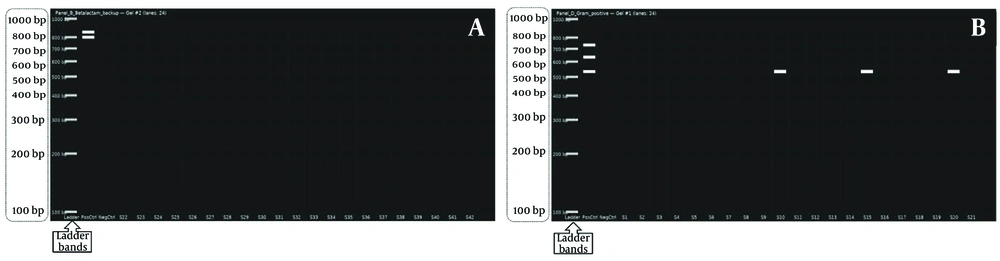
Figure 1.
Agarose gel electrophoresis analysis of resistance genes. (A) Detection of blaTEM (850 bp), blaSHV (800 bp), and blaKPC (800 bp) among tested Gram-negative isolates. (B) Detection of mecA (533 bp) and vanA (732 bp) among Gram-positive isolates. Lane M: 100-bp DNA ladder; positive controls are indicated by visible target bands; negative samples showed no detectable amplification products.
5. Discussion
This investigation underscores the need to characterize resistance-gene profiles in MDR bacteria recovered from hospitalized patients, as such data inform empirical therapy and surveillance strategies amid increasing nosocomial threats. Among 209 patients, who were predominantly middle-aged males, UTIs linked to urinary catheters emerged as the leading clinical problem. Klebsiella spp. dominated the isolates, followed by E. coli, P. aeruginosa, Staphylococcus spp., and Acinetobacter spp. PCR analysis across targeted panels for beta-lactamases, Enterobacteriaceae, nonfermenters, and Gram-positive bacteria revealed no evidence of blaTEM, blaSHV, or blaKPC genes in the tested samples, despite notable phenotypic carbapenem resistance. This finding suggests the possible involvement of alternative or uninvestigated resistance mechanisms, including undetected ESBL variants such as blaCTX-M. Conversely, mecA was confirmed in 14.3% of Gram-positive isolates, aligning with observed MRSA patterns, whereas vanA was entirely absent, consistent with low glycopeptide resistance rates. Collectively, these results indicate a resistance landscape characterized by possible ESBL-related resistance mechanisms and a moderate MRSA burden, with negligible contribution from the carbapenemase and glycopeptide resistance genes targeted in this study.
The demographic and clinical profile of the 209 hospitalized patients revealed a predominance of males (64.1%) and a concentration of cases among middle-aged adults (41 - 53 years), consistent with previous reports of higher nosocomial-infection rates in males and adults (15). This age-sex distribution aligns with patterns observed in bloodstream and other hospital-acquired infections (16), in which increased exposure to invasive devices, comorbidities, and healthcare contact among working-age and older male patients may contribute to a higher infection incidence (17).
Clinically, UTI was the most frequent indication, and urinary catheters were the leading infection site, underscoring the role of device-associated colonization in seeding nosocomial pathogens, particularly Enterobacteriaceae and nonfermenting Gram-negative bacilli. Similar studies have reported E. coli, Klebsiella spp., and P. aeruginosa as dominant agents in catheter-associated UTIs and other nosocomial settings, reflecting the capacity of these organisms to adhere to abiotic surfaces, form biofilms, and resist host immune clearance (18). In the present cohort, Klebsiella spp. emerged as the most prevalent species, followed by E. coli, P. aeruginosa, Staphylococcus spp., and Acinetobacter spp., a pattern that reflects the global epidemiology of Gram-negative nosocomial pathogens and highlights the continued importance of these organisms in immunologically vulnerable hospitalized populations. The substantial growth of isolates on EMB and MacConkey agars also reflects the predominance of lactose-fermenting Enterobacteriaceae and nonfermenting Gram-negative bacilli, whose outer-membrane architecture and efflux systems facilitate survival and resistance in hospital environments (19).
The molecular panels targeting Enterobacteriaceae, beta-lactamases, nonfermenters, and Gram-positive bacteria provided additional information on resistance-associated genes among the studied isolates. The molecular findings suggest a possible contribution of ESBL-related resistance mechanisms among Enterobacteriaceae isolates; however, broader molecular investigations are required to confirm the exact genetic basis of resistance. Such multiplex gene panels have increasingly been adopted in surveillance studies to link genotypic resistance profiles with phenotypic antimicrobial resistance patterns, thereby improving the precision of infection-control and empirical-therapy decisions. The predominance of Klebsiella spp., E. coli, P. aeruginosa, and Staphylococcus spp. in this cohort mirrors global data identifying these organisms as leading nosocomial pathogens with diverse resistance determinants.
In the beta-lactamase panel targeting blaTEM, blaSHV, and blaKPC, the absence of detectable amplicons in all tested isolates suggests a marked decline in historically prevalent class A ESBL genes and an absence of KPC-type carbapenemases, despite substantial phenotypic imipenem resistance (17). This pattern resembles reports from other regions in which blaTEM and blaSHV have been supplanted by blaCTX-M-type ESBLs, underscoring an epidemiological shift that may limit the utility of older PCR targets alone without broader coverage (20). The discordance between high imipenem resistance and undetectable blaKPC suggests that additional resistance determinants or uninvestigated molecular mechanisms may contribute to the observed phenotypic resistance patterns.
In Gram-positive isolates, the detection of mecA in 14.3% of tested strains, with corresponding phenotypic resistance to cefoxitin and oxacillin, confirms the presence of MRSA clones relying on PBP2a-mediated beta-lactam resistance. PBP2a, a low-affinity transpeptidase encoded by mecA, enables cell-wall synthesis even in the presence of beta-lactams (21), thereby conferring broad resistance to methicillin-class agents and contributing to the persistence of MRSA in nosocomial reservoirs. Similar prevalence estimates for mecA have been reported in other hospital-based series, suggesting that although MRSA remains a concern, its relative burden can vary substantially by setting and infection-control practices (17).
Conversely, the absence of vanA signals across all samples, with only minor nonspecific bands below 300 bp, aligns with the low observed phenotypic vancomycin resistance and effectively excludes the presence of vancomycin-resistant enterococci or vancomycin-resistant S. aureus clones in this cohort. vanA-mediated resistance typically involves modification of the cell-wall precursor D-Ala-D-Ala to D-Ala-D-Lac, reducing vancomycin binding and enabling high-level resistance. Its scarcity in this study may reflect local stewardship practices and relatively controlled glycopeptide use. Other studies have documented higher vanA frequencies in intensive-care and high-antibiotic-exposure settings, underscoring the importance of regional surveillance to tailor prevention strategies (20).
Overall, the molecular profiles suggest that the resistance burden in this cohort may be associated with ESBL-related resistance patterns among Enterobacteriaceae isolates and moderate MRSA prevalence, with minimal contribution from carbapenemase- and glycopeptide-resistance determinants. These findings support the concept that while broad-spectrum beta-lactams and glycopeptides remain partially effective, the underlying genetic architecture, particularly the displacement of classic ESBL genes and the possible involvement of alternative or uninvestigated resistance mechanisms, requires expanded PCR coverage and routine genotypic surveillance to guide antimicrobial stewardship and infection-control policies in hospital settings.
5.1. Limitations
Several methodological constraints should be acknowledged when interpreting these results. First, the study was conducted at a single hospital center and included a relatively limited sample size, which may limit the generalizability of the observed resistance-gene epidemiology to other healthcare settings or regions with different antibiotic-use patterns. Second, the PCR panels targeted only a predefined set of genes, including blaTEM, blaSHV, blaKPC, mecA, and vanA, thereby potentially missing emerging or region-specific resistance determinants such as blaCTX-M variants, other carbapenemases, including NDM and OXA-type genes, or alternative glycopeptide resistance mechanisms. Third, the investigation relied on phenotypic susceptibility testing paired with targeted molecular screening and did not include comprehensive whole-genome sequencing or transcriptomic analysis, which could have provided deeper insights into novel resistance pathways and regulatory mechanisms in the analyzed isolates.
5.2. Proposed Research Directions
Future studies could expand on these findings by implementing broader molecular surveillance platforms, such as next-generation sequencing-based resistome profiling, to capture the full spectrum of resistance genes and their horizontal transfer dynamics among nosocomial isolates. Investigating the interaction between bacterial resistance determinants and the host immune microenvironment, particularly in patients with catheter-associated UTIs, surgical site infections, and central-line-associated bloodstream infections, could provide novel insights into immunological factors that either favor or constrain resistant pathogen colonization and persistence. In addition, longitudinal multicenter collaborations integrating PCR-based resistance-gene screening with detailed antimicrobial-stewardship data and clinical outcomes would help define the real-world impact of moderate-burden resistance profiles on patient mortality, length of hospital stay, and infection recurrence, thereby informing more tailored prevention and treatment strategies.
5.3. Conclusions
This study demonstrates that Gram-negative Enterobacteriaceae and nonfermenters, especially Klebsiella spp. and P. aeruginosa, together with MRSA, appear to constitute a major component of nosocomial bacterial diversity and resistance in the evaluated hospital population. PCR-based resistance-gene profiling revealed a moderate resistance burden, possibly associated with ESBL-related resistance patterns and mecA-mediated beta-lactam resistance, whereas key carbapenemase- and glycopeptide-resistance genes were absent or negligible. These findings support the integration of molecular screening into routine microbiological surveillance to refine empirical therapy and infection-control measures, while also highlighting the need for expanded genomic and immunological investigations to better understand the evolving landscape of MDR nosocomial pathogens.