
1. Background
Seasonal influenza epidemics are caused by influenza A and B viruses; however, global pandemics are primarily driven by IAV, particularly the H1N1 and H3N2 subtypes (1). Although influenza vaccination remains the cornerstone of epidemic control, timely pathogen detection is essential for managing seasonal influenza outbreaks (2). Current methods for detecting IAV include viral culture, real-time reverse transcription polymerase chain reaction (RT-PCR), immunoassays, and sequencing (3, 4). Although viral culture is the diagnostic gold standard, it is slow, labor-intensive, and associated with biosafety risks (5). Real-time RT-PCR, the most widely adopted method, offers high sensitivity and specificity but is often unsuitable for low-resource settings because of its cost, equipment requirements, and need for skilled personnel (6).
Loop-mediated isothermal amplification (LAMP) is well-suited for POCT and field testing (7, 8). Its advantages include operational simplicity, minimal equipment requirements, the potential for direct sample use, and clear visual results through colorimetric indicators such as hydroxy naphthol blue (HNB) (9).
2. Objectives
Here, we developed an HNB-based RT-LAMP assay for the rapid detection of seasonal IAV, including H1N1 and H3N2. We systematically evaluated 10 primer sets using real-time RT-LAMP with genomic RNA standards, optimized HNB-based colorimetric detection, and validated the assay performance. The optimized HNB-RT-LAMP assay demonstrated high sensitivity, detecting as few as 67 and 42 RNA copies per reaction for H1N1 and H3N2, respectively. This assay represents a promising, rapid, and cost-effective diagnostic tool for use in resource-limited settings.
3. Methods
3.1. LAMP Primers
In this study, we implemented LAMP assays targeting conserved regions of IAVs, as previously reported by various laboratories (10-20). Each LAMP primer set consisted of 6 primers: 2 outer primers (F3 and B3), 2 inner primers (FIP and BIP), and 2 loop primers (LF and LB) to optimize the reaction. Detailed primer design information is provided Table 1 in Supplementary File. The reaction mixtures contained primers at the following final concentrations: 0.2 µM for F3 and B3, 1.6 µM for FIP and BIP, and 0.4 μM for LF and LB.
Table 1.
Gradient Dilutions and Different Copy Numbers per Reaction of IAV Subtypes H1N1 and H3N2 Genome RNA Standards
| Dilution | E-0 | E-1 | E-2 | 1/2E-2 | 1/4E-2 | E-3 | E-4 |
|---|---|---|---|---|---|---|---|
| Influenza A (H1N1) virus | 13510 | 1351 | 135 | 67 | 33 | 13 | < 2 |
| Influenza A (H3N2) virus | 16880 | 1688 | 168 | 84 | 42 | 16 | < 2 |
3.2. Preparation of Different Dilutions of Seasonal IAV Genomic RNA Standards
Certified reference materials for seasonal IAV subtypes H1N1 and H3N2 genomic RNA were obtained from the National Sharing Platform for Reference Materials (http://www.ncrm.org.cn; NIM-RM4054, NIM-RM4055). Copy numbers of the hemagglutinin (HA) genes per reaction were calculated according to the provided instructions. Gradient dilutions were systematically prepared from the RNA stock solutions using EASY Dilution Buffer (Takara, 9160), generating standardized panels covering 1,351 - 13 copies per reaction for the H1N1 HA gene and 1,688 - 16 copies per reaction for the H3N2 HA gene for analytical sensitivity evaluation (Table 1) (9).
3.3. Real-Time RT-LAMP Assay
The real-time RT-LAMP assay was performed using the WarmStart LAMP kit (NEB, E1700S) on a Roche LightCycler 96 real-time PCR instrument, and all experimental workflows were performed strictly according to the manufacturer’s recommended protocols. The 25 μL real-time RT-LAMP reaction system comprised 5 μL of viral RNA template quantified at 1,351 copies for H1N1 or 1,688 copies for H3N2, 12.5 μL of 2× isothermal amplification master mix, 2.5 µL of primer mix, 0.5 µL of intercalating dye, and 4.5 µL of nuclease-free water. Negative controls used DEPC-H2O in place of template RNA. Reaction tubes were incubated at 65°C for 45 minutes, with SYBR Green fluorescence measured at 30-second intervals. A reaction was considered positive if the fluorescence signal crossed a predetermined threshold, automatically set by the Roche LightCycler 96 software based on baseline noise, within the 45-minute incubation period and showed a characteristic sigmoidal amplification curve.
3.4. Colorimetric RT-LAMP Reaction
To enable visual POCT applications, a colorimetric detection system was implemented by incorporating HNB into the RT-LAMP reaction (NEB, E1700S). The 25 μL RT-LAMP reaction system comprised 5 µL of IAV RNA template, 12.5 µL of 2× LAMP reaction buffer, 2.5 µL of LAMP primer mix, 1 µL of HNB dye (Solarbio, G1218), and 4 µL of nuclease-free water. All HNB-based RT-LAMP reactions were performed under isothermal conditions at 65°C for 45 minutes. A positive reaction was indicated by a color change from violet to sky blue, enabling visual interpretation without instrumentation (8, 9).
3.5. Sensitivity and Specificity of the Real-Time and Colorimetric RT-LAMP Assays
To determine analytical sensitivity, certified RNA reference materials were serially diluted as shown in Table 1. Each concentration was tested in triplicate using the optimized RT-LAMP protocol at 65°C for 45 minutes. The sensitivity limit of the assay was defined as the lowest concentration yielding consistent positive results (21). Analytical specificity was validated through in silico analysis using the NCBI Influenza Virus BLAST tool (https://blast.ncbi.nlm.nih.gov/Blast.cgi?PAGE_TYPE=BlastSearch&BLAST_SPEC=Influenzavirus) for each primer (F3, B3, FIP, BIP, LF, and LB) in Set 6. Experimental validation was performed using nucleic acid extracts of common respiratory pathogens, including human influenza B virus subtype Victoria, human coronavirus (HCoV) types OC43 and HKU1, severe acute respiratory syndrome coronavirus 2 (SARS-CoV-2), human parainfluenza virus type 3 (HPIV-3), human respiratory syncytial virus (RSV) subgroups A and B, human rhinovirus (HRV), human adenovirus (HADV), and Mycoplasma pneumoniae (Mp). These materials were provided by Professor Minmin Xiao from the Department of Clinical Laboratory, the Second People’s Hospital of Wuhu City, and were derived from de-identified residual clinical samples collected under ethical approval from the Institutional Review Board of Wannan Medical College (approval number: 2021 - 084).
4. Results
4.1. LAMP Primer Design and Selection
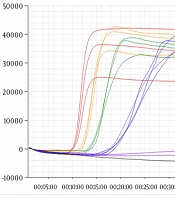
A total of 10 LAMP primer sets were prepared, with 9 sets (sets 1 and 3 - 10) targeting the matrix (M) gene and 1 set (set 2) specific to the HA gene of IAV (Table 1 in Supplementary File). Using prepared IAV genome RNA standards as templates (H1N1, 1,351 copies; H3N2, 1,688 copies), we systematically assessed the amplification efficiency of all 10 LAMP primer sets in the real-time RT-LAMP assay. The results showed that, for H1N1 amplification, only 2 of the 10 primer sets demonstrated efficient amplification kinetics and reached the plateau phase within 40 minutes; set 6 (S6) amplified faster than set 9 (S9), and both targeted the M gene (Figure 1A). Similarly, for H3N2 amplification, 4 of the 10 primer sets (S2, S4, S6, and S9) demonstrated efficient amplification within the 40-minute threshold; all targeted the M gene except set 2. Primer set 6 (S6) also demonstrated the fastest amplification performance (Figure 1B). Therefore, LAMP primer set 6 (S6), which targets the matrix protein gene of IAV, was identified as the most efficient set for detecting both H1N1 and H3N2 and was subsequently used in the RT-LAMP assay.
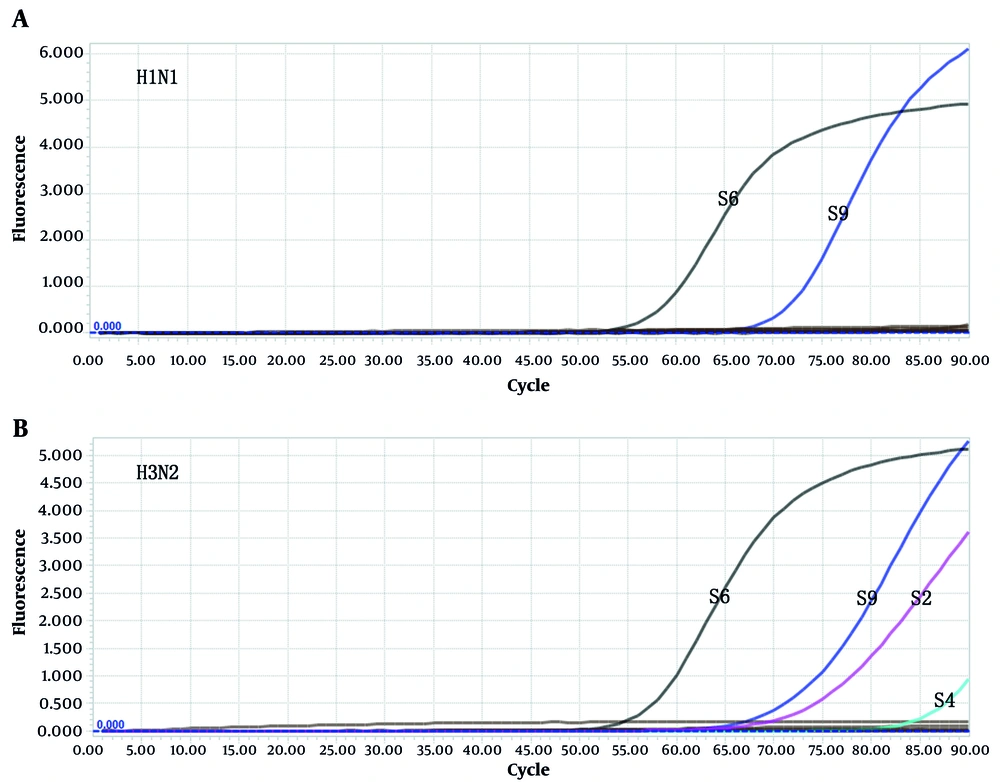
Figure 1.
Comparison of the performance of real-time RT-LAMP assay with different LAMP primer sets using IAV subtypes H1N1 (A) and H3N2 (B) genome RNA as templates. The x-axis shows reaction time (minutes); amplification curves represent fluorescence intensity over 45 minutes of isothermal incubation at 65°C, with fluorescence measured at 30-second intervals.
4.2. Direct Visual Detection of IAV by Colorimetric RT-LAMP
To develop a simplified colorimetric RT-LAMP detection system, HNB, a metal-ion indicator, was incorporated into the RT-LAMP reaction system and systematically evaluated. The color transition from violet to sky blue in reactions containing HNB confirmed successful amplification (8). Our results indicate that HNB is an effective chromogenic indicator for RT-LAMP, exhibiting distinct colorimetric transitions.
4.3. Analytical Sensitivity of the Real-Time and Colorimetric RT-LAMP Assays
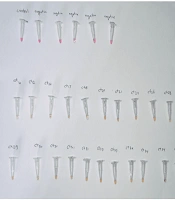
Serial dilutions of certified IAV RNA standards were analyzed by real-time and colorimetric RT-LAMP assays to determine analytical sensitivity (Table 1). The real-time RT-LAMP assay showed characteristic sigmoidal curves for all concentrations across the template concentration range from 1,351 to 13 copies per reaction for H1N1 and from 1,688 to 16 copies per reaction for H3N2 within 35 minutes (Figure 2A and 3A). In parallel, the HNB-RT-LAMP assays also showed positive reactions characterized by a color change across serial dilutions (Figure 2B and 3B). These findings indicate that the real-time and colorimetric RT-LAMP assays exhibited comparable sensitivity. The assay achieved preliminary sensitivity thresholds of 67 copies per reaction for H1N1 and 42 copies per reaction for H3N2. Notably, the real-time and colorimetric RT-LAMP assays outperformed conventional RT-LAMP platforms in terms of detection capability.
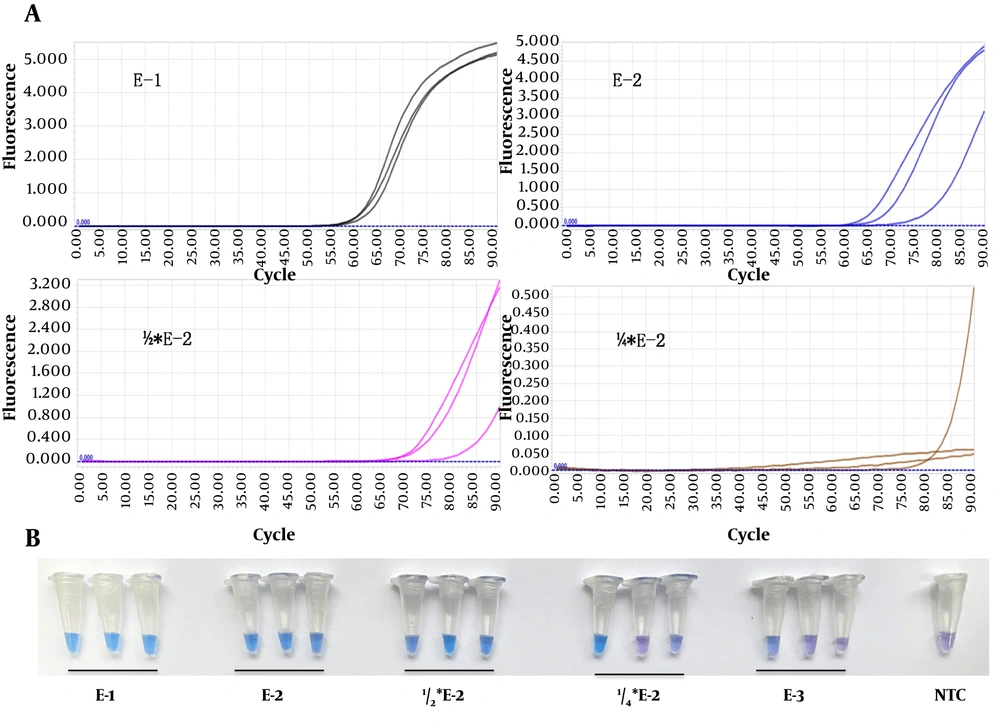
Figure 2.
Sensitivity tests of the real-time RT-LAMP (A) and colorimetric RT-LAMP (B) assays using serial dilutions of H1N1 genome RNA as templates. For the real-time RT-LAMP assay (A), the x-axis shows reaction time (minutes); amplification curves represent fluorescence intensity over 45 minutes of isothermal incubation at 65°C, with fluorescence measured at 30-second intervals. For the colorimetric RT-LAMP assay (B), reactions were performed under isothermal conditions at 65°C for 45 minutes.
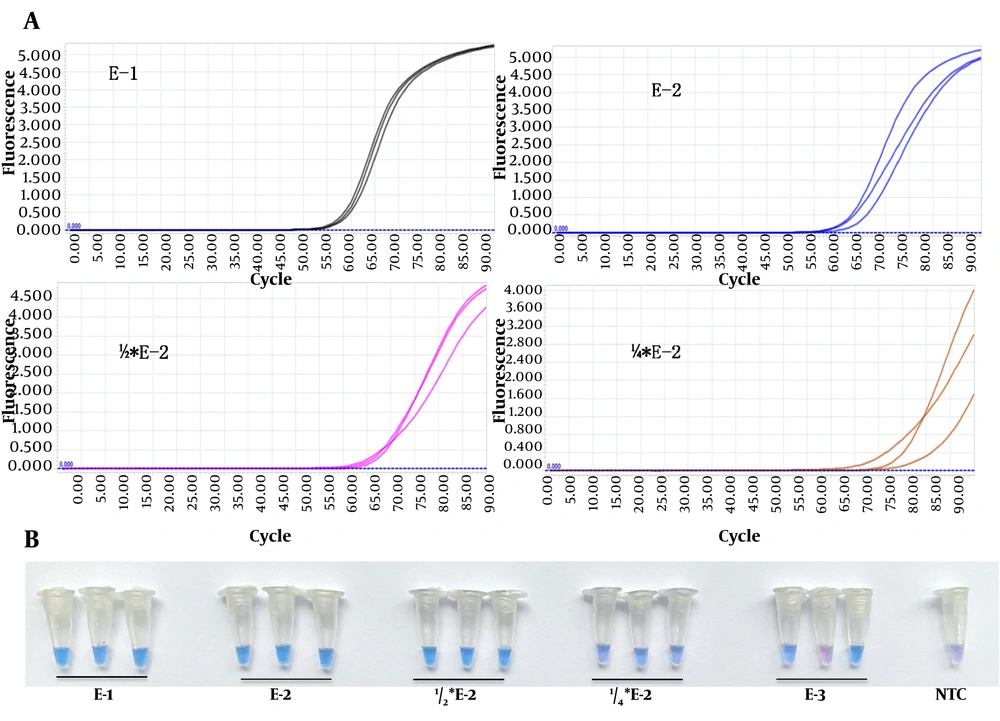
Figure 3.
Sensitivity tests of the real-time RT-LAMP (A) and colorimetric RT-LAMP (B) assays using serial dilutions of H3N2 genome RNA as templates. For the real-time RT-LAMP assay (A), the x-axis shows reaction time (minutes); amplification curves represent fluorescence intensity over 45 minutes of isothermal incubation at 65°C, with fluorescence measured at 30-second intervals. For the colorimetric RT-LAMP assay (B), reactions were performed under isothermal conditions at 65°C for 45 minutes.
4.4. Specificity Evaluation of the Real-Time and Colorimetric RT-LAMP Assays
First, prior research has extensively validated the specificity of all 10 primer sets, demonstrating consistent target recognition without cross-reactivity (10-20). Second, in silico analysis using the NCBI Influenza Virus BLAST tool demonstrated high conservation of all 6 primers in primer set 6 across human IAV isolates (Table 1 in Supplementary File). Third, the RT-LAMP assay demonstrated high specificity, with amplification signals detected exclusively in reactions containing H1N1 and H3N2 RNAs as templates. No cross-reactivity was observed with nucleic acid extracts of other respiratory pathogens, as validated in both the real-time (Figure 4A) and colorimetric (Figure 4B) RT-LAMP assays using RNA from clinical samples confirmed as positive. Collectively, these results demonstrate that both the real-time and colorimetric RT-LAMP assays exhibit high specificity for IAV detection.
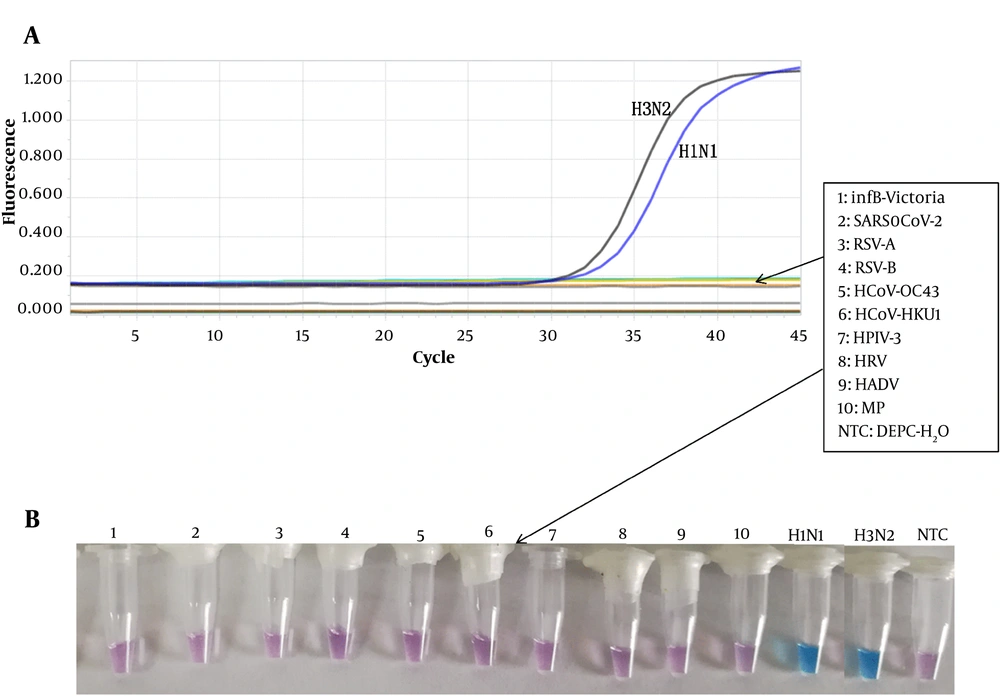
Figure 4.
Specificity tests of the real-time RT-LAMP (A) and colorimetric RT-LAMP (B) assays using seasonal IAV RNA (H1N1 and H3N2, tested separately) and nucleic acid extracts from other respiratory pathogens as templates. For the real-time RT-LAMP assay (A), the x-axis shows reaction time (minutes); only reactions containing IAV RNA (H1N1 and H3N2) showed amplification within 45 minutes, with fluorescence measured at 60-second intervals. For the colorimetric RT-LAMP assay (B), reactions were performed under isothermal conditions at 65°C for 45 minutes.
5. Discussion
Seasonal influenza, mostly caused by IAV, primarily H1N1 and H3N2, undergoes continuous genetic mutation, resulting in novel variants that impose a global disease burden and complicate detection (22). In this study, the optimized RT-LAMP assays exhibited high sensitivity and specificity. The detection limit was estimated at 67 copies per reaction for H1N1 and 42 copies per reaction for H3N2 in preliminary sensitivity testing, and these values exceed those reported in some prior RT-LAMP studies (23). Importantly, the RT-LAMP assay described here targets the conserved M gene of IAV and therefore detects all IAV subtypes without differentiation. The H1N1- and H3N2-specific sensitivity data presented in this study were obtained from separate reactions using purified RNA from each subtype individually. Analytical specificity was rigorously evaluated using RNA extracts from positive clinical samples of other prevalent respiratory virus (10). The findings of the present study showed that exclusive amplification was observed only in reactions in which IAV RNA served as the template. This observation supports the exceptional specificity of the optimized RT-LAMP assays for detecting seasonal IAV.
Although cross-contamination poses a substantial challenge in conventional LAMP assays, both real-time and colorimetric RT-LAMP methods mitigate this risk through closed-tube detection systems (8). The colorimetric RT-LAMP assay enables visual interpretation without specialized instruments. Our data show that HNB provides a detection threshold comparable to that of SYBR Green I, unlike the compromised sensitivity observed with calcein (7). During the reaction, magnesium pyrophosphate formation causes HNB to shift from violet to sky blue, enabling clear visual interpretation (9). This closed-tube system also minimizes the cross-contamination risks common in conventional LAMP. To further optimize real-time RT-LAMP assays, we monitored amplification curves using fluorescent signals generated by SYBR Green I. Additionally, melting curve analyses were routinely performed after real-time RT-LAMP assays, providing a convenient approach for analyzing LAMP products. In this study, all RT-LAMP assays were conducted using real-time, colorimetric, or combined methods.
In most published studies, IAV target sequences have been obtained using 2 approaches: In vitro RNA transcription and PCR-based DNA amplification. RNA quantities and copy numbers were quantified after transcription. Subsequently, a series of diluted RNA standards was prepared and used as experimental templates. These procedures are technically complex, labor-intensive, and require substantial financial investment (8, 22). Moreover, sensitivity comparisons are unreliable because different procedures used by different laboratories were applied to prepare IAV RNA standards for sensitivity studies (8, 9). In this study, we used commercial IAV RNA standards for subtypes H1N1 and H3N2, with copy numbers determined by the supplier, allowing easy comparison and accurate assessment of the sensitivity of H1N1 and H3N2 RT-LAMP assays designed by different laboratories. Additionally, the use of commercial RNA standards quantified by digital droplet PCR yielded robust and reproducible data for sensitivity evaluation, enabling direct comparability with existing diagnostic platforms (21).
Although the LAMP primers used in this study were adopted from previously validated designs targeting conserved regions of IAV, the amplification results obtained here were inconsistent with those reported in earlier studies. A key distinction lies in the optimization of reaction conditions. Previous studies systematically optimized both temperature and magnesium ion concentrations, identifying specific values, such as 63°C and 8 mM, that maximized amplification efficiency, while also noting that higher Mg2+ levels could inhibit amplification or cause false-positive results (10). In contrast, our protocol applied a fixed temperature of 65°C without iterative optimization of ionic components, which may have limited reaction efficiency. Furthermore, the inclusion of guanidine hydrochloride (GdmCl) in some studies significantly enhanced detection sensitivity, particularly at lower template concentrations, whereas our assay followed standard buffer conditions without such enhancers (13). The order of reagent assembly has also been shown to influence LAMP performance and reduce primer-dimer formation; however, this variable was not examined in our experiments (12). Additionally, different sample preparation strategies may contribute to variation in amplification outcomes. For instance, heat lysis methods used elsewhere may have facilitated more efficient RNA release from viral particles, whereas our use of certified RNA standards diluted in a commercial buffer may have introduced inhibitory effects that were not mitigated by further optimization (15). Collectively, these differences in experimental parameters, rather than the primer sequences themselves, likely contributed to the inconsistent amplification observed in our study (8, 9, 23).
5.1. Study Limitations
This study has certain limitations. First, this study represents the analytical evaluation phase of assay development. Although we established preliminary analytical sensitivity values of 67 and 42 copies per reaction for H1N1 and H3N2, respectively, and analytical specificity against a panel of respiratory pathogens, clinical validation remains to be completed. Future studies should evaluate the performance of the assay using respiratory clinical specimens (8). Second, the analytical sensitivity values of 67 copies for H1N1 and 42 copies for H3N2 represent preliminary limits of detection based on triplicate testing of reference RNA. Final limit-of-detection confirmation following Clinical and Laboratory Standards Institute guidelines would require testing 20 - 60 replicates at these concentrations across multiple runs to establish a 95% detection probability. Third, the assay targets the conserved matrix protein gene and uses SYBR Green for detection; therefore, any IAV subtype present will generate a positive signal, and the assay cannot provide subtyping information without additional subtype-specific assays. Finally, because amplification curves are presented in the RT-LAMP assay, detailed quantitative analysis of kinetic parameters, such as time-to-positivity values, and comprehensive reproducibility metrics were not the primary focus of this analytical evaluation. Future studies will prioritize a more in-depth characterization of these kinetic aspects.
5.2. Conclusions
In conclusion, this study represents the analytical development and optimization phase of a colorimetric RT-LAMP assay targeting seasonal IAV. The promising results reported here provide a strong foundation for subsequent clinical validation studies. Only after successful clinical validation can this assay be considered suitable for POCT deployment for IAV screening.