
1. Background
Antimicrobial resistance (AMR) is a longstanding and critical challenge in modern medicine and public health. Decades of progress in managing infectious diseases are threatened by the increasing incidence of resistant pathogens, posing a substantial risk to global health (1). Antibiotic overuse and misuse have accelerated the emergence of resistant bacterial strains, rendering many previously effective therapies ineffective (2). Moreover, bacterial biofilms, which are dense colonies attached to surfaces and embedded in a protective matrix, further complicate treatment. Because the biofilm structure confers substantial resistance to antimicrobial agents and the host immune system, biofilm-associated illnesses are extremely difficult to treat. These infections increase the burden of AMR and are notoriously challenging to manage, frequently resulting in chronic and recurrent infections (3).
As an alternative to conventional antibiotic monotherapy, this study investigated the combined use of a plant extract and an antibiotic. Aqueous licorice extract was combined with fosfomycin to determine its efficacy against E. coli. Licorice extract, derived from the roots of licorice (Glycyrrhiza glabra), has long been recognized for its medicinal properties in traditional medicine (4). Licorice contains bioactive compounds such as glycyrrhizin and flavonoids and has demonstrated antimicrobial activity against a wide range of pathogens, including bacteria and fungi (5). These compounds have been shown to disrupt microbial cell membranes, prevent biofilm formation, and interfere with key microbial enzymes (6). Licorice extract is increasingly being investigated as an adjunct to antimicrobial therapy because of its natural origin and therapeutic potential (7).
Fosfomycin is a broad-spectrum antibiotic with a distinctive mechanism of action. It blocks the initial stage of bacterial cell wall formation by inhibiting the enzyme MurA (8, 9). Fosfomycin has attracted interest because of its ability to penetrate biofilms and its low toxicity profile, particularly for the treatment of urinary tract infections and other resistant infections (10, 11). Its distinct mechanism of action also makes it a candidate for combination therapy to enhance antimicrobial efficacy while reducing the development of resistance (12). Several studies have reported synergistic effects of plant extracts and antibiotics in inhibiting bacterial growth. For example, Terminalia chebula extract at 50 μg/mL combined with cefixime at 15 μg/mL inhibited the growth of E. coli (13). Salvia officinalis extract combined with amoxicillin has also shown partial synergistic effects based on FICI interpretation (14).
2. Objectives
This integrative approach aims to enhance antimicrobial efficacy, reduce the required antibiotic dosage, and potentially mitigate the development of antibiotic resistance. Accordingly, this study aimed to evaluate the combined effects of an aqueous licorice extract and fosfomycin on the growth of E. coli.
3. Methods
3.1. Microorganisms, Growth Media, and Culture Conditions
The E. coli strain used was ATCC 53498. The isolate was routinely grown on Luria-Bertani (LB) agar. E. coli was streaked from an approximately 25% glycerol stock onto LB agar and incubated overnight at 37°C. Subsequently, a distinct single colony was selected from a fresh agar plate, transferred into 5 mL of sterile LB broth, and incubated on an orbital shaker (180 rpm) for 24 hours.
3.2. Preparation of Licorice Solution and Fosfomycin
Licorice roots cultivated in Guangzhou, China, were obtained from a traditional medicine shop in Kuala Lumpur, Malaysia. To prepare the aqueous extract, 300 g of dried roots were weighed and soaked in 1.2 L of deionized water in a beaker, which was then heated in a water bath maintained at 100 °C for 30 minutes. After cooling to room temperature, the preparation was left for 24 hours before filtration. This extraction procedure was repeated under the same conditions until the solution became colorless. The filtrates were then collected and freeze-dried. The overall yield was recorded, and the dried extract was stored in a desiccator until further use. A stock solution of licorice extract (1000 mg/mL) was prepared by dissolving 1000 mg of dried extract in 1 mL of sterile distilled water. Fresh stock solutions were prepared before each experiment. Fosfomycin powder (TargetMOI) was dissolved in sterile distilled water to prepare a 10 mg/mL stock solution. For each experimental run, a fresh fosfomycin solution was prepared at a final concentration of 400 µg/mL.
3.3. Checkerboard Assay
The interaction between licorice and fosfomycin was evaluated using Mueller-Hinton broth (MHB) as the diluent. Two-fold serial dilutions of licorice were prepared to final concentrations ranging from 250 mg/mL to 0.98 mg/mL, and fosfomycin was prepared to final concentrations ranging from 100 µg/mL to 1.56 µg/mL in a U-bottomed 96-well plate. Two-fold serial dilutions of fosfomycin were prepared vertically along rows A-H, whereas two-fold serial dilutions of licorice extract were prepared horizontally along columns 1 - 8. Each well therefore contained a unique combination of both agents. Subsequently, the E. coli inoculum was prepared, and 0.1 mL of bacterial suspension was added to each well to obtain a final inoculum of 5 × 10⁵ colony-forming units (CFU)/mL. The negative control contained MHB, and the growth control contained only E. coli and MHB. The plate was then incubated overnight at 37°C under aerobic conditions. After incubation, the plate was examined visually, and the MICs of licorice, fosfomycin, and licorice/fosfomycin in combination were recorded (15). The interaction was determined using fractional inhibitory concentration (FIC) index calculations.
Where:
FIC is the fractional inhibitory concentration.
MIC is the minimum inhibitory concentration.
The sum of the FIC values (ΣFIC) was used to interpret the interaction between the agents (16):
1) ΣFIC < 0.5 indicates synergy.
2) 0.5 < FICI < 1 indicates partial synergy.
3) 1 < FICI < 4 indicates indifference.
4) ΣFIC > 4 indicates antagonism.
For this study, the observed FICI of 1 was interpreted as indifferent, in accordance with the operator-confirmed manuscript interpretation.
3.4. Time-Kill Assay
The time-kill assay was performed using the MIC concentrations of licorice (62.5 mg/mL) and fosfomycin (12.5 µg/mL) and the FIC combination of licorice/fosfomycin (31.25 mg/mL/6.25 µg/mL). A volume of 0.05 mL of each preparation was transferred into sterile tubes, and 0.05 mL of inoculum at 5 × 10⁵ CFU/mL was added. The tubes were incubated at 37°C under aerobic conditions. Samples were aseptically removed at 0, 4, 8, 16, 20, and 24 hours. At each time point, 0.1 mL from each tube was plated onto sterile LB plates and incubated at 37 °C for 24 hours. After incubation, colonies on the plate surfaces were counted (15).
3.5. Antibiofilm Assay
This assay evaluated the effects of fosfomycin, licorice, and fosfomycin/licorice combinations on E. coli biofilm production. Two stages of biofilm development were examined: biofilm attachment inhibition (T0) and disruption of preformed biofilm after 24 hours (T24). The E. coli inoculum was prepared in tryptone soy broth (TSB) (17). Each condition was tested in triplicate wells and repeated across independent experiments.
3.5.1. Biofilm Inhibition Assay
The assay was performed by adding 0.1 mL of E. coli inoculum at 5 × 10⁵ CFU/mL to each well of a sterile flat-bottomed 96-well plate. Wells were then assigned to different treatment groups (0.1 mL), including licorice extract alone (62.5 mg/mL), fosfomycin alone (12.5 µg/mL), and their combinations at 2 × FIC, FIC, and 1/2 × FIC concentrations. Untreated wells containing bacterial inoculum without antimicrobial agents served as growth controls, whereas wells containing broth only without bacterial inoculum served as sterility controls. Biofilm was allowed to form in the presence of the treatment. The 96-well plate was incubated for 24 hours at 37°C without shaking. Crystal violet staining was then performed (17).
3.5.2. Preformed Biofilm Disruptor Assay
The assay was performed by adding 0.1 mL of E. coli inoculum at 5 × 10⁵ CFU/mL to each well of a sterile flat-bottomed 96-well plate and incubating for 24 hours at 37°C. Subsequently, 0.1 mL of licorice extract alone (62.5 mg/mL), fosfomycin alone (12.5 µg/mL), or their combinations at 2 × FIC, FIC, and 1/2 × FIC concentrations was added to the wells. Untreated wells containing bacterial inoculum without antimicrobial agents served as growth controls, whereas wells containing broth only without bacterial inoculum served as sterility controls. The 96-well plate was incubated for 24 hours at 37°C without shaking. Crystal violet staining was then performed (17).
3.5.3. Crystal Violet Staining
After incubation, the wells were washed three times with sterile distilled water and oven-dried at 60 °C for 45 minutes. Cells were fixed with 150 µL of 96% methanol for 15 minutes and then stained with 0.1% crystal violet for 20 minutes. Excess stain was washed off, and the cells were dissolved in 150 µL of ethanol. Biofilm formation was measured at 590 nm using an ELISA reader (17, 18). The data were expressed as the percentage of inhibition using the equation below (17).
3.6. Statistical Analysis
Statistical analyses were performed using GraphPad Prism 10. A two-way ANOVA was performed for the time-kill assay, and a one-way ANOVA was performed for the biofilm inhibition assay. Tukey HSD post hoc testing was used to determine which specific treatment groups differed significantly.
4. Results
4.1. Checkerboard Assay
The checkerboard assay showed an indifferent interaction between aqueous licorice extract and fosfomycin, with an FICI of 1. The MICs of both agents were reduced when tested in combination compared with when tested individually. The licorice extract and fosfomycin concentrations corresponding to the indifferent interaction (FICI = 1) were 31.25 mg/mL and 6.25 µg/mL, respectively (Figure 1). This combination was selected as the primary outcome of the checkerboard assay and was subsequently used for the time-kill and biofilm assays.
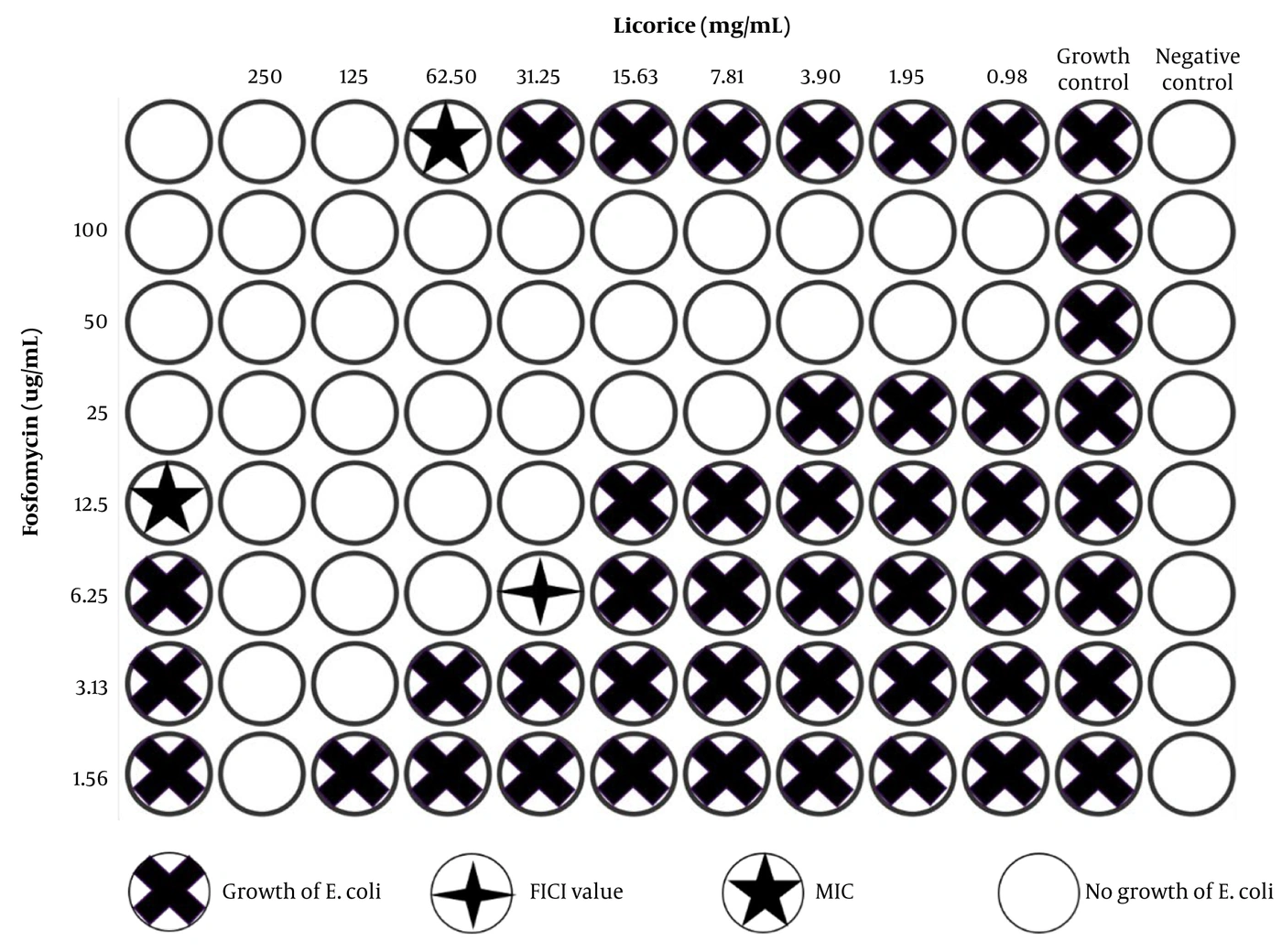
Figure 1.
Minimum inhibitory concentrations of licorice (62.5 mg/mL) and fosfomycin (12.5 µg/mL), and the FICI combination of licorice/fosfomycin (31.25 mg/mL/6.25 µg/mL).
4.2. Time-Kill Assay
The time-kill assay showed that both fosfomycin alone and its combination with licorice extract had bactericidal activity, with fosfomycin monotherapy producing a greater reduction in bacterial counts over time. Nevertheless, the combination completely reduced bacterial counts over 24 hours (Figure 2), indicating effective killing. Although the in vitro combined effect was not superior to fosfomycin alone, the combination concentration remained effective in inhibiting bacterial growth.
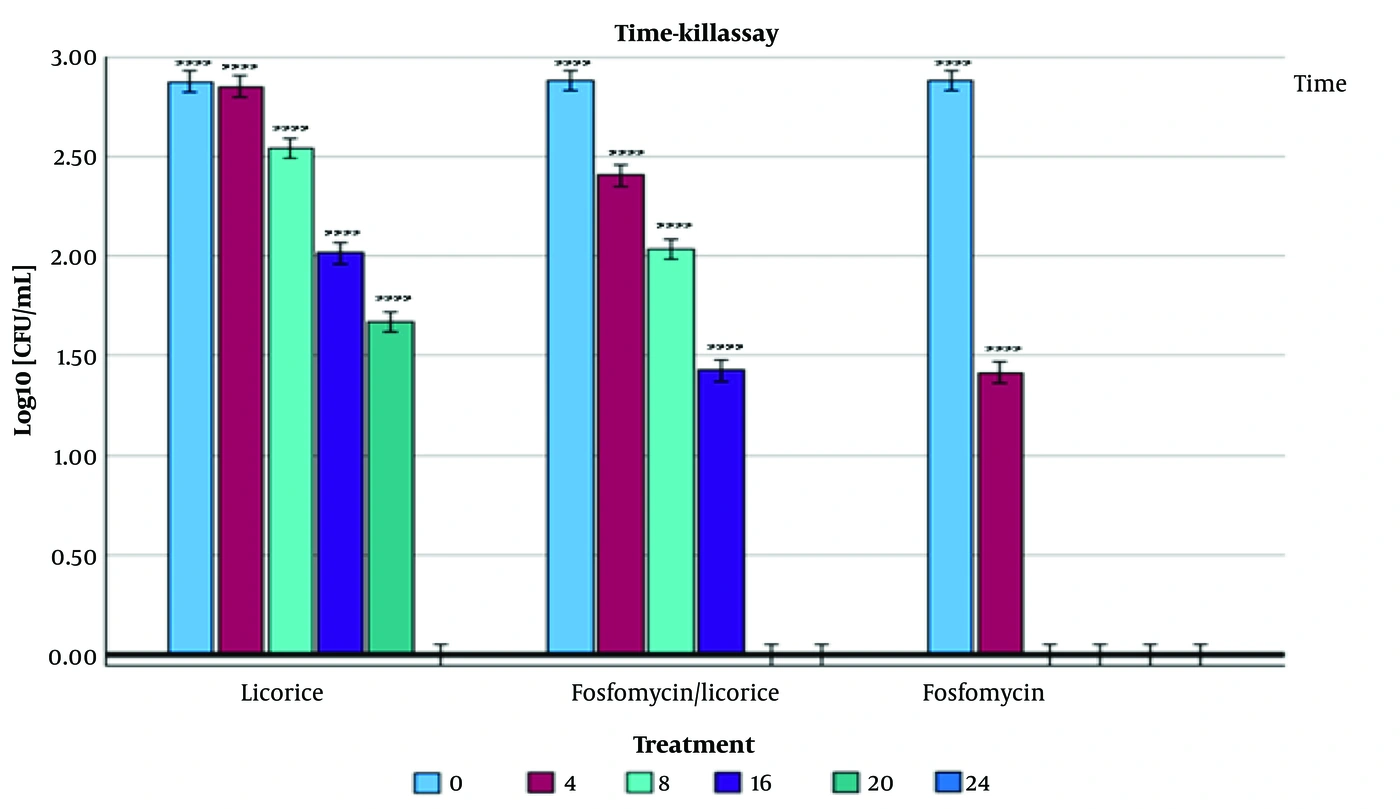
Figure 2.
Mean values with SEM of bacterial colonies (log10CFU/mL) for licorice/fosfomycin combined, licorice, and fosfomycin obtained from three separate biological replicates. **** indicates a statistically significant difference (P < 0.0001) compared with the 24-hour time point within each treatment group. Error bars represent standard deviation.
4.3. Biofilm Activity
For the biofilm inhibition assay, all tested licorice/fosfomycin combination concentrations produced more than 50% biofilm inhibition (Figure 3), indicating biofilm-inhibitory activity.
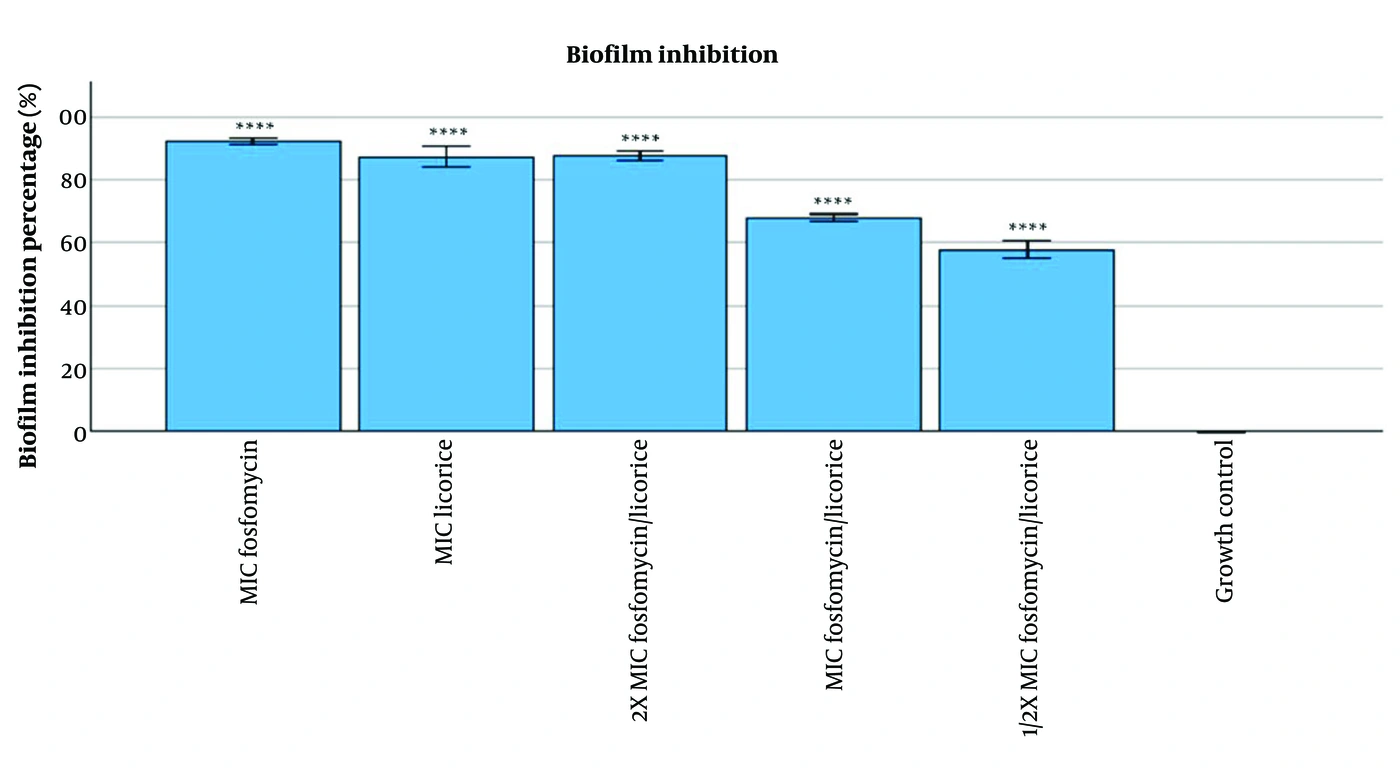
Figure 3.
Mean values with SEM of the percentage of biofilm inhibition for licorice/fosfomycin combined, licorice, and fosfomycin obtained from three separate biological replicates. **** indicates a statistically significant difference (P < 0.0001) compared with the growth control group. Error bars represent standard deviation.
For the preformed biofilm eradication assay, neither licorice nor fosfomycin effectively inhibited biofilm attachment, either alone or in combination at the tested concentrations, as shown by 0% inhibition under all test conditions. Based on these findings, L29A CFS, fosfomycin, and the combined licorice/fosfomycin treatment were not appropriate for eradicating preformed biofilms at the concentrations used in this investigation. Licorice, fosfomycin, and all tested licorice/fosfomycin combinations exhibited 0% biofilm inhibition, indicating poor activity as preformed biofilm eradicators.
5. Discussion
The checkerboard result was interpreted as indifferent at FICI = 1. Similar observations have been reported in studies of plant extract–antibiotic combinations. Terminalia chebula extract at 50 μg/mL combined with cefixime at 15 μg/mL inhibited the growth of E. coli, although the cited study interpreted its FICI value of 1 as partial synergy (13). Salvia officinalis extract combined with amoxicillin has also been reported to show partial synergistic effects based on FICI interpretation (14).
The time-kill findings indicate that the licorice/fosfomycin combination was bactericidal over 24 hours, although it was not superior to fosfomycin monotherapy. Similarly, Nigella sativa ethyl acetate extract combined with cefixime inhibited the growth of E. coli over 24 hours (13).
The assessment of antibiofilm activity is an important component of antimicrobial research because biofilm-associated resistance poses a substantial problem in clinical settings (17). Chatupheeraphat et al. (19) reported that K11 increased activity against 2 multidrug-resistant (MDR)/extensively drug-resistant (XDR) strong-biofilm-producing K. pneumoniae isolates when combined with meropenem, chloramphenicol, or rifampicin. The effectiveness of K11 in preventing biofilm formation was considerably higher when combined with a specific antibiotic than when K11 or the antibiotic was used alone, suggesting that antibiotic combinations may enhance biofilm-inhibitory activity against MDR/XDR K. pneumoniae (19).
Similar findings for preformed biofilms were reported by Fugaban et al. (20), who found that the biofilm-eradication activity of semipurified enterocins produced by strains ST651ea, ST7119ea, and ST7319ea combined with vancomycin required higher antimicrobial concentrations than those needed to prevent biofilm formation in L. monocytogenes protected within biofilms (20).
5.1. Conclusions
The combination of fosfomycin and aqueous licorice extract showed antimicrobial activity against E. coli under in vitro conditions. The checkerboard assay indicated an indifferent interaction (FICI = 1), and no strong synergistic interaction was observed. Nevertheless, the combination showed bactericidal activity over 24 hours and inhibited biofilm formation at the tested concentrations. Further studies involving additional bacterial isolates, extract standardization, and in vivo validation are necessary before potential clinical applications can be considered. These findings support continued investigation of plant–antibiotic combinations as part of broader efforts to develop more efficient and sustainable antimicrobial treatments.