
1. Background
Coronavirus disease 2019, caused by SARS-CoV-2, was first identified in December 2019 in Wuhan, China, and subsequently became a global pandemic and a major public health problem (1). By December 6, 2022, more than 641 million confirmed COVID-19 cases and 6.6 million deaths had been recorded worldwide. SARS-CoV-2 infection has a broad clinical spectrum, ranging from asymptomatic infection to severe acute respiratory disease (2). Most patients with COVID-19 are asymptomatic or have mild symptoms; however, some develop acute respiratory distress syndrome (ARDS) (3). Multiple studies have indicated that several factors contribute to COVID-19 mortality (4). Among the proposed cofactors, alterations in the renin-angiotensin system (RAS) have been considered important genetic contributors to COVID-19 pathogenesis (5).
Two key enzymes in the RAS, angiotensin-converting enzyme 1 (ACE1) and angiotensin-converting enzyme 2 (ACE2), are essential for regulating blood pressure and fluid and electrolyte balance and may contribute to COVID-19 development (5, 6). ACE1 and ACE2 have opposing effects, and an imbalance between them plays an important role in cardiovascular disease and hypertension (7). ACE2 functions as the receptor for the SARS-CoV-2 spike protein and facilitates viral entry into human cells (8). The interaction between the spike protein and ACE2 disrupts normal ACE2 activity because the high-affinity binding of the spike protein to ACE2 may antagonize angiotensin II (9). Downregulation of the protective ACE2/angiotensin 1 pathway and pathological upregulation of the ACE/angiotensin II pathway lead to vasoconstrictive and inflammatory responses that may adversely affect COVID-19 progression (10). Because ACE1 and ACE2 contribute to COVID-19 pathogenesis, several studies have evaluated the effects of their genetic variants on SARS-CoV-2 infection and susceptibility to COVID-19 (11). The ACE I/D polymorphism affects enzyme function and may be important in COVID-19 development (12).
Several ACE polymorphisms may affect ACE function, including the ACE2 G8790A polymorphism (rs2285666) in intron 3 and the ACE1 I/D polymorphism rs4646994 (13, 14). Yamamoto et al. comprehensively discussed the importance of these polymorphisms (15). A recent study indicated that ACE1 rs4646994 and ACE2 rs2285666 polymorphisms were associated with COVID-19 severity (16). ACE1 rs4646994 is an I/D polymorphism associated with increased enzyme activity and concentration (17). Patients with the DD genotype have the highest blood ACE levels, which may be associated with an increased risk of cardiovascular and respiratory diseases (18). Another study showed that individuals with the D allele and DD genotype had a higher risk of severe COVID-19 than those with the DI and II genotypes (19).
2. Objectives
Given the potential importance of ACE1 polymorphisms in COVID-19 progression, this study evaluated ACE I/D polymorphisms among patients with COVID-19. Although this association has been investigated internationally and in a limited number of Iranian cohorts, findings remain inconsistent across populations. Therefore, this study aimed to provide additional evidence from a distinct Iranian cohort in Khomein City, Iran, to help clarify this ongoing debate.
3. Methods
3.1. Patients and Inclusion Criteria
This cross-sectional study included 80 patients with COVID-19 and 20 healthy controls from Khomein City, Iran. Patients were divided into 2 severity groups of 40 participants each. Severe COVID-19 was defined by O2 saturation < 90%, radiological features of COVID-19 pneumonia, admission to the intensive care unit, or intubation. Outpatients with O2 saturation > 90% were classified as having mild COVID-19. This classification was broadly consistent with internationally recognized COVID-19 severity criteria, including those proposed by the World Health Organization and the National Institutes of Health. SARS-CoV-2 infection was confirmed by real-time polymerase chain reaction in all included patients. Written informed consent was obtained before sampling. The study was conducted in accordance with the Declaration of Helsinki and was reviewed by Khomein University of Medical Sciences, Khomein, Iran (ethical code: IR.KHOMEIN.REC.1400.011). Peripheral blood was collected from each participant into a 5-mL ethylenediaminetetraacetic acid tube and used for DNA extraction.
3.2. DNA Extraction
DNA was extracted from whole blood using the DNsol kit (Roje, Iran) according to the manufacturer's protocol. DNA quality was evaluated by NanoDrop spectrophotometry, and samples with a 260/280-nm absorbance ratio > 1.6 were retained for further analysis. Extracted DNA was stored at -20°C before polymerase chain reaction.
3.3. Polymorphism Evaluation
The insertion/deletion of a 287-base-pair sequence in intron 16 of the ACE gene was evaluated as previously described (20). Polymerase chain reaction primers were obtained from the study by Alvarez et al. (20). These primers amplified the ACE sequence and differentiated the D and I alleles based on electrophoretic band size. The 490-bp band represented the I allele, and the 190-bp band represented the D allele. Accordingly, the expected genotypes were DD and II homozygotes and DI heterozygotes. These primers were selected because they enabled rapid identification of the D and I alleles using conventional polymerase chain reaction without complementary methods such as Sanger sequencing. However, this single-round polymerase chain reaction strategy is susceptible to preferential amplification of the smaller D allele, which may lead to mistyping heterozygous I/D samples as DD homozygotes. A confirmatory insertion-specific polymerase chain reaction or Sanger sequencing step, which was not performed in this study, is generally recommended to exclude this bias; therefore, this is an important methodological limitation of the genotyping approach. The thermal cycling program comprised an initial denaturation for 10 minutes at 95°C, followed by 40 cycles of 15 seconds at 95°C, 1 minute at 58°C, and 30 seconds at 72°C, and a final extension for 5 minutes at 72°C. Polymerase chain reaction products were visualized by electrophoresis on a 1% agarose gel.
3.4. Statistical Analysis
Statistical analyses were performed using SPSS version 22 (IBM Corp), and P < 0.05 was considered statistically significant. Associations between ACE genotypes (DD, II, and DI) and COVID-19 severity (mild or severe) were evaluated using the chi-square test and Spearman correlation. Both genotype frequencies (II, DI, and DD) and the corresponding allele frequencies (I and D), derived from the observed genotype counts, were examined. Hardy-Weinberg equilibrium in the healthy control group was assessed using a chi-square goodness-of-fit test. No a priori sample size or statistical power calculation was performed; consequently, a type II error due to the limited sample size cannot be excluded. Potential confounders, including age, sex, diabetes, hypertension, and cardiovascular disease, were not adjusted for using multivariable regression analysis; therefore, the unadjusted associations should be interpreted with this limitation in mind.
4. Results
4.1. Demographic and Clinical Data
Among the patients, 54 (67.5%) were male and 26 (32.5%) were female. The mean age was 54 ± 17 years, and diabetes was the most common underlying disorder. Demographic characteristics and underlying disorders are presented in Table 1.
Table 1.
Demographic Characteristics and Underlying Disorders in the Evaluated Patients a
| Variables and Groups | Value | P-Value |
|---|---|---|
| Age, y | 0.300 | |
| Severe | 55 ± 17 | |
| Mild | 52 ± 18 | |
| Gender | 0.060 | |
| Severe | ||
| Male | 33 | |
| Female | 7 | |
| Mild | ||
| Male | 21 | |
| Female | 19 | |
| Diabetes | 0.080 | |
| Severe | 9 | |
| Mild | 4 | |
| Hypertension | 0.089 | |
| Severe | 8 | |
| Mild | 2 | |
| Chronic kidney disorders | 0.030 | |
| Severe | 3 | |
| Mild | 1 | |
| Chronic pulmonary disorders | 0.200 | |
| Severe | 1 | |
| Mild | 0 | |
| Cardiovascular disorders | 0.090 | |
| Severe | 5 | |
| Mild | 2 |
a Values are expressed as mean ± SD or number.
4.2. Polymorphism Evaluation
Among the patients, 20 (25%) had the ACE II genotype, 47 (58.7%) had the ACE DI genotype, and 13 (16.2%) had the ACE DD genotype (Figure 1). Among the healthy controls, 4 (20%) had the DD genotype, 8 (40%) had the DI genotype, and 8 (40%) had the II genotype. The genotype distribution in the healthy control group did not significantly deviate from Hardy-Weinberg equilibrium (χ2 = 0.56; df = 1; P = 0.46), supporting the validity of the genotyping approach in this reference population. Statistical analysis showed no significant association between ACE alleles and COVID-19 severity (P > 0.05). No significant differences in ACE alleles were observed between patients with COVID-19 and healthy controls (P > 0.05). ACE genotype distributions are summarized in Table 2. Furthermore, the ACE I/D genotype was not significantly associated with any underlying disorder, except cardiovascular disease (P = 0.01).
Table 2.
ACE I/D Genotypes in Patients with Severe or Mild COVID-19 and Healthy Controls a
| COVID-19 Severity and ACE Genotype | Prevalence | P-Value |
|---|---|---|
| Severe | 0.53 | |
| I | 13 (32.5) | |
| D/I | 21 (52.5) | |
| D | 6 (15.0) | |
| Mild | 0.53 | |
| I | 7 (17.5) | |
| D/I | 26 (65.0) | |
| D | 7 (17.5) | |
| Healthy controls | 0.21 | |
| I | 8 (40.0) | |
| D/I | 8 (40.0) | |
| D | 4 (20.0) |
a Values are expressed as No. (%).
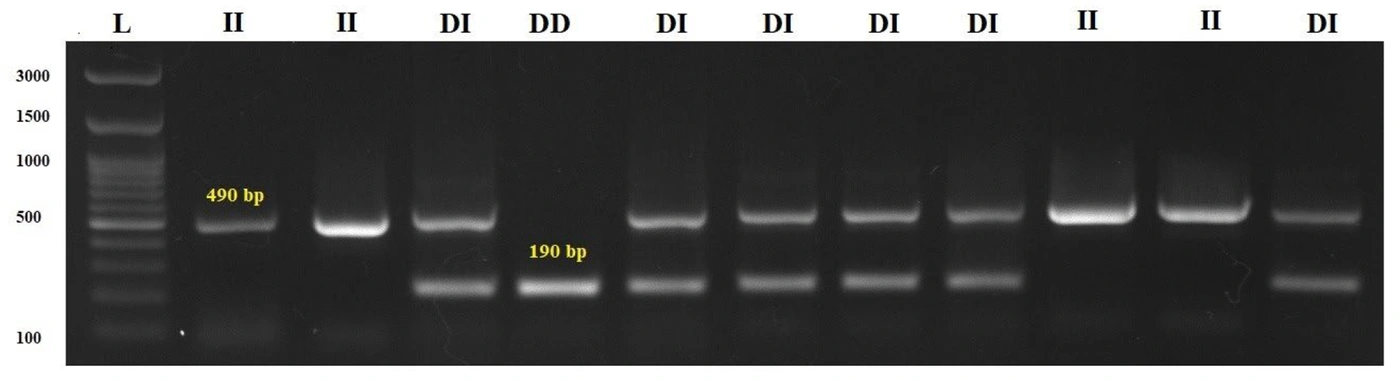
Figure 1.
ACE D, DI, and I Alleles in Patients with COVID-19. The ACE I allele is represented by a 490-bp band, whereas the D allele is represented by a 190-bp band. DD and II homozygotes and DI heterozygotes are shown. L indicates the DNA ladder. This representative gel image illustrates the electrophoretic band patterns underlying the genotype calls; the corresponding quantitative genotype distribution is summarized in Table 2.
5. Discussion
In this cross-sectional study, we assessed the potential relationship between the ACE I/D polymorphism and COVID-19 severity. This exploratory analysis showed no significant association between genotypes or alleles and COVID-19 severity; however, this negative finding should be considered preliminary because of the limited sample size and lack of adjustment for confounders. Gómez et al. reported a higher frequency of the DD genotype among patients with severe COVID-19 than among those with mild disease (21). In a meta-analysis, Abdul Aziz et al. reported that the ACE1 I/D rs1799752 and ACE2 rs2285666 genetic variants may increase the severity of SARS-CoV-2 infection and recommended future studies including diverse ethnic groups and related genetic polymorphisms to establish a robust relationship between COVID-19 severity and genetic variation (22). Several other studies reported associations between the ACE1 I/D rs1799752 polymorphism and COVID-19 comorbidities, including hypertrophic cardiomyopathy, obesity, hypertension, and myocardial infarction (7, 23-25).
Mir et al. reported that the ACE genotype was associated with COVID-19 severity. They also found a significant association between the ACE2 DD genotype and COVID-19 mortality (26). Verma et al. indicated that, in addition to COVID-19 comorbidities such as hypertension, diabetes, and older age, the rs4646994 DD genotype might influence disease severity (27). In a systematic review and meta-analysis, Keikha and Karbalaei suggested that the ACE1 rs4646994 DD genotype may serve as a predictive biomarker of susceptibility to SARS-CoV-2 infection and severe COVID-19 outcomes. Racial differences in ACE polymorphisms have been discussed in several studies. Keikha and Karbalaei concluded that the rs4646994 DD genotype increased the risk of susceptibility to COVID-19 by approximately 1.7-fold among Asian populations, whereas the ACE2 rs2285666 GG variant increased the risk of ARDS among Western populations (28).
Other studies have indicated that D-allele frequency may vary by race. A high D-allele frequency among African American and European populations may be associated with higher mortality than that observed among Asian, White, and Indian populations (29). Potentially fatal complications of SARS-CoV-2 infection, such as acute pulmonary embolism, may also be influenced by the DD genotype (30, 31). In contrast, both heterozygous and homozygous forms of the I allele have been associated with lower infection and mortality rates (31). Countries with fewer COVID-19 cases and deaths have shown a higher frequency of the ACE II genotype. Asian populations, which had lower COVID-19 morbidity and mortality, showed a higher II genotype frequency than European and African populations (32, 33). A study conducted in Turkey was consistent with our results and found no association between the ACE1 I/D polymorphism and COVID-19 severity (34). In a cross-sectional study, Faridzadeh et al. found that the risks of intubation and mortality among patients with COVID-19 were inversely correlated with the frequency of the ACE1 DD genotype (35).
Faridzadeh et al. reported significantly lower ACE1 D-allele and DD-genotype frequencies among patients admitted to the intensive care unit and among intubated patients and those who died in an Iranian population. They also observed that the ACE I/D polymorphism may alter C-reactive protein, interleukin 6, and ACE expression levels (35). These findings conflict with those of the present study. Differences in the evaluated populations and geographic variation may explain the inconsistency. Together with the differing findings reported by Soltani Rezaiezadeh et al. and Faridzadeh et al., our results indicate that the relationship between the ACE1 I/D polymorphism and COVID-19 severity remains unresolved, even within the Iranian population. This study extends the literature by providing data from a previously unstudied regional cohort in Khomein City and underscores the need for larger multicenter studies in Iran (19, 35).
A recent systematic review and meta-analysis identified a significant association of ACE1 I/D rs1799752/rs4646994 with susceptibility to SARS-CoV-2 infection but, consistent with our results, found no association between this genetic variant and COVID-19 severity. The meta-analysis also reported associations of ACE2 rs2285666, rs2106809, and rs2074192 with an increased risk of severe COVID-19 (36). In the present study, 80 patients with mild or severe COVID-19 and 20 healthy controls were evaluated for ACE alleles. Among the patients, 54 (67.5%) were male, and diabetes was the most common underlying disorder. The ACE I/D evaluation showed a high prevalence of the DI genotype: 20 (25%) patients had the II genotype, 47 (58.7%) had the DI genotype, and 13 (16.2%) had the DD genotype. Statistical analysis showed no significant association of ACE alleles with COVID-19 severity or differences between patients and healthy controls (P > 0.05). Furthermore, ACE genotype was significantly associated with cardiovascular disease (P = 0.01).
5.1. Study Limitations
The major limitations of this study were the small numbers of patients and controls and the absence of an a priori sample size or power calculation. Potential confounders, including age, sex, diabetes, hypertension, and cardiovascular disease, were not adjusted for using multivariable regression; therefore, residual confounding cannot be excluded. The healthy control group was not comprehensively characterized with respect to confirmation of negative SARS-CoV-2 polymerase chain reaction results, the absence of previous COVID-19, or explicit matching to cases by age, sex, and comorbidities. These factors should be clarified in future research to improve group comparability. Accordingly, the predominantly negative findings should be regarded as preliminary rather than conclusive evidence against an association between the ACE I/D polymorphism and COVID-19 severity.
The observed ACE allele frequencies cannot be generalized to the Iranian population with or without COVID-19. Another limitation was the lack of evaluation of ACE2 alleles or polymorphisms. Several studies recommend using a complementary primer in polymerase chain reaction to increase sensitivity (37, 38). Sanger sequencing may also improve the sensitivity or specificity of ACE polymorphism assessment. In addition, only ACE I/D alleles were evaluated, although numerous other ACE polymorphisms have been described; however, these polymorphisms reportedly have a low prevalence (21). Future studies should include larger samples from diverse populations, use more accurate methods such as Sanger sequencing, and evaluate possible associations of ACE polymorphisms with demographic factors, real-time polymerase chain reaction cycle threshold values, and interleukin 6 status.
5.2. Conclusions
This study identified no differences in ACE I/D alleles among patients with severe COVID-19, patients with mild COVID-19, and healthy controls; other ACE polymorphisms were not evaluated. The presence of the DD genotype did not differ statistically between patients with COVID-19 and healthy controls (P > 0.05). Given the limited sample size, absence of an a priori power calculation, and lack of adjustment for potential confounders, these negative findings should be considered preliminary and do not rule out a true association between the ACE I/D polymorphism and COVID-19 severity.