
1. Background
Respiratory tract infections (RTIs) are among the most common infectious diseases worldwide. They cause a clinical spectrum ranging from asymptomatic infection to fatal disease in all age groups (1, 2). Upper respiratory tract infections are among the leading contributors to the global disease burden, with approximately 17 billion cases annually (3). Consistent with the global situation, RTIs are among the most common reasons for seeking care in primary and advanced healthcare institutions in Turkey (4, 5). Pathogen identification using broad molecular panels is not performed in primary care in Turkey. This advanced diagnostic procedure is mostly performed in tertiary hospitals. Owing to their molecular diagnostic capabilities, tertiary hospitals play a critical role in defining epidemiological patterns of both community-acquired and hospital-acquired infections. Data obtained from these centers provide important information about pathogen distribution, support clinical decision-making processes, and contribute to public health planning.
Following the COVID-19 pandemic, significant changes occurred in the circulation of respiratory pathogens. Pandemic measures, such as isolation and social distancing, reduced the circulation of classic pathogens, including influenza virus and respiratory syncytial virus (RSV). This created a temporary immunity gap for these agents (6). As these pathogens re-emerged after the pandemic, changes also occurred in their seasonal and age-related distributions (7).
In Turkey, influenza vaccination is administered annually to specific risk groups. Similarly, vaccination against Streptococcus pneumoniae is recommended for certain population groups. However, although routine vaccination programs are recommended for RSV and other viral and bacterial respiratory pathogens, they are not yet routinely implemented. Although COVID-19 vaccination has largely ceased, the risk persists because of declining community immunity and the emergence of new variants. This is particularly important for older adults and individuals with chronic illnesses. Therefore, reassessment of COVID-19 booster doses or targeted vaccination strategies remains important (8).
The data for this study were obtained from Erzurum City Hospital, which serves as a key healthcare facility for Turkey’s eastern region, neighboring provinces, and neighboring countries. Respiratory samples sent to the microbiology laboratory between 2024 and 2025 were retrospectively analyzed. This study aimed to define the spectrum of respiratory pathogens during the post-pandemic transition period and to describe their dynamics according to age group, sex, and season.
2. Objectives
This study aimed to provide evidence-based data to support the improvement or updating of national diagnostic strategies and vaccination programs.
3. Methods
3.1. Study Design and Sample Collection
This retrospective study was conducted at the Erzurum City Hospital Medical Microbiology Laboratory. Respiratory samples collected from patients with a preliminary diagnosis of acute respiratory tract infection between January 2024 and June 2025 were analyzed. The study population included individuals from all age groups who sought care at this tertiary center.
3.2. Molecular Pathogen Detection
Pathogen identification was performed using the Bio-Speedy® Respiratory Tract RT-qPCR MX-24 Panel (Bioeksen, Turkey). This multiplex real-time polymerase chain reaction (PCR)-based system allows simultaneous detection of a comprehensive range of viral and bacterial agents.
Bacterial targets: Streptococcus pneumoniae, Haemophilus influenzae, Mycoplasma pneumoniae, Legionella pneumophila, and Bordetella pertussis.
Viral targets: RSV, influenza viruses A and B, severe acute respiratory syndrome coronavirus 2 (SARS-CoV-2), adenovirus, bocavirus, human metapneumovirus (hMPV), parainfluenza viruses (PIV) 1 - 4, and coronaviruses 229E, NL63, OC43, and HKU1. Respiratory syncytial virus results were reported as combined RSV A/B.
Laboratory procedures: Total nucleic acid extraction and RT-qPCR amplification were performed according to the manufacturer’s validated protocols. The reactions were performed on CFX96 (Bio-Rad) real-time PCR platforms compatible with the Bio-Speedy® system.
3.3. Ethical Approval
Ethics committee approval was obtained from the Research Ethics Committee of Health Sciences Universty, Erzurum Faculty of Medicine on December 11, 2024, with approval number BAEK 2024/12-218. The study was conducted in accordance with Good Clinical Practice principles and the Declaration of Helsinki.
3.4. Statistical Analysis
All statistical analyses were performed using IBM SPSS Statistics for Windows, version 30.0. The distribution of continuous variables was assessed using the Kolmogorov-Smirnov test. Normally distributed data are expressed as mean ± standard deviation, whereas nonnormally distributed data are expressed as median and interquartile range (IQR). Categorical variables are presented as numbers (No.) and percentages (%). The Mann-Whitney U test was used for comparisons between 2 groups because the data were not normally distributed. The Pearson chi-square test and Fisher exact test were used to evaluate categorical variables. A P-value < 0.05 was considered statistically significant.
4. Results
The study included 3197 respiratory tract samples. The median age of the patients was 6 years (IQR, 2 - 20 years). Overall, 44.1% of the patients were female, and 55.9% were male. When the seasonal distribution was examined, 26.68% of the samples were collected in spring, 12.11% in summer, 22.87% in autumn, and 38.35% in winter (Table 1).
Table 1.
Sociodemographic Characteristics of the Study Population a
| Variables | Overall |
|---|---|
| Sample size | 3197 |
| Age | 6 [2 - 20] |
| Gender | |
| Female | 1410 (44.1) |
| Male | 1787 (55.9) |
| Season | |
| Spring | 853 (26.68) |
| Summer | 387 (12.11) |
| Autumn | 731 (22.87) |
| Winter | 1226 (38.35) |
a Values are expressed as No. (%), No. or median [Q1 - Q3].
The most frequently detected viral agent was RSV, which was detected in 5.66% of the samples. This was followed by SARS-CoV-2 (4.44%) and influenza A virus (4.29%). Influenza B virus (2.38%) and parainfluenza virus type 4 (1.31%) were detected less frequently. The positivity rates of other viral pathogens remained below 1%. The most frequently detected bacterial pathogen was S. pneumoniae, which was positive in 26.78% of the samples. Haemophilus influenzae (21.24%) was the second most common pathogen. Legionella pneumophila was not detected during the study period. Mycoplasma pneumoniae (2.28%) and B. pertussis (1.19%) were detected at relatively low rates (Table 2).
Table 2.
Positivity Rates of Respiratory Viral and Bacterial Pathogens
| Pathogens | No. (%) |
|---|---|
| Viral | |
| Adenovirus | 120 (3.75) |
| Bocavirus | 47 (1.47) |
| Coronavirus 229E | 18 (0.56) |
| Coronavirus HKU1 | 7 (0.22) |
| Coronavirus NL63 | 7 (0.22) |
| Coronavirus OC43 | 53 (1.66) |
| Influenza A virus | 137 (4.29) |
| Influenza B virus | 76 (2.38) |
| hMPV | 3 (0.09) |
| Parainfluenza 1 | 21 (0.66) |
| Parainfluenza 2 | 2 (0.06) |
| Parainfluenza 3 | 38 (1.19) |
| Parainfluenza 4 | 42 (1.31) |
| RSV | 181 (5.66) |
| SARS-CoV-2 | 142 (4.44) |
| Bacterial | |
| Haemophilus influenzae | 679 (21.24) |
| Mycoplasma pneumoniae | 73 (2.28) |
| Bordetella pertussis | 38 (1.19) |
| Streptococcus pneumoniae | 856 (26.78) |
| Legionella pneumophila | 0 (0) |
Abbreviations: hMPV, human metapneumovirus; RSV, respiratory syncytial virus; SARS-CoV-2, severe acute respiratory syndrome coronavirus 2.
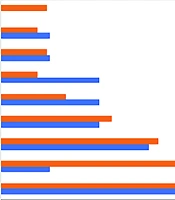
In the age group younger than 11 years, negative results were followed by bacterial monoinfection (21.25%), viral-bacterial coinfection (15.36%), and viral monoinfection (15.06%), with coinfections being more prominent in this age group. In the 11 - 20-year age group, bacterial monoinfection (24.30%) was the most common finding after negative results, and the rates of viral and bacterial coinfections were relatively lower. In the group older than 20 years, negative results were predominant, followed by viral monoinfection (16.44%) and bacterial monoinfection (10.66%), with coinfections detected at very low rates. Overall, the proportion of negative samples increased with age, whereas infection diversity and coinfection frequency decreased (Figure 1).
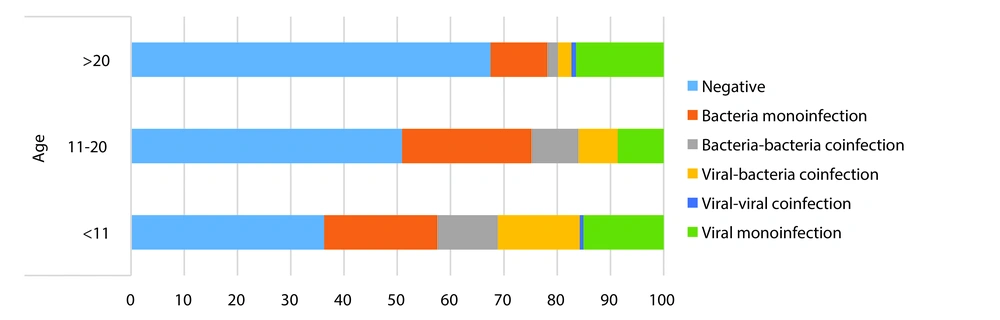
Figure 1.
Distribution of bacterial monoinfection, viral monoinfection, and coinfection patterns stratified by age group (< 11, 11 - 20, and > 20 years).
When the ages of pathogen-positive and pathogen-negative patients were compared, the ages of patients who tested positive for adenovirus, bocavirus, hMPV, parainfluenza viruses 1 - 3, RSV, H. influenzae, B. pertussis, and S. pneumoniae were significantly lower than those of negative controls (P < 0.05). The age distribution of coronavirus NL63-positive patients was significantly higher than that of coronavirus NL63-negative patients (P < 0.001) (Table 3).
Table 3.
Age Distribution According to Pathogen Test Results
| Pathogen | Age; Test Negative a | Age; Test Positive a | P-Value b |
|---|---|---|---|
| Adenovirus | 7 [2 - 24] | 4 [3 - 8] | 0.005 |
| Bocavirus | 7 [2 - 22] | 3 [2 - 4] | < 0.001 |
| Coronavirus 229E | 6 [2 - 20] | 6 [2 - 36] | 0.750 |
| Coronavirus HKU1 | 6 [2 - 20] | 6 [2 - 14] | 0.726 |
| Coronavirus NL63 | 6 [2 - 20] | 11 [2 - 69] | < 0.001 |
| Coronavirus OC43 | 6 [2 - 20] | 6 [2 - 17] | 0.803 |
| Influenza A virus | 6 [2 - 20] | 7 [3 - 19] | 0.122 |
| Influenza B virus | 6 [2 - 21] | 7 [4 - 18] | 0.376 |
| hMPV | 6 [2 - 20] | 4 [2 - 4] | 0.001 |
| Parainfluenza 1 | 6 [2 - 21] | 4 [2 - 5] | < 0.001 |
| Parainfluenza 2 | 6 [2 - 20] | 2 [2 - 2] | 0.024 |
| Parainfluenza 3 | 6 [2 - 21] | 2 [1 - 8] | < 0.001 |
| Parainfluenza 4 | 6 [2 - 19] | 9 [2 - 45] | 0.352 |
| RSV | 7 [2 - 27] | 2 [2 - 3] | < 0.001 |
| SARS-CoV-2 | 6 [2 - 19] | 4 [1 - 52] | 0.403 |
| Haemophilus influenzae | 8 [2 - 34] | 5 [2 - 9] | < 0.001 |
| Mycoplasma pneumoniae | 6 [2 - 22] | 9 [5 - 13] | 0.207 |
| Bordetella pertussis | 6 [2 - 22] | 2 [1 - 8] | < 0.001 |
| Streptococcus pneumoniae | 8 [2 - 36] | 4 [2 - 9] | < 0.001 |
Abbreviations: hMPV, human metapneumovirus; RSV, respiratory syncytial virus; SARS-CoV-2, severe acute respiratory syndrome coronavirus 2.
a Values are expressed as Median [Q1 - Q3].
b Mann-Whitney U test.
When the distribution of respiratory pathogens by sex was examined, only S. pneumoniae positivity differed significantly between females and males. No significant sex-related difference was detected for any other pathogen (Table 4).
Table 4.
Positivity Rates of Respiratory Viral and Bacterial Pathogens by Sex
| Pathogen | Female (n = 1410) a | Male (n = 1787) a | P-Value |
|---|---|---|---|
| Adenovirus | 51 (3.62) | 69 (3.86) | 0.718 b |
| Bocavirus | 21 (1.49) | 26 (1.45) | 0.936 b |
| Coronavirus 229E | 7 (0.5) | 11 (0.62) | 0.655 b |
| Coronavirus HKU1 | 3 (0.21) | 4 (0.22) | 1.00 c |
| Coronavirus NL63 | 3 (0.21) | 4 (0.22) | 1.00 c |
| Coronavirus OC43 | 24 (1.7) | 29 (1.62) | 0.862 b |
| Influenza A virus | 61 (4.33) | 76 (4.25) | 0.919 b |
| Influenza B virus | 32 (2.27) | 44 (2.46) | 0.722 b |
| hMPV | 3 (0.21) | 0 (0) | 0.086 c |
| Parainfluenza 1 | 6 (0.43) | 15 (0.84) | 0.150 b |
| Parainfluenza 2 | 1 (0.07) | 1 (0.06) | 1.00 c |
| Parainfluenza 3 | 18 (1.28) | 20 (1.12) | 0.683 b |
| Parainfluenza 4 | 22 (1.56) | 20 (1.12) | 0.277 b |
| RSV | 88 (6.24) | 93 (5.2) | 0.208 b |
| SARS-CoV-2 | 61 (4.33) | 81 (4.53) | 0.778 b |
| Haemophilus influenzae | 278 (19.72) | 401 (22.44) | 0.062 b |
| Mycoplasma pneumoniae | 34 (2.41) | 39 (2.18) | 0.667 b |
| Bordetella pertussis | 16 (1.13) | 22 (1.23) | 0.803 b |
| Streptococcus pneumoniae | 347 (24.61) | 509 (28.48) | 0.014 b |
Abbreviations: hMPV, human metapneumovirus; RSV, respiratory syncytial virus; SARS-CoV-2, severe acute respiratory syndrome coronavirus 2.
aValues are expressed as No (%).
b Chi-square test.
c Fisher exact test.
Adenovirus positivity was higher in summer than in autumn and winter (P = 0.003). Bocavirus infections were more common in winter than in spring (P = 0.039). Influenza A virus positivity was significantly higher in winter than in spring, summer, and autumn (P < 0.001), whereas influenza B virus positivity was higher in spring than in all other seasons (P < 0.001). Parainfluenza 1 infections were more common in autumn than in spring, summer, or winter (P < 0.001). Parainfluenza 3 positivity was higher in autumn than in winter (P = 0.017). Parainfluenza 4 infections were more frequently observed in spring than in summer and autumn (P = 0.001). Respiratory syncytial virus positivity was highest in winter and was higher than in spring, summer, and autumn; it was also higher in spring than in summer and autumn (P < 0.001). Severe acute respiratory syndrome coronavirus 2 positivity was higher in summer and autumn than in spring and winter (P < 0.001). Among bacterial agents, H. influenzae positivity was higher in spring and winter than in summer and autumn (P < 0.001). Mycoplasma pneumoniae infections were more common in summer and autumn than in spring and winter (P < 0.001). Bordetella pertussis positivity differed significantly across seasons (P = 0.016). Streptococcus pneumoniae positivity was higher in winter than in autumn, higher in autumn than in summer, and higher in spring than in summer (P < 0.001) (Table 5).
Table 5.
Positivity Rates of Respiratory Viral and Bacterial Pathogens by Season a
| Pathogen | Spring (1) (n = 853) | Summer (2) (n = 387) | Autumn (3) (n = 731) | Winter (4) (n = 1226) | P-Value/Post Hoc |
|---|---|---|---|---|---|
| Adenovirus | 39 (4.57) | 25 (6.46) | 19 (2.6) | 37 (3.02) | 0.003 b/(2 > 3, 4) |
| Bocavirus | 6 (0.7) | 5 (1.29) | 9 (1.23) | 27 (2.2) | 0.039 b/(4 > 1) |
| Coronavirus 229E | 9 (1.06) | 0 (0) | 2 (0.27) | 7 (0.57) | 0.088 c |
| Coronavirus HKU1 | 1 (0.12) | 0 (0) | 2 (0.27) | 4 (0.33) | 0.690 c |
| Coronavirus NL63 | 0 (0) | 0 (0) | 2 (0.27) | 5 (0.41) | 0.203 c |
| Coronavirus OC43 | 18 (2.11) | 2 (0.52) | 10 (1.37) | 23 (1.88) | 0.180 b |
| Influenza A virus | 2 (0.23) | 0 (0) | 1 (0.14) | 134 (10.93) | < 0.001 b/(4 > 1, 2, 3) |
| Influenza B virus | 57 (6.68) | 3 (0.78) | 6 (0.82) | 10 (0.82) | < 0.001 b/(1 > 2, 3, 4) |
| hMPV | 0 (0) | 0 (0) | 0 (0) | 3 (0.24) | 0.361 c |
| Parainfluenza 1 | 0 (0) | 0 (0) | 16 (2.19) | 5 (0.41) | < 0.001 c/(3 > 1, 2, 4) |
| Parainfluenza 2 | 0 (0) | 0 (0) | 0 (0) | 2 (0.16) | 0.620 c |
| Parainfluenza 3 | 11 (1.29) | 6 (1.55) | 15 (2.05) | 6 (0.49) | 0.017 b/(3 > 4) |
| Parainfluenza 4 | 19 (2.23) | 0 (0) | 3 (0.41) | 20 (1.63) | 0.001 b/(1 > 2, 3) |
| RSV | 34 (3.99) | 1 (0.26) | 0 (0) | 146 (11.91) | < 0.001 b/(4 > 1 > 2, 3) |
| SARS-CoV-2 | 33 (3.87) | 32 (8.27) | 53 (7.25) | 24 (1.96) | < 0.001 b/(2, 3 > 1, 4) |
| Haemophilus influenzae | 211 (24.74) | 51 (13.18) | 112 (15.32) | 305 (24.88) | < 0.001 b/(1, 4 > 2, 3) |
| Mycoplasma pneumoniae | 5 (0.59) | 19 (4.91) | 28 (3.83) | 21 (1.71) | < 0.001 b/(2, 3 > 1, 4) |
| Bordetella pertussis | 15 (1.76) | 9 (2.33) | 5 (0.68) | 9 (0.73) | 0.016 b, d |
| Streptococcus pneumoniae | 241 (28.25) | 65 (16.8) | 175 (23.94) | 375 (30.59) | < 0.001 b/(4 > 3 > 2/1 > 2) |
Abbreviations: hMPV, human metapneumovirus; RSV, respiratory syncytial virus; SARS-CoV-2, severe acute respiratory syndrome coronavirus 2.
a Values are expressed as No (%).
b Chi-square test.
c Fisher-Freeman-Halton test.
d No significant pairwise difference.
5. Discussion
This study, which included a comprehensive analysis of 3197 respiratory samples, presents the status of respiratory pathogens in eastern Turkey during the post-pandemic transition period. High detection rates of viral agents, such as RSV, influenza virus, and SARS-CoV-2, as well as bacterial agents, such as S. pneumoniae and H. influenzae, indicate substantial restructuring of the regional respiratory ecosystem. The period covering 2024 - 2025 marked a critical stage in the changes in circulation patterns caused by COVID-19 interventions. High-volume samples collected from a tertiary center, such as Erzurum City Hospital, provide a solid basis for interpreting these changing dynamics.
Notably, this study revealed a high frequency of RSV. Although human rhinovirus/enterovirus (HRV/EV) has frequently been identified as the primary agent in many studies conducted in Turkey, the present findings indicate that RSV was the primary viral agent. This difference is not solely the result of epidemiological differences but also reflects methodological differences. The Bio-Speedy® MX-24 panel used in this laboratory does not include HRV/EV targets. In contrast, studies conducted by Uğur and colleagues and Duclos and colleagues used panels with broader viral coverage, which naturally led to higher HRV/EV reporting (9, 10). This highlights the importance of diagnostic panel coverage in interpreting pathogen prevalence in clinical practice. Therefore, panel-specific limitations should not be overlooked when clinicians interpret laboratory reports and compare regional data.
The data presented in this study show that the resurgence of classic respiratory viruses, such as influenza virus and RSV, is consistent with the global resurgence model described in the literature (11, 12). Public health measures, such as mask wearing and social distancing during the COVID-19 pandemic, significantly suppressed the circulation of these pathogens (10). This suppression led to a temporary “immunity gap” or “immunity debt” in the general population (13). The present findings confirm that when protective measures are relaxed, classic pathogens re-emerge at substantial levels. Interestingly, whereas influenza virus and RSV showed sharp and high seasonal peaks, SARS-CoV-2 had a broader and more continuous distribution. These findings suggest that SARS-CoV-2 has become integrated into the respiratory ecosystem as a persistent year-round pathogen (14-16).
When evaluated by age, the data from this study further support the immunity gap theory. The highest pathogen diversity and coinfection rates were detected in the pediatric group. This suggests that children, especially those born during or shortly before the pandemic, had limited exposure to common respiratory viruses for several years because of isolation measures. With the lifting of isolation measures and the resumption of educational activities, this immunologically vulnerable group appears to have encountered multiple pathogens simultaneously. This may explain the high coinfection rates observed in the present data (17, 18). Data from Bukavaz and colleagues and Pizzo and colleagues, showing that the likelihood of detecting multiple pathogens decreases with age, are consistent with the present findings (19, 20). The persistent low-level circulation of SARS-CoV-2 indicates that community immunity has substantially improved through vaccination and previous exposure. Nevertheless, the persistence of SARS-CoV-2 among older adults remains a concern. This situation suggests that older age groups may remain at risk from new variants.
With respect to bacterial agents, the high positivity rates of S. pneumoniae and H. influenzae in the samples should be interpreted with caution. According to Karabulut et al, these organisms are part of the nasopharyngeal microbiota (21). In this retrospective study design, it was not possible to distinguish asymptomatic colonization from active infection on the basis of PCR results. Reverse transcription quantitative polymerase chain reaction is known to have high sensitivity and may detect bacterial DNA at levels that may not be clinically meaningful. This highlights the need for clinical correlation. Relying solely on molecular detection may lead to overdiagnosis of bacterial infections and unnecessary antibiotic use. Therefore, the correlation between molecular methods and clinical outcomes should be considered when promoting rational antibiotic use.
Regarding seasonal distribution, the results indicated that viral and bacterial positivity peaked during the winter months. These findings are consistent with the literature on the seasonal dynamics of respiratory pathogens in regions with pronounced cold seasons. Respiratory syncytial virus and influenza virus continue to be the main causes of respiratory infections during winter (14, 15). The results are similar in Erzurum, where winter conditions are long and harsh. However, the continued presence of SARS-CoV-2 throughout the year should not be overlooked in relaxed post-pandemic diagnostic strategies.
The transition of SARS-CoV-2 from a pandemic state to a low-level endemic state is among the important epidemiological findings of this study. Vaccination efforts and immunity gained between waves during the pandemic may have contributed to this change. However, the ability of the virus to coexist with classic respiratory pathogens in the ecosystem indicates that a new equilibrium has been reached. This study emphasizes the importance of monitoring this new normal.
5.1. Study Limitations
This study has several limitations. First, it had a retrospective design, and variables such as clinical findings, disease severity, antibiotic or antiviral use, and vaccination status were not included in the analysis. The multiplex PCR panel used in this study does not include some common respiratory pathogens, such as HRV/EV, in its target spectrum, which limits the interpretation of viral agent distribution. Furthermore, it was not possible to distinguish colonization from actual infection among the bacterial agents screened, and the clinical correlation of detected bacterial positivity could not be evaluated. The single-center design and reliance on data from a tertiary hospital may limit the direct generalizability of the findings to community-based and primary care settings. However, the center’s service to a large geographical area may partially mitigate these limitations.
5.2. Conclusions
This study provides current regional epidemiological information on the distribution patterns of respiratory pathogens during the transition from the pandemic period to the post-pandemic period in Turkey. The results showed that the distribution patterns of RSV and influenza viruses have returned to a dominant pattern, whereas SARS-CoV-2 shows lower prevalence and broader seasonality. The detection of S. pneumoniae and H. influenzae as the major bacterial agents indicates that bacterial results obtained by multiplex PCR should be interpreted carefully in the clinical setting. The high prevalence of coinfection, especially in the pediatric group, emphasizes the importance of appropriate diagnostic approaches for this age group. These results may help define diagnostic strategies for the treatment of acute respiratory infections.