1. Background
When the HIV epidemic peaked in 1993, AIDS was the leading cause of death among 25 - 44-year-old men and women and the eighth most common cause of death worldwide (1). Injection drug use (IDU) and unprotected sex are considered as major risk factors for the acquisition of retroviral infection (2-4), and more than half of people living with HIV are women and girls (2, 5-7). Because of social, economic, and political differences among regions, the epidemic has not been uniform (8, 9). The most common route of HIV transmission in high-income countries such as the United States and the United Kingdom is homosexuality. People who engage in high-risk sexual behaviors in Sub-Saharan Africa and IDUs in Eastern Europe and Southeast Asia are the major at-risk groups (10-14). In 2011, adolescents, women, homosexuals, and serodiscordant couples (i.e. one partner is HIV positive, and the other is HIV negative) were reported to be the populations with the highest risk of infection (10).
Although the AIDS epidemic is relatively mild in Asia, factors such as low condom use, unsafe injections among injection drug users, immigration, lack of education, and misconceptions about HIV/AIDS could affect the HIV/AIDS epidemic in all countries that currently have low prevalence (15-17). According to estimates by the Ministry of Health and Medical Education, as of September 21, 2011, approximately 23,500 people were living with HIV in Iran. More than 91% of these patients were men, and approximately 4,400 had died (18). Needle sharing in IDUs is the most common route of HIV transmission in men in Iran, accounting for approximately 70% of established transmissions. However, studies show an increased rate of high-risk behaviors for HIV infection, particularly unprotected sex (18-22). In addition, it is important to consider the HIV infection prevalence in specific populations in Iran, such as patients with tuberculosis (23).
Rapid changes in the epidemiological characteristics of infectious diseases necessitate health practitioners being aware of the current status of these diseases, especially in cases of pandemic diseases such as AIDS, whose control requires global efforts (24-26). In this regard, research should serve as a tool to improve the effectiveness of healthcare systems. Successful AIDS prevention and treatment depend on the complete and accurate identification of at-risk populations as well as regular and standardized data collection, analysis, and interpretation (1, 27). One of the best opportunities to combat AIDS in Iran is the use of the healthcare system. However, behavioral research in the general population and high-risk groups is not systematic, integrated, or consistent (24, 28).
2. Objectives
The present study investigated the epidemiology of HIV/AIDS in East Azerbaijan, Iran.
3. Patients and Methods
This retrospective study was conducted during 1987 - 2012 in East Azerbaijan, Iran. The target population was all patients with HIV/AIDS in East Azerbaijan province, including patients who acquired HIV infection through IDU, sexual transmission, mother-to-child transmission (i.e. vertical transmission), and contaminated blood products. The Vice Chancellor of Research and Technology of Tabriz University of Medical Sciences ethical committee approval was obtained for the study (decision number: 5.4.328).First, necessary supplies including computers, telephone lines, etc. were prepared for project implementation. Data including age, sex, transmission route, etc. (Table 1) were extracted and entered into Microsoft Excel software for classification and sorting. Next, data were analyzed, and diagrams and tables were created using Microsoft Excel and SPSS. Quantitative variables are presented as mean ± standard deviation (SD). The χ2 test was used to analyze qualitative variables. Meanwhile, regression analysis was used to evaluate the roles of confounding factors. The level of significance was set at P < 0.05.
Table 1.
| Characteristics | Values |
|---|---|
| Sex | |
| Male | 338 (91) |
| Female | 33 (9) |
| Total | 371 (100) |
| Age ,y | |
| 0 – 20 | 42 (11) |
| 20 - 40 | 264 (71) |
| ≥ 40 | 65 (18) |
| Total | 371 (100) |
| Education level | |
| Illiterate | 37 (10) |
| Primary and secondary school | 214 (58) |
| University | 7 (2) |
| Unknown | 113 (30) |
| Total | 371 (100) |
| Marital status | |
| Single | 200 (54) |
| Married | 122 (33) |
| Unknown | 49 (13) |
| Total | 371 (100) |
| Hometown | |
| Tabriz | 228 (61) |
| Maragheh | 44 (12) |
| Myaneh | 26 (7) |
| Other | 57 (15) |
| Unknown | 16 (5) |
| Total | 371 (100) |
| Transmission route | |
| IDU | 219 (59) |
| IDU and unprotected sex | 51 (14) |
| Unprotected sex | 42 (11) |
| Blood transfusion | 10 (2.5) |
| Vertical transmission | 3 (0.8) |
| Unprotected sex and tattooing | 3 (0.8) |
| IDU and blood transfusion | 1 (0.3) |
| Tattooing | 1 (0.3) |
| Needling | 1 (0.3) |
| Unknown | 40 (11) |
| Total | 371 (100) |
a Data are presented as No. (%).
b IDU: injection drug use.
4. Results
Among the 371 patients who were identified by healthcare centers in East Azerbaijan from 1987 to 2012 (Figure 1), 91% (n = 338) were men and 9% (n = 33 cases) were women. The prevalence of HIV/AIDS increased along with the population growth from 1987 to 2012 (data not shown), the current prevalence of HIV/AIDS in East Azerbaijan is 1/10,000. The mean ages of the total, male, and female patients were 30.8 ± 12.3, 31.3 ± 12.1, and 28 ± 10.3 years, respectively. Moreover, 48% of the patients were 25 - 34 years old.
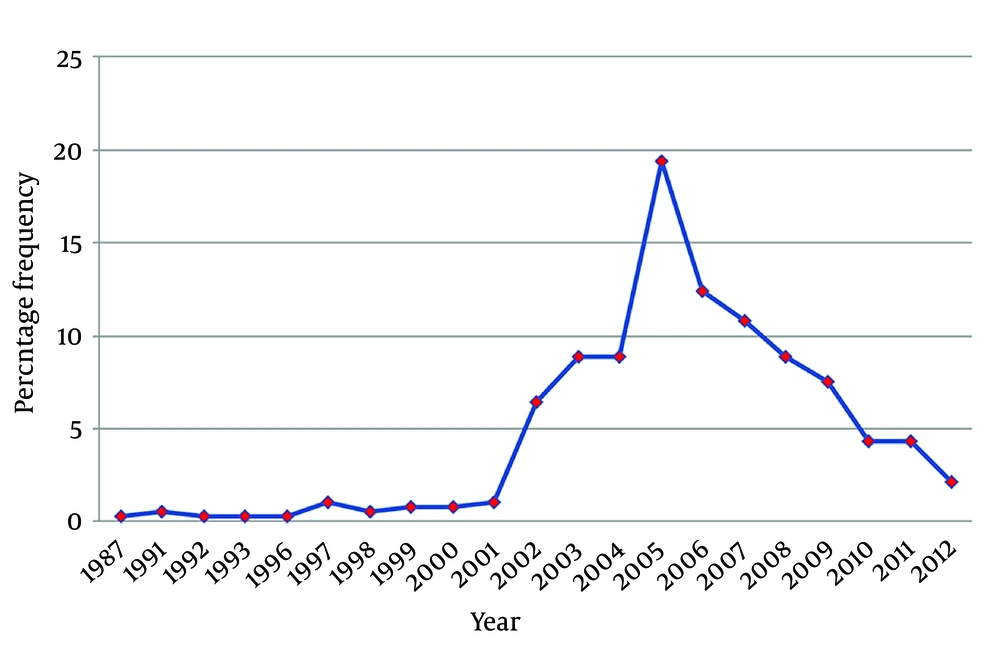
Figure 1.
Percentage of frequency in Patients With HIV/AIDS in East Azerbaijan, Iran From 1987 to 2012
Most identified patients were from Tabriz (n = 228). Approximately 54% (n = 200) of patients were single (Table 1). More than one-third (n = 131) of patients had died, and 27% (n = 99) were actively undergoing regular consultation (Figure 2). The most common transmission route was related to IDU (59%, n = 219) (Table 1). The educational status of about 30% of patients (n = 112) was unknown. Among patients with known educational status, approximately 80% (n = 208) of them had high school or lower (Table 1). The occupational status of 36% (n = 102) and 17% (n = 48) of patients was recorded as “self-employed” and “unemployed,” respectively (Table 1). The rest of the patients were employed in various jobs (data not shown).
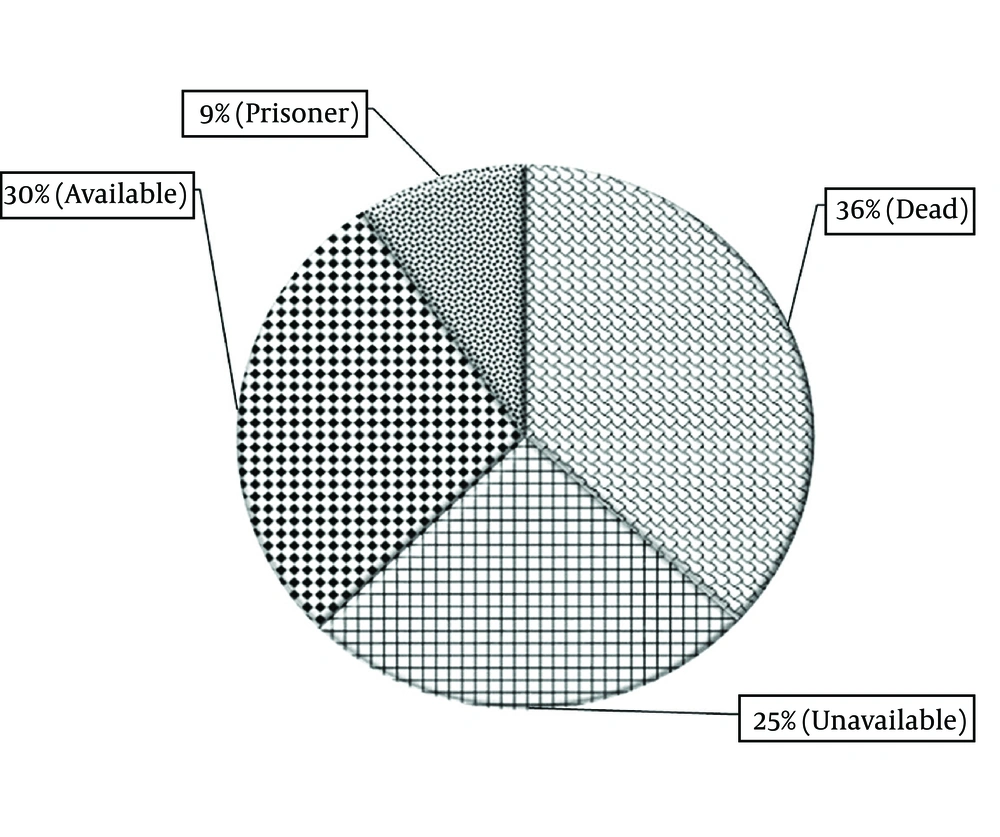
Figure 2.
Available: patients who actively undergoing regular consultation; Unavailable: Patients who haven’t referred to Council Centers since they have diagnosed as HIV positive.
The frequencies of coinfection with hepatitis C virus (HCV), hepatitis B virus (HBV), syphilis, and toxoplasmosis with respect to sex are shown in Table 2. Thirty-one of 207 patients (15%) were diagnosed with HBV, and 25 of 371 patients were diagnosed with HIV/HBV/HCV co-infection.
Table 2.
| Coinfection | Hepatitis B | Hepatitis C | Syphilis | Toxoplasmosis |
|---|---|---|---|---|
| Test result | P: 31 (8) | P: 168 (45) | P: 3 (1) | P: 94 (25) |
| Test result | N: 176 (48) | N: 42 (12) | N: 107 (29) | N: 63 (17) |
| Test result | UD: 164 (44) | UD: 161 (43) | UD: 261 (70) | UD: 214 (58) |
| Total | 371 (100) | 371 (100) | 371 (100) | 371 (100) |
a Data are presented as No.(%).
b P: positive, N: negative, UD: undetermined.
| Transmission route | Age group (y) | Total | ||
|---|---|---|---|---|
| 0 - 19 | 20 - 39 | ≥ 40 | ||
| IDU | 11 (3) | 166 (44.9) | 42 (11.4) | 219 (59.3) |
| IDU and unprotected sex | 0 | 42 (11.4) | 9 (2.4) | 51 (13.8) |
| Unprotected sex | 3 (0.8) | 33 (8.9) | 6 (1.6) | 42 (11.4) |
| IDU and blood transfusion | 0 | 1 (0.3) | 0 | 1 (0.3) |
| Other | 28 (7.6) | 22 (5.9) | 8 (1.8) | 58 (15.3) |
| Total | 42 (11.4) | 264 (71.4) | 65 (17.2) | 371 (100) |
a Data are presented as No. (%).
b IDU: injection drug use.
5. Discussion
The HIV epidemic has entered the concentrated phase in Iran. The prevalence of HIV infection among injection drug users is reported to be 15.07% (18). The results of the present study show that IDU is the most common HIV transmission route in East Azerbaijan province, which is similar to national reports on HIV/AIDS (18). In a study conducted in Tehran and Kermanshah provinces, unsafe needle sharing was the reported cause of 83% of HIV infections (29). Another study performed in 2007 in Imam Khomeini Hospital in Tehran reports IDU as the most common HIV transmission route (31%) (30). Furthermore, a study conducted by researchers at Shiraz University of Medical Sciences reports 76% of patients had a history of IDU. However, in the present study, IDU was not the only route of HIV acquisition (31), 15% of patients simultaneously had a history of IDU and other high-risk behaviors.
A study conducted in China in 2008 found that the most common HIV transmission route is IDU (> 43% of transmissions) (32). Meanwhile, a study in the US reports the most common HIV transmission route is homosexual contact in men, whereas IDU is ranked third (1). Thus, it seems that educating prisoners and injection drug users, reducing jail time, focusing on public education, making more efforts to provide methadone for people unable to quit their drug addiction, and doing research counseling methods and behavioral disorders at healthcare centers and prisons may improve the current status of the HIV epidemic (24, 33-36). Many studies conducted in Iran report the prevalence of HIV/AIDS is higher in men than in women (approximately 85 - 95% higher) (29, 31, 37, 38). However, the 2010 Joint United Nations Programme on HIV/AIDS Global Report states that more than 50% of people living with HIV worldwide are women and girls (39). The higher prevalence of HIV infection among men in Iran and East Azerbaijan could be due to a lack of precise data on the number of sex workers, which may partly explain the low rate of HIV/AIDS in women.
HBV and HCV coinfection among patients infected with HIV is common; and severe complications can occur in these patients (40). Severe complications can occur in patients with coinfection via the same transmission route of HIV (40-44). The present results show that 53% of patients with HIV/AIDS were coinfected with HCV, HBV, or both. In a study conducted in southwestern Iran, HCV or HBV coinfection was detected in 80% of patients infected with HIV (45). However, the prevalence of coinfection with hepatitis viruses in patients with HIV/AIDS varies among studies as well as populations with respect to exposure to different risk factors, geographic region, and ethnicity (41, 46).
One limitation of the present study is that the sample may not be representative of the total population in East Azerbaijan province. Furthermore, the paper-based records of some patients were incomplete, preventing us from analyzing some variables (associated to the clinical features) (e.g. some laboratory parameters). However, the present study is one of the few studies on this topic that have been conducted in Iran; there are no reports from many other provinces. The findings of this study highlight the information gap in this area and help fill in a small part of it. It is noteworthy that some countries have had success in controlling and preventing contagious diseases such as HIV through healthcare systems set up for the general population; thus, the development of effective methods on the basis of evidence and data is clearly possible (22, 24, 28, 47-50).