


1. Context
Human immunodeficiency virus (HIV) is an important concern with serious health consequences. Globally, there were 29.2 million HIV-infected patients in 2013 (1). The current global prevalence of HIV primarily originates in drug injection and engagement in high risk sexual behaviors (2-5).
In Southwest Asia, the southern Persian Gulf border (Figure 1) has been characterized by small and newly-established Arab and Arabic-speaking states. These states include Kuwait, Qatar, Bahrain and the United Arab Emirates (UAE) (6-9). However, the vast northern area has been characterized by Iran, the most populated Persian Gulf country.
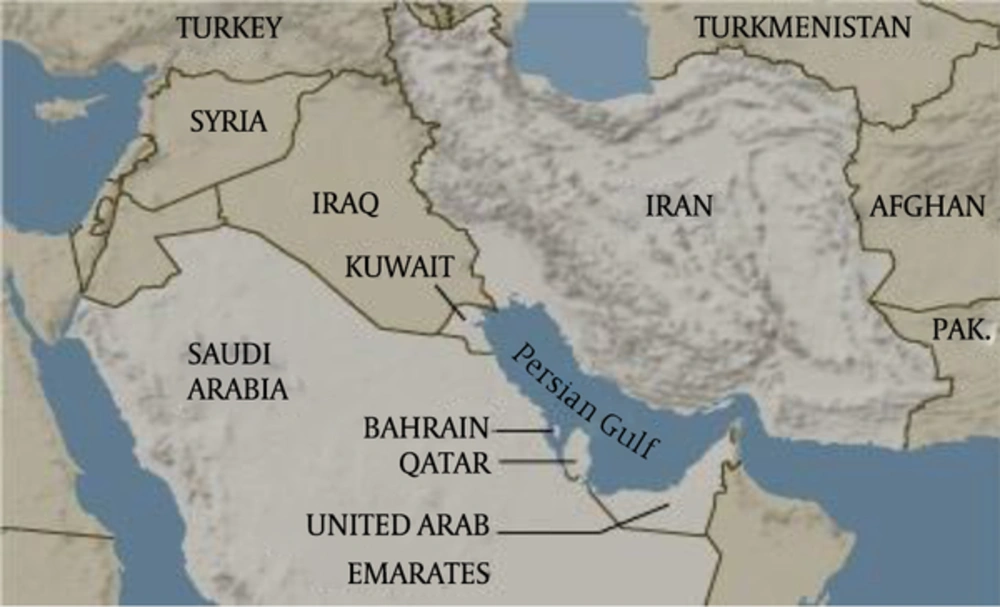
Figure 1.
Arab States in Southwest Asia
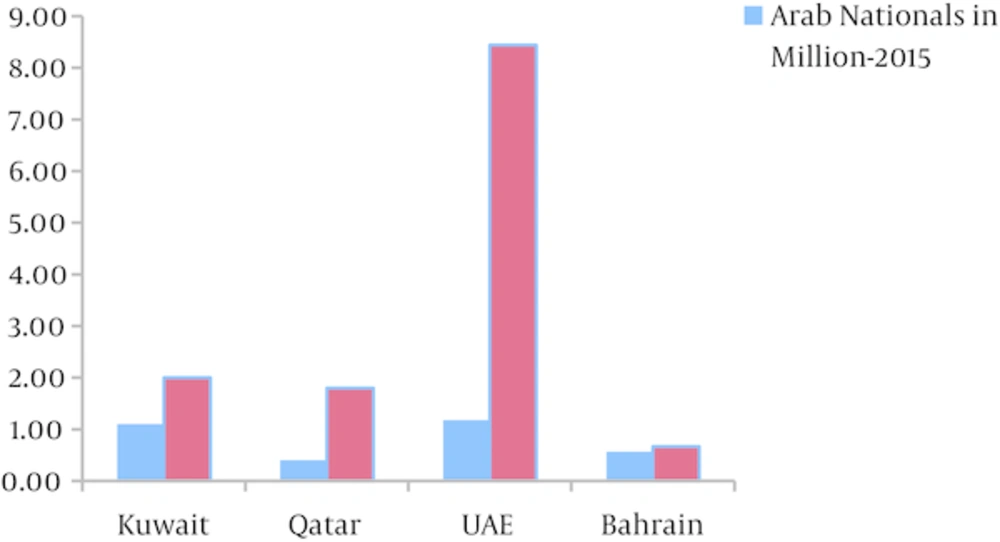
According to the recent world population reviews, the states have minorities of Arab or Arabic-speaking nationals. However, there are a number of expatriate workers in the states (Figure 2). Expatriates in the states are mainly temporary workers from India, Pakistan, Southeast Asia, Africa or Western Asia (6-9).
2. Evidence Acquisition
Data regarding evidence of HIV responses were collected through a literature search. Searching the literature was conducted in compliance with an international guideline for preparing narrative literature reviews (10). The review had an emphasis on
1) HIV prevalence and testing in recent national reports
2) The main routes of HIV transmission
3) HIV knowledge and education
4) The current status of key populations and high risk behaviors and
5) HIV treatment and harm reduction programs (HTAHRPs)
HTAHRPs were defined as the availability of
1) Strategic plans for HIV
2) Antiretroviral therapy (ART)
3) Drug treatment
4) Voluntary counseling and testing (VCT)
5) Needle and syringe program (NSP) and
6) HIV-related activities of non-governmental organizations (NGOs)
English publications with no time limit were retrieved through searching Web of Sciences, Medline, EMBASE, Pub Med citation indexes, CINHAL, EMRO and Google Scholar. Grey literature was sought using the regional reports of the world health organization and the latest global AIDS response progress reports. The global state of harm reduction reports and the regional HIV reports were also searched. The last search was completed in the first day of December 2015. Key words related to HIV were selected based on the MESH terms and key words for searching in Pub Med.
3. Results
In total, 9000 studies and reports were found but only 16 original papers and reports were related to the study aim. One paper and one regional report were related to all of the states. One national report and two studies were related to Kuwait. Only one national report was related to Qatar. One national report and four studies were related to Bahrain. One national report and four studies were related to the UAE.
3.1. HIV Prevalence in Recent National Reports
In Kuwait, 252 HIV-infected patients have been sporadically found since 1980. Overall, 72.6% of them are men and 27.4% of them are women. Only 8% of the total Kuwaiti population was tested for HIV in 2013. At the same time, 34 HIV-infected patients were found among 94,086 nationals. Heterosexual relationship is the main route of HIV transmission (Table 1). HIV-infected patients are detected by mandatory HIV testing. Blood donation, pre-marital testing and employment are the other ways of HIV detection (11).
Table 1.HIV Status Based on the Reports of the Ministries of Health
| State | HIV Prevalence 1 | Main Route of HIV Transmission | HIV Knowledge and Education | Key Populations and High Risk Behaviors |
|---|---|---|---|---|
| Kuwait | 252 | 2 | 4 | 5 |
| Qatar | 10 - 18a | 2 | 4 | 5 |
| Bahrain | 437 | 3 and 2 | 4 | 5 |
| UAE | 780 | 2 | 4 | 5 |
1. sporadic case-finding since detecting the first HIV case; 2. heterosexual relationship; 3. drug injection; 4. not considerable; 5. not well-studied.
aPer year.
In Qatar, more than 500,000 HIV tests are taken every year. Almost 10 new HIV-infected patients are detected every year. The latest report of the ministry of health indicated that 18 new HIV-infected patients were detected in 2013. This number is mainly based on taking mandatory HIV testing. Heterosexual relationship is the main route of HIV transmission (Table 1). HIV-infected patients are also detected by testing for marriage, employment or blood donation (12).
In Bahrain, current reports including a four-year study (2009 - 2013) indicate that HIV is a health concern (13, 14). Overall, 487 Bahraini HIV-infected patients, generally men have been detected since 1986. Two hundred and thirty-three of them were found alive in 2014. Approximately 90% of all HIV tests (i.e. 30185 Bahraini patients) in 2012 and (i.e. 50289 non-Bahraini patients) in 2013 were the results of mandatory testing. The main route of HIV transmission is drug injection (55.8%). HIV rates related to heterosexual transmission have ranged from 62.5% in 2010 to 52.6% in 2011. HIV-infected patients are detected by testing illicit drug users entering drug treatment. Blood and organ donation, surgery, imprisonment and employment are other ways of HIV detection (13).
In the UAE, 780 HIV-infected patients have been detected among Arab nationals by mandatory HIV testing since 1980. Overall, 591 of them are men and 189 of them are women. Overall, 90% of all tests included screening of expatriate workers mainly Indian workers. Heterosexual relationship is the main route of HIV transmission (Table 1). Pre-marital testing, blood donation and mandatory HIV testing of some sporadic groups in the community are the other ways of HIV detection (15).
3.2. HIV Knowledge and Education
In Kuwait, a study of HIV knowledge among dental students indicated that HIV was stigmatized. Fifty-eight percent of the respondents had good HIV knowledge while, 63.6% reported negative attitudes toward HIV-infected patients (16). Furthermore, People Living with HIV (PLHIV) encounter problems in finding employment because of stigma (17). Therefore, the government of Kuwait has provided HIV education for the private sector and people in public places (11). However, no study of HIV knowledge and education was found in Qatar (17, 18).
In Bahrain, there are a few studies of HIV knowledge (13). The only study of 277 female college students in three countries indicated that HIV knowledge among Bahraini students was associated with negative attitudes toward HIV-infected patients (19). To remove stigma and to contribute to HIV awareness, Bahrain Reproductive Health has approved a HIV/AIDS plan for workplaces. Moreover, NGOs such as Bahrain Reproductive Health Society, Bahrain Development Society (women’ group) and Shiite leaders work on increasing HIV knowledge in the community. Friendly Addiction People`s Society also works with eighteen former drug dependents to increase HIV knowledge among young people (13, 17).
In the UAE, some studies have been conducted on HIV knowledge. A survey was conducted on HIV knowledge among students at three universities between 2010 and 2011. Overall, 3359 students participated in the study; 63% of them were Arab students. Arab respondents, especially women, had less HIV knowledge than other participants (15). A survey of 119 men and 148 women at the university of Al-Ain state indicated that HIV knowledge was poor among 75% of the respondents (20). A study of 106 dental students in Ajman state indicated that HIV knowledge was poor among 39.5% of the respondents and stigma against HIV was reported (21). Red Crescent Organization has provided some HIV peer education among young people. However, no HIV education has been provided outside Red Crescent Organization and the only drug treatment center (15).
3.3. Key Populations and High Risk Behaviors
Key populations such as local and expatriate female sex workers (FSW) are present in Kuwait (11). However, condom promotion has not been provided among this group. This is because, condom promotion has been considered as a way to increase sex work (11).
Some Kuwaiti groups in the general population are likely to be at risk of HIV infection because of FSW or extramarital sex. For example, a study of university students, aged 18 to 25 years indicated that 50 - 75% of young adults travelled overseas to have sexual relationships with sex workers. However, condom use was reported by only 25% of them (11).
Men who have sex with men (MSM) are found in Kuwait yet their rates of condom use are not clear. An online rapid MSM assessment in the region found that 36% of Kuwaiti respondents reported irregular condom use and 64% of them reported regular condom use. The report highlights that the percentage of 64% is exaggerated while a few MSM in Kuwait are likely to use condoms consistently (11).
People who inject drugs (PWID) are found in Kuwait. The only drug treatment center (i.e. Addiction and Psychiatric Hospital) has 6000 clinical files and approximately 60% of them include PWID. Some PWID travel to other countries for drug treatment to remain anonymous. Therefore, it is difficult to estimate HIV-related problems among them (11, 17). Key populations such as PWID have not been identified in Qatar (18). However, the only report indicates that no HIV-infected patient has been found among PWID (12).
Key populations such as PWID are found in Bahrain. There are 20,000 to 30,000 illicit drug users (22). Two-thirds of the 3200 registered illicit drug users include PWID. Mandatory testing at the drug rehabilitation center has indicated a high HIV prevalence of 3.3 - 4.6% among this group (13). Two studies show that HIV prevalence among PWID is different ranging from 21.1% in drug treatment (23) to 0.3% in a study (24). Nevertheless, HIV data are not updated. The only survey indicated that among 421 PWID in drug treatment, 53.4% of them reported unsafe drug injection and 25% of them reported sharing needles in the last month (17, 22).
Local and expatriate FSW are present in Bahrain. Sex work is illegal and is likely to be a route of HIV transmission in Bahrain. This is because condom promotion has not been implemented among FSW (13). Sex workers are only tested for HIV at the time of arrest. For example, a report indicated that 724 arrested FSW (i.e. 11 Bahraini and 713 non-Bahraini FSW) were tested for HIV between 2010 and 2011. Overall, 0.8% of them were infected with HIV (13).
In the states of the UAE, there are a few studies of key populations and high risk behaviors (17). While drug injection is present in the community, its role in increasing HIV problem has not been studied. Furthermore, because of stigma, some PWID may travel to other countries for drug treatment to remain anonymous. Therefore, the rate of HIV prevalence is not clear among them. People who inject drugs are tested for HIV when they are arrested or imprisoned, as well as, when they are referred for drug treatment (15). When it comes to high risk behaviors, a study of students at three universities in 2010 ‐ 2011 indicated that almost 10% of the respondents reported sexual relationships without marriage. Only 50% of them reported condom use in their last sexual relationships. The study suggests that a few nationals admit that they are sexually active before marriage because of common Islamic beliefs (15). Furthermore, a study indicated that 57% of university students did not use condoms in their last sexual relationships. The study findings indicated that HIV knowledge did not necessarily led to the prevention of high risk sexual behaviors (15).
3.4. Treatment and Harm Reduction
In Kuwait, the national AIDS program has had no strategic plan for HIV since the late 1980s. The provision of ART for the nationals is the main HIV response. According to the ministry of health, 238 Kuwaiti nationals were on ART by the end of 2013. The 12-month retention rate of patients on ART was 91.7% in 2012. Furthermore, short-term inpatient drug treatment has been provided for HIV-infected patients with drug use problems. The National AIDS Control Committee has also reviewed establishing VCT centers (11) (Table 2).
Table 2.HIV Treatment and Harm Reduction Programs Based on the Latest Reports of the Ministries of Health
| State | Strategic Plan | ART | ART Coverage | Drug or HIV Treatment | VCT | NSP | NGO |
|---|---|---|---|---|---|---|---|
| Kuwait | 2 | 1 | 238 | APH | 3 | 2 | 2 |
| Qatar | 1 | 1 | 10 - 18 | HMC | 1 | 2 | 2 |
| Bahrain | 3 | 4 | 17.2% out of 233 | SMC | 2 | 2 | 1 |
| UAE | 3 | 1 | 276 | NRC | 2 | 2 | 2 |
Abbreviations: HMC, Hamad Medical Center; SMC: Salmaniya Medical Complex; APH, Addiction and Psychiatric Hospital; NRC: National Rehabilitation Center,; 1. available; 2. non-available; 3. considered; 4. sporadic.
In Qatar, the national health strategy (2011 - 2016) has considered HIV treatment (12). The National AIDS program has taken steps to control HIV since 2006. HIV response includes the provision of ART for all nationals and expatriates (18). HIV services have been based on maintaining a low HIV prevalence and supporting PLHIV (12). A clinic has also been established for HIV-infected patients at Hamad Medical Center in Doha city. The clinic provides ART and VCT. According to the ministry of health (2013), all HIV treatment charges were paid by the government, which included approximately US$25000 per patient annually (12). Furthermore, short-term inpatient drug treatment is the only treatment response for HIV-infected patients with drug use problems (17, 18) (Table 2).
In Bahrain, the national strategy for AIDS prevention (2008 - 2010) is the first strategic plan. There is no specific budget for HIV. HIV response is based on the sporadic provision of ART for the nationals (13). Patients with HIV infection are admitted to the Salmaniya Medical Complex, which has an infectious disease clinic. Among 233 PLHIV, 17.2% of them have received ART so far. Moreover, short-term inpatient drug treatment has been provided for HIV-infected patients with drug use problems. Some NGOs also contribute to HIV prevention in the community (13) (Table 2).
In the UAE, the AIDS national strategic plan was drafted in 2006 and 2007. The last strategic plan was considered for revision in 2012 (18). The provision of ART for the nationals is the main HIV response. HIV treatment has been provided for Arabs (15, 18). Eleven health facilities provided ART in 2012. According to the ministry of health, 276 Arabs were enrolled in ART by the end of 2012. Furthermore, treatment has been provided for HIV-infected patients with drug use problems at National Rehabilitation Center (NRC) in Abu-Dhabi state. The program includes short-term inpatient drug treatment for Arab men only (15, 18) (Table 2).
4. Conclusions
Many people are likely to be in early stages of HIV but, HIV-related behaviors in Arab states are issues with poor cultural acceptance among people, as well as insufficient responses in public health sectors (20, 25-27). As a result, HIV data are not documented. Apparently, the available HIV data have been based on sporadic case finding. There is no sero-surveillance data system and the current HIV data have not been used for the development of HIV policies and programs (4). This issue may also originate in lack of adequate well-trained human resources, and poor infrastructural development. The provision of comprehensive surveillance data systems needs to be culturally sensitive and encourages the collaboration of public health sectors.
Inadequate HIV knowledge and education are important concerns in Arab states (17, 18). It should be noted that NGOs and religious leaders might contribute to increasing HIV knowledge and education. For example, Bahrain has NGO-based activities for HIV education in the community (13). Shiite leaders in Bahrain also contribute to increasing HIV knowledge (13). The experience of Bahrain can be learnt by other states. Special educational programs are needed to reduce stigma and increase HIV knowledge among the general and key populations. Part of this issue should consider Islamic and cultural values in each state.
The most challenging gaps in HIV responses are the illegal nature of HIV-related behaviors such as sex work, extramarital sex and drug injection, which may reduce the provision of effective HIV responses for key and general populations (11, 18). The provision of supportive environments for key populations is controversial because of traditional attitudes toward key populations and their behaviors (17). It should be noted that some states such as Kuwait and Bahrain have local and expatriate sex workers, who work illegally in the community (11, 13). In regard to cultural values, mass-media, public health sectors and educational centers are needed to deal with these challenging issues.
The absence of a national strategic plan for HIV is apparent in each state (18). There is an essential need for the provision of national strategic plans considering both Arab nationals and expatriate workers. Governmental support and international collaborations are needed to address the effective provision of national strategic plans for HIV.
When it comes to HIV treatment and harms reduction programs, the levels of responses need consideration. HIV responses have been provided for Arabs while the main population in each state includes Indian and Pakistani workers (6-9). The government of Qatar has paid for HIV treatment of all HIV-infected patients and has developed VCT (12). The experience of Qatar can be considered by other Arab states. Providing opioid substitution therapy and NSP has remained a critical gap, which should be gradually addressed. In addition, NGOs should be encouraged for the provision of harm reduction programs for HIV-infected patients.
To sum up, HIV problem needs a comprehensive policy response in each Arab state. An investment in research, empowering human resources and infrastructural development are suggested. The development of effective HIV responses should be addressed by governments as well as, by increasing HIV awareness in the community. The current review has a major limitation. It should be noted that because of a dearth of research studies, the review is mainly based on the latest reports of the ministries of health. Conducting more studies about HIV problem is suggested in Arab states on the southern Persian Gulf border.

