
1. Background
Helicobacter pylori is a curved, gram-negative, microaerophilic bacterium that can persist in the gastric mucous layer (1). This pathogen can chronically colonize mammalian hosts and, in some cases, contribute to life-threatening conditions such as cancer. H. pylori is a major factor in the development of peptic ulcers, gastric malignancies, and functional dyspepsia (2, 3). The infection is among the most common chronic bacterial conditions worldwide and is associated with gastric inflammation and increased production of proinflammatory cytokines such as tumor necrosis factor (TNF), interferon-gamma (IFN-γ), and various interleukins (4-6).
It is estimated that nearly 50% of the global population carries H. pylori, with infection usually acquired during childhood. In Iran, the prevalence of infection is particularly high, reaching approximately 80%. Lower socioeconomic status and a positive family history are known risk factors for infection (3, 7). In Europe, prevalence can exceed 50%. In different regions of Iran, infection rates range from 34% to 61% in asymptomatic individuals, whereas reported rates among symptomatic patients range from 52% to 86% (8-10).
The exact mode of H. pylori transmission remains debated, but person-to-person, oral-oral, gastric-oral, and fecal-oral transmission are considered likely pathways (11-13).
Methods for detecting H. pylori are generally classified as invasive or noninvasive. Invasive techniques include the rapid urease test (RUT), histology, and microbial culture, whereas noninvasive methods include the urea breath test and stool antigen tests. Molecular methods such as polymerase chain reaction (PCR) are also used (14). Microbial culture is recognized as a reference method for isolating and identifying H. pylori from clinical laboratory specimens (15-17).
Evidence suggests that diet influences H. pylori pathogenicity and the progression of gastric cancer. Studies have reported associations among salt consumption, dietary minerals such as zinc, iron, and nickel, and bacterial virulence, although findings remain inconclusive. Some studies also suggest that folate, carotenoids, and vitamin C may contribute to the prevention of gastric cancer (18, 19).
Although the relationship between overall nutritional status and H. pylori infection is not always clear, infection has been associated with micronutrient deficiencies in developing countries. H. pylori infection may be associated with lower levels of vitamins A, C, and B12, as well as iron, zinc, selenium, and folic acid (20-23).
Reduced or absent hydrochloric acid secretion can impair beta-carotene bioavailability. Accordingly, beta-carotene concentrations in the gastric mucosa are lower in patients with gastric atrophy and intestinal metaplasia (24). In H. pylori-positive individuals, beta-carotene concentrations in gastric juice are reduced even when plasma concentrations are similar to those of healthy controls (25). H. pylori may interfere with beta-carotene bioavailability, and enterocyte function may also be affected by the less acidic environment associated with infection (21, 26).
2. Objectives
Previous studies have examined individual nutritional factors in relation to H. pylori infection; however, fewer studies have evaluated the associations between combined intakes of micronutrients, vitamins, and minerals and infection status. This study aimed to address this gap by evaluating these associations.
3. Methods
3.1. Study Population and Design
This case-control study included 180 participants (90 cases and 90 controls) referred to a specialist infectious diseases clinic. Eligible participants were enrolled consecutively during the study period; random sampling was not used. The case group comprised patients aged 18 - 60 years with dyspepsia who tested positive for H. pylori using a stool antigen test and had no history of previous treatment for the infection. No additional confirmatory testing, such as a urea breath test or endoscopy with histology, was performed. The control group included symptomatic individuals, primarily those with dyspepsia, who were referred to the same clinic and tested negative for H. pylori. The control group was selected to achieve broadly comparable age and gender distributions at the group level; however, individual pair matching was not performed, and participants were not matched for other potential confounders, such as socioeconomic status. Therefore, age and gender were included as covariates in the multivariable logistic regression model.
3.2. Inclusion and Exclusion Criteria
The study protocol was approved by the Ethics Committee of Kerman University of Medical Sciences (ethics code: IR.KMU.REC.1397.151). To maintain the accuracy of dietary data, individuals with diseases that could substantially affect diet, such as cancer or cardiovascular disorders, were excluded. Pregnant and lactating women were also excluded. Individuals who had used bismuth or antibiotics within the 4 weeks before the study or proton pump inhibitors (PPIs) within the preceding 2 weeks were ineligible. All participants provided written informed consent before their height, weight, and demographic data were recorded.
3.3. Dietary Assessment
Dietary intake during the previous year was assessed through face-to-face interviews using a 147-item semiquantitative food frequency questionnaire (FFQ). Nutrient estimates reflected food sources only; vitamin and mineral supplements were not included in the analysis. The FFQ has been reported to be a valid and reproducible method for assessing long-term nutrient intake in epidemiological studies (27-29). Participants reported the frequency and portion size of foods consumed daily, weekly, monthly, or yearly (27). The FFQ is susceptible to recall bias, and the dietary data in this study were not validated against biochemical markers, which may have affected the accuracy of the estimates. To evaluate the prevalence of micronutrient inadequacy, daily intakes were compared with Dietary Reference Intake (DRI) standards established by the Food and Nutrition Board of the Institute of Medicine. Participants whose intake was below the recommended level for their age and gender were classified as having inadequate intake or deficiency.
3.4. Statistical Analysis
Data were analyzed using SPSS version 23. Descriptive statistics, including the mean, standard deviation (SD), standard error of the mean (SEM), and frequencies, were used to summarize the data. Group comparisons were performed using the chi-square test for categorical variables and the independent two-sample t-test for continuous variables. Data distributions were evaluated before parametric testing, and the independent t-test was used because of its robustness with a sample size of 90 participants per group; equality of variances was assessed using Levene's test. A P value < 0.05 was considered statistically significant. Because of the exploratory nature of the study and the high correlation among dietary variables, no formal adjustment for multiple comparisons was applied. Multivariable logistic regression was used to estimate odds ratios (ORs). Age, gender, and BMI were included as clinically relevant covariates regardless of their univariate significance, whereas dietary variables with P < 0.05 in the univariate analysis were entered simultaneously into the multivariable model using the Enter method. The events-per-variable (EPV) ratio was approximately 4.1, based on 90 cases and 22 predictors. Face-to-face interviews and cross-checking of records for completeness at recruitment yielded a final analytical sample with no missing values.
4. Results
The study included 90 H. pylori-positive cases and 90 controls. As shown in Table 1, the groups were comparable in age and height. The case group had significantly lower mean body weight (61.41 ± 10.75 kg vs. 65.46 ± 12.89 kg; P = 0.02) and BMI (22.57 ± 3.62 vs. 23.85 ± 4.49 kg/m2; P = 0.04) than the control group. The gender distribution showed a borderline difference (P = 0.05), with a higher proportion of males in the case group.
Table 1.
Demographic Characteristics and Dietary Energy and Macronutrient Intake in the Case and Control Groups a
| Variables | Case (n = 90) | Control (n = 90) | P-Value |
|---|---|---|---|
| Demographic characteristics | |||
| Age (y) | 37.8 ± 12.19 | 38.62 ± 11.71 | 0.66 b |
| Gender | 0.05 c, d | ||
| Female | 22 (24.4) | 34 (37.8) | |
| Male | 68 (75.6) | 56 (62.2) | |
| Weight (kg) | 61.41 ± 10.75 | 65.46 ± 12.89 | 0.02 b, d |
| Height (cm) | 164.54 ± 7.25 | 165.71 ± 8.71 | 0.47 b |
| BMI (kg/m2) | 22.57 ± 3.62 | 23.85 ± 4.49 | 0.04 b, d |
| Dietary intake | |||
| Daily energy intake (kcal) | 2911.33 ± 965.00 | 3870.57 ± 1018.22 | 0.001 d |
| Daily carbohydrate intake (g) | 414.43 ± 146.03 | 558.62 ± 145.79 | 0.001 d |
| Daily protein intake (g) | 112.42 ± 39.06 | 153.01 ± 41.92 | 0.001 d |
| Daily fat intake (g) | 119.83 ± 42.34 | 94.19 ± 39.19 | 0.001 d |
| Daily dietary fiber intake (g) | 20.86 ± 8.24 | 24.46 ± 7.33 | 0.002 d |
a Values are expressed as mean ± SD or No. (%).
b P values were calculated using the independent two-sample t test for continuous variables (age, weight, height, BMI, and nutrient intakes).
c P values were calculated using the chi-square test for categorical variables (gender).
d Significant at P < 0.05.
H. pylori-positive participants generally reported lower dietary intake. Total energy, carbohydrate, protein, and dietary fiber intakes were significantly lower than those of controls (all P ≤ 0.002). In contrast, daily fat intake was significantly higher in the case group (119.83 ± 42.34 g vs. 94.19 ± 39.19 g; P < 0.001).
A detailed comparison of vitamin and mineral intake between the groups is presented in Table 2. H. pylori-positive participants had significantly lower dietary intakes of all evaluated micronutrients than controls (P < 0.05).
Table 2.
Comparison of Daily Dietary Vitamin and Mineral Intake Between the Case and Control Groups a
| Variables | Case (n = 90) | Control (n = 90) | P Value b, c |
|---|---|---|---|
| Vitamins | |||
| Daily vitamin B1 (mg/d) | 2.56 ± 0.84 | 3.89 ± 1.05 | < 0.001 |
| Daily vitamin B2 (mg/d) | 2.35 ± 0.69 | 3.79 ± 1.04 | < 0.001 |
| Daily vitamin B3 (mg/d) | 23.58 ± 7.60 | 34.11 ± 9.62 | < 0.001 |
| Daily vitamin B5 (mg/d) | 3.60 ± 1.16 | 5.91 ± 1.64 | < 0.001 |
| Daily vitamin B6 (mg/d) | 2.02 ± 0.53 | 3.31 ± 0.78 | < 0.001 |
| Daily biotin (µg/d) | 36.35 ± 15.17 | 58.17 ± 20.20 | < 0.001 |
| Daily folate (µg/d) | 382.47 ± 110.03 | 566.54 ± 129.83 | < 0.001 |
| Daily vitamin B12 (µg/d) | 1.50 ± 0.68 | 2.79 ± 0.99 | < 0.001 |
| Daily vitamin A (µg/d) | 368.17 ± 151.87 | 631.62 ± 283.51 | < 0.001 |
| Daily vitamin D (µg/d) | 0.83 ± 0.49 | 1.38 ± 0.84 | 0.001 |
| Daily vitamin E (mg/d) | 11.36 ± 2.85 | 15.43 ± 4.45 | < 0.001 |
| Daily vitamin C (mg/d) | 66.17 ± 23.33 | 112.21 ± 46.92 | < 0.001 |
| Minerals | |||
| Daily calcium (mg/d) | 693.26 ± 209.23 | 1099.44 ± 430.85 | < 0.001 |
| Daily magnesium (mg/d) | 259.60 ± 84.30 | 406.53 ± 108.63 | < 0.001 |
| Daily zinc (mg/d) | 7.68 ± 2.53 | 13.04 ± 3.16 | < 0.001 |
| Daily iron (mg/d) | 15.56 ± 6.05 | 20.62 ± 5.80 | < 0.001 |
| Daily selenium (µg/d) | 50.25 ± 17.87 | 76.41 ± 22.43 | < 0.001 |
| Daily copper (µg/d) | 571.51 ± 212.34 | 894.37 ± 279.14 | < 0.001 |
| Daily manganese (mg/d) | 1.94 ± 0.95 | 3.14 ± 1.29 | 0.002 |
a Values are expressed as mean ± SD or No. (%).
b P values were calculated using the independent two-sample t test to compare mean vitamin and mineral intakes between the case and control groups.
c Significant at P < 0.05.
Intakes of antioxidant vitamins were notably lower in the case group, including vitamin C (66.17 ± 23.33 vs. 112.21 ± 46.92 mg/d) and vitamin E (11.36 ± 2.85 vs. 15.43 ± 4.45 mg/d; both P < 0.001). Daily iron intake was also significantly lower in participants with H. pylori infection (15.56 ± 6.05 vs. 20.62 ± 5.80 mg/d; P < 0.001). Intakes of B-family vitamins, including folate and vitamin B12, and minerals such as zinc and magnesium were also significantly lower in the H. pylori-positive group.
The prevalence of inadequate intake was significantly higher in the H. pylori-positive group for most vitamins and minerals (Table 3). Inadequate intake was particularly common for vitamin C (75.6% vs. 31.1%), vitamin E (86.7% vs. 50.0%), folate (58.9% vs. 10.0%), calcium (90.0% vs. 43.3%), magnesium (86.7% vs. 41.1%), and iron (58.9% vs. 28.9%) compared with controls (all P < 0.001). Vitamin D intake was inadequate in all participants in both groups, and most participants also had inadequate vitamin A intake.
Table 3.
Prevalence of Inadequate Dietary Intake of Micronutrients in the Case and Control Groups a
| Micronutrient | Case | Control | P Value b |
|---|---|---|---|
| Vitamin B1 | 0.249 | ||
| Deficiency | 2 (2.2) | 0 (0.0) | |
| Sufficiency | 88 (97.8) | 90 (100) | |
| Vitamin B2 | 0.249 | ||
| Deficiency | 2 (2.2) | 0 (0.0) | |
| Sufficiency | 88 (97.8) | 90 (100) | |
| Vitamin B3 | 0.014 c | ||
| Deficiency | 6 (3.3) | 0 (0.0) | |
| Sufficiency | 84 (93.3) | 90 (100) | |
| Vitamin B5 | < 0.001 c | ||
| Deficiency | 77 (85.6) | 29 (32.2) | |
| Sufficiency | 13 (14.4) | 61 (67.8) | |
| Vitamin B6 | 0.123 | ||
| Deficiency | 4 (4.4) | 0 (0.0) | |
| Sufficiency | 86 (95.6) | 90 (100) | |
| Biotin | < 0.001 c | ||
| Deficiency | 39 (43.3) | 8 (8.9) | |
| Sufficiency | 51 (56.7) | 82 (91.1) | |
| Folate | < 0.001 c | ||
| Deficiency | 53 (58.9) | 9 (10.0) | |
| Sufficiency | 37 (41.1) | 81 (90.0) | |
| Vitamin B12 | < 0.001 c | ||
| Deficiency | 77 (85.6) | 29 (32.2) | |
| Sufficiency | 13 (14.4) | 61 (67.8) | |
| Vitamin A | < 0.001 c | ||
| Deficiency | 90 (100) | 68 (75.6) | |
| Sufficiency | 0 (0.0) | 22 (24.4) | |
| Vitamin D | - | ||
| Deficiency | 90 (100) | 90 (100) | |
| Sufficiency | 0 (0.0) | 0 (0.0) | |
| Vitamin E | 0.002 c | ||
| Deficiency | 78 (86.7) | 45 (50.0) | |
| Sufficiency | 12 (13.3) | 45 (50.0) | |
| Vitamin C | < 0.001 c | ||
| Deficiency | 68 (75.6) | 28 (31.1) | |
| Sufficiency | 22 (24.4) | 62 (68.9) | |
| Calcium | < 0.001 c | ||
| Deficiency | 81 (90.0) | 39 (43.3) | |
| Sufficiency | 9 (10.0) | 51 (56.7) | |
| Magnesium | < 0.001 c | ||
| Deficiency | 78 (86.7) | 37 (41.1) | |
| Sufficiency | 12 (13.3) | 53 (58.9) | |
| Zinc | < 0.001 c | ||
| Deficiency | 60 (66.7) | 11 (12.2) | |
| Sufficiency | 30 (33.3) | 79 (87.8) | |
| Iron | < 0.001 c | ||
| Deficiency | 53 (58.9) | 26 (28.9) | |
| Sufficiency | 37 (41.1) | 64 (71.1) | |
| Selenium | < 0.001 c | ||
| Deficiency | 54 (60.0) | 21 (23.3) | |
| Sufficiency | 36 (40.0) | 69 (76.7) | |
| Copper | < 0.001 c | ||
| Deficiency | 82 (91.1) | 48 (53.3) | |
| Sufficiency | 8 (8.9) | 42 (46.7) | |
| Manganese | < 0.001 c | ||
| Deficiency | 57 (63.3) | 19 (21.1) | |
| Sufficiency | 33 (36.7) | 71 (78.9) |
a Values are expressed as No. (%).
b P values were calculated using the chi-square test or Fisher exact test, where applicable, to compare the prevalence of nutrient inadequacy between groups.
c Significant at P < 0.05.
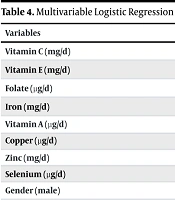
To identify independent dietary factors associated with H. pylori infection, a multivariable logistic regression model was fitted with adjustment for age, gender, and BMI (Table 4). Dietary nutrients were included based on their univariate associations and biological plausibility. Four micronutrients were significantly and independently associated with infection status. Higher intakes of vitamin C (OR = 0.954), vitamin E (OR = 0.733), and folate (OR = 0.976) were associated with a lower likelihood of H. pylori positivity (P < 0.05). In contrast, iron intake showed a positive association with infection. After adjustment for age, gender, and BMI, iron intake remained significantly associated with H. pylori positivity (OR = 2.573; 95% CI, 1.292 - 5.096; P = 0.007). The direction of this association differed from the univariate findings, potentially reflecting confounding or model instability.
Table 4.
Multivariable Logistic Regression Analysis of Dietary Factors Associated with H. pylori Positivity
| Variables | Odds Ratio (OR) | 95% CI | P Value a |
|---|---|---|---|
| Vitamin C (mg/d) | 0.954 | 0.920 - 0.990 | 0.013 b |
| Vitamin E (mg/d) | 0.733 | 0.553 - 0.969 | 0.029 b |
| Folate (µg/d) | 0.976 | 0.958 - 0.995 | 0.012 b |
| Iron (mg/d) | 2.573 | 1.292 - 5.096 | 0.007 b |
| Vitamin A (µg/d) | 1.000 | 0.992 - 1.007 | 0.907 |
| Copper (µg/d) | 0.994 | 0.981 - 1.007 | 0.357 |
| Zinc (mg/d) | 0.515 | 0.253 - 1.048 | 0.067 |
| Selenium (µg/d) | 0.943 | 0.814 - 1.092 | 0.432 |
| Gender (male) | 1.336 | 0.214 - 8.332 | 0.757 |
| BMI (kg/m2) | 0.918 | 0.760 - 1.110 | 0.378 |
| Age (y) | 0.915 | 0.834 - 1.004 | 0.060 |
| Vitamin D (µg/d) | 0.705 | 0.191 - 2.603 | 0.600 |
| Manganese (mg/d) | 0.849 | 0.068 - 10.673 | 0.899 |
| Magnesium (mg/d) | 0.998 | 0.967 - 1.030 | 0.899 |
| Calcium (mg/d) | 1.002 | 0.994 - 1.009 | 0.665 |
| Vitamin B1 (mg/d) | 0.654 | 0.040 - 10.581 | 0.765 |
| Vitamin B2 (mg/d) | 0.186 | 0.027 - 1.300 | 0.090 |
| Vitamin B3 (mg/d) | 0.953 | 0.706 - 1.286 | 0.752 |
| Vitamin B6 (mg/d) | 0.697 | 0.039 - 12.558 | 0.806 |
| Vitamin B12 (µg/d) | 0.877 | 0.181 - 4.253 | 0.870 |
| Vitamin B5 (mg/d) | 2.044 | 0.446 - 9.361 | 0.357 |
| Biotin (µg/d) | 0.977 | 0.914 - 1.045 | 0.503 |
a P values, ORs, and 95% CIs were estimated using a multivariable binary logistic regression model. Age, gender, and BMI were included as covariates. Dietary variables were selected based on univariate association (P < 0.05) and biological plausibility.
b Significant at P < 0.05.
5. Discussion
The demographic findings showed significant differences in weight and BMI between H. pylori-positive cases and H. pylori-negative controls (P < 0.05), whereas age, gender, and height did not differ significantly. H. pylori infection may impair nutrient absorption and thereby contribute to a lower BMI; however, the study design does not permit causal inference. Alternatively, lower body mass may reflect reduced appetite caused by dyspeptic symptoms or socioeconomic factors that independently affect both infection risk and weight (30). Mean dietary intakes of vitamins, minerals, energy, macronutrients, and fiber were generally lower in the case group, whereas fat intake was higher. Higher fat intake may delay gastric emptying, aggravate dyspeptic symptoms, and promote early satiety, potentially reducing the intake of other foods and total energy. These observations suggest that micronutrient intake and absorption may be impaired in individuals with H. pylori infection. Micronutrients may also play roles in the pathogenesis and progression of H. pylori-related gastric disease. The large differences in intake observed for several nutrients, including vitamin C and folate, may also be clinically relevant. Nevertheless, reverse causality should be considered because H. pylori-associated gastritis and dyspeptic symptoms may reduce appetite and food intake; therefore, lower micronutrient intake may be a consequence rather than a cause of infection.
This case-control study identified statistically significant associations between lower dietary intake of certain micronutrients and H. pylori infection status. As an observational study, however, it cannot establish causality. H. pylori infection may impair gastric function and nutrient absorption, leading to lower micronutrient levels rather than micronutrient deficiency predisposing individuals to infection. This interpretation is consistent with the known effects of chronic gastritis on gastric acid secretion and nutrient uptake (31). Because participants were recruited consecutively from a single referral clinic rather than through random sampling, the findings may not be fully generalizable to the broader population.
Dietary vitamin and mineral intakes in both groups were compared with DRI standards. Significant differences were observed for vitamins B1, B3, B5, B12, A, E, and C, biotin, folate, calcium, magnesium, zinc, iron, selenium, copper, and manganese (P < 0.001).
Assessment of dietary intake using an FFQ is inherently subject to recall bias, and the dietary estimates were not validated against biochemical markers. The significant difference in BMI between cases and controls is another potential confounder because BMI may influence both micronutrient status and susceptibility to H. pylori infection. Although the multivariable analyses were adjusted for age, gender, and BMI, residual confounding cannot be excluded. The study also did not assess downstream clinical outcomes of H. pylori infection, such as gastric atrophy, intestinal metaplasia, or malignancy, or evaluate the effects of micronutrient supplementation. Accordingly, micronutrient supplementation for prevention or treatment should be interpreted cautiously and within current clinical guidelines, including the Maastricht VI consensus, which does not support routine micronutrient supplementation based solely on associative dietary findings.
Multivariable logistic regression showed significant independent associations of vitamin E, vitamin C, folate, and iron intake with H. pylori positivity (P < 0.05). These variables should be interpreted as associated markers rather than definitive predictors.
Vitamin D intake was inadequate in both the case and control groups. Vitamin D has important roles in multiple physiological and immune functions (32). Successful eradication of H. pylori has been associated with increased serum vitamin D levels, suggesting a possible role in eradication. Shafrir et al. reported that vitamin D deficiency was 31% more prevalent among H. pylori-positive patients, whereas in the present study the prevalence of inadequate vitamin D intake was the same in both groups (33). Because vitamin D deficiency is common in the Iranian population, the high and similar prevalence in both groups may reflect broader regional public health patterns (34).
Bravo et al. reported that H. pylori in gastric microsamples can affect host immune status and alter the microbiome at multiple body sites, changes that may contribute to gastric and nongastric disease (35). Adequate micronutrient intake is important for innate immune function. Deficiencies of zinc and vitamins A and D can reduce natural killer cell function, whereas zinc or vitamin C supplementation may enhance activity (36, 37). Thus, reduced micronutrient intake or absorption may contribute to impaired immune function in patients with H. pylori infection.
Reported prevalence estimates for H. pylori vary substantially among populations. Studies cited in the manuscript reported a prevalence of 56.3% in Russia and 13.1% among 2,380 Chinese participants aged 16 - 19 years, with no significant differences by age or gender. In contrast, a study in Kuwait reported infection in 49.7% of 362 participants, with a lower prevalence among young women than among men (38, 39).
Previous studies have linked poor hygiene and inadequate nutrition with H. pylori infection, and Jarosz et al. reported an association between low fruit and vegetable intake and H. pylori positivity (40).
Mechanisms proposed for H. pylori-associated iron deficiency anemia include chronic gastritis with reduced gastric acid secretion, decreased ascorbic acid levels, and impaired intestinal iron absorption (41, 42). In the univariate analysis, dietary iron intake was significantly lower in H. pylori-positive participants than in controls. Milman et al. reported lower serum ferritin levels among infected adults (42, 43). In the multivariable model, however, higher iron intake was independently associated with greater odds of H. pylori positivity (OR = 2.573; 95% CI, 1.292 - 5.096). This reversal in direction may reflect confounding, model instability, or multicollinearity. H. pylori requires iron for survival and persistence, and mechanisms of bacterial iron acquisition have been described (44, 45). Choe et al. (46) reported increased lactoferrin sequestration in H. pylori-infected gastric mucosa, which may affect iron availability. Given the lower overall food intake in H. pylori-positive participants and the simultaneous inclusion of correlated dietary variables, the independent association of iron should be interpreted cautiously.
A Polish study reported that high fruit and vegetable intake was associated with a lower risk of H. pylori reinfection, an effect attributed to vitamin content (40). Vitamin C intake has also been suggested to inhibit H. pylori infection and gastric carcinogenesis (26). Habbash et al. found an inverse association between green pepper intake and H. pylori infection (47). Mard et al. reported associations between intake of chickpeas, tomatoes, onions, green peppers, apples, and citrus fruits and lower prevalence of infection; the inverse associations for green peppers, citrus fruits, and tomatoes were attributed to their vitamin C content (48). Öztürk et al. reported that H. pylori eradication may improve vitamin B12, vitamin A, and vitamin E deficiencies without vitamin replacement (49, 50). Other studies have reported that therapeutic doses of vitamins C and E may reduce H. pylori colonization and neutrophil activity, potentially through complementary effects with antibiotics and improved eradication rates (50, 51).
Overall, H. pylori infection is an important contributor to gastric carcinogenesis, whereas diet and lifestyle may influence infection and its consequences. Franceschi et al. suggested that H. pylori may contribute to nutritional imbalance (21), and other studies have linked infection with malnutrition and growth retardation. These observations suggest that adequate intake of vitamins and minerals may be relevant to the management of H. pylori infection (52). Further longitudinal and interventional studies incorporating biomarker validation and clinical outcomes are needed to clarify the role of micronutrients in H. pylori infection and management.
5.1. Limitations
This study has several limitations. First, participants were recruited from a single infectious diseases clinic in Kerman, which may limit generalizability to the broader Iranian population and to populations with different dietary cultures. Although the biological roles of micronutrients in gastric health are likely similar across populations, regional differences in food availability and dietary patterns mean that these associations should be confirmed in larger, multicenter studies. Despite efforts to achieve broadly comparable groups, baseline differences in BMI and gender were observed. These variables were adjusted for in the multivariable analysis, but residual confounding cannot be excluded. Lifestyle factors such as smoking, socioeconomic status, and physical activity were not available for adjustment, and nutrient intake was not energy-adjusted.
H. pylori infection status was not confirmed using a gold-standard invasive method. Although the stool antigen test is a reliable noninvasive method, the lack of invasive confirmation may have introduced nondifferential misclassification. No formal multicollinearity diagnostics, such as the variance inflation factor (VIF), were performed despite the high intercorrelation among nutrients. The EPV ratio of 4.1 was below the commonly preferred threshold, increasing the risk of model overfitting and instability. In addition, no correction for multiple comparisons was applied, increasing the potential for type I error. Together with the simultaneous inclusion of correlated dietary factors, these limitations may have reduced the precision of the OR estimates and may help explain the inconsistent direction of the iron association.
Dietary assessment relied on a self-reported FFQ covering the previous year and was therefore susceptible to recall bias. Because this was a case-control study, the temporal sequence between nutrient intake and infection cannot be established, and the observed associations may be influenced by reverse causality. Dietary intake also does not necessarily reflect biological micronutrient status because metabolism and H. pylori-associated changes in gastric absorption can alter nutrient status. The absence of biochemical markers, such as serum ferritin or vitamin concentrations, prevents confirmation of true clinical deficiencies. Finally, the relatively wide CIs for some estimates reflect the limited sample size and variability in dietary intake. The findings should therefore be interpreted cautiously and validated in larger studies with energy-adjusted dietary analyses.
5.2. Conclusions
In summary, lower dietary intakes of vitamin C, vitamin E, folate, and iron were associated with a higher likelihood of H. pylori positivity in this adult Iranian population. Because of the observational design, these findings do not establish a causal relationship. Whether micronutrient supplementation is effective for the prevention or management of H. pylori infection remains a hypothesis that should be evaluated in randomized clinical trials.
5.3. Recommendations
Given the importance of H. pylori as a risk factor for gastritis, peptic ulcer disease, and gastric adenocarcinoma, larger epidemiological studies across diverse regions and demographic groups are recommended. Future studies should examine regional risk factors and the effects of environmental and lifestyle variation on infection prevalence. Prospective clinical trials are also needed to determine whether targeted nutritional interventions can complement standard eradication therapy.