
1. Background
Candidiasis remains the most common fungal infection of the oral cavity, arising when host defences are compromised locally or systemically and the commensal yeast Candida transitions to an invasive, tissue-colonising state (1, 2). Reduced salivary flow, denture wearing, corticosteroid or broad-spectrum antibiotic use, uncontrolled diabetes, and immunosuppression each shift this balance, and the resulting pseudomembranous, erythematous, and denture-associated forms carry appreciable morbidity in vulnerable patients (2). C. albicans has long dominated the clinical picture, but the epidemiology is changing. Non-albicans species now account for a growing proportion of isolates, including C. krusei, which is intrinsically fluconazole-resistant, and C. parapsilosis, a biofilm-forming coloniser of prosthetic and mucosal surfaces; both frequently show reduced azole susceptibility (1, 2).
Chemical plaque control with antiseptic rinses is a mainstay of adjunctive oral care, and chlorhexidine remains the reference agent for both antibacterial and anti-candidal activity (3-5). However, its long-term acceptability is limited. Extrinsic staining of teeth and restorations, taste disturbance, mucosal desquamation, and calculus build-up are well documented, and together they erode patient adherence (6, 7). Combined with the broader clinical concern regarding antifungal resistance, these drawbacks have renewed interest in botanical rinses, whose multi-target chemistry is less prone to selecting resistant phenotypes (7, 8). Products based on Salvadora persica, Rosa damascena, and Punica granatum are already used in dentistry, and head-to-head trials indicate that a carefully standardised plant rinse can rival chlorhexidine on plaque and gingival indices while being better tolerated (8-10).
Punica granatum L. (Lythraceae) is a particularly attractive candidate. Its flowers, known in Persian ethnomedicine as golnar, are rich in hydrolysable tannins, mainly punicalagin and punicalin, together with ellagic and gallic acids and a range of flavonoids (11-13). These ellagitannins account for much of the plant’s antioxidant and antimicrobial reputation (14, 15). Mechanistic studies link pomegranate phenolics to fungal membrane permeabilisation and protein precipitation, and Brighenti and co-workers recently identified DNA topoisomerases I and II as direct molecular targets of punicalagin (16-18). Ethanolic pomegranate extracts inhibit Candida spp. in vitro and cause visible ultrastructural damage to the yeast wall and membrane, while clinical pomegranate rinses reduce plaque scores to a degree comparable with chlorhexidine (19-25).
Myrtus communis L. (Myrtaceae), the common myrtle (mūrd), complements this profile. Its leaves yield an essential oil rich in 1,8-cineole, α-pinene, myrtenyl acetate, and linalool, alongside gallotannins and the distinctive acylphloroglucinol myrtucommulone (26-28). Myrtle preparations show broad antibacterial and antifungal activity, disrupt Candida biofilms, and act synergistically with amphotericin B, indicating that the plant is a source of membrane-active antifungal leads (29-31). Its astringent, anti-inflammatory, and wound-healing properties, long used in traditional treatments of aphthous ulcers and other mucosal lesions, further support the development of a mucosal dosage form (27, 28, 32, 33).
Pairing the two botanicals is chemically rational. The bulky, protein-binding ellagitannins of pomegranate flower and the lipophilic, membrane-partitioning terpenoids of myrtle leaf may reach the fungal cell via different routes. This difference raises the prospect of additive or complementary inhibition within a single palatable rinse (29, 34, 35); formal synergy (e.g. by checkerboard/FICI) was not assessed in the present study and is therefore not claimed. Although single-plant data are abundant, no standardised P. granatum–M. communis polyherbal mouthwash has been formulated and benchmarked against a marketed herbal product across several Candida species.
2. Objectives
Four questions guided this work. What is the total phenolic content of the hydroethanolic pomegranate-flower and myrtle-leaf extracts? What are their intrinsic MIC and MFC against C. albicans, C. krusei, and C. parapsilosis? Can mouthwashes containing 1 - 5% total extract be compounded while maintaining the pH within an enamel-safe range? How does their anti-candidal activity compare with that of a vehicle control and the commercial rinse Persica™? We anticipated that a 5% combined formulation would approximate the commercial comparator in a species-dependent manner, without compromising physicochemical quality.
3. Methods
3.1. Plant Material and Extraction
Flowers of Punica granatum var. pleniflora and leaves of Myrtus communis L. were collected in Khuzestan Province, Iran, in July–August 2019, botanically authenticated by the Department of Pharmacognosy, and voucher specimens (P. granatum: A192330101FP; M. communis: A191850201LP) were deposited in the Herbarium of the Faculty of Pharmacy, Ahvaz Jundishapur University of Medical Sciences. Each material was shade-dried; 500 g of each dried material was milled and extracted by maceration in 70% (v/v) ethanol over three successive 48-h cycles with intermittent agitation. The pooled filtrates were concentrated under reduced pressure using a rotary evaporator (40 °C) and dried to constant weight in a vacuum oven; the extraction yields were 22.40% w/w (112.0 g) for pomegranate flower and 18.60% w/w (93.0 g) for myrtle leaf. The resulting semisolid extracts were stored at 4 °C, protected from light, until use.
3.2. Total Phenolic Content
Total phenolic content (TPC) was determined spectrophotometrically using the Folin–Ciocalteu method, following the assay format used in comparable botanical anti-Candida studies (19). Aliquots (0.5 mL) of extract or tannic-acid standard were mixed with 2.5 mL of ten-fold-diluted Folin–Ciocalteu reagent; after 5 min, 2.0 mL of 7.5% (w/v) sodium carbonate was added, and the tubes were kept in the dark for 2 h before absorbance was read at 600 nm. A tannic-acid calibration series at 12.5, 25, 50, and 100 µg/mL yielded the regression y = 0.0112x + 0.0018 (R2 = 0.999). Results are expressed as µg tannic-acid equivalents per gram of dry extract (µg TAE/g), n = 3.
3.3. Fungal Strains, MIC and MFC
Candida albicans (PTCC 5027) and C. krusei (PTCC 5295) were obtained as lyophilised cultures from the Iranian Collection of Industrial Fungi and Bacteria, and C. parapsilosis was obtained from the Medical Mycology collection of Ahvaz Jundishapur University of Medical Sciences. Minimum inhibitory concentrations (MIC) were established by broth macrodilution in Sabouraud dextrose broth using two-fold serial dilutions of each extract (0.78 - 200 mg/mL), prepared from the crude extracts alone, without sodium benzoate or any other formulation excipient, to measure intrinsic potency independently of the finished-product preservative system. Broth macrodilution (rather than 96-well microdilution) was selected because the intense colour and turbidity of the extracts interfere with optical turbidity read-outs, whereas tube dilution with confirmatory subculture provides an unambiguous end-point for pigmented extracts. A standardised inoculum (20 µL of a 0.5 McFarland suspension, corresponding to approximately 1 - 5 × 10⁶ CFU/mL for yeast) was added to each tube, which was then incubated at 27 °C for 48 h; the extract-free tube served as the growth control. For minimum fungicidal concentration (MFC), 20 µL from each clear tube was subcultured onto Sabouraud dextrose agar, and the lowest concentration yielding no colonies after 24 - 48 h was recorded (n = 3).
3.4. Mouthwash Formulation
Mouthwashes were compounded with equal parts of the two extracts as the active phase, purified water as the vehicle, glycerin 1% (co-solvent/humectant), ethanol 8% (co-solvent), sodium saccharin 0.1% (sweetener), and sodium benzoate 0.1% (preservative); dilute phosphoric acid/vinegar 0.01% was used as an acidulant in selected formulations. Because the buffered rinses were near neutral (pH ≈ 6.5) and benzoate (pKa ≈ 4.2) is more than 99% dissociated at this pH, the undissociated—and antimicrobially active—fraction is negligible; sodium benzoate therefore functioned only as a short-term stabiliser for the laboratory screening batches rather than as an effective preservative at the finished pH. A market-ready product would require a preservative system compatible with a neutral pH (for example, a paraben combination or phenoxyethanol), with adequacy demonstrated by a USP <51> antimicrobial-effectiveness (challenge) test. Four test preparations (F-A to F-D) were coded: F-A (1% total extract, acidulated), F-B (2.5%, non-acidulated), F-C (2.5%, acidulated) and F-D (5%, non-acidulated). Two extract-free vehicles served as negative controls: E (non-acidulated) and E+acid (acidulated with 0.01% phosphoric acid/vinegar); these were included so that any contribution of the acidulant itself could be distinguished from that of the botanical actives. The full quantitative composition is provided in Table 1. The commercial herbal rinse Persica™ (P) was used as the positive control (Persica™; Pursina Pharmaceutical Co., Tehran, Iran; a marketed herbal mouthwash containing hydroalcoholic extracts of Salvadora persica, Achillea millefolium, and Mentha spicata). The intrinsically acidic extract phase (initial pH ≈ 3.5) was titrated dropwise with sodium bicarbonate to a near-neutral target (6.5 ± 0.1), in accordance with established pharmaceutical practice for oral rinses (36).
Table 1.
Quantitative Composition of the Mouthwash Formulations and Vehicle Controls a
| Component | Role / Function | F-A (1%) | F-B (2.5%) | F-C (2.5%+A) | F-D (5%) | Vehicle E | Vehicle E+acid |
|---|---|---|---|---|---|---|---|
| P. granatum flower extract | Active botanical (% w/v) | 0.5 | 1.25 | 1.25 | 2.5 | — | — |
| M. communis leaf extract | Active botanical (% w/v) | 0.5 | 1.25 | 1.25 | 2.5 | — | — |
| Ethanol 96% | Co-solvent (% v/v) | 8.0 | 8.0 | 8.0 | 8.0 | 8.0 | 8.0 |
| Glycerin | Humectant (% v/v) | 1.0 | 1.0 | 1.0 | 1.0 | 1.0 | 1.0 |
| Sodium saccharin | Sweetener (% w/v) | 0.1 | 0.1 | 0.1 | 0.1 | 0.1 | 0.1 |
| Sodium benzoate | Lab stabiliser (% w/v) | 0.1 | 0.1 | 0.1 | 0.1 | 0.1 | 0.1 |
| Dilute phosphoric acid / vinegar | Acidulant (% v/v) | 0.01 | — | 0.01 | — | — | 0.01 |
| Sodium bicarbonate | pH buffer | q.s. (pH 6.5) | q.s. (pH 6.5) | q.s. (pH 6.5) | q.s. (pH 6.5) | — | — |
| Purified water | Vehicle base | q.s. 100 mL | q.s. 100 mL | q.s. 100 mL | q.s. 100 mL | q.s. 100 mL | q.s. 100 mL |
a Extract percentages denote total extract (equal parts P. granatum flower and M. communis leaf). The acidic extract phase was buffered to pH 6.5 ± 0.1 with sodium bicarbonate. “—” denotes a component not included.
3.5. Physicochemical Characterisation
The pH of each formulation was measured using a calibrated Metrohm electrode, and dynamic viscosity was recorded using a Brookfield rotational viscometer (Model DV-E, Spindle LV-1 / Spindle 61, 60 rpm) at 25 °C; both determinations were performed in triplicate.
3.6. Anti-Candidal Activity by Agar Well Diffusion
Sabouraud dextrose agar plates were surface-inoculated with a 0.5 McFarland–adjusted suspension of each species. Each 6-mm well was then loaded with a fixed volume of exactly 100 µL of the respective formulation, pure extract, or control. This volume filled the 6-mm well to capacity without overflow; keeping the loaded volume constant across all wells ensured that any differences in inhibition reflected composition rather than the amount of test article delivered. After incubation at 37 °C for 24 - 48 h, the zone of inhibition (ZOI) around each well was measured to the nearest 0.1 mm using a digital caliper (resolution 0.01 mm). All assays were performed as three independent replicates (n = 3).
3.7. Statistical Analysis
Data are presented as mean ± standard deviation (SD) from three independent experimental runs performed on separate days (biological replicates, n = 3), with each treatment assayed once per run. Distributional normality and variance homogeneity were verified (Shapiro–Wilk and Levene tests, P > 0.05) before parametric analysis. A two-way analysis of variance (ANOVA) evaluated the effects of formulation, Candida species, and their interaction on the inhibition zone, followed by Tukey's honestly significant difference (HSD) post-hoc test. Eight treatment levels were entered as the formulation factor—the two pure extracts, the four formulations (F-A–F-D), Persica™, and a single extract-free vehicle (E) as the baseline (negative-control) level (df = 8 − 1 = 7). The second vehicle (E+acid) was omitted from the factorial model because it and vehicle E returned identical, all-zero inhibition (0.00 ± 0.00) across every species; retaining both would have introduced a redundant, perfectly collinear, zero-variance level without adding information. The acidulant's null contribution is nonetheless established descriptively, as both vehicles were inactive against all three species. Given the modest replicate number, the key F-D versus Persica™ contrast was interpreted conservatively: the parametric result (Tukey HSD) is reported after the normality and homogeneity assumptions were met, the corresponding non-parametric comparison agreed in direction, and the small-sample finding should therefore be interpreted as exploratory rather than definitive. Effect sizes are reported as partial eta-squared (partial η2). Analyses were performed using SPSS v22 (IBM Corp., Armonk, NY, USA), with statistical significance set at P < 0.05.
4. Results
4.1. Total Phenolic Content
The Folin–Ciocalteu calibration curve was linear across the tested range (R2 = 0.999; Figure 1). Pomegranate-flower extract was the richer source of phenolics, at 4626.00 ± 42.50 µg TAE/g, exceeding myrtle-leaf extract (3287.00 ± 31.20 µg TAE/g) by approximately 40% (Table 2). This ranking is consistent with the high ellagitannin content expected for P. granatum floral tissue.
Table 2.
Total Phenolic Content of the Crude Hydroethanolic Extracts (N = 3) a
| Crude Extract | Plant Part | TPC (µg TAE/g Dry Extract) |
|---|---|---|
| Punica granatum var. pleniflora | Flower | 4626.00 ± 42.50 |
| Myrtus communis L. | Leaf | 3287.00 ± 31.20 |
a Values are expressed as mean ± SD. quantified against a tannic-acid standard (y = 0.0112x + 0.0018, R2 = 0.999).
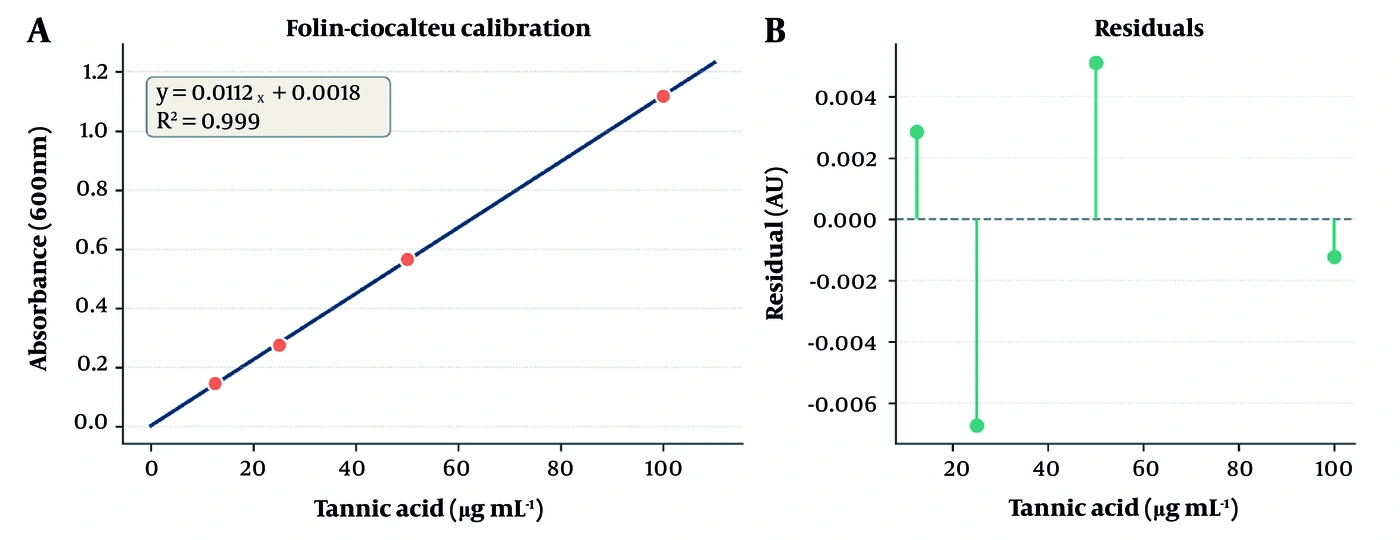
Figure 1.
(A) Folin–Ciocalteu calibration for tannic acid at 12.5, 25, 50, and 100 µg/mL (R2 = 0.999); (B) residuals of the fit.
4.2. Intrinsic Antifungal Potency (MIC and MFC)
Broth macrodilution showed identical potency for the two crude extracts across all three species: MIC = 50 mg/mL and MFC = 100 mg/mL. The two-fold MFC/MIC ratio indicates fungicidal rather than fungistatic activity at these concentrations, and the uniformity across C. albicans, C. krusei, and C. parapsilosis suggests a broadly acting, phenolic-driven mechanism rather than a species-selective effect. Notably, the finished mouthwashes deliver substantially lower extract concentrations: even the 5% rinse (F-D) provides about 50 mg/mL, which corresponds to the MIC rather than the MFC. Accordingly, the formulations act at an inhibitory (fungistatic) level, whereas fungicidal activity was confined to pure-extract concentrations ≥ 100 mg/mL.
4.3. Physicochemical Properties
All extract-containing rinses were buffered from their acidic starting point into a narrow, near-neutral range (pH 6.44 - 6.52), above the critical enamel demineralisation threshold (pH ≈ 5.5), whereas the extract-free vehicles remained more acidic (pH 5.62 - 5.81) (Table 3). Viscosity reflected composition rather than extract load, ranging from 1.10 to 2.40 cP; the 5% formulation (F-D) combined the highest phenolic content with a low, easily swished viscosity of 1.65 cP, favouring rapid mucosal spreading.
Table 3.
Physicochemical Parameters of the Mouthwash Formulations (N = 3) a
| Formulations | Composition | pH (25 °C) | Viscosity (cP, 25 °C) |
|---|---|---|---|
| F-A | 1% extract, acidulated | 6.48 ± 0.02 | 1.95 ± 0.05 |
| F-B | 2.5% extract | 6.44 ± 0.03 | 2.30 ± 0.08 |
| F-C | 2.5% extract, acidulated | 6.48 ± 0.02 | 2.40 ± 0.06 |
| F-D | 5% extract | 6.52 ± 0.02 | 1.65 ± 0.04 |
| E | Vehicle (extract-free) | 5.81 ± 0.04 | 1.24 ± 0.03 |
| E+acid | Vehicle, acidulated | 5.62 ± 0.03 | 1.10 ± 0.02 |
a Values are expressed as mean ± SD.
4.4. Anti-Candidal Activity of the Formulations
Inhibition zones for all extract-containing preparations, the pure extracts, both vehicle controls, and Persica™ are presented in Table 4 and illustrated in Figures 2 and 3. Neither vehicle produced measurable inhibition, whether acidulated (E+acid) or not (E): both yielded 0.00 mm against all three species. Activity therefore derives from the botanical actives rather than the excipient base or the acidulant. Among the formulations, inhibition increased steeply with extract concentration. F-A (1%) produced modest 10 - 12 mm zones. By contrast, F-D (5%) reached 23.00 ± 0.82 mm against C. parapsilosis, 20.00 ± 0.82 mm against C. albicans, and 25.00 ± 0.82 mm against C. krusei. As expected, the undiluted single extracts outperformed the finished rinses, and myrtle extract produced the largest zone (29.00 ± 1.00 mm against C. parapsilosis).
Table 4.
Zone of Inhibition (mm) of Extracts, Formulations, and Controls Against Three Candida Species (N = 3) a
| Treatment | C. parapsilosis | C. albicans | C. krusei |
|---|---|---|---|
| M. communis extract | 29.00 ± 1.00 | 22.00 ± 0.82 | 25.00 ± 0.82 |
| P. granatum extract | 25.00 ± 0.82 | 22.00 ± 1.00 | 20.00 ± 0.82 |
| F-A (1%) | 10.00 ± 0.47 | 10.00 ± 0.82 | 12.00 ± 0.47 |
| F-B (2.5%) | 22.00 ± 1.41 | 17.00 ± 0.82 | 20.00 ± 0.82 |
| F-C (2.5% + acid) | 17.00 ± 0.82 | 17.00 ± 0.82 | 21.00 ± 0.82 |
| F-D (5%) | 23.00 ± 0.82 | 20.00 ± 0.82 | 25.00 ± 0.82 |
| Vehicle E (non-acidulated) | 0.00 ± 0.00 | 0.00 ± 0.00 | 0.00 ± 0.00 |
| Vehicle E+acid (acidulated) | 0.00 ± 0.00 | 0.00 ± 0.00 | 0.00 ± 0.00 |
| Persica™ (P) | 22.00 ± 0.82 | 23.00 ± 0.82 | 28.00 ± 0.82 |
a Values are expressed as mean ± SD. Both vehicle controls, acidulated (E+acid) and non-acidulated (E), were inactive; all extract-containing treatments differed from them at P < 0.001. F-D versus Persica™: P = 0.412 (C. parapsilosis, not significant); P < 0.01 (C. albicans and C. krusei).
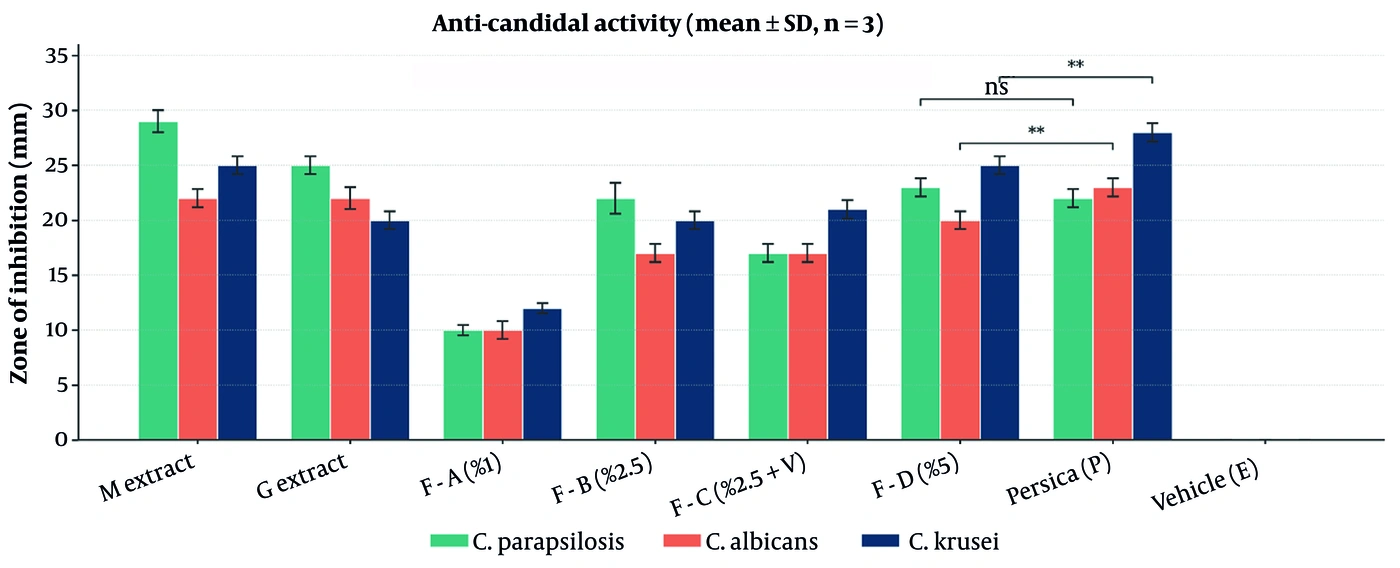
Figure 2.
Zone of inhibition (mean ± SD, n = 3) across the three species. Markers denote the F-D vs Persica™ contrast: ns (C. parapsilosis, P = 0.412); **, P < 0.01.
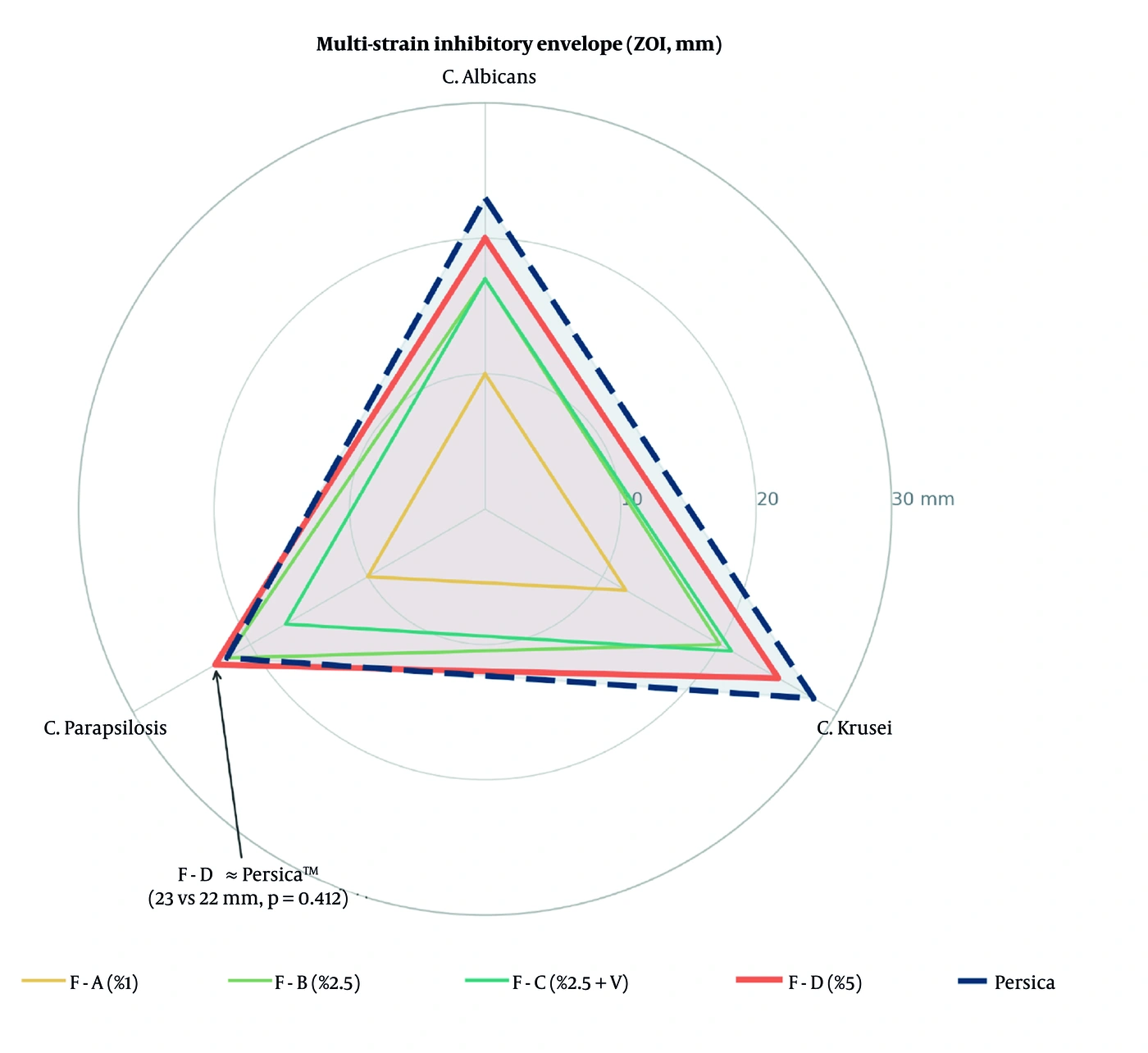
Figure 3.
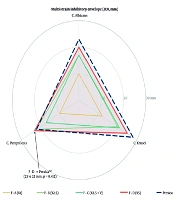
Multi-strain inhibitory envelope (ZOI, mm) for Formulations A–D and Persica™. The F-D and Persica™ contours coincide on the C. parapsilosis axis (P = 0.412).
4.5. Dose–response and Physicochemical Matrix
Linking crude-extract chemistry to the delivered strength clarifies the concentration–response relationship. Because the two extracts were blended in equal parts, the combined material had a mean phenolic load of 3956.5 µg TAE/g. At 1%, 2.5% and 5% (w/v), this corresponds to formulation phenolic densities of 39.6, 98.9 and 197.8 µg TAE/mL, respectively (Table 5). Grand-mean inhibition, averaged across the three species, increased with this density from 10.67 mm for F-A to 22.67 mm for F-D. The acidulant conferred no advantage: acidulated F-C matched its non-acidulated counterpart, F-B, almost exactly (18.33 vs 19.67 mm), consistent with the null activity of the acidulated vehicle.
Table 5.
Integrated Dose–response and Physicochemical Matrix for the Extract-Containing Formulations a
| Formulation | Extract (% w/v) | TPC density (µg TAE/mL) | Buffered pH | Viscosity (cP) | Mean ZOI (mm) |
|---|---|---|---|---|---|
| F-A | 1.0 | 39.56 | 6.48 | 1.95 | 10.67 |
| F-B | 2.5 | 98.91 | 6.44 | 2.30 | 19.67 |
| F-C | 2.5 (+acid) | 98.91 | 6.48 | 2.40 | 18.33 |
| F-D | 5.0 | 197.83 | 6.52 | 1.65 | 22.67 |
a TPC density is derived from the 1:1 extract blend (mean 3956.5 µg TAE/g) at the stated % w/v; the grand-mean ZOI is averaged across C. albicans, C. krusei, and C. parapsilosis.
4.6. Two-Way ANOVA
The factorial analysis (Table 6) identified formulation as the principal source of variance in inhibition (F7,48 = 1046.40, P < 0.001), accounting for most of the between-group variance (partial η2 = 0.99). Candida species also had a significant main effect (F2,48 = 68.90, P < 0.001, partial η2 = 0.74). A formulation × species interaction was also significant (F14,48 = 22.90, P < 0.001, partial η2 = 0.87), indicating that the ranking of preparations depended on the target organism. Post-hoc contrasts identified the key clinical finding. Against C. parapsilosis, the 5% formulation showed no statistically significant difference from the commercial rinse (23.00 vs 22.00 mm; P = 0.412), whereas Persica™ retained a modest advantage against C. albicans and C. krusei (P < 0.01). The radar plot in Figure 3 depicts the multi-strain inhibitory profile, with the F-D and Persica™ contours converging on the C. parapsilosis axis.
Table 6.
Two-Way ANOVA of the Inhibition Zone, with Formulation and Candida Species as Factors a
| Sources | df | F | P | Partial η2 |
|---|---|---|---|---|
| Formulation | 7 | 1046.40 | < 0.001 | 0.99 |
| Candida species | 2 | 68.90 | < 0.001 | 0.74 |
| Formulation × species | 14 | 22.90 | < 0.001 | 0.87 |
| Residual | 48 | — | — | — |
a The formulation factor comprised eight levels—the two pure extracts, formulations F-A–F-D, Persica™, and one extract-free vehicle (E) as the baseline level (df = 8 − 1 = 7); vehicle E+acid was excluded from the model as a redundant, zero-variance duplicate of vehicle E (both 0.00 ± 0.00 across all species).
5. Discussion
This study integrates two botanicals that have been investigated individually into a single, physicochemically rational rinse and evaluates it against a marketed comparator. The results converge on three points. First, the combined 5% formulation showed marked anti-candidal activity (inhibitory, at an MIC-level extract concentration; the crude extracts themselves were fungicidal at ≥ 100 mg/mL) against all three Candida species. Second, activity increased sharply with extract concentration, and the factorial model attributed most of the variance in inhibition to the formulation (partial η2 = 0.99), with a genuine species-dependent component captured by the interaction term. Third, against the biofilm-forming coloniser C. parapsilosis, the formulation showed in vitro activity comparable to that of the commercial rinse; this in vitro parity is of potential interest given the organism’s prominence on prosthetic and mucosal surfaces, but it does not imply clinical equivalence.
These outcomes have a clear mechanistic basis. Pomegranate activity is mainly attributed to hydrolysable tannins: punicalagin, punicalin, and their hydrolysis products, ellagic and gallic acid. These compounds precipitate fungal surface proteins and permeabilise the plasma membrane; as Brighenti and colleagues showed, punicalagin additionally inhibits Candida DNA topoisomerases I and II, a target reported there for the first time (16, 17, 19). The higher phenolic titre we recorded for the pomegranate-flower extract (4626 vs 3287 µg TAE/g) is consistent with this mechanism and aligns with reports correlating pomegranate antifungal activity with phenolic content (37). Myrtle contributes complementary chemistry. Its volatile fraction (1,8-cineole, α-pinene, myrtenyl acetate) and the acylphloroglucinol myrtucommulone favour partitioning into and disruption of the ergosterol-containing membrane, an action linked to inhibition of Candida biofilm formation and potentiation of amphotericin B (26, 29, 30). Combining large, protein-binding ellagitannins with small, membrane-active terpenoids provides two largely independent routes of attack, plausibly underlying the concentration-responsive potency observed here (18, 35). The Folin–Ciocalteu assay quantifies total phenolics only; punicalagin, myrtucommulone, and the other individual constituents named here are inferred from previous phytochemical studies of these species rather than being identified or quantified in the present extracts.
Our inhibition data fall within the published range for the two plants when assayed separately. Ethanolic pomegranate extracts and their isolated tannins inhibit Candida spp. with concomitant ultrastructural damage (19), and various Persian pomegranate cultivars show cultivar-dependent anti-candidal activity attributable to punicalagin content (20). Reports on pomegranate flower and peel against C. albicans bracket our values, with differences tracking extract type, solvent, and assay format (38). Myrtle extracts and essential oils likewise yield inhibition zones and MICs against Candida comparable to those observed in the present matrix (30, 31). The stronger performance of the undiluted single extracts is unsurprising, reflecting the dilution inherent to a palatable, mucosally tolerable dosage form rather than antagonism between the two botanicals.
From a pharmaceutics standpoint, the pH strategy is as important as the antifungal outcome. The extract phase is markedly acidic owing to its tannin and organic-acid content, and an unbuffered rinse at pH ≈ 3.5 would risk enamel demineralisation because hydroxyapatite dissolves below a critical pH of about 5.5. Titrating every formulation into the 6.44 - 6.52 range preserved antifungal performance while reducing that risk, and the low viscosity of the 5% product (1.65 cP) should support even mucosal coverage during the brief oral residence typical of a rinse. These attributes are areas in which botanical rinses may differentiate themselves from chlorhexidine, whose efficacy is offset by staining and dysgeusia that limit sustained use (6, 7).
The comparison with Persica™ warrants a measured interpretation. Parity against C. parapsilosis (P = 0.412) is encouraging, but the commercial rinse retained a statistically significant edge against C. albicans and C. krusei. Persica™ is a multi-herb product, and its broader phytochemical envelope may account for the residual advantage; it also underscores that a two-plant system, however rational, does not necessarily outperform an established formulation across all species. The species-dependent ranking evident in the interaction term highlights that anti-candidal claims should be resolved at the species level rather than asserted for the genus as a whole.
5.1. Study Limitations
Several limitations temper these conclusions. This work is entirely in vitro. Agar diffusion is a standard comparative screen, but it reflects diffusion behaviour as well as intrinsic potency; because the formulations differ in extract concentration, viscosity, and diffusion behaviour, inhibition zones should be interpreted as in vitro screening outcomes rather than direct measures of antifungal potency, and the ranking of a viscous, tannin-rich rinse should be confirmed by broth-based and time-kill assays. MIC and MFC were determined for the crude extracts; because the finished mouthwash also contains co-solvents, a humectant, a sweetener, and a buffer, the 50 mg/mL crude-extract MIC should not be equated with an MIC of the complete formulation, which was not determined. We performed no anti-biofilm, germ-tube, or ergosterol-quantification assays, leaving the proposed mechanisms inferential for this specific blend. Because the formulation relies on crude botanical extracts characterised only by total phenolic content, batch-to-batch variability in phenolic composition may affect reproducibility and biological activity; marker-based standardisation (for example, punicalagin and myrtucommulone by HPLC) would be required for pharmaceutical development. The 1:1 extract ratio was a rational equal-parts choice rather than an experimentally optimised one; alternative ratios were not investigated, and the present composition therefore cannot be considered optimal from a pharmacological or formulation-development standpoint. Cytocompatibility on human gingival fibroblasts, long-term ICH-guided physicochemical and microbiological stability, preservative efficacy, taste acceptability, and the risk of tannin-driven extrinsic staining were outside the present scope and must precede clinical use. Finally, the analysis is based on three independent replicates per condition within a single-laboratory design; because each treatment was assayed once per run, experimental day was not modelled as a separate factor, and any between-day variation is therefore confounded with residual error. The resulting very large effect sizes should be interpreted with caution and confirmed in additional independent experiments. The apparent comparability between the lead formulation and the commercial comparator, in particular, should be regarded as preliminary and requires confirmation in larger, independently replicated studies.
Future work should therefore prioritise a stability-indicating formulation study, fibroblast cytotoxicity and biofilm-eradication assays, mechanistic confirmation (membrane integrity, reactive-oxygen and topoisomerase read-outs), and ultimately a randomised clinical comparison against chlorhexidine and Persica™ in denture stomatitis and oral thrush. Standardising the extracts to defined punicalagin and myrtucommulone contents (for example by HPLC) would also improve batch reproducibility and regulatory tractability.
Figure 4 integrates these two strands, mapping the formulation workflow and pH-buffering strategy onto the proposed (and, for this specific blend, not yet directly measured) dual mechanism by which the pomegranate and myrtle actives are hypothesised to converge on the Candida cell.
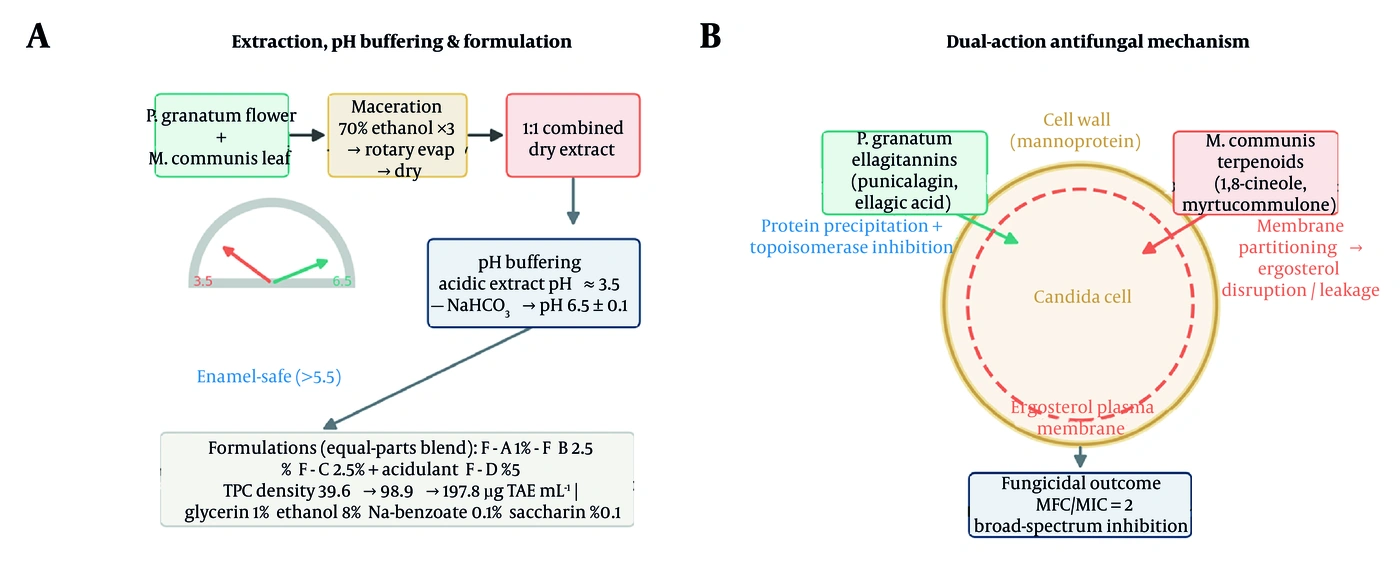
Figure 4.
Graphical abstract. (A) Extraction, NaHCO3 pH buffering (3.5 → 6.5), and 1:1 blend formulation (1 - 5% w/v). (B) Proposed dual mechanism (hypothesised, not directly measured for this blend): P. granatum ellagitannins precipitate wall proteins and inhibit topoisomerases; M. communis terpenoids disrupt the ergosterol membrane (MFC/MIC = 2).
5.2. Conclusions
A lead polyherbal mouthwash containing 5% combined Punica granatum var. pleniflora flower and Myrtus communis L. leaf extracts combines marked, MIC-level inhibitory activity (with the crude extracts fungicidal at ≥ 100 mg/mL) against C. albicans, C. krusei, and C. parapsilosis with a near-neutral pH maintained above the critical enamel-demineralisation threshold and a favourable rinsing viscosity. Its inhibition of C. parapsilosis showed no statistically significant difference from that of a commercial herbal rinse, and formulation concentration emerged as the dominant driver of efficacy. Together with the two extracts’ complementary tannin- and terpenoid-based mechanisms, these results characterise the polyherbal rinse as a preliminary in vitro candidate whose potential as an adjunct for oral candidiasis remains to be established through cytotoxicity, mucosal-compatibility, anti-biofilm, preservative-efficacy, stability, and clinical studies; no clinical applicability is implied by these in vitro findings.