
1. Background
Prolonged exposure to solar UV radiation is strongly associated with adverse effects on human skin, including sunburn, photoaging, hyperpigmentation, and an increased risk of skin cancer. Environmental factors, such as air pollution and depletion of the stratospheric ozone layer, have further increased human exposure to UV radiation. Consequently, UV radiation is recognized as an important environmental factor affecting skin health. Based on wavelength and biological effects, UV radiation is classified into 3 regions:
1) UVA, wavelength range 320 - 400 nm.
2) UVB, wavelength range 280 - 320 nm.
3) UVC, wavelength range 100 - 280 nm.
Although UVC is the most harmful form of UV radiation, it is completely absorbed by the ozone layer and does not reach the Earth's surface. Therefore, photoprotection strategies primarily focus on UVA and UVB radiation. UVB radiation is mainly responsible for erythema, sunburn, and hyperpigmentation, whereas UVA radiation penetrates deeper into the skin and contributes to wrinkles and premature skin aging (1).
UVB is primarily absorbed by chromophores in the stratum corneum and can damage critical biomolecules, such as melanin, cellular DNA, proteins, lipids, and amino acids. It induces acute inflammatory responses by stimulating the release of mediators, such as histamine, serotonin, and prostaglandins, leading to erythema and edema. Moreover, UVB can directly damage DNA by forming pyrimidine dimers, leading to mutations and impaired DNA repair mechanisms. In contrast, UVA radiation exerts its effects mainly through the indirect generation of reactive oxygen species (ROS), which cause oxidative damage to cellular components, including collagen and elastin fibers. These processes contribute to photoaging, immunosuppression, and carcinogenesis (1).
Sunscreens are topical products designed to reduce the harmful effects of UV radiation by absorbing, reflecting, or scattering UV rays. Both synthetic and natural UV filters are used in sunscreen formulations. Given the potential for prolonged and repeated exposure, the safety of sunscreen ingredients is of critical importance (2). Ideal UV filters should be nontoxic, nonallergenic, and photostable and should not penetrate the skin barrier or induce systemic or cellular toxicity (1).
Despite their widespread use, several synthetic UV filters used in commercial sunscreen formulations have been associated with adverse effects on human health and the environment. Certain chemical UV absorbers may undergo photo-degradation after UV exposure, generating ROS that exert cytotoxic and genotoxic effects on skin cells. In addition, inorganic UV filters, such as zinc oxide and titanium dioxide nanoparticles, although highly effective, have raised concerns because of their potential to penetrate cells and induce apoptosis and cellular damage. Consequently, increasing attention has been directed toward safer and more sustainable alternatives to conventional synthetic sunscreen agents. Natural compounds have emerged as promising candidates for photoprotection because of their favorable safety profiles and multifunctional biological activities. Many naturally derived substances exhibit UV-absorbing capabilities in addition to antioxidant, anti-inflammatory, and anticarcinogenic properties. These compounds are generally biodegradable, environmentally compatible, and less likely to cause adverse skin reactions, making them attractive alternatives for incorporation into sunscreen formulations. Consequently, interest in natural UV filters for use in cosmetic and pharmaceutical products has increased (3).
Marine algae represent a rich and renewable source of bioactive compounds with diverse applications in the pharmaceutical, cosmetic, and nutraceutical industries. Sargassum, a genus of brown algae in the family Sargassaceae, has attracted considerable attention (4). Various Sargassum species are found in tropical and subtropical waters, including the coastal areas of the Persian Gulf and the Oman Sea in Iran (5). Morphologically, Sargassum species are characterized by densely branched cylindrical thalli with leaf-like structures of various shapes, including round, spatulate, linear, and lanceolate forms (4). Biochemically, Sargassum algae are rich in vitamins, carotenoids, proteins, minerals, and secondary metabolites, including terpenoids, sterols, sulfated polysaccharides, and polyphenols. These constituents have been reported to exhibit antioxidant, anti-inflammatory, antimicrobial, neuroprotective, hepatoprotective, and anticancer activities (4).
Brown algae, including Sargassum species, are adapted to environments with high sunlight exposure and can synthesize UV-absorbing compounds as a protective mechanism. This inherent photoprotective capability suggests that brown algae extracts may serve as natural UV filters. Several studies have demonstrated that phenolic compounds and polyphenols present in Sargassum species may contribute to their antioxidant and UV-absorbing properties (6).
Herbal formulations have been widely investigated for pharmaceutical applications and have demonstrated acceptable safety and efficacy profiles, supporting continued exploration of natural bioactive compounds in topical products (7).
2. Objectives
This study aimed to investigate the extraction, characterization, and incorporation of S. oligocystum extract into topical gels and to evaluate their physicochemical properties and sun-protection efficacy.
3. Methods
3.1. Collection and Preparation of Algae
The brown seaweed S. oligocystum was collected from the coastal area of Bushehr, Persian Gulf, Iran, in March 2023. After collection, the samples were inspected and manually cleaned to remove epiphytes, sand, and other adhering materials. The algae were thoroughly rinsed with distilled water to remove residual seawater salts and surface debris. The samples were then transferred to the Marine Pharmaceutical Science Research Center, Ahvaz Jundishapur University of Medical Sciences, for taxonomic identification and were identified as S. oligocystum.
After identification, the cleaned algal material was spread in a thin layer and air-dried under shaded, well-ventilated conditions at room temperature. Direct sunlight was avoided to minimize potential degradation of light-sensitive bioactive compounds. The samples were dried until no visible moisture remained and were then ground into a fine powder using a mechanical grinder. The powdered algae were transferred to clean, airtight containers and stored in a cool, dry, and dark environment until extraction and analysis.
3.2. Extraction and Preparation of Algal Powder
The dried and powdered S. oligocystum material (996 g) was subjected to maceration extraction with 70% (v/v) ethanol. The algal powder was placed in an extraction vessel, and sufficient 70% ethanol was added to completely immerse the material. Extraction was performed at room temperature for 48 hours. After each extraction cycle, the mixture was filtered through Whatman filter paper, and the filtrate was collected. The extraction procedure was repeated 3 times to maximize recovery of extractable constituents, and the filtrates from the 3 cycles were combined.
The combined extract was concentrated under reduced pressure using a rotary evaporator at 45 °C and 90 rpm. After solvent removal, the concentrated extract was further dried to obtain a dry powdered extract. The dried extract was weighed, and the extraction yield was calculated as the weight of the dried extract relative to the initial weight of dried algal powder. The extraction yield was approximately 16.67% (w/w). The powdered extract was stored in an airtight container at 4 °C until formulation and subsequent analyses.
3.3. Folin-Ciocalteu Assay
The total phenolic content of the algal extract was quantified using the Folin-Ciocalteu assay. Briefly, aliquots of the extract were mixed with Folin-Ciocalteu reagent and a sodium carbonate solution. After incubation in the dark for 2 hours, absorbance was measured at 765 nm using a UV-Vis spectrophotometer.
3.4. Formulation Preparation
Gel formulations containing different concentrations of algal extract (0%, 5%, 7%, and 10%) were prepared using either carbomer or HPMC as the gelling agent. The gelling agents were dispersed in distilled water and allowed to hydrate. The algal extract and other formulation components, including emulsifiers and preservatives, were then added with continuous stirring until a homogeneous gel was obtained. The compositions of the gel formulations are shown in Table 1. Triethanolamine was added dropwise to F1-F4 until the pH reached 6 - 7; however, the exact quantity was not recorded.
Table 1.
Composition of Gel Formulations (% w/w)
| Ingredients | F1 | F2 | F3 | F4 a | F5 | F6 | F7 | F8 |
|---|---|---|---|---|---|---|---|---|
| Sargassum extract | 0 | 5 | 7 | 10 | 0 | 5 | 7 | 10 |
| Carbomer 940 | 2.1 | 2.1 | 2.1 | 2.1 | 0 | 0 | 0 | 0 |
| HPMC | 0 | 0 | 0 | 0 | 4 | 4 | 4 | 4 |
| Glycerin | 5 | 5 | 5 | 5 | 5 | 5 | 5 | 5 |
| Propylene glycol | 5 | 5 | 5 | 5 | 5 | 5 | 5 | 5 |
| Methylparaben | 0.02 | 0.02 | 0.02 | 0.02 | 0.02 | 0.02 | 0.02 | 0.02 |
| Triethanolamine | b | b | b | b | 0 | 0 | 0 | 0 |
| Distilled water c | 100 | 100 | 100 | 100 | 100 | 100 | 100 | 100 |
a F4 was biphasic and nonuniform.
b Triethanolamine was added dropwise to F1-F4 until the pH reached 6 - 7; however, the exact quantity was not recorded.
c Quantum satis (q.s.) to 100% (w/w).
3.5. Physicochemical Tests
3.5.1. Appearance and Homogeneity Evaluation
All developed gels were evaluated for uniformity, clarity, color, overall visual appearance, and odor. The product was expected to have an appropriate clear appearance and be free of turbidity.
3.5.2. pH Measurement
The pH of the gel formulations was determined using a digital pH meter calibrated at room temperature (25 °C). The electrode was immersed directly in the gel samples, and readings were taken after stabilization. Measurements were repeated 3 times for each formulation. Measurements were performed on days 1, 30, 60, and 90 after preparation to detect changes in pH over time.
3.5.3. Spreadability Test
Spreadability was assessed using the glass-slide method. A 1 g sample of gel was placed between 2 glass slides. A standard weight of 250 g was placed on the upper slide, allowing the gel to spread for 1 minute. The diameter of the spread gel was measured in centimeters with a ruler before and after weight placement. Spreadability was calculated using the following formula and expressed in g·cm/s:
where M is the weight placed on the upper plate (g), Df is the final diameter after placement of the weight (cm), Di is the initial diameter (cm), and T is the time in seconds.
3.5.4. Viscosity Measurement
Viscosity was measured at room temperature (25 °C) using a Brookfield viscometer. Readings were obtained at 4, 5, 10, and 20 rpm using spindle No. 64. Viscosity was recorded in centipoise (cP).
3.6. In Vitro Spectrophotometric Sun Protection Factor Estimate
The effectiveness of a sunscreen is commonly expressed by the sun protection factor (SPF), defined as the ratio of UV energy required to produce a minimal erythemal dose (MED) in protected skin to that required in unprotected skin.
The MED refers to the shortest exposure time or lowest dose of UV radiation required to induce minimal perceptible erythema in unprotected skin. A higher SPF corresponds to greater effectiveness in protecting against sunburn.
In vitro evaluation provides a rapid and practical approach for preliminary screening and can reduce the need for in vivo experiments, as well as the risks associated with UV exposure in human participants, when experimental parameters are appropriately standardized and optimized. In vitro methods are generally of 2 types: those that measure absorption or transmission of UV radiation through sunscreen films on quartz plates or biomembranes, and those that determine the absorption characteristics of sunscreen agents through spectrophotometric analysis of dilute solutions (9).
An efficient and reproducible in vitro method for estimating SPF is based on spectrophotometric measurement of product absorbance from 290 to 320 nm at 5 nm intervals. Before analysis, gel samples were diluted in water at 1:100 and filtered to obtain clear solutions suitable for spectrophotometric measurement. SPF was then calculated according to the Mansur equation (10).
where CF is the correction factor (10), EE(λ) is the erythemogenic effect of radiation at wavelength λ, and ABS(λ) is the spectrophotometric absorbance at wavelength λ. The normalized EE × I(λ) constants reported by Sayre et al. (11) were used and are presented in Table 2 (12).
Table 2.
Association Between the Erythemogenic Effect and Corresponding Radiation Intensity at Individual Wavelengths
| Wavelength (λ, nm) | EE × I(λ) |
|---|---|
| 290 | 0.0150 |
| 295 | 0.0817 |
| 300 | 0.2874 |
| 305 | 0.3278 |
| 310 | 0.1864 |
| 315 | 0.0837 |
| 320 | 0.0180 |
3.7. Statistical Analysis
All experiments were performed in triplicate (n = 3), and results are expressed as mean ± SD. Statistical analysis was performed using one-way analysis of variance (ANOVA), followed by Tukey honestly significant difference (HSD) post hoc testing for multiple pairwise comparisons. A P value < 0.05 was considered statistically significant.
4. Results
4.1. Total Phenolic Content
The total phenolic content, measured using the Folin-Ciocalteu assay, was 30.611 mg gallic acid equivalents per gram of extract (mg GAE/g).
4.2. Physicochemical Properties of the Formulations
4.2.1. Appearance and Homogeneity Evaluation
Formulations F1 and F5, which did not contain Sargassum extract, were clear and colorless. The formulations containing Sargassum extract were clear and amber-colored; however, F4 was biphasic and nonuniform and was therefore excluded from the remaining tests. This behavior may have resulted from disruption of the polymer network at the high extract concentration, possibly due to solubility limitations or interactions between extract components and the gelling agent. Brown algae extracts contain various ionic and bioactive compounds, including phenolics and polysaccharides, which may interfere with the carbomer gel structure and reduce formulation stability.
4.2.2. pH
The pH of topical gel formulations is important because these systems are applied directly to the skin and should be compatible with its physiological pH. Gel preparations should therefore have a pH similar to that of human skin (4.5 - 6.5) to minimize irritation or erythema (13). Excessively acidic formulations may irritate the skin, whereas excessively alkaline formulations may cause scaling (14).
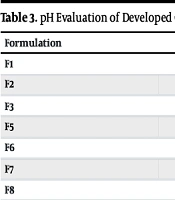
The pH of the carbomer-based gel formulations ranged from 6.75 to 7.15, whereas the HPMC-based gels had pH values of 5.91 to 6.49. These ranges are close to the natural pH of human skin (approximately 5.5 - 7), supporting the suitability of the gels for topical application. The results are presented in Table 3.
Table 3.
pH Evaluation of Developed Gels (N = 3) a
| Formulation | pH (day 0) | pH (day 30) | pH (day 60) | pH (day 90) |
|---|---|---|---|---|
| F1 | 6.97 ± 0.011 | 7.05 ± 0.010 | 7.10 ± 0.010 | 7.15 ± 0.011 |
| F2 | 6.78 ± 0.029 | 6.77 ± 0.015 | 6.81 ± 0.006 | 6.87 ± 0.015 |
| F3 | 6.75 ± 0.015 | 6.76 ± 0.006 | 6.79 ± 0.015 | 6.83 ± 0.011 |
| F5 | 6.49 ± 0.011 | 6.45 ± 0.025 | 6.47 ± 0.025 | 6.49 ± 0.076 |
| F6 | 6.02 ± 0.105 | 6.09 ± 0.043 | 6.11 ± 0.058 | 6.18 ± 0.015 |
| F7 | 5.96 ± 0.010 | 6.01 ± 0.010 | 6.02 ± 0.020 | 6.08 ± 0.006 |
| F8 | 5.89 ± 0.040 | 5.96 ± 0.070 | 5.91 ± 0.015 | 5.94 ± 0.006 |
a Values are expressed as mean ± SD.
Increasing the concentration of Sargassum extract caused a significant decrease in the formulation pH (P < 0.05), possibly because acidic compounds in the algae extract lowered the pH as extract concentration increased. During 3 months of storage, the pH did not change significantly (P > 0.05), indicating pH stability.
4.2.3. Spreadability
Spreadability is an important parameter in the evaluation of topical preparations because it describes the ease of distribution across the skin surface. Appropriate spreadability facilitates uniform dosing and affects patient compliance and sensory perception. A larger dispersion diameter allows the gel to cover a larger surface area (13).
Spreadability values ranged from 6.111 to 8.334 g·cm/s. F1 had the highest spreadability and may therefore have had a softer texture and greater response to applied pressure, whereas F8 had the lowest spreadability, potentially reflecting a denser structure (Table 4).
Table 4.
Spreadability Evaluation of Developed Gels (N = 3) a
| Formulation | Spreadability (g·cm/s, 250 g) |
|---|---|
| F1 | 8.334 ± 0.00 |
| F2 | 7.639 ± 0.24 |
| F3 | 7.916 ± 0.00 |
| F5 | 6.667 ± 0.42 |
| F6 | 6.667 ± 0.00 |
| F7 | 6.250 ± 0.42 |
| F8 | 6.111 ± 0.48 |
a Values are expressed as mean ± SD.
Mean spreadability differed significantly between carbomer- and HPMC-based gels (P < 0.05), with carbomer-based gels showing higher spreadability. This difference may be related to the structure and properties of the base polymers.
Within both gel groups, different concentrations of Sargassum extract did not significantly affect spreadability (P > 0.05), although spreadability decreased slightly as extract concentration increased. This slight decrease may reflect the effect of increasing active-ingredient concentration on the internal gel structure and viscosity, but the effect was insufficient to significantly alter spreadability.
Overall, the spreadability of the studied formulations was within a suitable range, indicating that the gels could spread readily on the skin under different pressures, potentially improving consumer acceptance and product performance.
4.2.4. Viscosity
Viscosity is a measure of a gel's resistance to flow and affects ease of application, spreadability, and stability. Fluids with high viscosity, at least approximately 2,000 - 4,000 cP, are considered gels (13).
At 10 rpm, the measurable carbomer-based gels had viscosities ranging from 40,831 to 54,888 cP, substantially higher than the HPMC-based gels, which had viscosities ranging from approximately 6,500 to 8,400 cP. The higher viscosity of the carbomer gels suggests a thicker consistency and potentially slower release of active compounds (Table 5).
Table 5.
Viscosity Evaluation of Developed Gels (N = 3) a
| Formulation | Viscosity (cP, 10 rpm) |
|---|---|
| F1 | Not measurable b |
| F2 | 54888 ± 766 |
| F3 | 40831 ± 1301 |
| F5 | 7978 ± 317 |
| F6 | 7298 ± 249 |
| F7 | 7238 ± 242 |
| F8 | 7498 ± 779 |
a Values are expressed as mean ± SD.
b The formulation behaved as a free-flowing liquid below the viscometer's detection threshold.
In carbomer-containing samples, viscosity decreased as Sargassum concentration increased, whereas in HPMC-containing samples, viscosity generally increased with increasing Sargassum concentration. However, ANOVA showed that increasing the extract concentration did not significantly affect viscosity (P > 0.05).
These results indicate that the type of base polymer had the greatest effect on viscosity; carbomer produced higher viscosity by creating a denser network, whereas HPMC produced less viscous gels.
The viscosity of F1 could not be reliably determined under the selected measurement conditions because the formulation had very low viscosity and behaved as a free-flowing liquid. Its viscosity was likely below the lower detection limit of the viscometer for the selected spindle and rotational-speed configuration.
4.3. In Vitro Spectrophotometric SPF Estimates
Formulations containing S. oligocystum extract demonstrated significantly improved SPF values compared with control gels. SPF values for gels without extract were approximately 0.7 - 1. Formulations containing 5%, 7%, and 10% extract had SPF values of approximately 5.3, 7.6, and 8.8, respectively. The increase was significant from 0% to 5% and from 5% to 7%, whereas no significant further increase in UV protection was observed at 10%, indicating that the SPF effect plateaued at 7% extract concentration.
As shown in Table 6, the lowest in vitro spectrophotometric SPF values, approximately 0.7 - 1, were observed for F1 and F5, which contained no Sargassum extract. This finding indicates that the other additives did not provide meaningful sunscreen activity in the absence of the active extract. SPF values slightly below 1.0 in the control formulations indicate no photoprotective effect and may reflect acceptable instrumental or measurement variation during UV-Vis spectroscopy. In contrast, formulations containing Sargassum extract had substantially higher in vitro spectrophotometric SPF values, ranging from approximately 5.3 to 8.8, indicating measurable UV-protective activity.
Table 6.
In Vitro Spectrophotometric SPF Values of Developed Gels (N = 3) a
| Formulation | SPF Value |
|---|---|
| F1 | 0.996 ± 0.098 A |
| F2 | 5.510 ± 0.357 B |
| F3 | 7.784 ± 0.187 C |
| F5 | 0.576 ± 0.074 A |
| F6 | 5.328 ± 0.103 B |
| F7 | 7.671 ± 0.265 C |
| F8 | 8.801 ± 0.751 C |
a Values are expressed as mean ± SD. Different superscript letters (A, B, C) within the same column indicate statistically significant differences between formulations (P < 0.5). Formulations sharing at least 1 common letter are not significantly different from each other (P > 0.05).
One-way ANOVA followed by post hoc testing confirmed that increasing the Sargassum extract concentration from 0% to 5% and from 5% to 7% significantly increased the in vitro spectrophotometric SPF values (P < 0.05). However, increasing the concentration to 10% did not produce a significant additional increase compared with 7% (P > 0.05), indicating a plateau in UV-absorbing capacity at higher extract concentrations. At similar extract concentrations, no significant difference in in vitro spectrophotometric SPF was observed between carbomer and HPMC gels.
For comparison, a commercially available sunscreen labeled SPF 50 was evaluated using the same method and had an in vitro spectrophotometric SPF value of 15.215 ± 0.761. This discrepancy highlights a limitation of in vitro spectrophotometric methods, which may underestimate labeled SPF values but remain useful for comparative analysis.
Although the in vitro SPF values were calculated from UV-Vis spectrophotometric data using the Mansur equation, measurements were performed on diluted samples. Consequently, this method may not fully represent physical film-forming capabilities, rheological properties, and particulate UV filters, which can substantially influence UVB absorption and protection.
5. Discussion
Ultraviolet radiation, particularly UVA and UVB, induces oxidative stress, DNA damage, inflammation, and premature skin aging, thereby increasing the risk of skin disorders and carcinogenesis. Sunscreens are a primary strategy for mitigating these harmful effects and are widely recommended for routine photoprotection (15).
Despite their effectiveness, many synthetic UV filters used in commercial sunscreens have been associated with adverse effects, including skin irritation, allergic reactions, systemic absorption, and environmental contamination, particularly in marine ecosystems. These concerns have increased interest in natural, safer, and environmentally friendly alternatives (16).
Natural photoprotective compounds, such as polyphenols, flavonoids, and carotenoids, have attracted considerable attention because of their ability to absorb UV radiation and neutralize ROS. In addition to UV filtering, these compounds may provide antioxidant and anti-inflammatory benefits, offering multifaceted skin protection. Furthermore, these compounds occur naturally in marine plants and algae and may be attractive alternatives to synthetic filters because of their biodegradability and environmental compatibility (17).
Chemical and biological studies of brown algae from the Persian Gulf, including S. oligocystum, have shown that these algae contain phenolic compounds, polyphenols, and bioactive metabolites with UV-absorbing properties. These compounds may protect algae from intense sunlight exposure and reduce DNA damage and oxidative stress. The presence of these bioactive compounds in S. oligocystum supports its potential as a natural source of sunscreen compounds for herbal cosmetic formulations (5, 8).
Thus, the use of plant and algal extracts containing natural UV-absorbing compounds may help reduce UV-associated damage while providing a more sustainable and environmentally compatible approach to sunscreen formulation (15, 16).
In this study, 8 gel formulations were prepared using the brown alga S. oligocystum extract with 2 gelling agents, carbomer and HPMC, and extract concentrations of 0%, 5%, 7%, and 10%. The phenolic content of the extract and the physicochemical properties of the formulations, including appearance and uniformity, pH, viscosity, and spreadability, as well as SPF estimated by spectrophotometry, were evaluated.
A relatively high phenolic content was observed in the S. oligocystum extract. Although phenolic compounds may contribute to UV absorption, the observed photoprotective effect cannot be attributed solely to phenolics because other compounds, including carotenoids and polysaccharides, may also contribute.
Several studies have reported a positive correlation between total phenolic content and SPF values; however, some such findings have been subject to editorial concern, indicating that these correlations may not be universally reliable and should be interpreted cautiously. Further studies involving detailed phytochemical analysis and antioxidant assays are needed to better characterize the mechanisms underlying UV protection (18).
Interest in incorporating natural products and botanical extracts into pharmaceutical and cosmetic formulations has increased because of their diverse biological activities. Natural extracts and bioactive compounds have been extensively investigated for broad protective effects, ranging from antimicrobial activity to systemic protection against oxidative damage (19, 20). More specifically, the incorporation of phenolic compounds and natural antioxidants into topical formulations has been reported to enhance in vitro UVB-absorbing potential, supporting further study of marine and botanical extracts in sunscreen formulations (21).
The formulations retained after exclusion of F4 remained stable during the 3-month study period, with no significant changes in appearance, uniformity, or pH. Their pH values ranged from 5.91 to 7.15 and were close to the physiological pH range of the skin. In addition, no visible signs of microbial contamination were observed during the study period.
The type of base polymer played an important role in the physical and functional properties of the gels. The viscosity of the carbomer formulations was substantially higher than that of the HPMC formulations, which may be attributed to the formation of a more structured 3-dimensional network after neutralization, whereas HPMC formulations typically produce less rigid systems. Viscosity was measured at 4, 5, 10, and 20 rpm, and viscosity decreased as rotational speed increased in all samples. However, the available data were insufficient to conclusively characterize the rheological behavior, such as Newtonian or non-Newtonian behavior, of the formulations.
Gel spreadability was adequate, with carbomer gels showing higher spreadability than the HPMC formulations. Although higher viscosity is generally associated with lower spreadability, structural differences between carbomer and HPMC gels may explain the observed behavior. In contrast, increasing extract concentration had no significant effect on viscosity or spreadability.
This behavior may be consistent with the shear-thinning behavior commonly reported for carbomer systems. Such systems can have high apparent viscosity at rest or at very low shear rates, whereas viscosity decreases substantially when shear stress is applied, such as during rubbing on the skin. This shear-thinning property may allow highly viscous carbomer gels to spread readily during application.
All formulations containing Sargassum extract had in vitro spectrophotometric SPF estimates ranging from 5.3 to 8.8, indicating measurable UV-protective activity. However, these values fall within the low-protection category and do not meet minimum requirements for commercial sunscreen products.
5.1. Study Limitations
Several limitations should be considered. UVB-absorbing activity was determined using an in vitro method that primarily reflects UVB protection and may not fully represent in vivo performance. In addition, UVA protection, photostability, and detailed chemical composition were not evaluated.
Recent studies have demonstrated that optimization of herbal sunscreen formulations using systematic approaches such as the design of experiments can improve SPF values and physicochemical properties such as spreadability and stability. These findings highlight the importance of formulation strategy, in addition to the selection of active natural compounds, in achieving effective photoprotective performance. Thus, the relatively low in vitro SPF values observed in the present study may be improved through systematic optimization approaches, which were beyond the scope of this study (22).
The in vitro SPF values in this study were determined using UV-Vis spectrophotometry combined with the Mansur equation on diluted solutions. This approach was used as a preliminary screening tool to evaluate the intrinsic UV-absorbing potential of the extract within the gel base. However, this solution-based method does not simulate real-world sunscreen application, in which the formulation forms a continuous, uniform protective film on the skin. Physical film-forming capabilities and rheological behavior on the skin, which are important for actual in vitro UVB-absorbing potential, cannot be accurately captured using a dilution method. Therefore, the reported in vitro SPF values represent chemical UV-absorption capacity rather than final clinical efficacy. Standardized film-based in vitro methods followed by in vivo clinical testing are recommended to establish true sun-protection performance and validate these formulations for commercial use.
The current study focused primarily on the physical characteristics and UV-absorbing capacity of the formulations. Comprehensive safety and long-term stability assessments, including cytotoxicity, skin irritation, heavy-metal testing, microbial-limits analysis, and preservative efficacy testing (PET), were not performed. Comprehensive microbiological screening, in vivo dermatological testing, and formal preservative efficacy evaluations are therefore needed to establish clinical safety, long-term stability, and commercial viability.
5.2. Conclusions
Herbal sunscreens are intended to protect the skin from harmful UVA and UVB radiation while reducing concerns associated with conventional chemical sunscreen ingredients. Because of their natural constituents, these products may also provide additional skin-related benefits.
In this study, S. oligocystum extract was successfully obtained by ethanolic extraction and incorporated into topical gel formulations using carbomer and HPMC as gelling agents. The Folin-Ciocalteu assay indicated a relatively high phenolic content, which may contribute to the observed photoprotective effects. The prepared gels exhibited pH, spreadability, and viscosity characteristics suitable for topical application. Formulations containing Sargassum extract demonstrated a significant increase in estimated photoprotective potential as concentration increased to 7%, after which the effect plateaued; however, the achieved SPF values remained within the low-protection category.
Overall, S. oligocystum extract may represent a natural photoprotective ingredient for the development of sunscreen products and may potentially reduce reliance on synthetic UV filters. Nevertheless, the observed activity should be interpreted as preliminary evidence of UVB absorption under solution-based in vitro conditions rather than confirmation of sunscreen efficacy. Further optimization and more comprehensive studies, including in vivo evaluation and assessment of UVA protection and photostability, are required before commercial sunscreen application can be considered.