Full Text
Full text is available in PDF
Jundishapur Journal of Natural Pharmaceutical Products
The Official Journal of Ahvaz Jundishapur University of Medical Sciences
Authors
The aim of study was to determine whether nystatin, amphotericin B and miconazole have similar effects upon phospholipids of Candida albicans and C. dubliniensis. A serial dilution of antifungals was prepared in flasks, then, 50 ml of standardised suspension was inoculated into each flask and incubated in shaking water bath at 37oC for 48 h. The Candida growth in last flask was centrifuged and yeast cells harvested, washed and freeze-dried. Polar lipids were extracted from freeze-dried cells and then analysed by Fast Atom Bombardment Mass Spectrometry (FAB MS) in negative-ion mode. Nystatin, amphotericin B and miconazole different effects on phospholipids and fatty acids of two strains of C. albicans and a single strain of C. dubliniensis. The content of phosphatidylethanolamine (PE) in C. dubliniensis decreased in the presence of nystatin and amphotericin B, whereas this phospholipid was absent in cultures exposed to miconazole. PE in both examined strains of C. albicans decreased in the presence of amphotericin B and nystatin, whereas PE in one strain of C. albicans increased and in the other decreased when cultures were exposed to nystatin. It is concluded that biosynthesis of fatty acids and phospholipids of C. albicans and C. dubliniensis were affected by nystatin, amphotericin B and miconazole, in addition to effects on ergosterol previously described. Also, antifungals have various effects on different strains of C. albicans.
© 2006, Author(s). This open-access article is available under the Creative Commons Attribution 4.0 (CC BY 4.0) International License (https://creativecommons.org/licenses/by/4.0/), which allows for unrestricted use, distribution, and reproduction in any medium, provided that the original work is properly cited.
Amirrajab N, Badali H, Didehdar M, Afsarian MH, Mohammadi R, et al. In Vitro Activities of Six Antifungal Drugs Against Candida glabrata Isolates: An Emerging Pathogen. Jundishapur J Microbiol. 2016;9(5):e36638. doi: https://doi.org/10.5812/jjm.36638
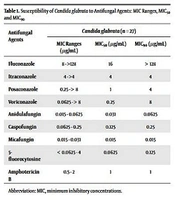
Hitkova HY, Georgieva DS, Hristova PM, Marinova-Bulgaranova TV, Kirilov Borisov B, et al. Antifungal Susceptibility of Non-albicans Candida Species in A Tertiary Care Hospital, Bulgaria. Jundishapur J Microbiol. 2020;13(8):e101767. doi: https://doi.org/10.5812/jjm.101767
Zarei Mahmoudabadi A, Zarrin M, Kiasat N. Biofilm Formation and Susceptibility to Amphotericin B and Fluconazole inCandida albicans. Jundishapur J Microbiol. 2014;7(7):e17105. doi: https://doi.org/10.5812/jjm.17105
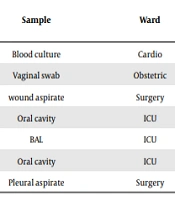
Hitkova HY, Georgieva DS, Hristova PM, Sredkova MP. Antifungal Susceptibility of Candida albicans Isolates at a Tertiary Care Hospital in Bulgaria. Jundishapur J Microbiol. 2019;12(7):e92079. doi: https://doi.org/10.5812/jjm.92079
Rezazadeh E, Sabokbar A, Moazeni M, Rezai MS, Badali H. Microdilution in vitro Antifungal Susceptibility Patterns of Candida Species, From Mild Cutaneous to Bloodstream Infections. Jundishapur J Microbiol. 2016;9(7):e34151. doi: https://doi.org/10.5812/jjm.34151
Last Update: 3 weeks ago
Last Update: 3 weeks ago
Last Update: 3 weeks ago
Last Update: 7 hours ago
Last Update: 10 hours ago
Last Update: 4 days ago