1. Background
Among pathogenic fungi, Candida species are most common cause of candidemia infections, with high mortality rates, and the incidence of candidemia infections has significantly increased in recent decades (1, 2). Although C. albicans is the most frequently detected fungal species in this type of infection, non-C. albicans species (C. glabrata, C. tropicalis, C. parapsilosis, and C. krusei) have been increasingly detected, particularly in high-risk populations. C. glabrata, the most prominent of these species (3), shows great variation in pathogenicity and antifungal susceptibility (4). It exerts its most important impact on human health via bloodstream Candida infections, particularly in healthy individuals and those treated in the ICU and BICU (5-7). Systemic infections due to C. glabrata lead to high mortality, owing to treatment failure (8). Candida glabrata reduces antifungal susceptibility to all azole drugs, independently of the presence of acquired resistance.
The prevalence of non-C. albicans species is critical because different species have different levels of resistance, either via intrinsic or acquired resistance mechanisms (9). A genetic analysis revealed fluconazole (FCZ) resistance mechanisms in 8% of C. glabrata isolates and 0.3% of C. albicans isolates (2). The resistance of C. glabrata to several antifungal drugs, limiting its medical efficacy (5, 8, 10). The cause of the increased prevalence of C. glabrata is unclear, but it could plausibly be related to the low intrinsic susceptibility of C. glabrata to azole drugs compared with that of most other Candida species (5, 11, 12). The long-term use of azoles has resulted in the development of Multidrug resistance (MDR), which is an important healthcare issue worldwide and poses a significant obstacle to antifungal therapy (13). Limited data are available on the susceptibility profiles of currently available antifungal agents, as only a small number of strains have been tested in most studies. A rapid, reproducible method of determining the drug susceptibility of C. glabrata is needed to select the most appropriate and effective antifungal agent (4).
2. Objectives
The present investigation evaluated the in vitro antifungal susceptibilities of six antifungal agents to 40 clinical C. glabrata strains: amphotericin B (AmB), ketoconazole (KTZ), fluconazole (FCZ), itraconazole (ITZ), voriconazole (VCZ), and caspofungin (CASP).
3. Materials and Methods
3.1. Fungal Isolates
From 2008 to 2011, 40 (3.8%) strains of C. glabrata in 1055 yeast isolates were recovered from patients with candidiasis. All the patient data, including gender, age, host status, and source of the isolates, are shown in Table 1. The patients were between 4 and 84 years, with a mean age of 44.65 ± 17.39 years. C. glabrata was the most common species recovered from the clinical samples: bronchoalveolar lavage (n = 14, 35%), blood (n = 2, 5%), urine (n = 5, 12.5%), vagina (n = 10, 25%), sputum (n = 4, 10%), wound (n = 3, 7.5%), abdominal drain (n = 1, 2.5%), and tracheal aspirate (n = 1, 2.5%). The most frequent underlying disease was respiratory failure, followed by diabetes, malignancy, septicemia, and vaginal candidiasis. The isolates were deposited at reference culture collections in the invasive fungi research center (IFRC; Sari, Iran).
Table 1.
Variation in the MIC Profiles of the Antifungal Agents by Gender, Age, Host Status, and Source of the Isolatesa
| C. glabrata Collection no. | Sex/Age | Host Status | Source | GenBank Accession No. | AmB | FCZ | KTZ | ITZ | VCZ | CASP |
|---|---|---|---|---|---|---|---|---|---|---|
| C. glabrata ((IFRC 1451) | M/44 | Respiratory failure | BAL | KT763084 | 1 | 2 | 1 | 0.5 | 0.25 | 0.063 |
| C. glabrata (IFRC 1452) | M/37 | ND | BAL | KT763085 | 1 | 4 | 0.5 | 4 | 0.5 | 0.125 |
| C. glabrata (IFRC 1453) | F/39 | Immunocompetent | Vagina | KT763086 | 1 | 4 | 8 | 2 | 0.5 | 0.25 |
| C. glabrata (IFRC 1454) | M/56 | ND | Sputum | KT763087 | 1 | 64 | 8 | 16 | 4 | 0.25 |
| C. glabrata (IFRC 1455) | M/40 | Respiratory failure | Wound | KT763088 | 2 | 4 | 8 | 16 | 0.25 | 0.25 |
| C. glabrata (IFRC 1456) | F/31 | ND | Sputum | KT763089 | 1 | 4 | 8 | 16 | 0.5 | 0.25 |
| C. glabrata (IFRC 1457) | M/54 | ND | Urine culture | KT763090 | 1 | 8 | 2 | 2 | 0.5 | 0.25 |
| C. glabrata (IFRC 1458) | F/4 | Burn | Urine culture | KT763091 | 1 | 4 | 16 | 8 | 0.5 | 1.0 |
| C. glabrata (IFRC 1459) | F/69 | Respiratory failure-burn | Wound | KT763092 | 0.25 | 4 | 0.25 | 0.5 | 0.125 | 0.125 |
| C. glabrata (IFRC 1460) | M/27 | Burn | Urine culture | KT763093 | 1 | 4 | 1 | 0.5 | 0.5 | 0.25 |
| C. glabrata (IFRC 1461) | M/27 | HCV-burn | Wound | KT763094 | 1 | 8 | 4 | 4 | 2 | 0.25 |
| C. glabrata (IFRC 1462) | M/27 | Burn | Sputum | KT763095 | 1 | 8 | 1 | 2 | 0.5 | 0.063 |
| C. glabrata (IFRC 1463) | M/48 | Leukemia | BAL | KT763096 | 2 | 16 | 16 | 8 | 16 | 0.25 |
| C. glabrata (IFRC 1464) | F/29 | Immunocompetent | Vagina | KT763097 | 2 | 8 | 4 | 2 | 2 | 0.125 |
| C. glabrata (IFRC 1465) | F/33 | ND | BAL | KT763098 | 1 | 16 | 4 | 4 | 1 | 0.125 |
| C. glabrata (IFRC 1466) | M/58 | Respiratory failure | BAL | KT763099 | 0.5 | 4 | 0.25 | 0.5 | 0.125 | 0.25 |
| C. glabrata (IFRC 1467) | M/81 | Respiratory failure | BAL | KT763100 | 1 | 4 | 1 | 2 | 0.25 | 0.25 |
| C. glabrata(IFRC 1468) | M/55 | Solid organ recipient | BAL | KT763101 | 2 | 64 | 8 | 4 | 8 | 0.25 |
| C. glabrata (IFRC 1469) | M/28 | Respiratory failure | BAL | KT763102 | 1 | 4 | 0.5 | 0.5 | 0.25 | 0.125 |
| C. glabrata (IFRC 1470) | F/24 | Immunocompetent | Vagina | KT763103 | 0.5 | 16 | 2 | 0.5 | 0.5 | 0.25 |
| C. glabrata (IFRC 1471) | M/47 | Solid organ recipient | BAL | KT763104 | 1 | 8 | 2 | 0.5 | 0.5 | 0.125 |
| C. glabrata (IFRC 1472) | M/67 | Respiratory failure | BAL | KT763105 | 1 | 4 | 2 | 2 | 0.5 | 0.25 |
| C. glabrata (IFRC 1473) | M/63 | ND | Blood | KT763106 | 1 | 4 | 1 | 0.5 | 0.25 | 0.125 |
| C. glabrata (IFRC 1474) | M/65 | Immunocompetent | BAL | KT763107 | 2 | 4 | 0.5 | 2 | 0.25 | 0.063 |
| C. glabrata (IFRC 1475) | M/44 | Respiratory failure | Tracheal aspirate | KT763108 | 2 | 16 | 2 | 2 | 1 | 0.125 |
| C. glabrata (IFRC 1476) | M/48 | Bone marrow recipient | BAL | KT763109 | 2 | 8 | 16 | 8 | 8 | 0.125 |
| C. glabrata (IFRC 1477) | M/84 | ND | Urine culture | KT763110 | 1 | 8 | 2 | 0.5 | 0.5 | 0.25 |
| C. glabrata (IFRC 1478) | F/41 | Immunocompetent | Vagina | KT763111 | 2 | 64 | 16 | 8 | 16 | 0.25 |
| C. glabrata (IFRC 1479) | M/54 | ND | Abdominal drain | KT763112 | 1 | 16 | 4 | 2 | 4 | 0.063 |
| C. glabrata (IFRC 1480) | F/33 | Immunocompetent | Vagina | KT763113 | 1 | 16 | 4 | 4 | 8 | 0.063 |
| C. glabrata (IFRC 1481) | M/22 | Respiratory failure | Sputum | KT763114 | 1 | 8 | 4 | 4 | 16 | 0.25 |
| C. glabrata (IFRC 1482) | F/35 | Immunocompetent | Vagina | KT763115 | 2 | 8 | 8 | 8 | 16 | 0.063 |
| C. glabrata (IFRC 1483) | M/57 | Solid organ recipient | Urine culture | KT763116 | 0.5 | 16 | 1 | 2 | 0.25 | 0.25 |
| C. glabrata (IFRC 1484) | F/36 | Immunocompetent | Vagina | KT763117 | 1 | 4 | 0.5 | 2 | 0.125 | 0.125 |
| C. glabrata (IFRC 1485) | F/35 | Immunocompetent | Vagina | KT763118 | 2 | 8 | 0.5 | 0.5 | 0.25 | 0.063 |
| C. glabrata(IFRC 1486) | M/37 | Respiratory failure | BAL | KT763119 | 1 | 16 | 4 | 2 | 8 | 0.125 |
| C. glabrata (IFRC 1487) | M/79 | Cancer | BAL | KT763120 | 1 | 8 | 0.5 | 2 | 0.125 | 0.25 |
| C. glabrata (IFRC 1488) | M/50 | ND | Blood | KT763121 | 1 | 4 | 8 | 4 | 2 | 0.25 |
| C. glabrata (IFRC 1489) | F/32 | Immunocompetent | Vagina | KT763122 | 1 | 8 | 0.5 | 0.5 | 0.25 | 0.5 |
| C. glabrata (IFRC 1490) | F/46 | Diabetes | Vagina | KT763123 | 2 | 64 | 4 | 2 | 0.5 | 0.25 |
Abbreviations: AmB, amphotericin B; FCZ, fluconazole; KTZ, ketoconazole; ITZ, itraconazole; VRZ, voriconazole; CASP, caspofungin; BAL, broncho Alveolar Lavage; HCV, hepatitis C virus; IFRC; invasive Fungi tesearch center.
aaThe MIC values are expressed in μg/mL.
To differentiate the Candida species, stock cultures were initially grown on malt extract agar, supplemented with chloramphenicol (MEA; Difco Laboratories, Detroit, MI, USA) and CHROMagar Candida (BD Biosciences Missisanga, Ontario, Canada) at 24°C in the dark. All the strains were preliminarily identified at the species level, based on microscopic and macroscopic characteristics (i.e., germ tube formation, chlamydospores production, and temperature growth analysis at elevated temperatures of 42 - 45°C), and carbohydrate assimilation. The strains were subsequently confirmed by PCR assays and sequencing, using the following primers: 5’-GTC AAA TGC CAC AAC AAC AAC CT-3’ and 5’-AGC ACT TCA GCA GCG TCT TCA G-3’ (14). Briefly, the amplification was performed with a cycle of 7 minutes at 94°C for primary denaturation, followed by 30 cycles at 94°C (60 seconds), 55°C (60 seconds), and 74°C (60 seconds), and a final extension step at 74°C for 10 minutes (14). PCR amplicons were purified with Sephadex G-50 fine (GE Healthcare Bio-Sciences AB, Uppsala, Sweden), and sequencing was conducted using an ABI 3730XL automatic sequencer (Applied Biosystems, Foster city, CA, USA). The sequence data obtained in this study were adjusted using the SeqMan of Lasergene software (DNAStar Inc., Madison, Wisconsin, USA) and compared with those in the GenBank database (http://blast.ncbi.nlm.nih.gov) and local database of the CBS-KNAW fungal biodiversity centre, Utrecht, Netherlands. Prior to use, the identified strains were stored at -70°C in a Tryptone soya broth medium (Oxoid, CM0129) containing 2% glucose, 2% peptone, and 20% glycerol. This research was approved by the ethics committee (Ethical no. 92-3-8) of Mazandaran University of Medical Sciences, Sari, Iran.
3.2. Antifungal Susceptibility Testing
In vitro antifungal susceptibility testing was determined according to the recommendations of the clinical and laboratory standards institute (CLSI) M27-A3 and M27-S4 documents) (15, 16). AmB (Sigma-Aldrich, USA), FCZ (Pfizer Central Research, UK), KTZ (Sigma-Aldrich), ITZ (Sigma-Aldrich), VCZ (Pfizer Central Research, UK), and CASP (Merck, Whitehouse Station, NJ, USA) were obtained as reagent-grade powders from the respective manufacturers for preparation of CLSI microdilution trays. The antifungal agents were diluted in standard RPMI-1640 medium with L-glutamine without bicarbonate (Sigma Chemical Co.), buffered to pH 7.0 with 0.165 M-morpholinepropanesulfonic acid (Sigma) was used to yield twice as strong concentrations, which were dispensed into 96-well microdilution trays, with a final concentration of 0.016 - 16 μg/mL for AmB, KTZ, ITZ, and VCZ; 0.063 - 64 μg/mL for FCZ; and 0.008 - 8 μL/mL for CASP.
The plates were stored at -70°C until used. Homogeneous conidial suspensions were measured spectrophotometrically at wavelengths of 530 nm to a percent transmission in the range of 75 - 77. The final densities of the stock inoculum suspensions of the tested isolates ranged from 2.5 to 5 × 10³ colony-forming units/mL, as determined by quantitative colony counts on Sabouraud glucose agar (Difco). They were incubated at 35°C and examined visually after 24 and 48 hours to determine the MIC values. The MIC endpoints were determined using a reading mirror and were defined as the lowest concentration of the drug that prevented recognizable growth (i.e., exerted 100% inhibition for AmB) or significant (50%) growth diminution levels (all other agents) compared with the growth of a drug-free control. C. parapsilosis (ATCC 22019) and C. krusei (ATCC 6258) strains were chosen as quality controls. Analysis of these strains was performed with every new batch of MIC determinations. The MIC range, geometric mean, MIC50, and MIC90 are provided for all the isolates. All the tests were performed in duplicate, and differences among mean values were determined by a Student’s t-test. The statistical analyses were conducted using the statistical SPSS package (version 7.0). A P value of < 0.05 was considered statistically significant.
4. Results
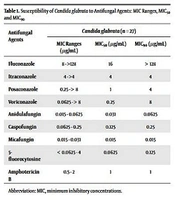
All 40 isolates were classified as C. glabrata based on DNA sequencing. The DNA sequences showed > 99% sequence similarity to the available C. glabrata type isolate in the GenBank database. The sequences of all isolates were submitted to the NCBI GenBank and assigned under the accession nos.KT763084-KT763123 (Table 1). The in vitro antifungal susceptibility of the six antifungal drugs to C. glabrata isolates is summarized in Table 2, showing the geometric mean MICs, MIC ranges, MIC50s, and MIC90s. The MIC results of all the C. glabrata isolates revealed that they were highly susceptible to CASP but not to the azole agents. FCA showed the widest range and highest MICs (2 - 64 μg/mL), followed by VCZ, KTZ, ITZ, and CASP (0.125 - 16, 0.25 - 16, 0.5 - 16, and 0.063 - 1 μg/mL, respectively). The GM MICs against all the tested strains were as follows, in increasing order: CASP (0.17 μg/mL), VCZ (0.67 μg/mL), AmB (1.1 μg/mL), ITZ (1.82 μg/mL), KTZ (1.85 μg/mL), and FCZ (6.7 μg/mL). The results showed that, in terms of the MIC50 and MIC90, CASP (both 0.25 μg/mL) was more active than FCZ (8 and 16 μg/mL, respectively). For all strains of C. glabrata, the AmB MIC was 2-log2-dilution steps and 1-log2-dilution steps less active than CASP. The MICs of 30 (75%) strains of C. glabrata against five of the antifungal drugs were high, and the MICs of 10 (25%) strains to all the tested drugs were low. Only 4 (10%) C. glabrata strains were FCZ resistant. The remaining strains (n = 36, 90%) were susceptible dose-dependent (SDD), with an FCZ value of ≤ 32 μg/mL. Eleven (27.5%) strains were SDD to ITZ, and an additional 29 (72.5%) strains were resistant to ITZ.
Table 2.
In Vitro Susceptibilities of 40 Clinical Isolates of Candida glabrata to Six Antifungal Agents
| Isolate | Antifungal Agent | No. (Cumulative %) of Isolates Inhibited at MIC, µg/mL | MIC Range, µg/mL | MIC 50, µg/mL | MIC 90, µg/mL | G Mean, µg/mL | |||||||||||||
|---|---|---|---|---|---|---|---|---|---|---|---|---|---|---|---|---|---|---|---|
| 0.008 | 0.016 | 0.031 | 0.063 | 0.125 | 0.25 | 0.5 | 1 | 2 | 4 | 8 | 16 | 32 | 64 | ||||||
| C. glabrata (n = 40) | |||||||||||||||||||
| AmB | 1 (2.5) | 3 (10) | 25 (72.5) | 11 (100.0) | 0.25 - 2 | 1 | 2 | 1.109569 | |||||||||||
| FCZ | 1 (2.5) | 15 (40) | 12 (70) | 8 (90) | 0 (90) | 4 (100) | 2 - 64 | 8 | 16 | 6.7271713 | |||||||||
| KTZ | 2 (5) | 7 (22.5) | 6 37.5) | 6 (52.5) | 8 (72.5) | 7 (90) | 4 (100) | 0.25 - 16 | 2 | 8 | 1.851749 | ||||||||
| ITZ | 11 (2.75) | 0 (2.75) | 14 (62.5) | 7 (80) | 5 (92.5) | 3 (100) | 0.5 - 16 | 2 | 8 | 1.821169 | |||||||||
| VCZ | 4 (10) | 9 (32.5) | 12 (62.5) | 2 (67.5) | 3 (75) | 2 (80) | 4 (90) | 4 (100) | 0.125 - 16 | 0.5 | 8 | 0.67295 | |||||||
| CASP | 7 (17.5) | 11 (45) | 20 (95) | 1 (97.5) | 1 (100) | 0.063 - 1 | 0.25 | 0. 25 | 0.168 | ||||||||||
Abbreviations: AmB, amphotericin B; FCZ, fluconazole; KTZ, ketoconazole; ITZ, itraconazole; VCZ voriconazole, CASP, caspofungin; IFRC, invasive fungi research center.
5. Discussion
An increasing incidence of candidiasis caused by C. glabrata was reported during the 1990s. C. albicans was the most predominant agent of bloodstream infections, followed by C. glabrata in north America, while C. glabrata was the third one in Europe. In Latin America, C. parapsilosis was followed by C. albicans and C. glabrata was the fourth (17). By contrast, the prevalence of C. glabrata infections was reported to be low in Iran (18).
Owing to the increasing frequency of C. glabrata isolates in clinical specimens and the association of this species with resistance to antifungal drugs (i.e., azoles and echinocandins), C. glabrata drug resistance patterns have a disproportionate impact on treatment strategies and surveillance programs (9, 19). Timely targeted administration of antifungal agents in patients with invasive candidiasis requires reliable, up-to-date epidemiological data on both the distribution and susceptibility of the species. Such data are important not only in health centers where antifungal susceptibility testing is not routinely performed, but also in evaluations of invasive yeast infections (17). The intrinsically low susceptibility of C. glabrata, an emerging opportunistic fungal pathogen, to azole antifungals has made its treatment challenging, and infection is accompanied by frequent relapse and failure (20).
In the present study, the results of the antifungal susceptibility tests of FCZ and ITZ were comparable to those reported in different continents, including the U.S., Canada, Europe, and Asia, with slight differences (21-23). The MIC ranges for AmB were 0.25 - 2 μg/mL for all strains of C. glabrata, with a GM MIC of 1.1 μg/mL. In addition, 11 of the 40 (27.5%) strains assayed with AmB were resistant to this antifungal agent, with the level of resistance higher than that reported in previous studies in Iran (24-28). The main problems in the treatment of C. glabrata include resistance to numerous azoles (29). The findings indicate that the decreased susceptibility of Candida to azole agents may contribute to the increased proportion of infections caused by these species (5, 30).
In the present study, the highest resistance rate (72.5%) was to ITZ, both consistent (2, 21, 22) and inconsistent (24, 27) with the findings of previous studies. The findings on resistance to ITZ differ slightly from those reported in the U.S., Canada, Europe, and Latin America (2, 21, 22). In the latter regions, C. glabrata was reported to be most resistant to ITZ, followed by C. krusei and C. tropicalis. The resistance to KTZ (47.5%) in the current study was similar to the rate of 50% reported by Razzaghi-Abyaneh et al. (18) but higher than that reported in other studies (25-27). The resistance rate to FCZ (10%) was somewhat similar (6%) to the findings of Shokohi et al. (24). Compared with previous research, the resistance rate to FCZ (10%) in the current study was relatively low. As noted elsewhere, the prevalence of FCZ resistance among C. glabrata isolates varies, depending on the country and region (31). In the present study, the percentage of SDD isolates was notably high (90%), with a rapid decline in the rate of FCZ susceptibility. It seems that a higher dose of FCZ is required as a drug of choice for invasive C. glabrata infections (32).
In the present study, the VCZ resistance rate (37.5%) was consistent with that of a recent report (38%) (18). In other studies, C. glabrata strains were reported to be susceptible to VCZ (21, 22, 26). Data from health care centers in the U.S. and Denmark provide more information about MDR in C. glabrata strains. One potential explanation for the emergence of MDR in C. glabrata is the haploid nature of the organism, which makes it particularly successful in acquiring and expressing resistant mutations under prolonged drug pressure (10, 33, 34). The observations herein support the potential emergence of MDR isolates of C. glabrata, with 70% cross-resistance to azole classes. Cross-resistance between the new and azoles, such as FCZ and VCZ, is a cause for concern (17, 35).
AmB is becoming less effective against azole-resistant C. glabrata and C. krusei. Experts therefore recommend using higher-than-normal doses. As higher doses of polyenes increase the risk of nephrotoxicity, and VCZ may be ineffective in treating certain strains of C. glabrata, there is consensus about the administration of echinocandins (CASP, anidulafungin, and micafungin) as the drugs of choice for azole-resistant C. glabrata and C. krusei infections (36). Echinocandins are the preferred therapy for patients with renal failure, when polyenes cannot not be administered (37).
A valuable finding of the present study was that 95% of the isolates were susceptible to CASP, with an MIC range of 0.063 - 1 μg/mL. These results are consistent with those of the Global ARTEMIS and national SENTRY antifungal surveillance studies (17, 38). According to previous research, antifungals with low MICs and high activity against C. glabrata can be administered to high-risk patients (39). The results of the present study demonstrated that CASP was the most effective agent, with the lowest MIC50 (0.25 μg/mL) and MIC90 (0.25 μg/mL) and geometric mean MIC (0.168 μg/mL) values against all C. glabrata strains. These results are somewhat consistent with data published in other studies (24, 26, 28). The emergence of high multiresistant C. glabrata is a concern, given the fact that neither azoles nor AmB are an optimal treatment for C. glabrata infections (35, 40). This constitutes a strong warning to use fewer effective antifungal agents in our hospitals and with greater caution, in order to relieve pressure on sensitive Candida strains (41). Caution is thus recommended with CASP therapy for C. glabrata infections when azole resistance is predicted (42). The resistance of C. glabrata clinical isolates to both azoles and echinocandins has emerged over time. This is problematic, owing to its treatment limitations (7, 10).
In conclusion, CASP exhibited potent activity against C. glabrata clinical isolates and showed the least evidence of emerging resistance. The relevance of these in vitro findings to the treatment of C. glabrata infections in clinical practice remains to be determined.