
1. Background
Over the past decades, the incidence of Candida infections among hospitalized patients has progressively increased. This is a consequence of the frequent usage of broad-spectrum antibiotics, admission to critical care settings, invasive manipulations, surgical procedures, indwelling devices, transplantation, chemotherapy, immunosuppression, etc. (1-6). In the USA, the rate of fungal infections rose from 6% in 1980 to 10.4% in 1990 and about 80% of them were caused by Candida species (7) Also, the proportion of Candida spp. among isolates from blood cultures increased from 8% in 1995 to 12% in 2002 (8).
Nowadays, a shift toward non-albicans Candida (NAC) species has been observed (9). Emerging NAC such as Candida glabrata, C. parapsilosis, C. tropicalis, and C. krusei can cause various superficial, disseminated and deep-tissue infections, but the species involvement depends on infection sites and geography regions (10, 11). As is well known, NACs have reduced sensitivity to clinically relevant antifungal agents due to intrinsic or acquired resistance (12, 13). Candida krusei is considered inherently resistant to fluconazole and C. glabrata may be echinocandin resistant in association with cross-resistant to azoles (14). With the increasing rate of Candida infections and the emergence of resistant strains, it is essential to perform routine antifungal susceptibility testing of clinical yeast isolates (15). Despite a large number of reports on spreading Candida species worldwide and detection of yeasts resistant to antifungals, there are scant data for Bulgaria (16, 17).
2. Objectives
The purpose of our study was to reveal in vitro activity of nine antifungal agents against NAC isolates.
3. Methods
3.1. Yeast Isolates
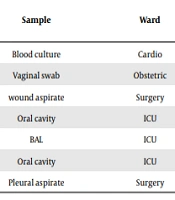
The object of this study was 67 non-repeated NAC isolates obtained from clinical specimens of 67 patients treated in University Hospital, Dr. G. Stranski”-Pleven, Bulgaria from September 2016 to December 2017. NACs were isolated from urines (31), throat swabs and oral cavity samples (9), wound aspirates (7), lower respiratory tract samples (6), blood cultures (4), vaginal swabs (3), feces (3), ear swabs (3), and central venous catheter (1). Patients' samples were collected from the intensive care unit (28), urology (9), surgery (8), hematology (7), oncology (7), nephrology (4), and pediatrics (4).
3.2. Species Identification
The preliminary identification of isolates was based on colonies coloration on CHROM agar Candida (BD, UK) and microscopic characteristics on cornmeal agar. The final identification was made by MIKROLATEST CANDIDA test 21 (Erba Lachema, CZ) and Vitek 2 compact system (Bio Merieux, France).
3.3. Antifungal Susceptibility Testing
Micronaut-AM (Merlin Diagnostika GmbH, Germany) was used to determine the minimum inhibitory concentrations (MICs) of amphotericin B (APH), 5-fluorocytosine (FCY), fluconazole (FCA), voriconazole (VOR), posaconazole (POS), itraconazole (ITR), micafungin (MIF), anidulafungin (ANF), and caspofungin (CAS). The concentration ranges of drugs used in each row was the following: APH (0.031 - 16 µg/mL), FCY (0.0625 - 32 µg/mL), FCA (0.002 - 128 µg/mL), VOR and POS (0.0078 - 8 µg/mL), ITR (0.031 - 4 µg/mL), MIF, ANF and CAS (0.002 - 8 µg/mL). Depending on color change (pink) of the growth control, the plates were incubated 22 - 48 hours at 35°C before reading. The MICs were interpreted in accordance with the European Committee on Antimicrobial Susceptibility Testing (EUCAST), 2018 (18), with MIC breakpoints in µg/mL. For C. glabrata, C. tropicalis, C. parapsilosis, C. krusei: APH susceptibility (S) ≤ 1 and resistance (R) >1. For C. glabrata: FCA S ≤ 0,002 and R > 32. For C. tropicalis and C. parapsilosis: FCA S ≤ 2 and R > 4; ITR S ≤ 0.125 and R > 0.125; POS S ≤ 0.064 and R > 0.064; VOR S ≤ 0.125 and R > 0.25. For C. glabrata, C. krusei, and C. tropicalis: ANF S ≤ 0.064 and R > 0.064. For C. glabrata: MIF S ≤ 0.032 and R > 0.032. For C. parapsilosis: ANF S ≤ 0.002 and R > 4; MIF S ≤ 0.002 and R > 2. The data for FCY were evaluatеd as per recommendations of the manufacturer (Micronaut-AM, Merlin Diagnostika GmbH, Germany): S ≤ 4 µg/mL, intermediate (I) 8 - 32 µg/mL and R > 32 µg/mL.
3.4. Multidrug Resistance
The simultaneous resistance to ≥1 drug in ≥ 2 classes of antifungals was accepted as multidrug resistance (19).
4. Results
Out of 67 non-albicans Candida isolates obtained from clinical specimens, 27 (40.3%) were identified as C. glabrata, 10 (14.9%) -as C. tropicalis, 6 (8.9%)- as C. krusei and 6 (8.9%) - as C. parapsilosis. The other species comprised overall 27% as follows: C. lusitaniae (4), C. lipolytica (4), C. guilliermondii (2), C. utilis (2), C. famata (2) and C. norvegensis, C. lambica, C. pelliculosa, C. kefyr (each one 1). From 27 C. glabrata isolates, 20 (74.1%) were recovered from urines. The results from susceptibility testing are given in Table 1 as MIC ranges, MIC50 and MIC90, as well as in Tables 2 and 3 as MIC ranges. Susceptible to nine antifungal agents were 18 yeasts (26.87%): C. parapsilosis (6), C. tropicalis (4), C. lusitaniae (4), C. utilis (2), C. pelliculosa (1), and C. kefir (1). The remaining 49 (73.13%) demonstrated decreased susceptibility to one or more antifungals.
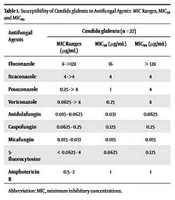
Table 1.
Susceptibility of Candida glabrata to Antifungal Agents: MIC Ranges, MIC50 and MIC90
| Antifungal Agents | Candida glabrata (n = 27) | ||
|---|---|---|---|
| MIC Ranges (µg/mL) | MIC50 (µg/mL) | MIC90 (µg/mL) | |
| Fluconazole | 8 - >128 | 16 | > 128 |
| Itraconazole | 4 - >4 | 4 | 4 |
| Posaconazole | 0.25 - > 8 | 1 | 4 |
| Voriconazole | 0.0625 - > 8 | 0.25 | 8 |
| Anidulafungin | 0.015 - 0.0625 | 0.031 | 0.0625 |
| Caspofungin | 0.0625 - 0.25 | 0.125 | 0.25 |
| Micafungin | 0.015 - 0.031 | 0.015 | 0.015 |
| 5-fluorocytosine | < 0.0625 - 4 | 0.0625 | 0.125 |
| Amphotericin B | 0.5 - 2 | 1 | 1 |
Abbreviation: MIC, minimum inhibitory concentrations.
Table 2.
Minimum Inhibitory Concentrations Ranges to Antifungal Agents of the Less Common Non-albicans Candida Species
| Candida spp. | Antifungal Agents (MIC Ranges in µg/mL) | ||||||||
|---|---|---|---|---|---|---|---|---|---|
| FCA | ITR | POS | VOR | ANF | CAS | MIF | FCY | APH | |
| C. tropicalis (n = 10) | 2- > 128 | 0.125- > 4 | 0.0625- > 8 | 0.125 - > 8 | 0.015 - > 8 | 0.125 - 4 | 0.031- > 8 | < 0.0625 - 32 | 1 - 2 |
| C. krusei (n = 6) | 32 – 64 | 1 - 4 | 0.0625-0.125 | 0.125 | 0.031 - 0.0625 | 0.25 | 0.031 - 0.125 | 1 - 8 | 1 |
| C. parapsilosis (n = 6) | 0.5 - 2 | < 0.031 - 0.125 | < 0.0078-0.015 | < 0.0078 - 0.0625 | < 0.002 - 0.031 | 0.125 | <0.015 - 0.0625 | 0.0625 - 0.125 | 0.5 - 1 |
| C. lusitaniae(n = 4) | 0.5 | < 0.031 | <0.0078 | < 0.0078 | < 0.002 - 0.0625 | 0.0625 - 0.125 | 0.015 - 0.031 | 0.5 - 2 | 0.5 |
| C. lipolitica(n = 4) | 16 - 32 | 0.031 - 4 | 0.031 - 1 | 0.031 - 1 | 0.015 - 1 | 0.125 - 8 | 0.015 - > 8 | 0.0625 - 0.5 | 0.5 - 1 |
Abbreviation: MIC, minimum inhibitory concentrations; MIC, minimum inhibitory concentrations; FCA, fluconazole; ITR, itraconazole; POS, posaconazole; VOR, voriconazole; ANF, anidulafungin; CAS, caspofungin; MIF, micafungin; FCY, 5-fluorocytosine; APH, amphotericin B.
Table 3.
Minimum Inhibitory Concentrations Ranges to Antifungal Agents of the Rare Non-albicans Candida Species
| Candida spp. | Antifungal Agents (MIC Ranges in µg/mL) | ||||||||
|---|---|---|---|---|---|---|---|---|---|
| FCA | ITR | POS | VOR | ANF | CAS | MIF | FCY | APH | |
| C. guilliermondii(n = 2) | 2 - 8 | 0.5 - 4 | 0.125 | 0.125 | 0.015 - 0.0625 | 0.25 | 0.0625 | < 0.0625 | 0.5 |
| C. utilis (n = 2) | 0.5 - 2 | < 0.031 - 0.5 | < 0.007-0.125 | < 0.0078 - 0.0625 | 0.002 - 0.015 | 0.125 | 0.015 - 0.0625 | < 0.0625 - 4 | 0.5 - 1 |
| C. famata (n = 2) | > 128 | > 4 | 8 | 8 | 0.031 | 0.125 | 0.015 | < 0.0625 | 1 - 2 |
| C. norvegensis (n = 1) | 128 | 4 | 0.125 | 0.25 | 0.0625 | 0.0625 | 0.125 | 4 | 1 |
| C. lambica (n = 1) | 16 | < 0.031 | 0.031 | 0.031 | 0.125 | 0.125 | 0.015 | 2 | 0.5 |
| C. pelliculosa (n = 1) | 0.5 | 0.0625 | 0.0625 | 0.031 | 0.015 | 0.0625 | 0.015 | 2 | 0.5 |
| C. kefyr(n = 1) | 0.25 | < 0.031 | < 0.0078 | < 0.0078 | 0.031 | 0.0625 | 0.0625 | < 0.0625 | 1 |
Abbreviation: MIC, minimum inhibitory concentrations; MIC, minimum inhibitory concentrations; FCA, fluconazole; ITR, itraconazole; POS, posaconazole; VOR, voriconazole; ANF, anidulafungin; CAS, caspofungin; MIF, micafungin; FCY, 5-fluorocytosine; APH, amphotericin B.
High level resistance to all azoles was observed in overall 18 yeasts (26.87%): C. glabrata (12), C. tropicalis (3), C. famata (2), and C. lipolitica (1). Four yeasts (5.97%) were resistant to amphotericin B with MICs of 2 µg/mL. As shown in Table 1C. glabrata showed decreased susceptibility to azoles with fluconazole MIC90 > 128 µg/mL. Of overall 27 isolates, 12 (44.4%) were resistant to fluconazole (MICs: 32 - > 128 µg/mL) and 15 (55.6%) were intermediate susceptible (MICs: 8 - 16 µg/ml). The MICs of itraconazole, posaconazole and voriconazole were elevated (MIC90s of 4 - 8 µg/mL). C. glabrata revealed good susceptibility to echinocandins (MIC90 of anidulafungin - 0.0625 and MIC90 of micafungin - 0.015 µg/mL), 5-fluorocytosine (MIC90 - 0.125), and amphotericin B (MIC90 - 1 µg/mL).
The MICs of echinocandins for the other NAC are shown in Tables 2 and 3. Only 2 isolates (1 C. tropicalis and 1 C. lipolitica) indicated high MICs to anidulafungin (MICs: > 8 and 1 µg/mL, respectively) and micafungin (MICs > 8 µg/mL). Six (8.95%) of NAC were multidrug resistant, including C. glabrata (1), C. tropicalis (3), C. lipolitica (1), and C. famata (1). These isolates showed high-level resistance to all azoles with a combination of echinocandin and/or amphotericin B resistance (Table 4).
Table 4.
Multidrug-Resistant Non-albicans Candida Isolates
| Candida spp. | Sample | Antifungal Agents (MICs in µg/mL) | ||||||||
|---|---|---|---|---|---|---|---|---|---|---|
| FCA | ITR | POS | VOR | ANF | CAS | MIF | FCY | APH | ||
| C. glabrata | Urine | 16 | > 4 | 2 | 1 | 2 | ||||
| C. tropicalis | Wound | > 128 | > 4 | > 8 | > 8 | > 8 | 4 | > 8 | ||
| C. tropicalis | Bal | > 128 | 4 | 8 | > 8 | 32 | 2 | |||
| C. tropicalis | Wound | > 128 | > 4 | > 8 | > 8 | 32 | 2 | |||
| C. lipolitica | Urine | 32 | 4 | 1 | 1 | 1 | 8 | > 8 | ||
| C. famata | Urine | > 128 | > 4 | 8 | 8 | 2 | ||||
Abbreviation: MIC, minimum inhibitory concentrations; FCA, fluconazole; ITR, itraconazole; POS, posaconazole; VOR, voriconazole; ANF, anidulafungin; CAS, caspofungin; MIF, micafungin; FCY, 5-fluorocytosine; APH, amphotericin B.
5. Discussion
Antifungal susceptibility of clinical non-albicans Candida isolates was presented in this study. Overall, 13 species were found of which C. glabrata was the most common, followed by C. tropicalis, C. krusei, and C. parapsilosis. These four species make up about 70% of the tested isolates. Many authors reported predominance of the same NAC in hospitalized patients (8-10, 17, 20-23), but the rate of a definitive species varied according to the study designs. Basseti et al. (24) detected C. parapsilosis and C. glabrata as the second and third species isolated from blood cultures in the period 2008-2010.
A Bulgarian study indicated similar results in candidemic patients on the basis of 38 Candida strains collected during a 5-year period (2007-2011) (17). According to the data in the review of Whaley et al. (9), C. glabrata was the main invasive NAC species in North America, Northern Europe, and some other regions, with the exception of Latin America, and it was a frequent etiological agent of vulvovaginal candidiasis and candiduria. In the present study, the predominant part of C. glabrata isolates (74.1%) was obtained from urine samples. Some authors also reported urine as a common site of C. glabrata isolation (15, 25), whereas the others detected C. tropicalis as a primary agent of candiduria (26, 27).
Our data concerning antifungal susceptibility showed decreased susceptibility to azoles in 73.13% of NAC. Furthermore, 26.87% of the isolates were resistant to all azoles. Savastano et al. (28) presented about 50% resistance to fluconazole among non-albicans Candida. As is well known, azole resistance is more common in NAC as compared to C. albicans (9). The results from Bulgarian trials confirmed these observations (16, 17, 29). In the current study, C. glabrata showed MIC50 and MIC90 of fluconazole 16 and > 128 µg/mL, until voriconazole MIC50 and MIC90 were considerably lower – 0.25 and 8 µg/mL. Similar MICs were observed in studying of 2379 C. glabrata isolates: fluconazole MIC50 and MIC90 – 10.6 and > 165 µg/mL, and voriconazole MIC50 – 0.63 µg/mL (20). The data for Bulgaria revealed fluconazole and voriconazole MIC90s > 64 and 16 mg/L, respectively (16). These values were established in the testing of 21 C. glabrata collected between 2009 and 2013. According to a 4-year global evaluation, voriconazole demonstrated 1 to 2 logs larger action than fluconazole against all tested Candida species (12). Analogous results were obtained by other authors (15, 30).
Candida glabrata exhibits decreased intrinsic susceptibility to azoles and it is able to develop high-level resistance after azole exposure (10). The published data concerning this problem varied widely. Pfaller et al. (27) reported different rates of fluconazole resistance in C. glabrata among Latin American countries - from 5.9% in Brasilia to 36% in Venezuela. In a study, including 35 countries worldwide, about 81% of C. glabrata were susceptible or susceptible dose-dependent to fluconazole; however, there was an increasing rate of resistant strains from blood and upper respiratory tract samples (16). Surprisingly, we detected 3 C. tropicalis isolates with high-level resistance to all azoles. Kaur et al. (21) found that this species was more resistant to azoles than other Candida spp. – out of 37 C. tropicalis strains, 15 were resistant to fluconazole. While the increasing rate of fluconazole resistance in C. tropicalis is well documented (31), voriconazole resistance is extremely rare. Little is known about the mechanisms of azole resistance in this species (10). Recently, ERG11 overexpression was detected in C. tropicalis isolates from China and Korea, especially in fluconazole-resistant strains also resistant to itraconazole and voriconazole (32, 33).
Our data confirmed the intrinsic resistance of C. krusei to fluconazole, but MIC values (32 - 64 µg/mL) were considerably lower than those observed in Bulgaria (MIC90 > 256 mg/L) (16). This could be explained by the very small number of tested isolates. Furthermore, the MICs of posaconazole and voriconazole ranged between 0.0625 - 0.125 µg/mL, whereas the MICs of itraconazole were considerably higher (1 - 4 µg/mL). Azevedo et al. (15) found decreased susceptibility to fluconazole in about 70% of overall 54 C. krusei strains. The same workers determined fluconazole MIC90 of 146.76 µg/mL and voriconazole MIC90 of 0.37 µg/mL. According to Hazen et al. (20), C. krusei was the species with the highest voriconazole MIC50- 1.5 µg/mL. Generally, the itraconazole resistance of NAC species varied in different reports- from 0 (34) to 33.3% (28). Iranian researchers (22) revealed itraconazole MICs: 0.125 - 4 µg/mL when testing 49 NAC strains.
Our results about echinocandins were in concordance with the conception of a low resistance rate among Candida species (35, 36). A possible reason for that is the limited use of echinocandins in our hospital. Pfaler et al. (36) established only 0.1% caspofungin resistance in 5,346 Candida isolates. In a multicenter Bulgarian study covering 106 C. albicans and 96 NAC strains, elevated MICs of anidulafungin were observed in 26 C. parapsilosis with MIC90 > 2 mg/L (16). In the present study, amphotericin B-resistance (5.97%) was less than azole resistance. These data collected are close to some reports (21) and are in contrast to others, presenting about 20% (17) - 25% (22) resistance to this drug in NAC species. Yüksekkaya et al. (23) did not find any amphotericin B-resistant strain in 56 Candida spp. We detected 6 (8.95%) multidrug-resistant isolates in our study. Taghipour et al. (22) also found four multiresistant strains among 49 NAC. Three of which were resistant to amphotericin B and itraconazole, and one to amphotericin B, itraconazole, and terbinafine.
5.1. Conclusions
About 70% of the tested 69 NAC isolates demonstrated decreased susceptibility to one or more azoles, and 18 of them were resistant to all azoles. These findings highlight the need for appropriate antifungal control programs in our institution.