
1. Background
The concept of time perspectives (TP) has garnered considerable attention in fields such as education and health, yet it remains underexplored within the domain of sport psychology (1). A fundamental research problem in this area is the variability in athletes’ temporal focus: Some attend primarily to the present moment, while others direct their mental attention toward the past or future (F) through memories, anticipations, or dreams. This leads to two key research questions that have not been sufficiently addressed: How do different temporal orientations affect athletic performance? Can these orientations explain psychological differences between elite and non-elite athletes?
Despite the intuitive relevance of these questions, empirical research has yet to clarify whether, and how, various TP dimensions contribute to athletic success across competitive levels. Addressing this gap is critical because athletes’ temporal orientations can profoundly influence their pre-competition mindset, motivation, and focus. In other words, an athlete’s dominant temporal perspective may shape not only training and competition behaviors but also the trajectory of their long-term athletic development (2).
According to Zimbardo and Boyd’s theory (3), a balanced time perspective (BTP) supports athletes' development and success while promoting harmony in their sporting lives. This profile includes high levels of F orientation for planning and goal setting, present-hedonistic (PH) orientation for enjoyment and positive experiences, and past-positive (PP) orientation reflecting favorable past views. It also involves low levels of past-negative (PN) and present-fatalistic (PF) orientations, which relate to negative past memories and a sense of helplessness about the F (3). In this regard, Stolarski et al. (1), proposed a psychological model elucidating the role of BTP in athletic performance. Their model suggests that TP influences performance through three key pathways: Enhancing motivation, regulating emotions, and evaluating outcomes. Positive temporal orientations such as PP and F bolster self-efficacy, confidence, and long-term goal setting, thereby increasing motivation and persistence in training and competition. Effective emotion regulation is facilitated by an appropriate present orientation and the avoidance of PN and PF perspectives, helping athletes manage anxiety and maintain focus under pressure. The third pathway, performance evaluation, concerns how athletes interpret successes and failures; F-oriented athletes tend to view failures as learning opportunities, whereas a PN orientation may lead to pessimistic interpretations and reduced confidence (1).
Given the emphasis of Zimbardo’s TP Theory (3) and Stolarski’s model (1), exploring the relationship between temporal perspectives and motivational theories can enhance our understanding of the psychological processes affecting performance. In this context, Ryan and Deci’s self-determination theory (4), which focuses on three basic psychological needs autonomy, competence, and relatedness provides a framework for explaining intrinsic motivation and goal-directed behavior. Accordingly, time perspective may serve as a mediator between temporal orientations and motivational needs (1). Furthermore, Levin (5), defines TP as how individuals perceive past and F in the present, with related cognitive and emotional activities influencing current behavior and shaping F actions. Thus, athletes’ present mental states affect their F goals and achievements. Understanding athletes’ TP profiles helps identify a BTP to improve performance (5).
The BTP positively influences a range of outcomes, including well-being and education (6-11), but research on its dimensions in athletic performance is limited. Studies show mixed results: Notarnicola et al. (12) found spatiotemporal differences between volleyball players and non-athletes; Nazarpouri and Aghdasi (13) reported higher PP and F in elite wrestlers; Zentsova and Leonov (14) observed stronger PP in elite athletes; Popovych et al. (2) highlighted the role of F in sports like tennis, wrestling, shooting, rowing, track and field, handball, and gymnastics. In contrast, Mitic et al. (15) found lower F scores in elite athletes from basketball, football, volleyball, handball, and water polo. These inconsistencies suggest TP’s effects may depend on sport type, level, and individual traits, calling for broader, cross-sport research. Differences in sport types individual, team, and combat likely shape athletes’ TP differently. For example, team athletes may focus more on present social experiences, while individual and combat athletes emphasize F goals. This underscores the need for more cross-sport research on TP’s role in performance (2, 13, 15).
Athletic performance is not limited to physical readiness and technical skills; psychological skills play a fundamental role in optimizing performance (16, 17). Research has shown that psychological preparedness such as goal-setting, anxiety coping, and concentration significantly impacts athletic success (17, 18). Hence, psychological skills that help manage negative factors like anxiety are critical for achieving sustainable performance (2). In the sport of taekwondo, which demands rapid decision-making and sustained focus due to its technical, speed, and tactical characteristics, psychological factors gain even greater importance. Skills such as goal-setting, anxiety control, concentration, and emotion regulation are key determinants of success among Taekwondo athletes (17, 19). Therefore, investigating TP in this sport closely linked with motivation, emotional regulation, concentration, and goal-setting can provide valuable insights.
2. Objectives
Overall, given the importance of TP in athletic performance (1, 3, 5), the contradictory findings of previous research, and the lack of focused studies in taekwondo, the present study aims to compare different dimensions of TP in elite and non-elite Taekwondo athletes. This research represents the first investigation of various TP dimensions among Iranian taekwondo practitioners and seeks to identify an BTP profile in this cultural context.
3. Methods
3.1. Subjects
This study was a comparative cross-sectional design. The statistical population included all elite and non-elite Taekwondo athletes in Tehran. Accordingly, 300 male athletes were selected through purposive sampling, consisting of 105 elite athletes with at least one previous appearance on the national team (mean age = 27.45 years) and 195 non-elite athletes (mean age = 28.50 years) who had at least five years of training experience but no history of national team membership. The sample size was determined to be appropriate using G*Power software with a significance level (α) of 0.05 and a statistical power (1 - β) of 0.95.
3.2. Apparatus and Task
3.2.1. Demographic Questionnaire
This questionnaire gathered information on personal details, education level, economic status, sports experience, history of national team membership, and any history of disorders or illnesses. At the end of the questionnaire, a consent form was provided for participants to give their approval to take part in the study.
3.2.2. Zimbardo Time Perspective Inventory
The Zimbardo’s Time Perspective Inventory (ZTPI) has 36 questions divided into five subscales (3). The Persian version of the inventory was previously validated in Iranian samples (20). In the current study, the Persian version was reviewed and slightly modified by three sport psychology experts and two taekwondo coaches to better suit the target population (Taekwondo athletes). These modifications involved simplifying culturally ambiguous terms and replacing some expressions with sport-specific language to improve clarity and relevance. Care was taken to preserve the original construct meanings of each subscale. A pilot study involving 35 athletes was conducted to assess reliability and confirm construct validity. The instrument demonstrated good internal consistency, with Cronbach’s alpha coefficients ranging from 0.74 to 0.89.
3.3. Procedure
After obtaining consent from the Taekwondo federations and receiving an official letter of introduction, the researcher began data collection. In this study, elite Taekwondo athletes were defined as those who had at least once participated in a national team training camp in their sport. Non-elite athletes were defined as individuals who, in an organized manner, trained in Taekwondo for at least two to three sessions per week for five years, but had no experience of participating in a national team training camp (15). The execution of the study was coordinated with the provincial federation, taking into account the limitations related to the athletes' performance levels. Therefore, due to the national team training camps being held in Tehran, elite athletes were selected from this city. The study was approved by the Ethics Committee of Lorestan University of Medical Sciences with the code IR.LUMS.REC.1403.898.
3.4. Data Analysis
To examine differences between elite and non-elite Taekwondo athletes in various dimensions TP, a multivariate analysis of variance (MANOVA) was conducted. The independent variable was athletic skill level (elite vs. non-elite), and the dependent variables included the five subscales of the ZTPI. Prior to the main analysis, MANOVA assumptions were assessed. Normality of data distribution was examined using the Kolmogorov–Smirnov test. The homogeneity of covariance matrices was tested using Box’s M test, and Levene’s test was used to assess the homogeneity of variances across subscales. No covariates were included in the model. All statistical analyses were performed using SPSS 26 (α = 0.05).
4. Results
The results of the normality test using the Kolmogorov-Smirnov test showed that the data followed a normal distribution. Additionally, the results of the homogeneity of variances test using Levene's test indicated that the assumption of homogeneity of variances was met (P > 0.05). Furthermore, the results showed no significant differences between elite and non-elite athletes in demographic characteristics and confounding variables, including Body Mass Index [BMI; I (298) = -0.769, P = 0.433], economic status [chi-square (2) = 0.409, P = 0.825], and education level [chi-square (2) = 0.133, P = 0.922] (Table 1).
Table 1.
Frequency Distribution of Demographic Characteristics of the Participants a
| Demographic Characteristics | Athletes | |
|---|---|---|
| Elite | Non-elite | |
| Frequncy (n) | 105 | 195 |
| Age (y) | 27.45 ± 3.20 | 28.50 ± 4.01 |
| BMI | 24.93 ± 0.85 | 25.04 ± 0.97 |
| Education level | ||
| Elementary | 60 (20) | 35 (18) |
| Diploma | 105 (35) | 66 (34) |
| Academic | 135 (45) | 94 (48) |
| Economic status | ||
| Inappropriate | 22 (21) | 37 (19) |
| Relatively appropriate | 52 (50) | 92 (47) |
| Appropriate | 31 (29) | 66 (34) |
Abbreviation: BMI, Body Mass Index.
a Values are expressed as mean ± SD or No. (%).
As shown in Table 2, descriptive statistics for the dimensions of TP were presented for the study participants. A MANOVA was conducted to compare TP dimensions between elite and non-elite athletes. The results of Wilks’ Λ test indicated a significant difference between the two groups of Taekwondo athletes [Λ = 0.863, F(5, 29) = 80.46, P < 0.001], suggesting that at least one TP dimension differed significantly between them.
Table 2.
Comparing Scores of Different Time Perspective in Research Participants a
| Variables | Athletes | |
|---|---|---|
| Elite | Non-elite | |
| PN orientation | 19.08 ± 4.81 | 27.01± 3.84 b |
| PP orientation | 38.21 ± 5.14 b | 26.48 ± 5.12 |
| PF orientation | 23.23 ± 5.01 | 31.66 ± 8.26 b |
| PH orientation | 55.01 ± 5.02 b | 51.79 ± 5.10 |
| F orientation | 53.64 ± 8.63 b | 27.14 ± 4.87 |
Abbreviations: PN, past-negative; PP, past-positive; PF, present-fatalistic; PH, present-hedonistic; F, future.
a Values are expressed as mean ± SD.
b P ≤ 0.001.
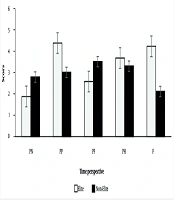
Elite Taekwondo athletes had higher scores compared to non-elite Taekwondo athletes in the dimensions of PP (F = 77.07, P < 0.001, η2 = 0.531), PH (F = 14.09, P < 0.001, η2 = 0.172), and F (F = 313.96, P < 0.001, η2 = 0.822). However, the dimensions of PF (F = 16.08, P = 0.003, η2 = 0.191) and PN (F = 63.90, P < 0.001, η2 = 0.484) were more pronounced in non-elite Taekwondo athletes compared to elite Taekwondo athletes (Table 2, Figure 1).
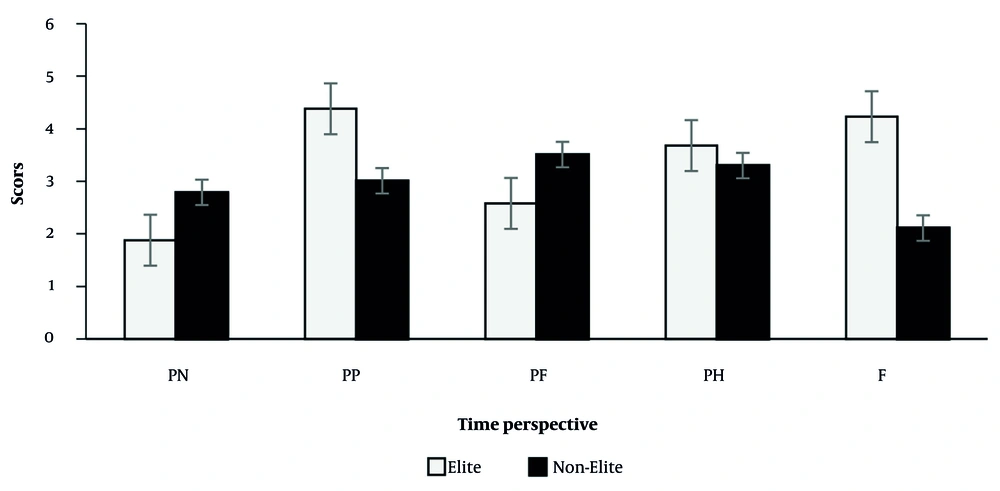
Figure 1.
Comparison of time perspectives (TP): Past-negative (PN), past-positive (PP), present-fatalistic (PF), present-hedonistic (PH), and future (F), in elite and non-elite Taekwondo athletes.
5. Discussion
The study revealed that elite male Taekwondo athletes demonstrated a BTP, characterized by higher scores on positive dimensions PP, PH, and F and lower scores on negative dimensions PN and PF compared to their non-elite counterparts. These findings support the notion found in the literature that possessing a BTP is associated with better motivation, emotion regulation, and goal setting, whereas negative TP (such as PN and PF) can impair athletic performance (1, 3). Our results are also consistent with previous studies by Zentsova and Leonov (14) and Popovich et al. (2). Given the limited number of studies in this area and the lack of research specifically on Taekwondo athletes, the present findings can serve as a foundation for further investigations and the development of psychological interventions tailored to athletes' TP in Taekwondo.
According to Zimbardo and Boyd's (3), TP theory, athletes with a BTP tend to be associated with higher levels of psychological readiness and athletic performance. In the current study, the higher scores among elite Taekwondo athletes on PP, PH, and F dimensions may reflect a tendency to focus more on positive past experiences, goal setting, planning, and self-regulation factors identified in Ryan and Deci’s (4), self-determination theory as key elements of intrinsic motivation and sustained performance. Stolarski et al.'s (1), model further shows that a BTP influences athletic performance by enhancing motivation, improving emotion regulation, and fostering constructive interpretation of experiences. Accordingly, elite Taekwondo athletes leverage positive past experiences and a clear F outlook to maintain a constructive attitude towards successes and failures, whereas non-elite athletes may show less psychological cohesion when facing challenges, which could be linked to a stronger focus on negative TP (such as PN or PF) (1).
Moreover, based on Lewin’s (5), field theory, it can be argued that a BTP may be associated with a more stable and positive psychological field for elite Taekwondo athletes. This psychological field facilitates behaviors such as commitment, motivation, focus, and optimal athletic performance. Positive past memories, including victories and coach support, are likely linked to higher motivation, confidence, self-efficacy, and psychological stability in competitive situations. The PH orientation appears to be related to increased mindfulness and focus in the moment, which may improve the quality of practice and competition. The F orientation, as a component of the athlete’s psychological field, may support overcoming challenges, maintaining systematic planning, and sustaining steady athletic progress. Therefore, a BTP, especially across these three dimensions, may be associated with a more coherent, dynamic, and purposeful psychological field in elite Taekwondo athletes, promoting enhanced performance, increased intrinsic motivation, and reduced psychological stress under competitive pressure (5).
The findings of this study have important practical implications for improving the performance of Taekwondo athletes. Coaches, by understanding BTP, can design targeted training and psychological programs that encourage athletes toward an F-oriented and balanced temporal focus. For instance, long-term goal-setting training can boost motivation, self-efficacy, and commitment among athletes (3). Sports psychologists can also employ cognitive-behavioral techniques and mindfulness exercises to help athletes manage negative TP such as PN and PF; such interventions reduce anxiety, improve focus under pressure, and enhance performance (1). Additionally, consistent with Ryan and Deci’s (4), self-determination theory, creating a supportive environment that fosters athletes' sense of autonomy, competence, and social relatedness facilitates the development of positive and stable TP, thereby enhancing intrinsic motivation. Ultimately, structured psychological interventions such as goal-setting, mindfulness training, and cognitive restructuring may positively influence BTP, which could potentially contribute to improvements in focus, motivation, and athletic performance. Coaches and sports psychologists can implement short-term group workshops or individual sessions aimed at strengthening positive TP and managing negative ones. These interventions have the potential to enhance both athletic success and mental well-being among Taekwondo athletes. These interventions can be delivered through weekly group workshops or individual sessions lasting 45 - 60 minutes over multiple weeks, incorporating psychoeducation, practical exercises, and feedback (21).
Despite the significance of this study, several limitations should be noted. First, the cross sectional design precludes causal inferences, and the sample limited to male Taekwondo athletes from Tehran restricts the generalizability of the findings to other genders, regions, and sports. Second, reliance on self reported measures may have introduced social desirability bias or recall inaccuracies, leading athletes to portray their motivation and time perspective more favorably than they truly are. Finally, unmeasured variations in coaching style and athlete coach dynamics could have shaped athletes’ psychological states and responses, further biasing the results. The F longitudinal studies with more diverse samples and multi informant data (e.g., coach ratings or objective performance metrics) are recommended to address these issues. Furthermore, cultural context plays a significant role in shaping athletes’ time perspective. In Iranian culture, which is deeply rooted in traditional values, respect for elders, and strong familial bonds, individuals may be more inclined to score higher on the PP dimension. Recollections of family traditions, national pride, and religious observances may serve as emotional anchors, boosting self-confidence and a sense of identity in athletes. On the other hand, prevalent cultural beliefs in fate and divine will, which are more common in collectivist and religious societies, may enhance PF dimension, potentially reducing athletes’ perceived control over F outcomes and diminishing motivation (3, 22). However, the strong social support structures in Iranian culture especially from family, coaches, and peers can foster F orientation by providing external motivation and reinforcing long-term commitment to sport. In contrast, athletes from more individualistic cultures might rely more on internalized goal-setting and autonomy, aligning with different TP profiles. These cultural nuances highlight the importance of tailoring psychological interventions to the sociocultural background of athletes, ensuring more effective and relevant outcomes.