
1. Background
Autism spectrum disorder (ASD) is a neurodevelopmental condition that leads to some disorders in social interactions, behavioral flexibility, stereotyped games, abnormal thoughts, and sensory processing (1). Motor disorders are also prominent in ASD children (2, 3), so ASD children have significant delays in many fundamental motor skills, and recently such a thing has been identified as a key feature of ASD (4). The proper development of motor skill competence is a key element that moderates future participation in physical activities. Therefore, the lack of motivation to participate in physical activities may be explained by the poor development of motor skills in children with ASD (3, 4). Theories state that one of the most important steps in motor learning is the ability to create internal models; i.e. predicting the sensory consequences of motor commands and learning errors to improve performance in the next attempt (5, 6). The development of these internal models depends on different parts of the CNS, especially the cerebellum, and it has been shown that cerebellar growth in these children is abnormal (7, 8). Fortunately, the results of research in the field of motor learning show the ability of these individuals to understand other motor learning variables to improve throw performance (2, 4). For example, Zamani et al. (9) showed that frequency feedback is an effective method for promoting motor learning in children with ASD. In addition, Taheri-Torbati and Sotodeh (10) showed that video and live modelling is an efficient method to teach motor skills to children with ASD. Homayounnia Firouzjah et al. (11) also showed that implicit practice could improve motor skill learning in children with ASD more than explicit practice. Nevertheless, one of the techniques that have been widely studied, is the manipulation of the focus (12). Children with ASD have problems in this variable and need more time to shift attention from one stimulus to another than normal people (13). The amount of attention of learners is one of the main factors in teaching and learning, so the initial stage of any learning begins with attention if not enough attention, the ASD children learning is impaired, and timely teaching of attention improves it in children with ASD (14). Therefore, given that ASD children can understand other motor learning variables mentioned above, and that these variables (frequency feedback, video and live modelling and implicit practice) have also affected their motor learning, we hypothesize that attentional focus instructions can also be effective on learning ASD children. Regarding the attention variable, in the field of normal people, it has been shown that external attention instructions (paying attention to how their actions affect the environment; for example, focusing on the path of the throw; or the target of the throw) are more effective than internal attention instructions (directing ones focus of attention to their movements, for example focusing on finger movements, focusing on the position of their hand, bending the elbow) (12, 15). Recently, this strategy-based difference as a result of motor learning has also been observed in children with mental disorders (9). Chiviacowsky et al. examined the effect of focus on motor learning in people with mental disorders. The findings demonstrated that during training, retention, and transfer tests, the external attention group outperformed the internal attention group. These results not only support the advantages of an external focus on motor learning (16) but have been documented by several previous studies (17, 18); but also show the possibility of using an external attention effect for motor learning in children with mental disorders who, along with children with ASD, have developmental delays and motor learning problems (19). However, the results of previous research also indicate that internal focus has a higher impact on ASD children learning of motor skills compared to external focus (13). The difference between our work and the research of Tse (13) and Chiviakovsky et al. (16) is related to the type of task, different subjects, age, and type of disorder. In the research of Tse (13), ASD children with an age range of 9 - 12 years, low-functioning autism, overhand throwing towards a vertical target and throwing with the dominant hand were used. In the research of Chiviakovsky et al. (16), children with intellectual disabilities, age range of 10 - 14 years, overhand throwing with a bean bag towards a vertical target and throwing with the dominant hand were used. Whereas the present study used high-functioning autistic children with a younger age range (8 - 10 years), and the task of underhand throwing with a clay tennis ball towards a target on the ground were used.
2. Objectives
Given the different type of disorder (high functioning) with the above research, different task (with different movement pattern), throwing with the non-dominant hand and lower age range, We hypothesize that children with ASD (high-functioning autistic) may also benefit from the attentional focus method, given its efficacy in improving learning and motor performance and the potential to extend this effect to children with motor dysfunction. Investigating this notion was, thus, the aim of this investigation. In addition, it has been shown that children with ASD perform better than normal individuals when their movements are driven by proprioception feedback (18) therefore, on the one hand, because the internal focus is more related to the Proprioception than the external focus, and on the other hand, because the role of the proprioception is critical in improving motor performance (17, 19); Our other hypothesis is that an internal focus is more advantageous than an external focus on motor learning in children with ASD.
3. Methods
3.1. Subjects
Three groups [internal attention (n = 10), external attention (n = 10), and control group (n = 10)] participated in repeated measurements and retention tests as part of the current study's semi-experimental methodology. Convenience sampling was used to choose 30 ASD children (age mean ± SD = 8.96 ± 0.76 years) for the statistical sample. Simple random assignment was used to place them in one of three groups. Each child was assigned a unique identification number between 1 and 30. These numbers were then entered into a random number generator (online randomizer) and randomly sorted. The first ten numbers were assigned to the internal attention group, the next ten to the external attention group, and the last ten to the control group. This method ensured that each participant had an equal chance of being placed in each group, thus reducing selection bias and maintaining a basic balance between the groups. This process was carried out by a researcher who was not involved in the implementation of the intervention or the evaluation of the outcomes to minimize the possibility of bias in group assignment.
Inclusion criteria were: Willingness to participate in research, consent of students' parents to participate in the research, a psychiatrist's diagnosis of autism using the diagnostic and statistical manual of psychiatric disorders, high-functioning autism children (according to DSM-IV-TR), IQ more than 70, ability to follow instructions and perform requested movement tasks, The lack of experience with tasks similar to those employed in the current study. Participants' exclusion criteria also included the following: Multiple mental illnesses at the same time, a complicated neurological condition (such as epilepsy, phenylketonuria, or fragile X syndrome), Unwillingness to continue participating in any phase of the study, absence from more than 2 intervention sessions, development of any new medical or psychological problem that would prevent continued participation in the study, and failure to cooperate in performing research tasks or completing assessments.It should be noted that a written consent form was also received from the children's parents to participate in the study. This study was approved according to the ethical considerations provided by The Research Institute of Movement Sciences, Kharazmi University and carried out under the code of ethics IR.KHU.KRC.1000.255.
3.2. Attentional Focus Instructions
The guidelines were comparable to those employed in Chiviacowsky et al. (16) investigation. While participants in the internal focus group were told to concentrate on the action of their throwing hand, those in the external focus group were told to concentrate on the ball's flight path. Before every set of experiments, the attention instructions were given again. No attention-related instructions were given to participants in the control group. All participants in each group received the same instructions.
3.3. Apparatus and Task
The tasks featured in the present study were comparable to those found in the study performed by Chua et al. (19). Using matte glasses, participants were instructed to throw 100 g clay court tennis ball toward a circular target on the ground with their non-dominant hand from a distance of two meters. The zones used to evaluate the accuracy of the throws were concentrated circles drawn around the target with radii of 20, 30, 40, 50, 60, 70, 80, 90, and 100 cm. When the clay court tennis ball lands on the center point (a circle filled with black), a score of 100 is given to the person. 90, 80, 70, 60, 50, 40, 30, 20, 10, or 0 points were awarded, correspondingly, if the location was outside the circles or in one of the other sections (9, 20, 21) (Figure 1). Higher scores indicate better performance accuracy. It should be noted that after each block of 10 trials, the mean of these trials was taken as performance accuracy.
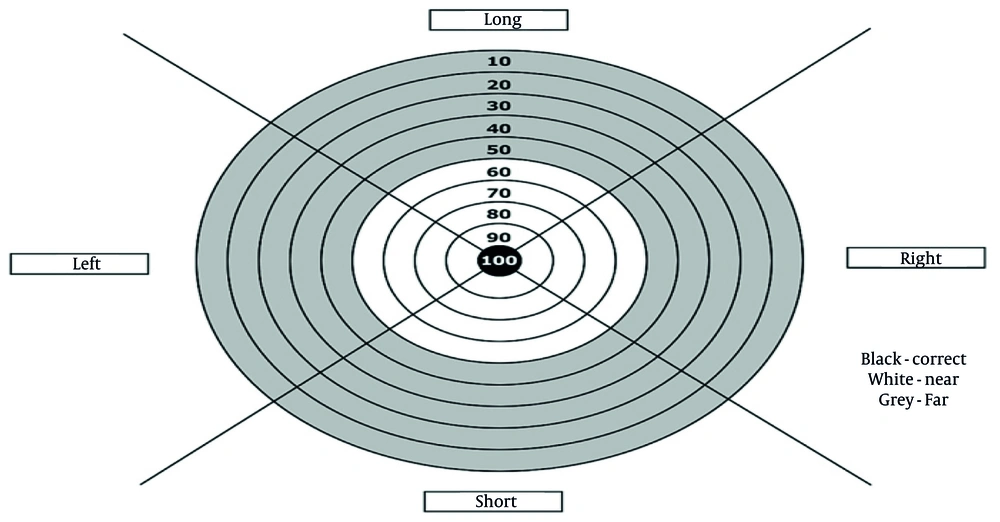
Figure 1.
Diagram of the target and zone areas used to evaluate throwing accuracy (16)
3.4. Procedure
This study was conducted in a specialized center for motor development and learning. participants were tested individually in a completely quiet, well-lit room. To familiarize themselves with the purpose of the study, participants performed 5 clay court tennis ball throws towards a target. After selecting participants and assigning them to different groups, they were instructed to use their non-dominant hand to throw a clay court tennis ball into the court after being briefed on the task's objective. Matte swimming goggles were used to prevent the participants from seeing the target at different stages of the research. However, before each of the three test phases, they were permitted to view the target. The study consisted of three stages: Pre-test, acquisition, and retention test. Each participant was asked to throw a clay court tennis ball to hit the center of the goal as much as possible. Before throwing, each participant received instructions on how to grasping the ball and how to stand (for example, stand behind the line, and hold the clay court tennis ball with five fingers). As a pre-test, participants first completed 10 throwing trials, and their results were noted. Participants subsequently engaged in 6 blocks of 10 trials each, interspersed with a one-minute rest period between blocks (16). At this stage, each group completed their trials according to the given attentional focus instructions. Participants in the internal focus group were told to focus on the action of throwing their hand, while participants in the external focus group were told to focus on the flight path of the ball. It is worth noting that the internal and external attention instructions were given to the subjects before the start of each training block. block 6 was recorded as the post-test phase. 48 hours after the acquisition phase, participants performed retention tests in 10 trials (without receiving any attentional focus instructions). It should be noted that the distance between the subjects and the target was 2 meters (16). However, they did not receive any instructions before or during the retention test. To ensure that participants adhered to the attention focus instructions, the following steps were taken: Verbally repeating the instructions for each exercise before each block, indirectly observing the researcher performing the movements, using a Likert scale to self-report the amount of focus after each block, and asking an open-ended question about the participant’s mental content during the throw. These procedures helped to examine the alignment of participants’ attention with the type of focus desired.
3.5. Data Analysis
The study's variables were described using the mean and standard deviation. Following the Shapiro-Wilk test's examination of the data's normality in the inferential data analysis. Scores for the 10 trials in each test (pre-test, acquisition and retention) and each practice block were averaged for statistical analysis. For acquisition data, a 3 (group) × 6 (block) mixed ANOVA with repeated measures on block was conducted to assess the impact of attentional focus on practice performance. Testing data were subjected to a 3 (group) × 3 (test) mixed ANOVA with repeated measures on test to determine if groups differed at any test phase. Self-reported adherence to attentional focus instructions was assessed with a one-way ANOVA to identify if groups differed in their level of adherence. Significant effects were followed up with Bonferroni post-hoc tests to determine the nature of group and block/phase differences. Partial eta squared is reported as an effect size for main effects and interactions with values being interpreted as small (0.01 - 0.09), medium (0.09 - 0. 25), and large (greater than 0.25) (22). SPSS software version 26 was used to analyze all of the data and for all analyses, an alpha level of .05 was used.
4. Results
The average accuracy of the participants' performances in various groups and stages when throwing from below the shoulder is depicted in Figure 2.
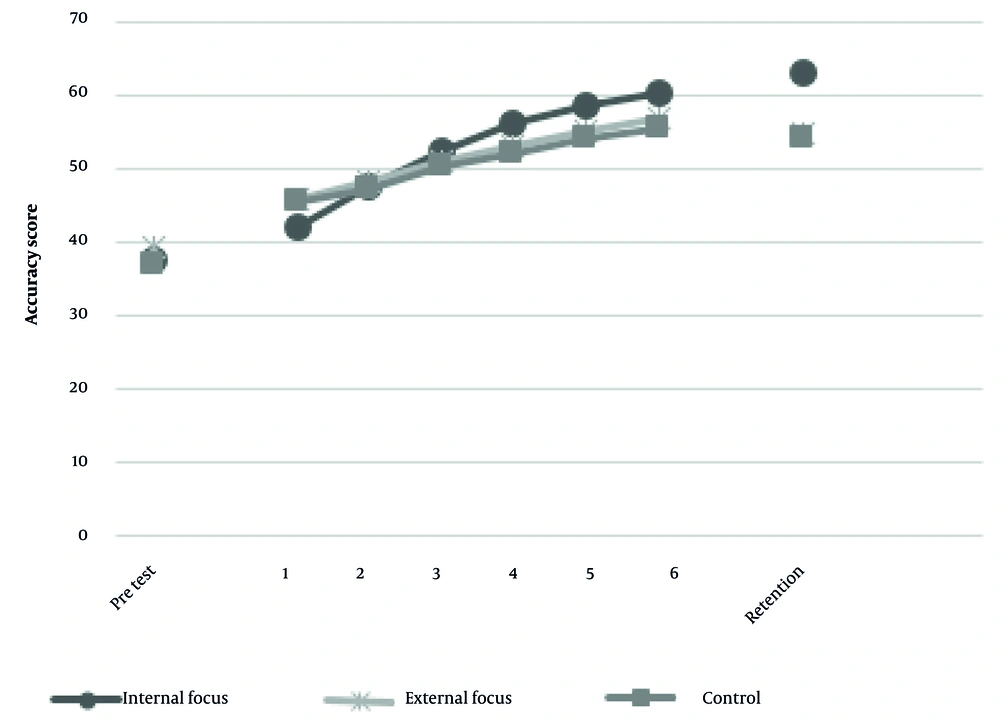
Figure 2.
Average accuracy of participants in different groups and phases
4.1. Acquisition Phase
Figure 1 shows the performance curves for each group across the six training blocks. For further analysis of the impact and differences, statistical data are examined according to inferential tests. The mixed ANOVA analysis of the variance test (3 groups × 6 blocks) with repeated measures was used to assess the impact of training under the conditions of the instructions of the focus on throwing skill performance in the acquisition phase. Significant improvement was observed in all groups during the acquisition phase, and this finding was supported by a significant effect of block [F (2, 27) = 117.03, P = 0.001, ηp2 = 0.81]. Bonferroni post hoc tests showed that throwing skill in block 6 was better than blocks 1(P = 0.001), 2 (P = 0.001), and 3 (P = 0.001), and that the other blocks did not differ significantly from each other (P > 0.05). The main effect of group was not significant [F (2, 27) = 0.55, P = 0.59, ηp2 = 0.04]; in other words, there were no significant differences between the groups. The group × block interaction was not significant [F (2, 27) = 0.68, P = .64, ηp2 = 0.03].
4.2. Testing Phases
Figure 1 shows the performance curve at each test point. A mixed ANOVA (3 groups × 3 test) with repeated measures on test indicated significant main effects of test [F (2, 27) = 43.60, P = 0.001, ηp2 = 0.46) and group [F (2, 27) = 19.59, P = 0.001, ηp2 = 0.31]. These main effects were superseded by a significant group × test interaction [F (2, 27) = 10.49, P = 0.003, ηp2 = 0.26)]. Simple effects analysis was used to examine the nature of the interaction to determine where and how the groups differed over time. Simple effects of group were examined at each time point of the test and showed that no significant differences were observed among the three groups at the pre-test stage (P > 0.05). At the retention stage, the internal focus group performed significantly better than the external focus group and the control group (P = 0.001), but there was no significant difference between the external focus group and the control group (P > 0.05). Also, examining the effect of "test" within each group showed that only the internal focus group made a significant improvement from the pre-test to the recall test (P = 0.001).
5. Discussion
This study's objective was to investigate how focus instructions affected the learning of throwing motor skills in children with ASD. We hypothesized that children who received internal attention training would be more accurate in all three phases (pre-test, acquisition, retention) of throwing a tennis ball on a clay court than children who received external attention training and those who received no attention training. There were no differences between the groups in the acquisition stage, according to the study's findings. Most significantly, the retention test results contrast with the results of previous studies in ASD children (23, 24) and in children with mental disorders (17, 18). The internal attention group outperformed the control group and the external attention group in retention assessments, even though all three groups demonstrated the effects of parity learning during the acquisition phase. Only the internal attention group demonstrated a substantial learning effect in the delay tests, even though all three groups' performance scores at the acquisition stage were comparable (Figure 1). Children with ASD may exhibit a greater feeling of depth, which could be one reason for the findings in the learning process (retention) (25). Deep sense is the ability to move, be aware of the circumstance, and understand how the body is related to the situation (5). According to earlier research, whether learning a new motor task or adjusting to a new environment, children with ASD rely more on their feeling of depth than their eyesight to direct their motions (19, 26). Marko et al. (27) examined autistic and normal subjects in a movement task (moving a cursor over a target position). Later in the experiment, the experimenter accidentally disrupted movements, and motor errors were felt through deep sense and vision. Experiments have found that children with ASD perform better than normal children when adaptive movements are guided by a sense of depth but perform less well than normal children when errors are sensed through vision. Many previous studies suggest that profundity is critical in improving motor function (28).
In this study, the internal attention instructions may have focused on the individual's movements (e.g., paying attention to hand movements), which is consistent with their sensorimotor experience and cause individuals to use their proprioception to guide movements in unfamiliar contexts (such as the retention test) and improve their motor performance.
External attention instructions, on the other hand, might have caused the student to concentrate on the movement's effect (such as the clay court tennis ball flight and the target itself), which calls for more assured movement regulation in the retention test and results in worse performance. To confirm these findings, we can refer to the research of Gottwald et al. Their study showed that when the internal focus of attention is aligned with the afferent task information, the superiority of internal focus is due to the increased coordination between the internal focus of attention and proprioceptive information (28). Also, the benefits of internal attention and performance were more pronounced when the dependence on motion-sensing information was strengthened (28). In another study, Toussaint et al. (29) examined whether manipulating (or modifying) the internal focus of attention and the available information providers increases the rate of successful movement execution. The results of this study also showed that internal attention facilitates performance by directing participants' attention to information about the deep sense of task. They also showed that the difference in concentration of attention in the group that works with the internal focus is due to the increase in the power of deep sense information. Emanuel et al. (30) investigated the effect of attention focus (external versus internal) on dart-throwing performance in normal children. They discovered that directions for internal attention allowed darts to be thrown more accurately in retention and transfer tests. They observed that children tend to use a movement sense system (dependent on depth sense) as a source of feedback to enhance motor awareness and conduct. Children's sense of motion system can be strengthened by focusing on body movements, which enhances motor performance. They found that children in an external attention group reported focusing on their hands while throwing darts, a finding consistent with the principles of attentional commitment (30). Even though they were in the control group (n = 3) or the external attention group (n = 3), about 10% of the participants in this study indicated internal attention. None of the individuals in the control group or internal attention group, however, reported changing their attention to the clay court tennis ball flight path or concentrating on the goal. This implies that during the motor learning process, autistic youngsters can naturally choose to concentrate their internal attention. However, learners may unintentionally focus on their body movements when verbal feedback or instructions contain body components or movements (13). Another possible reason for justifying the results of this study can be considered in individual differences. van Abswoude, et al. (31) in a study examined individual differences in the immediate effect of internal and external attention instructions on children's motor function and showed that people perform best with their attention span guidelines. The results of this study show that individual differences are the main factor in the effectiveness of children's motor function. Therefore, children with ASD may be better stimulated by the inner focus and have the most optimal performance due to their different abilities and individual differences compared to normal people. Because, as noted, better internal focus leads to adaptation to in-depth information, and because these children are highly dependent on in-depth information (8, 13). Overall, the findings of this investigation refute the notion that motor function can be increased in children with ASD with external attention guidelines (17-19). Asadi et al. (17) showed that children with ASD performed better in throwing a ball when they observed a motor pattern and received external attention instructions. The Quiet Eye Duration was also longer in the external attention group, indicating greater attention to the target and improved motor performance. Zheng (18) emphasized in a review article that implicit motor learning in children with ASD can be improved by using indirect instructions such as external attention, as this method places less strain on cognitive processes and is potentially more compatible with the neurocognitive characteristics of children with ASD. The study by Chua et al. (19) was a large meta-analysis across multiple population groups (including individuals with developmental disabilities) that showed that externally focused instructions in most cases led to better learning and motor performance than internally focused instructions.
While most previous studies have supported external focus, the results of the current study emphasize that for some children with ASD, internal focus may have a greater impact on the retention and sustainability of motor learning. These differences could be due to the nature of the task (simpler tasks are usually better performed with external focus, but in complex tasks, internal attention may provide finer control (18), cognitive characteristics of the participants (level of cognitive functioning, type of ASD that is high or low functioning, and age of the children), methodology and training (how attention instructions are presented, e.g. verbal or visual, duration of practice, and time intervals between sessions can affect results), or the phase of learning assessment (the present study did not observe any difference in the acquisition phase, but the internal attention group performed better in the retention phase. This difference suggests that internal focus may help enhance motor memory, whereas external focus may only improve immediate performance). These results have several important consequences. First, these findings shed valuable light on how teachers, exercise educators, and physiotherapists should design guidelines for helping ASD children learn new motor abilities. To better understand the motor learning behaviors of children with ASD and to develop better motor learning strategies for these children, it is important to remember that these children tend to emphasize internal focus when learning motor skills. In some respects, the present study includes limitations such as not using the female sex, not controlling the cultural, social and economic differences of the participants and not investigating the long-term learning other than 48 hours.