
1. Background
Several studies and theories have investigated factors that contribute to autism spectrum disorder (ASD) risk. Three cognitive theories are more commonly studied than others, namely theory of mind, central cohesion, and executive functions (1). Theory of mind is one of the most frequently used methods to improve the functions of ASD children. Improving the social recognition of ASD children and having a better understanding of human psychology can be achieved by enhancing the content and level of children’s minds. In other words, successful social interaction involve specific mechanisms to understand the inner status of others. so that the theory of mind by possessing these specific capabilities has a vital role in developing social recognition (2). So one of the main components of social recognition is the theory of mind that widely refers to the ability to understand emotions and thoughts and consequently recognizing recognize the other’s behaviors (3). This ability contains three levels: (1) recognition; (2) emotions and representing the real based theory of mind, that is the level of the theory of mind or the primary wrong beliefs; and (3) understanding the secondary wrong beliefs or understanding kidding (4). Treatment and education of autistic and related communication handicapped children (TEACCH) is a comprehensive teaching program for individuals with autistic disorder, including ASD children, developed by the University of North Carolina in 1996. The TEACCH contains interfering programs that possess the advantage of proper research and experiment-control groups (5).
Since nowadays, “language” is considering a core component of ASD, hence, recently inattention to disorders of language and social interaction has been introduced as a major shortcoming of the theory of mind (6). The inability of ASD children to use cognitive processes has caused difficulties for dealing with such children, an issue that is categorized as “difficulty in executive functions”. Executive function is conceptualized as the efficiency with which individuals go about acquiring knowledge, as well as how well problems can be solved in nine areas: attention, emotion regulation, flexibility, inhibitory control, initiation, organization, planning, self-monitoring, and working memory (7). ASD causes several behaviors, which are the result of inactiveness to inhibit the response. In most of the people with ASD, the inability to prevent inappropriate responses causes improper behaviors. In turn, the inability to inhibit inappropriate answers leads to inappropriate behaviors and emotions, which is common in most of the individuals with ASD (8).
2. Objectives
Several studies have investigated issues related to autism, but few have studied the effects of training based on the theory of mind and TEACCH method on the executive functions of ASD children. Therefore, the current study aimed to investigate the effects of training based on the theory of mind and TEACCH method on executive functions (i.e. selective attention, inhibiting response) in ASD children.
3. Methods
This research is applied purposefully and methodologically is a quasi-experimental with pre-test, post-test, and a control group. The statistical population was all ASD children in Bushehr province in 2018, which was 108 children, based on the data obtained from the Health and Welfare Organization of the province. Various methods are introduced for calculating the sample size, which research method is one of the most frequently used. Based on this approach, in quasi-experimental studies, 10 subjects is sufficient per each group. Nevertheless, in the present study, the possibility of attrition was considered, and 15 subjects were selected per each group. In total, 45 ASD children were recruited using the convenience sampling method. Then, they were randomly allocated to three groups: two groups of experiment, each with 15 members, and a control group (9). Convenience sampling was performed on those who were passed the diagnostic interview and clinical evaluations of psychiatrists and psychologists in accordance with the diagnostic criteria, had a medical record at the welfare organization of the Bushehr, and their parents’ were willing to participate in the study.
The inclusion criteria were as follows: being aged 6 to 9 years and living with the family (due to the congruity in the social interaction), parents’ willingness to participate in the study, and being diagnosed with autism (as proved by medical records). The exclusion criteria were having disorders other than autism, absence of more than two sessions of training, accompanying disorders were either mental disability (such as hyperactivity, attention deficit) or physical (such as blindness or deafness), and participation in similar studies. It worth noting that those ASD children who were receiving their particular treatment at the start of the study continued their previous treatment. Before starting the study, parents were informed about the objectives of the study, its advantages, nature, and duration as well as the confidentiality of the data. Besides, it was emphasized that the intervention will bring no harm to their children. Parents were informed that they can withdraw whenever they want.
3.1. The Stroop Color and Word Test
The Stroop Color and Word test (SCWT) contains 96 colorful words, 48 congruent words (each words’ color complies its meaning, red, yellow, green, and blue), and 48 incongruent words (each word’s color do not compile its meaning). The colors display inpeseudo-randomly on a monitor with a 2000 milliseconds with 800 ms inter-stimulus interval. For example, blue ink represents a stimulus distance of 800 ms. The participants should identify the color regardless of its meaning. The SCWT contains three attempts. Any attempt is made of instruction, sample, practice, and the main section. To calculate the final score, the number of false answers should be reduced from true answers. Consistency and reliability of the SCWT were evaluated and the value of coefficients was 0.80 to 0.91, respectively (10). Three clinical trials in healthy individuals showed that the mean reliability of retest for the three tests was more than 0.75. (11). Cronbach’s alpha coefficient was calculated for the SCWT, and a value of 0.73 was obtained. As mentioned before, 45 ASD children participated in the present study. Then, they were separated into three groups, each with 15 subjects (two experiments and one control). The first experimental group received 36 60-minute sessions of training based on the theory of mind (6 sessions every week). The second experiment group received 36 sixty-minute sessions of training based on the method of TEACCH (6 sessions every week). The control group didn’t receive any intervention. At the end of the experiment, both groups received the Stroop post-test.
The overall structure is shown in Figure 1. Data were analyzed using descriptive and inferential methods. In the descriptive section, the average methods, deviating from the norm, frequency, percent, and in inferential section, the multivariate covariance (MANCOVA), univariate covariance analysis (ANCOVA), Alpha coefficients Cronbach were used. Also, the statistical methods of Kolmogorov-Smirnov, Levin test, and homogeneity of regression slope to investigate the covariance presumptions were used. Statistical significance was considered when P value < 0.05.
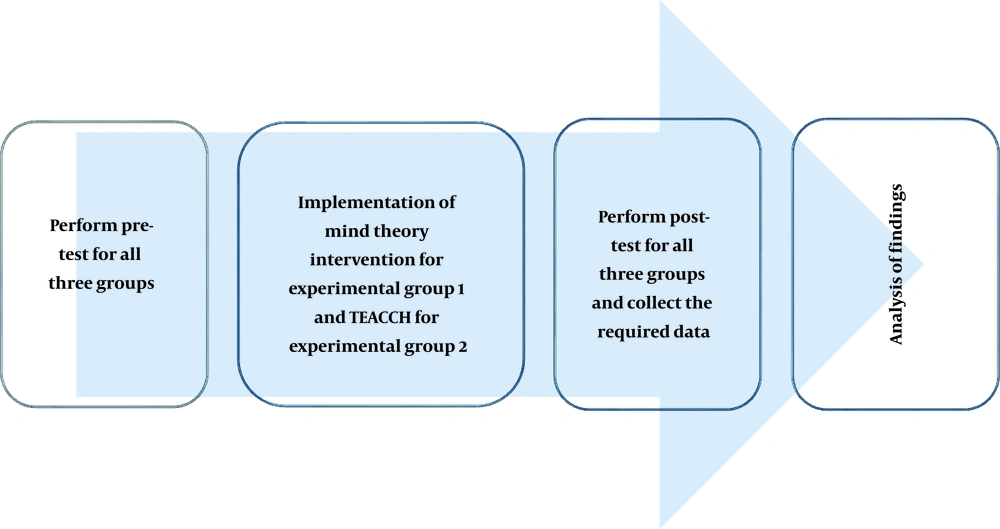
Figure 1.
Research flowchart
4. Results
As showed in Table 1, concerning the variable of executive function, the variance of the three groups was not significantly different, and, therefore, the assumption of homogeneity of variances was confirmed. The Kolmogorov-Smirnov test was used to test for normal distribution of data. The results indicated the normal distribution of data in all three groups. Also, the interaction of helping variables (pre-tests) and dependent (post-test) at agent levels were not significant. Therefore, the assumption of homogeneity of regression was rejected.
Table 1.
The Statistical Characteristics of the Score of Executive Functions (Stroop Interfering) Experimental and Control Groupa
| Stage | Group | ||
|---|---|---|---|
| The First Experimental Group (The Theory of Mind) | The Second Experimental Group (TEACCH) | Control Group | |
| Pre-test | -8.27 ± 2.18 | -8.13 ± 2.13 | -8.61 ± 1.88 |
| Post-test | -3.93 ± 1.03 | -4.53 ± 1.18 | -8.40 ± 1.63 |
aValues are expressed as mean ± SD.
As shown in Table 2, there was no significant difference between the first (training based on the theory of mind) and the second experimental group (TEACCH method) concerning the executive functions (P < 0.157, F = 2.11).
Table 2.
The Results of Univariate Covariance Analysis on the Post-Test Mean Scores of Executive Functions in Both Experimental Groups by Controlling Pre-Test
| Variable | Statistic | |||||
|---|---|---|---|---|---|---|
| Sum of Squares | df | Mean of Squares | F | The Level of Significance | The Level of Efficacy | |
| Pre-test | 2.16 | 1 | 2.16 | 1.79 | 0.192 | 0.062 |
| Group | 2.54 | 1 | 2.54 | 2.11 | 0.157 | 0.073 |
| Error | 32.51 | 27 | 1.21 | |||
| Total | 575.01 | 30 | ||||
As shown in Table 3, the intra-comparison of groups indicated no significant difference between the first (training based on the theory of mind) and the second experimental group concerning the executive functions.
Table 3.
The Comparison Between the First and the Second Experimental Group Concerning the Executive Functions (Bonferroni Test)
| Group(I), Group(J) | Statistic | ||
|---|---|---|---|
| The Mean Differences | The Standard Error | P value | |
| The theory of mind | |||
| TEACCH | 0.583 | 0.401 | 0.157 |
5. Discussion
This study showed that there is a significant difference between the first experimental group (training based on the theory of mind) and the second experimental group (TEACCH method) respecting with one of the dependent variables, including the executive functions. It can be concluded that both methods could have had a significantly improve efficacy on the variable of executive functions in comparison with the control group. Regarding the effect of training based on the theory of mind, the findings of the present study are in line with the previous studies by Lukito et al. (12), Nyden et al. (13), Yuk et al. (14). In the domain of the efficacy of training based on the method of TEACCH, the findings of current research agree with the researches of Brunsdon et al. (15), Yang et al. (9), Miranda et al. (16), Durrleman and Franck (17), Kimhi et al. (18), Williams et al. (19).
To interpret the finding, it can be argued that few studies have investigated the efficacy of training based on the theory of mind on the executive functions as the primary assumption of creating the autistic symbols, and most of them were focused on the association between such variables. The ability of meta-conceptualization, which is the core of the theory of mind, is assumed as a preliminary for executive functions. When the reaches the conceptual image of the mind, she can have flexible and purposeful behaviors. Therefore, the impairment of executive control in autism can be attributed to the primary damage in meta-conceptualizing and the theory of mind. The executive functions set up an approximate relation with obtaining the ability of wrong beliefs during the primary stages of childhood (20). In the present study, since the data collection phase was prolonged, it was not possible to have a following-up period (one or three months after data collection). Hence, caution should be taken when generalizing the data. Moreover, since the possibility of a false decline of final scores was high, the variables of age and autistic children’s intelligence were not controlled.
The current study had limitations, including spending a substantial time to introduce the intervention and the pedagogical devices to the participants, the difficulties of working with autistic children, and the obtaining the satisfaction of parents of ASD children to participate in the study. Moreover, since few ASD children in the province of Bushehr are female, and most of them were not willing to participate in the study, only males were investigated.
To obtain comprehensive information concerning the effectiveness of training the ASD children using the theory of mind and the TEACCH method, participants should be investigated for one to three months so that long-term effects can also be studied. Moreover, participants of all groups should be matched concerning the demographic characteristics and IQ-related factors. Also, the authors recommend including female ASD patients in future studies. As several studies have reported that the effectiveness of the TEACCH method is positively associated with children’s age, this issue should be considered by healthcare providers. On the other hand, due to the importance of learning the theory of mind for the autistic children at pre-school age, it is suggested to the therapists of autism to use the interference at lower ages.
5.1. Conclusions
This study demonstrated that both approaches of the theory of mind and TEACCHs method can effectively improve the executive functions, but no significant difference was found between the first (training the theory of mind) and the second experimental group (TEACCHs method) regarding the executive functions. It can be concluded that training based on the theory of mind and the TEACCH method is effective on the executive functions of ASD children.