
1. Background
Female primary school students often face substantial demands for self-regulation and sustained attention, placing additional pressure on their EFs, particularly inhibitory control (1). EFs are core cognitive processes that include inhibitory control, working memory, and cognitive flexibility (2, 3). Recent research indicates that the development of inhibition and working memory follows a similar trajectory in boys and girls during middle childhood, from 9 to 12 years of age, making this period a critical window for cognitive intervention (4-7). Therefore, enhancing inhibitory control is fundamental to students' self-regulation and academic success.
The beneficial effects of PA on EFs are well documented (8). Meta-analytic evidence suggests that acute PA improves attention and inhibitory control in preadolescent children (9). Furthermore, school-based PA programs support EF development, particularly when interventions are cognitively demanding (10). A robust body of evidence supports the notion that increased physical fitness and acute exercise bouts positively influence children's brain function and EFs (11, 12). Effective interventions range from high-cognitive-load team sports to structured high-intensity exercise (13-17). Recently, both HIIT and Exergame have emerged as effective approaches for enhancing EFs in children (18-21).
Although moderate-intensity continuous exercise has traditionally been supported, acute HIIT has recently gained attention because of its time efficiency and potential effects on brain health (22, 23). Studies have demonstrated that a single session of HIIT can positively affect children's inhibition (24, 25). However, the duration of these benefits and comparisons with more engaging modalities remain underexplored.
Exergame, a combination of digital gaming and physical movement, involves gross motor activity and cognitive engagement (26). This modality may increase PA levels and enjoyment, potentially leading to better adherence than repetitive traditional exercises (27, 28). Although some evidence suggests that Exergame improves EFs in adolescents, limited comparative research has examined its acute effects versus traditional HIIT in primary school settings (11, 29-31).
2. Objectives
Despite the known benefits of PA, a critical knowledge gap remains regarding the differential acute effects of HIIT versus Exergame on inhibitory control in young girls. Specifically, it remains unclear whether the physiological demands of HIIT or the combined physical and cognitive engagement of Exergame provide more sustained acute benefits, such as those lasting up to 45 minutes after exercise. This study aimed to directly compare the acute effects of a single HIIT session and an Exergame intervention on inhibitory control performance. We hypothesized that both interventions would significantly improve inhibitory control compared with a control condition, but that Exergame might yield more robust effects because of its greater cognitive engagement.
3. Methods
3.1. Subjects
Twelve female students in the 4th and 5th grades (M ± SD age = 10.41 ± 0.51 years) were recruited through convenience sampling from a primary school in Kurdistan Province in spring 2024.
An a priori power analysis was conducted using G*Power software (version 3.1.9.4) to determine the required sample size for a within-subject repeated-measures ANOVA with 3 conditions and 2 measurements. Based on a medium effect size (36), an alpha level of 0.05, and statistical power of 0.80, the analysis indicated that a total sample size of 12 participants was sufficient. The inclusion criteria were as follows: 1) no physical or mental disabilities, 2) no prior experience with the experimental tasks, and 3) being naive to the specific purpose of the study.
3.2. Apparatus and Task
The Stroop Color and Word Test was used to evaluate acute changes in inhibitory control. The task consisted of 96 trials: 48 congruent trials, in which the color and word matched, and 48 incongruent trials, in which the color and word did not match. Inhibitory control was quantified using reaction times (RTs) and response accuracy. The Stroop interference score was calculated as follows:
Interference score = Incongruent score - Congruent score
3.3. Procedure
The study employed a counterbalanced crossover design to minimize potential order effects. Each participant completed 3 experimental conditions: HIIT, Exergame, and Control. A 4-day washout period was implemented between sessions to ensure full recovery and prevent carryover effects. All sessions lasted 30 minutes and included a 5-minute warm-up, a 20-minute intervention period, and a 5-minute cool-down.
Exercise intensity was individually prescribed and monitored throughout the intervention sessions. Resting heart rate (HRrest) was measured after 5 minutes of seated rest, and maximum heart rate (HRmax) was estimated using the Tanaka equation (HRmax = 208 - 0.7 × age). Target heart rate (THR) was then calculated using the Karvonen formula:
High-intensity intervals were performed at 80% of heart rate reserve (HRR), whereas active recovery periods were maintained at 60% HRR. Heart rate was continuously monitored using Polar heart rate monitors (Polar Electro, Finland) to ensure compliance with the prescribed intensity levels.
In the HIIT condition, participants completed ten 1-minute bouts of high-intensity exercises, such as jumping jacks and cross jacks, at 80% HRR, each followed by 1 minute of active recovery consisting of running in place at 60% HRR. The Exergame condition was designed to match the HIIT protocol in both intensity and interval structure. Participants played Fruit Ninja on an Xbox 360 with Kinect, performing 1-minute bouts of high-intensity gameplay interspersed with 1-minute active recovery periods at the same target HRR levels. In the Control condition, participants remained seated and engaged in a quiet coloring activity for 30 minutes.
Inhibitory control was assessed at 2 time points. The immediate assessment, Post-test 1, was administered immediately after the cool-down period, whereas the delayed assessment, Post-test 2, was conducted 45 minutes later. During this interval, participants engaged in a low-arousal coloring activity to minimize additional physical or cognitive stimulation.
3.4. Data Analysis
Data were analyzed using a 3 (Condition: HIIT, Exergame, and Control) × 2 (Time: Post-test 1 and Post-test 2) two-way within-subject repeated-measures ANOVA. Mauchly's test was used to verify sphericity, and Greenhouse-Geisser corrections were applied when necessary. Pairwise comparisons were performed using Bonferroni adjustment. Effect sizes were reported as partial eta squared (η²p). All analyses were conducted in SPSS version 26, with significance set at P < 0.05.
4. Results
4.1. Stroop Accuracy: Interference Score of Correct Answers
The Stroop accuracy interference results showed a significant main effect of Condition. The main effect of Time and the Condition × Time interaction were not statistically significant (Table 1).
Table 1.
Means ± SD of Outcome Measures at Immediate and Delayed Post-Test and Repeated-Measures ANOVA Results a
| Variables | Exergame Condition Immediate | Exergame Condition Delayed | HIIT condition Immediate | HIIT condition Delayed | Control condition Immediate | Control condition Delayed | Time (P, η²p) | Condition (P, η²p) | Time × Condition (P, η²p) |
|---|---|---|---|---|---|---|---|---|---|
| Interference score of correct answers | 0.00 ± 1.95 | 0.16 ± 3.40 | -0.16 ± 1.52 | 0.75 ± 1.71 | 6.00 ± 4.28 | 5.16 ± 5.44 | 0.878, 0.002 | < 0.001, 0.644 | 0.729, 0.028 |
| Interference score of reaction time | 34.00 ± 48.32 | 2.83 ± 45.41 | 44.58 ± 45.97 | 44.33 ± 46.56 | 14.66 ± 64.63 | 31.75 ± 39.89 | 0.625, 0.023 | 0.178, 0.145 | 0.118, 0.176 |
a Values are presented as Mean ± SD. Abbreviation: HIIT = high-intensity interval training.
Pairwise comparisons with Bonferroni adjustment indicated that the Exergame and HIIT conditions yielded significantly lower interference scores than the Control condition at both the immediate and delayed post-tests (all P ≤ .002). No significant differences were observed between the Exergame and HIIT conditions, indicating that the 2 exercise modalities were similarly effective in reducing interference in response accuracy. Moreover, the improvements in both exercise conditions were maintained at the 45-minute delayed post-test, with no significant differences between the 2 assessment occasions (P > .05).
The Control condition showed the highest interference scores at both post-tests (Post-test 1: M = 6.00; Post-test 2: M = 5.16), indicating poorer inhibitory control accuracy. By contrast, the Exergame and HIIT conditions showed interference scores close to or below zero, indicating minimal interference and better inhibitory performance. Overall, the intervention effects were reflected in consistently lower interference scores in the 2 exercise conditions than in the persistently higher scores in the Control condition across both post-test assessments (Figure 1).
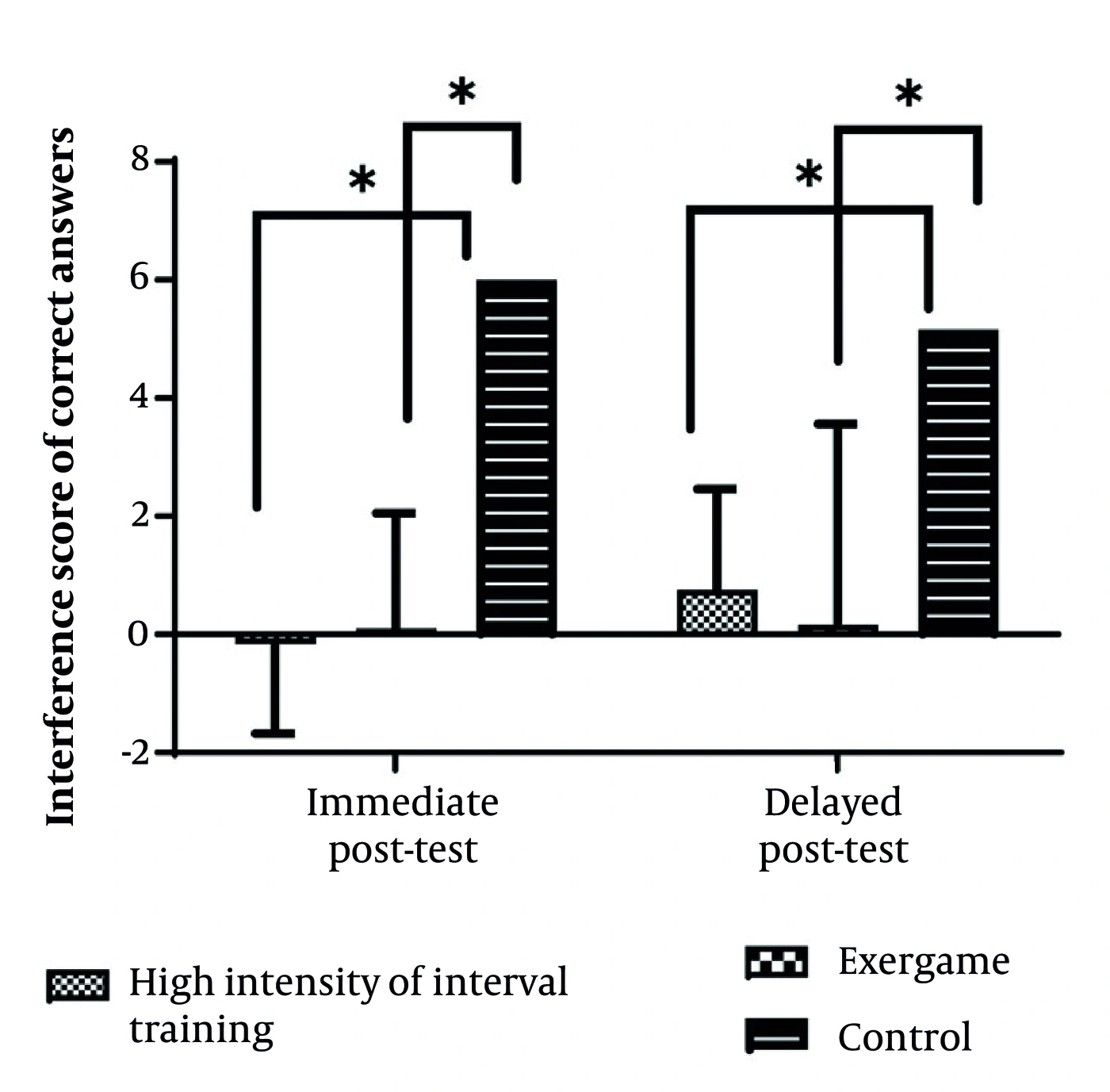
Figure 1.
Mean (± SD) of the Interference Score of Correct Answers for each condition (Exergame, HIIT, Control) at immediate (Post 1) and delayed (Post 2) post-intervention.
4.2. Stroop Reaction Time: Interference Score of Reaction Time
For the RT interference score, there were no significant main effects of Condition or Time and no significant Condition × Time interaction (Table 1). Although the Exergame condition showed a descriptive reduction in RT interference from the immediate to the delayed post-test, this change did not reach statistical significance. Similarly, the HIIT condition remained relatively stable across the 2 assessment occasions, whereas the Control condition showed a slight increase in RT interference at the delayed post-test.
Overall, these patterns suggest that the intervention effects on inhibitory control speed were not statistically robust in the present sample, despite descriptive differences among conditions. Specifically, the Exergame condition showed a trend toward reduced interference over time, whereas the Control condition showed a tendency toward poorer performance at the delayed assessment. These trends are illustrated in Figure 2.
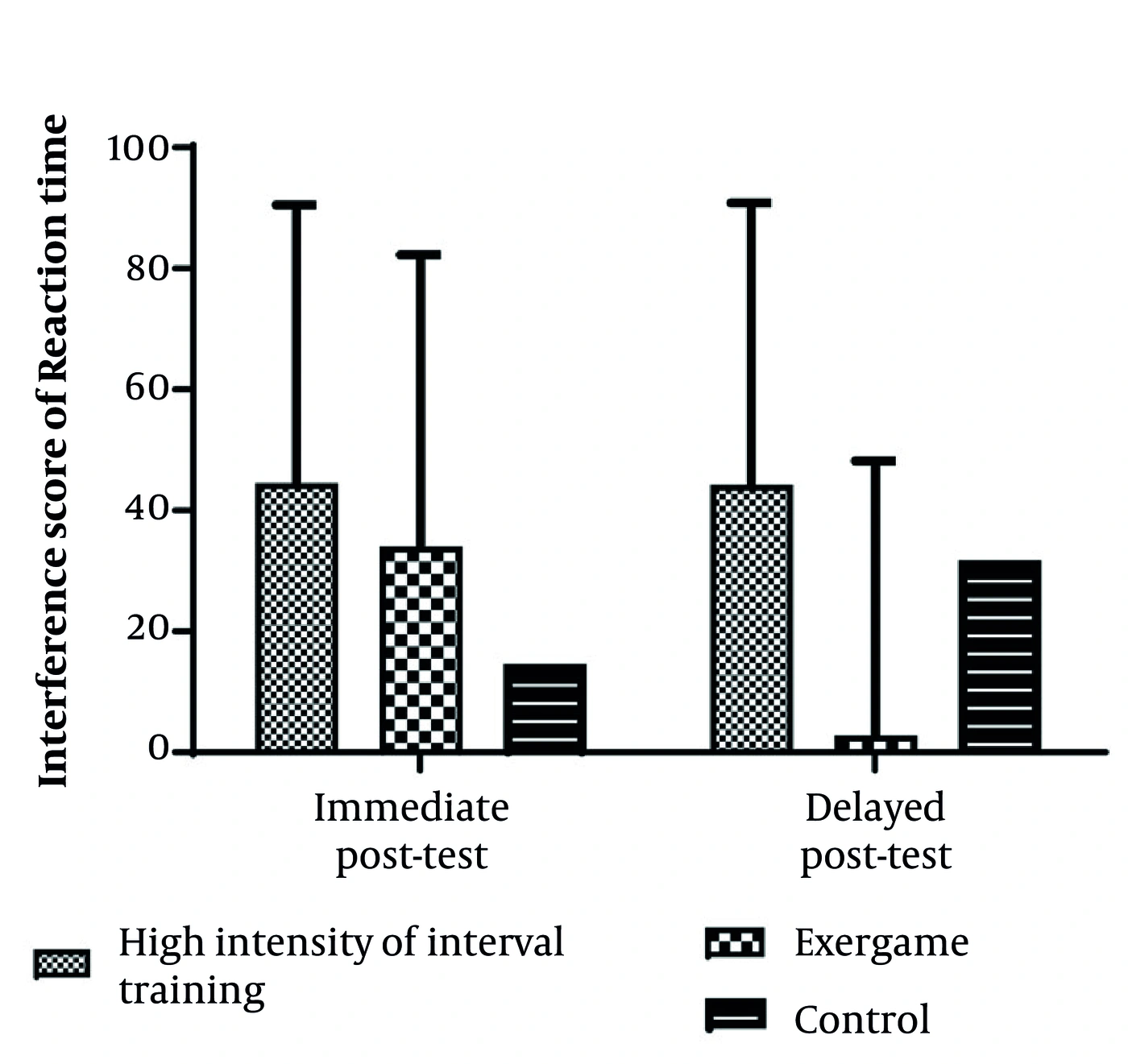
Figure 2.
Mean (± SD) of the Interference Score of Reaction Time for each condition (Exergame, HIIT, Control) at immediate (Post 1) and delayed (Post 2) post-intervention.
5. Discussion
The primary finding of this study is that a single acute bout of both HIIT and Exergame significantly enhances inhibitory control accuracy in primary school girls. Notably, these cognitive benefits remained stable up to 45 minutes after the intervention, although no significant changes were observed in RT interference. These results support the hypothesis that high-intensity PA, whether delivered through traditional exercise or cognitively engaging gaming, can acutely facilitate the executive function of inhibitory control (32).
The improvement in Stroop accuracy interference suggests that both interventions enhanced the participants' ability to suppress prepotent responses (ie, reading the word) in favor of goal-directed responses (ie, naming the color). This finding aligns with the literature indicating that acute exercise can lead to transient improvements in EFs in children (29-31). Although the exact mechanisms remain to be fully elucidated, acute exercise is thought to promote transient increases in cerebral blood flow and temporary upregulation of neurotrophic factors, such as brain-derived neurotrophic factor, which may support prefrontal cortex efficiency (33, 34). However, it is important to note that the current findings reflect acute behavioral shifts rather than permanent neurological adaptations.
A key observation was the comparable effectiveness of HIIT and Exergame. HIIT is primarily characterized by physiological stress and rapid recovery cycles, which are proposed to improve cognitive performance through metabolic and arousal-based pathways. In contrast, Exergame combines physical exertion with a high cognitive load, requiring players to divide attention, process visual stimuli, and inhibit incorrect motor movements simultaneously (11). The lack of a significant difference between these 2 modalities suggests that, in primary school girls, the arousal produced by high-intensity physiological demands and the cognitive engagement provided by the digital game environment may be equally potent in acutely reducing interference during inhibitory tasks.
In contrast to the accuracy findings, RT interference did not show significant changes across conditions or time. This dissociation between accuracy and speed is not uncommon in pediatric exercise science. It suggests that the interventions primarily improved the quality of inhibitory processing, leading to fewer errors, rather than the speed of information processing or motor execution. In this sample, the 30-minute intervention may have been sufficient to sharpen the focus required for accuracy but insufficient to accelerate the neural conduction or motor response speed needed to reduce RT interference (35).
Several limitations of the present study must be acknowledged. First, the sample size (N = 12) was small, which may limit the generalizability of the findings and the statistical power to detect smaller effects, particularly in RT. Although the crossover design and post hoc power analysis mitigate this limitation, the results should be interpreted with caution. Second, we did not measure baseline cognitive performance on a separate day to account for potential learning effects, although a 4-day washout period and counterbalancing were used to minimize this concern. Lastly, because this was an acute study, these findings do not provide evidence for long-term or chronic cognitive changes.
5.1. Conclusions
In conclusion, a single session of either HIIT or Exergame can acutely improve inhibitory control accuracy in primary school girls, with effects persisting for at least 45 minutes. These findings suggest that Exergame can be as effective as traditional HIIT, offering a versatile and engaging alternative for school-based cognitive enhancement strategies. Future research with larger cohorts and neuroimaging tools is needed to further explore the underlying mechanisms and the long-term impact of these interventions.