
1. Background
The effective organization of practice sessions is a critical factor in motor-skill learning, with the primary aim of enhancing learning outcomes and optimizing performance (1). Understanding the criteria for success and the optimal conditions for practice plays a crucial role in improving the learning process (2). In this regard, the OPTIMAL theory posits that enhancing learners’ positive expectations, self-efficacy, and intrinsic motivation through optimized practice conditions can strengthen motor-skill learning (3). Studies generally indicate that making success criteria easier to achieve by increasing confidence and positive expectations helps individuals learn and retain motor skills more effectively (4, 5). However, Parma and colleagues (6) reported that although easy success criteria increase motivation and self-belief, they do not necessarily improve long-term learning or performance. This finding contradicts certain aspects of the OPTIMAL theory. These authors argued that other factors, such as the number of successful attempts and an appropriate level of challenge, are also important. In contrast, studies in children continue to show that easy success criteria can facilitate both the learning and retention of motor skills (2). These findings challenge some aspects of the OPTIMAL theory and underscore the need to address more complex determinants, such as the optimal challenge point and the role of learning strategies.
Among these factors, learning strategies represent a key variable in motor behavior that should not be overlooked. Rahavi Ezabadi et al. (7) identified self-regulation as a core component of metacognitive knowledge. In other words, self-regulation refers to a set of purposeful behavioral processes and actions undertaken to achieve learning goals and strive for success (8). Increasing evidence emphasizes the importance of this construct in the learning process. For example, Theobald (9) demonstrated that self-regulation training has a positive and significant effect on various aspects of students’ learning. Similarly, Hemmler and Ifenthaler (10) emphasized the critical role of self-regulation in improving learning and performance in continuing education.
Training approaches that carefully adjust task difficulty can improve learners’ performance and learning. Task difficulty, determined by factors such as throwing distance and target size, directly influences individuals’ perceptions of success and their motivation to learn (11). Greater distances or smaller targets make success more difficult, which can reduce motivation and self-belief (12). Shorter distances or larger targets make success easier and provide more frequent positive experiences (13). According to optimal challenge point theory, optimal learning occurs when task difficulty is neither too easy, which reduces the sense of achievement, nor too difficult, which increases anxiety and reduces self-efficacy (14). Therefore, setting an appropriate level of challenge is essential, particularly in sports such as darts.
Despite the recognized importance of success criteria in motor-skill learning, substantial research gaps remain. Previous studies have primarily examined their effects on motivational variables such as self-efficacy, whereas interactions among task difficulty, environmental parameters, and metacognitive strategies such as self-regulation have been examined less frequently. This study addresses this gap by investigating the interactive effects of success criteria, manipulated through self-selected throwing distances and target sizes, on performance and motor learning in university students. It aims to clarify how changes in environmental variables, combined with learners’ self-regulatory capacities, affect perceived success, metacognitive processes, and long-term learning. The findings are expected to enrich motor-learning theory by integrating metacognitive components and to provide practical guidance for designing effective training programs.
2. Objectives
This study aimed to determine whether success criteria that dynamically adjust task difficulty via self-selected distance and target parameters improve metacognitive monitoring, as assessed using adaptive behavioral proxies, and subsequent performance during acquisition and learning (retention/transfer), relative to fixed criteria, in a dart-throwing task.
3. Methods
3.1. Subjects
The target population comprised all female students enrolled in the general physical education course at Yazd University during the 2024 semester. Based on prior studies, 48 participants aged 19 - 22 years were recruited using convenience sampling. After providing informed consent and completing a physical health questionnaire, participants were randomly assigned to four groups (n = 12 each). The study included three distance self-regulation groups: standard target (Std-T), small target (Small-T), and large target (Large-T), and one target self-regulation group (Fixed-D), which could self-select small, large, or standard target sizes while throwing from a fixed distance. Inclusion criteria were no prior dart experience; physical and mental health (Goldberg and Williams, 1972); normal or corrected-to-normal vision (Snellen chart); and right-handedness. Exclusion criteria were unwillingness to continue participation or risk of injury.
3.2. Apparatus and Task
A standard dartboard was mounted at a height of 1.73 m from the floor. During the practice phase, participants in the large-target and small-target groups aimed at yellow circular paper targets with radii of 16 cm and 7 cm, respectively. The targets were affixed to the dartboard with their centers aligned with the board center. The large target covered approximately five times the surface area of the small target and nearly the entire board. Throws landing outside the yellow area were recorded as errors with no score, whereas throws landing within the yellow target were considered successful. To clarify the concept of success for participants, scores were recorded and displayed after each throw (Figure 1) (15).
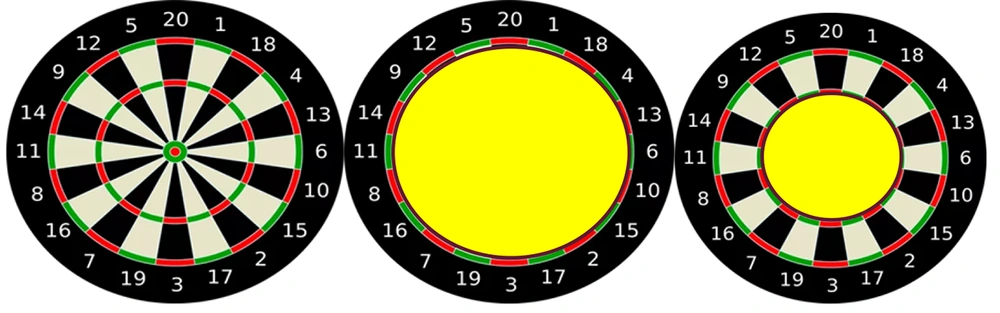
Figure 1.
View of the dartboard (on the right) and the yellow practice targets, large and small (12).
3.3. Procedure
In the first session, a dart-throwing pre-test was conducted to assess group homogeneity. In the second session, participants in each group completed five blocks of ten trials during the acquisition phase, following their respective training protocols. Immediately after practice, a retention test was administered. One week later, delayed retention and transfer tests were conducted. Overall, the study consisted of five main phases: pre-test, acquisition, immediate retention, delayed retention, and transfer.
3.3.1. Pre-Test Phase
In this phase, a pre-test consisting of one block of 10 trials was conducted to ensure group homogeneity. Participants stood 2.37 m from the dartboard and threw darts toward the target. The mean score across the 10 trials was recorded as each participant's pre-test score. Scoring followed the official dart system: the board was divided into 20 sections, with darts landing in a main section receiving the corresponding points; the outer and inner rings awarded double and triple points, respectively; and the center included two areas scoring 25 and 50 points. The sum of all throws represented the final score for each trial. Based on these results, participants were randomly assigned to four groups.
3.3.2. Acquisition Phase
During the acquisition session, all participants received standardized instruction on the skill, and correct execution was demonstrated. During this phase, yellow paper targets were affixed to the dartboard to visually indicate the success zone (small, large, or standard) for each group. The three distance self-regulation groups completed five blocks of 10 trials (50 trials total). In these groups, participants self-regulated their throwing distance on each trial, freely selecting from five marked distances (1.5, 2, 2.5, 3, and 3.5 m), with the requirement to use all distances at least once during the practice session. The Fixed-D group performed 50 throws from the standard distance of 2.37 m, selecting the target size (small, large, or standard) before each block. Participants aimed at the yellow practice target (circular with radii of 16 cm and 7 cm). Performance was scored binarily (hit = 1, miss = 0) based on whether the dart landed within the yellow zone, providing the direct, criterion-specific feedback required for self-regulation. The official dartboard rings were obscured during this phase (15).
3.3.3. Retention and Transfer Tests
At the end of the acquisition session, an immediate retention test consisting of one block of 10 trials was conducted. This test was similar to the pre-test and did not include yellow targets. Scoring was based on the official dart system. One week after the practice sessions, participants completed delayed retention and transfer tests. First, three warm-up throws were performed (scores were not recorded), followed by ten throws from the standard distance of 2.37 m for the delayed retention test, with results recorded after each throw. The transfer test was conducted on the same day after a 10-minute rest, during which each group performed ten throws from 3.5 m without yellow targets. Scoring in both phases followed the official dart system.
3.4. Data Analysis
Descriptive statistics, including the mean and standard deviation, were used to summarize the data, and inferential statistics were used to test the research hypotheses. Data normality was assessed using the Shapiro-Wilk test, and homogeneity of variances was evaluated using Levene's test. A two-way mixed ANOVA (Group x Block) was used to analyze performance across all phases. When significant main effects or interactions were detected, post hoc pairwise comparisons were performed using the LSD test. Data were analyzed using SPSS version 23, with the significance level set at P < 0.05.
4. Results
The 5 (Training Block) x 4 (Group) mixed-design analysis of variance revealed a significant main effect of Training Block, F (4, 41) = 41.45, P = 0.001, partial eta2 = 0.76, observed power = 1.00; a non-significant main effect of Group, F (3, 44) = 4.32, P = 0.080, partial eta2 = 0.13, observed power = 0.54; and a significant Group x Training Block interaction, F (12, 119) = 176.12, P = 0.001, partial eta2 = 0.28, observed power = 0.99. Given the significant interaction, post hoc analyses were conducted to further examine differences between groups across training blocks (Tables 1, 2).
Table 1.
Pairwise Comparisons of Groups Across Training Blocks a
| Blocks | Group (i) | Group (j) | Mean Difference (i-j) | Standard Error | P-Value |
|---|---|---|---|---|---|
| Block1 | Small-T | Large-T | 1.50 | 0.85 | 0.08 |
| Small-T | Std-T | 0.41 | 0.85 | 0.62 | |
| Small-T | Fixed-D | 3.00 | 0.85 | 0.001 b | |
| Large-T | Std-T | -1.08 | 0.85 | 0.21 | |
| Large-T | Fixed-D | 1.50 | 0.85 | 0.08 | |
| Std-T | Fixed-D | 2.58 | 0.85 | 0.004 b | |
| Block2 | Small-T | Large-T | 1.41 | 0.82 | 0.09 |
| Small-T | Std-T | -0.41 | 0.82 | 0.61 | |
| Small-T | Fixed-D | 1.50 | 0.82 | 0.07 | |
| Large-T | Std-T | -1.83 | 0.82 | 0.03 b | |
| Large-T | Fixed-D | 0.08 | 0.82 | 0.92 | |
| Std-T | Fixed-D | 1.91 | 0.82 | 0.02 b | |
| Block3 | Small-T | Large-T | 2.08 | 0.93 | 0.03 b |
| Small-T | Std-T | 0.50 | 0.93 | 0.59 | |
| Small-T | Fixed-D | 1.83 | 0.93 | 0.05 | |
| Large-T | Std-T | -1.58 | 0.93 | 0.09 | |
| Large-T | Fixed-D | 0.25 | 0.93 | 0.78 | |
| Std-T | Fixed-D | 1.33 | 0.93 | 0.15 | |
| Block4 | Small-T | Large-T | 1.83 | 0.92 | 0.05 |
| Small-T | Std-T | 0.41 | 0.92 | 0.65 | |
| Small-T | Fixed-D | 0.50 | 0.92 | 0.59 | |
| Large-T | Std-T | 1.41 | 0.92 | 0.13 | |
| Large-T | Fixed-D | 1.33 | 0.92 | 0.15 | |
| Std-T | Fixed-D | 0.08 | 0.92 | 0.92 | |
| Block5 | Small-T | Large-T | 2.00 | 0.96 | 0.04 b |
| Small-T | Std-T | 1.00 | 0.96 | 0.30 | |
| Small-T | Fixed-D | 0.75 | 0.96 | 0.44 | |
| Large-T | Std-T | 1.00 | 0.96 | 0.30 | |
| Large-T | Fixed-D | -2.75 | 0.96 | 0.006 b | |
| Std-T | Fixed-D | 1.75 | 0.96 | 0.07 |
a Abbreviations: Std-T, standard target; Small-T, small target; Large-T, large target; Fixed-D, self-regulation group.
b P ≤ 0.05 was considered statistically significant.
Table 2.
Pairwise Comparison of the Pre-Test, Immediate Retention Test, Delayed Retention Test, and Transfer Test for Each Group a
| Variables | Times | Small-T | Large-T | Std-T | Fixed-D | |||||||||
|---|---|---|---|---|---|---|---|---|---|---|---|---|---|---|
| (i) | (j) | MD (i-j) | Std- Error | P-Value | MD (i-j) | Std- Error | P-Value | MD (i-j) | Std- Error | P-Value | MD (i-j) | Std- Error | P-Value | |
| 1 | Pre-test | Immediate retention | -38.41 | 10.85 | 0.001 b | -44.33 | 10.85 | 0.001 b | -58.75 | 10.85 | 0.001 b | -46.33 | 10.85 | 0.001 b |
| 2 | Pre-test | Delayed retention | -38.66 | 11.38 | 0.001 b | 5.75 | 11.38 | 0.61 | -40.08 | 11.38 | 0.001 b | 2.41 | 11.38 | 0.83 |
| 3 | Pre-test | Transfer | 0.25 | 10.04 | 0.98 | 2.08 | 10.04 | 0.83 | 5.41 | 10.04 | 0.59 | 28.58 | 10.04 | 0.007 b |
| 4 | Immediate retention | Delayed retention | -0.25 | 11.74 | 0.98 | 38.58 | 11.72 | 0.002 b | 18.66 | 11.74 | 0.11 | 48.75 | 11.74 | 0.001 b |
| 5 | Immediate retention | Transfer | 38.66 | 12.72 | 0.004 b | 42.25 | 12.72 | 0.002 b | 53.33 | 12.72 | 0.001 b | 74.91 | 12.72 | 0.001 b |
| 6 | Retention | Transfer | 38.91 | 11.28 | 0.001 b | 3.66 | 11.28 | 0.74 | 34.66 | 11.28 | 0.004 b | 26.16 | 11.28 | 0.02 b |
a Abbreviations: Std-T, standard target group; Small-T, small target group; Large-T, large target group; Fixed-D, self-regulation group; MD, mean difference.
b P ≤ 0.05 was considered statistically significant.
Simple effects analyses indicated significant group differences in Block 1, F (3, 44) = 4.88, P = 0.005, partial eta2 = 0.25, observed power = 0.88, and in Block 5, F (3, 44) = 3.09, P = 0.030, partial eta2 = 0.17, observed power = 0.68. Based on the effect size estimates, approximately 25% of the variance in Block 1 performance and 17% of the variance in Block 5 performance were attributable to differences among the self-regulation training protocols.
In addition, a 4 (Group) × 4 (Time) mixed-design analysis of variance revealed a significant main effect of Time, F (3, 44) = 25.05, P = 0.001, partial eta2 = 0.66, observed power = 1.00; a significant main effect of Group, F (3, 44) = 3.09, P = 0.030, partial eta2 = 0.11, observed power = 0.79; and a significant Group x Time interaction, F (12, 119) = 50.06, P = 0.040, partial eta2 = 0.13, observed power = 0.84. Given the significant interaction, post hoc analyses were conducted to further examine differences between groups across time.
In the immediate retention test, no significant differences were observed among the groups. In the delayed retention test, significant differences were observed between the Small-T and Large-T groups (P = 0.030), the Small-T and Fixed-D groups (P = 0.010), the Large-T and Std-T groups (P = 0.040), and the Fixed-D and Std-T groups (P = 0.020). Based on the group means, the Small-T and Std-T groups demonstrated superior performance.
In the transfer test, a significant difference was observed only between the Large-T and Changing Target Width groups (P = 0.030), with the Large-T group demonstrating better performance based on the mean scores.
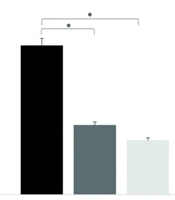
Consistent with the interaction effect, significant within-group differences were observed for Small-T (F (3, 44) = 6.48, P = 0.001, partial eta2 = 0.31, observed power = 0.95), Large-T (F (3, 44) = 6.02, P = 0.002, partial eta2 = 0.30, observed power = 0.94), Std-T (F (3, 44) = 10.54, P = 0.0001, partial eta2 = 0.43, observed power = 0.99), and Fixed-D (F (3, 44) = 11.35, P = 0.0001, partial eta2 = 0.44, observed power = 0.99). Based on the effect size values, approximately 31% of the variance in the Small-T group, 30% in the Large-T group, 43% in the Std-T group, and 44% in the Fixed-D group can be attributed to the training methods used during practice (Figure 2). It needs to edit : retention instead of recall
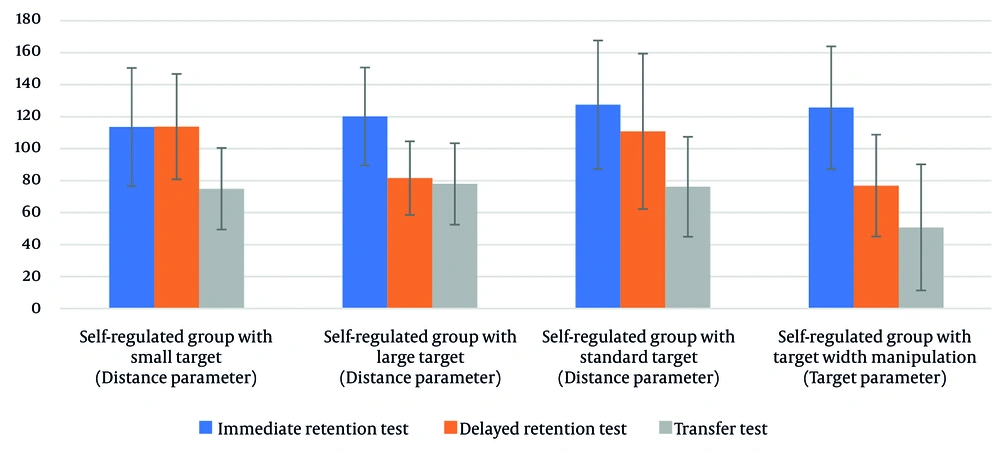
Figure 2.
Descriptive Statistics of the Four Groups in Immediate Retention, Delayed Retention, and Transfer Tests.
5. Discussion
This study investigated how success criteria affect dart-throwing performance and learning in female students using a metacognitive approach. All groups improved during immediate retention, but the Std-T group performed best. In delayed retention, the same group again outperformed the other groups. In the transfer test, both the Std-T and L-Target groups showed strong performance. The researchers suggest that the distance-based self-regulation groups learned better than the target-choice group because of differences in task structure. In the distance-based conditions, participants had a fixed visual target and could adjust only the throwing distance. This setup provided clear binary feedback (hit or miss) for correcting motor errors against a stable goal. As a result, learners focused on solving a specific motor problem: how to adjust force and coordination to hit the target from different distances.
In contrast, the target-choice condition shifted regulation to a metacognitive level: distance was fixed, and learners selected the target size (small, standard, or large). The binary feedback guided both motor accuracy and strategic choice, which may have increased cognitive load and ambiguity, thereby reducing learning outcomes. These findings suggest that novice motor learning is more effective when self-regulation focuses on adjusting a motor parameter relative to a clear, fixed performance goal (31). This aligns with Wigfield and Eccles' (2000) expectancy-value theory, which emphasizes that realistic goals and measurable criteria play crucial roles in maintaining motivation, regulating learner behavior, and enhancing performance (17). The present study found significant group differences during the acquisition sessions and the immediate retention test, in contrast to several previous studies using different self-regulation or goal-manipulation paradigms that reported no significant differences in these phases (6, 12, 14, 15).
The challenge point framework proposes that distance-based self-regulation, namely adjusting throwing distance, keeps practice within an optimal challenge zone, promoting robust and transferable motor learning. In contrast, target-choice self-regulation engages higher-order cognitive processes that increase task complexity but do not improve retention or transfer, likely because attention is diverted from core motor parameters. This finding aligns with previous research on the importance of self-regulation and optimal challenge (11, 12, 18, 19). Additionally, many studies support the OPTIMAL theory, showing that success criteria enhance learners' expectations, self-efficacy, and perceived competence (20, 21). These psychological improvements increase motivation and attentional focus, thereby strengthening motor learning. However, other research suggests that motivational benefits do not always translate into significant or sustained improvements in skill performance (19, 22, 23), qualifying the OPTIMAL framework. Moreover, recent studies indicate that practice interventions supporting self-regulation, which allow learners to choose task difficulty, enhance intrinsic motivation and facilitate motor learning (16, 20, 24, 25). Additionally, the optimal challenge point framework (26) posits that learning is optimized when learners experience an appropriate level of challenge during practice that is not too low to reduce motivation and not too high to cause frustration. This is consistent with the present findings regarding the limited effect of easy success criteria and underscores the importance of self-regulation and practice strategies in achieving success. Furthermore, previous research (27, 28) indicates that dopaminergic activity related to rewards supports the relationship between success expectations and motor-memory consolidation. However, inconsistencies across studies suggest that this relationship is influenced by task complexity, practice conditions, and individual differences in motivation and cognitive strategy.
This study highlights the critical interaction between self-regulation type and goal structure in motor-skill learning. The most effective approach for durable, transferable learning was self-regulation of an execution parameter (e.g., distance) within a fixed, standard target. By combining parametric adaptability with goal stability, this method optimally balances perceptual-motor refinement and cognitive processing and may lead to better learning outcomes. In contrast, self-regulating goal selection, although engaging metacognitive processes, was less effective for long-term learning due to the instability of the success criterion. Thus, for novices, self-regulated practice should prioritize execution flexibility within consistent, challenging goals. As noted by Coker (29), tasks that require active integration of sensory-environmental cues with motor planning may support more effective skill acquisition. In contrast, emphasizing the target may lead to simpler visuomotor strategies that rely less on fine-tuning internal movement parameters.
Second, the distance-based paradigm allows gradual adjustment of task difficulty according to the learner's skill level. This characteristic aligns with the challenge point framework (26), which posits that learning is optimized when task difficulty is sufficiently challenging to fully engage attention but not so high as to induce failure. Progressive distance adjustments achieve this optimal balance while enhancing learners' sense of competence and autonomy, which are core motivational factors emphasized in the OPTIMAL theory of motor learning (30). Therefore, a distance-oriented training paradigm should not be viewed as a minor instructional variation but as a fundamental shift in how learners interact with motor tasks. By providing richer intrinsic feedback and a structured progression of challenges, this approach may lead to better learning outcomes, superior skill transfer, and enhanced self-efficacy, constituting a central methodological innovation of the present study.
The findings highlight that metacognitive engagement in goal selection can increase cognitive load, potentially limiting skill improvement (32). Focusing self-regulation on execution parameters within a stable goal may optimize both skill performance and learning. However, the study has several limitations: participants' daily rest, psychological factors (stress and anxiety during testing), individual differences, and the exclusive inclusion of female participants, which may limit generalizability to males. The novelty of the transfer test also varied across groups. Future research should include mixed-sex or male-only samples to examine sex differences in self-regulation effects under the OPTIMAL theory. Additionally, future studies should examine other activities that may influence performance, use longer and more frequent training sessions, and apply the study variables to both sexes for comparison. The results indicate that success criteria, combined with a self-regulated and metacognitive approach, play a significant role in motor-skill learning. Designing training aligned with learners' needs and environmental conditions, along with the effective use of self-regulation, enhances performance and learning quality.